
The Hindu Reawakening: How Bharat’s Civilizational Majority Broke Its Silence
 Rati Agnihotri · 11/28/2025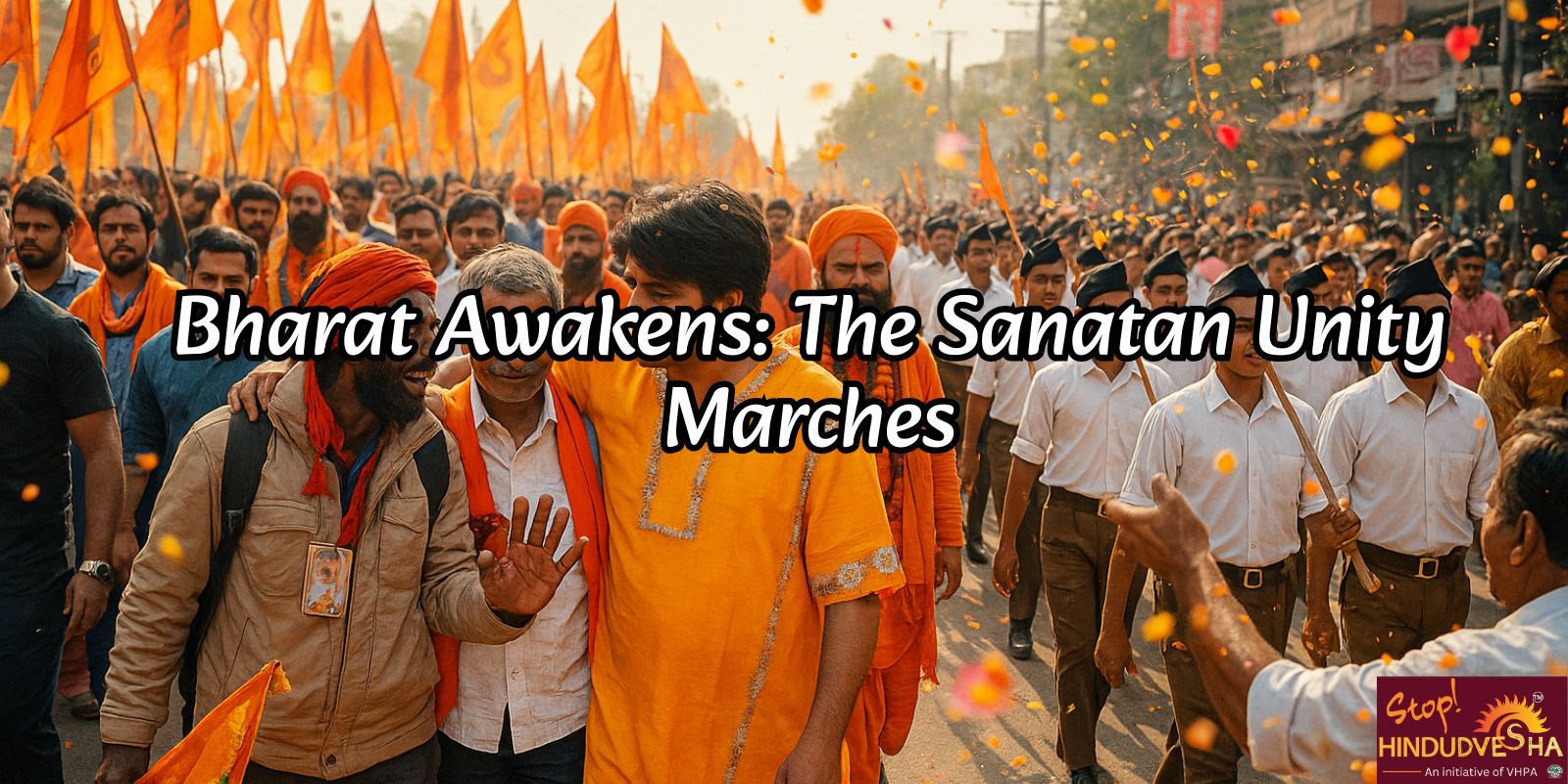
- With India’s ongoing civilizational resurgence, anti-Hindutva stereotypes are weakening, and Hindus are reclaiming public spaces.
- The Hindu community now shows a renewed confidence in raising its issues openly—whether through Dharma Sansads, rallies, peaceful demonstrations, or marches aimed at building a pan-India Hindu identity.
- The Sanatan Hindu Ekta Yatra emerged as a rallying point for Hindus across the country, creating space to highlight key concerns such as Gau Raksha, the call for a Hindu Rashtra, the end of caste discrimination, and the revival of major Dharmic sites.
- Although the community is still some distance from operating as a fully unified national force, the growing number of Dharma Sabhas, Sansads, rallies, and Padyatras led by spiritual leaders and community members reflects the increasingly prominent place of Hindu issues in the Indian public sphere.
Barely two decades ago, being a Hindu in India often meant constant secular posturing and a careful downplaying of one’s own identity. A “good Hindu” was expected to stay quiet, keep faith and culture limited to the private sphere, and avoid speaking about issues affecting the community. This silence continued even in the face of gaslighting of Hindu concerns, rising Hinduphobia, and recurring anti-Hindu hostility.
Over time, the community absorbed a profound cultural and civilizational amnesia. What began as a legacy of Macaulay’s thinking slowly became a way of life in the post-independence Nehruvian environment.
In the past decade, though, the situation has changed. Hindu society in Bharat is experiencing a strong civilizational and cultural revival. This is visible in the construction of the Ayodhya Ram Mandir, the restoration of ancient heritage sites such as Sambhal in Uttar Pradesh, the remarkable rise of Dharmic tourism, and the growing role of Hindu issues in national politics.
One aspect of this shift that has not received much attention is the community’s new confidence in raising its concerns openly. This can be seen in Dharma Sansads, rallies, peaceful demonstrations, and mass marches aimed at building a pan-India Hindu identity. Traditionally, Hindus have avoided appearing together in public as a unified group. The current resurgence breaks this long-standing trend and signals the rise of a Hindu identity that is comfortable speaking up in public spaces.
The following sections examine this emerging phenomenon of a consolidated Hindu identity asserting itself on a large scale. They also consider how this shift can help counter the anti-Hindu narratives regularly promoted by the left-liberal ecosystem.
Consolidating a Pan-India Hindu Identity
Hindu Dharma has long been vulnerable to external attacks and distortions. Missionaries and the European colonial establishment were the first to lay the groundwork for misrepresenting Hindu Dharma and its scriptures under the banner of Indology. This was followed by the colonial construction of a divisive caste narrative, which distorted the Varna system and created deep internal fault lines within Hindu society. After independence, the Nehruvian ecosystem unfortunately amplified these narratives rather than correcting them. In time, a firmly rooted left-liberal establishment expanded these colonial ideas even further, fragmenting Hindu society and entrenching those divisions.
While these fault lines are far from resolved, the community has begun to challenge these narratives and work toward a broader pan-India national identity.
Dharmic and spiritual leaders across India are playing an important role in this resurgence, organizing padayatras (foot marches) and mass movements to unite the Hindu community.
Hindu spiritual leader Pandit Dhirendra Krishna Shastri, also known as Bageshwar Dham Sarkar, recently led the ‘Sanatan Hindu Ekta Yatra’ in collaboration with several other saints and spiritual leaders. A first-of-its-kind initiative, the yatra began at the Chhatarpur Temple premises in Delhi on November 7, 2025, and concluded at the Banke Bihari Temple in Vrindavan on November 16. Hindus from many walks of life have joined in large numbers over the ten-day journey. Participation was open to all through both online and offline registration.[1] [2]
According to the organizers, the yatra aimed to foster unity among Sanatanis and unite them as a cohesive community, setting aside divisions based on caste, creed, financial status, and other social barriers. Pandit Dhirendra Shastri stressed that the yatra was not political but purely spiritual. He noted that the 150-kilometer foot march was meant to inspire unity among the 150 crore citizens of Bharat. As Hindus joined the yatra in large numbers, the atmosphere resonated with chants of “Jai Shri Ram”, “Bharat Mata Ki Jai”, and “Sanatan Dharma Amar Rahe.” The yatra featured a series of events along the route, including Dharmic gatherings and Bhajan programmes.[3] [4]
Pt. Dhirendra Shastri has consistently spoken about the need for Hindu society to move beyond externally-imposed caste-based divisions and embrace a unified Sanatani identity. In July 2025, he criticized the government’s decision to conduct a caste census, arguing that such an exercise would harm national unity. He suggested that any census should focus on economic criteria rather than caste categories. He stressed that Hindu society must address its internal challenges by working to end caste-based discrimination.[5]
Speaking about the need for Hindu unity is no longer considered taboo in India, even though it continues to be frowned upon by the left-liberal ecosystem. Across the country, there is a noticeable rise in community-led initiatives stressing the importance of Hindu unity. From calls for a Sanatan Board and renewed efforts to safeguard temples, heritage, and community rights at the Maha Kumbh 2025[6], to the Dharma Sansad convened by spiritual leader Devkinandan Thakur in November 2024, and the growing demand for a National Sanatan Board[7], Hindu issues are increasingly being expressed through the framework of a consolidated Hindu identity.
These developments have unsettled the left-liberal ecosystem, which has long relied on the demonization of Hindutva and routinely labels any attempt to highlight Hindu concerns as anti-minority or an expression of “Hindu majoritarianism.” Pt. Dhirendra Shastri, because of his substantial influence among Hindu communities, has been at the forefront of organizing large rallies and Dharmic gatherings across India. Ordinary Hindus, regardless of caste, creed, or economic background, participate in these events in significant numbers. His wide following has also made him an easy target for left-liberal groups, who frequently portray him as a representative of the Modi government’s supposed “Hindu majoritarian” agenda.
Normalizing Hindutva: Public Display of Hindu Pride
StopHinduDvesha has extensively documented the large-scale vilification and demonization of Hindutva by the left-liberal ecosystem.[8] Elite Western academia has played a leading role in this process, pushing narratives that portray Hindutva—or even basic expressions of Hinduness—in a hostile light. An entire website titled Hindutva Harassment Field Manual, claiming to be “a collaborative effort of South Asia scholar activists based in North America,” promotes open hostility toward the Hindu community and alleges that the BJP and RSS form part of “The Structure of Organized Hindutva Harassment.”[9]
The anti-Hindutva narrative has had serious repercussions in India. Any public expression of Hindu identity came to be labeled as fascist or anti-minority, which pushed Hindu issues to the margins of public discourse. With India’s ongoing civilizational resurgence, however, these stereotypes are beginning to weaken, and Hindus are reclaiming public spaces with greater confidence.
To mark the 100th anniversary of its founding in 2025, the RSS has been holding rallies across India, where Swayamsevaks participate in route marches wearing the traditional RSS uniform. A series of seminars and workshops highlighting the Sangh’s achievements, work culture, and ideological ethos has also been planned. The organization has already conducted several such programs in Uttar Pradesh, and the broader outreach effort is expected to reach thousands of centers across the state.[10]
The pride march of Rashtriya Swayamsevak Sangh members on Indian streets during the organization’s centenary carries significant symbolic weight. Throughout post-independence India, the RSS has been shunned, vilified, and often dehumanized. It was banned three times: in 1948, during the Emergency in 1975, and again in 1992. In July 2024, the 44-year-old restriction on government employees joining the RSS was finally removed.
Decades of anti-Hindu propaganda contributed to a situation where many ordinary Hindus kept their distance from organizations like the RSS. Public expressions of Hindu values and culture were portrayed so negatively that a large section of India’s English-speaking elite began viewing any public display of Hinduness with suspicion—whether it was the Kanwad Yatra, Shobha Yatras, or Dharma Sansads and conferences led by spiritual leaders.
Although the shift is gradual, the normalization of public expressions of “Hinduness” has begun. Increasingly, Bhartiyas are becoming more comfortable acknowledging and displaying their Hindu identity. The year-long RSS centenary celebrations are likely to reinforce this trend.
The organization has announced an ambitious plan to reach every administrative block in every Indian state and to carry its message of self-reliance, unity, and Dharmic resurgence to even the most remote regions. It also plans to organize more than 1,500 Hindu conferences across the country. These gatherings are expected to serve as points of dynamic interconnectedness, bringing together swayamsevaks, saints, scholars, community leaders, artisans, and youth from across the Hindu society.[11]
Consensus Building on Critical Hindu Issues
The Hindu community taking to the streets to speak about its own issues has been a rare occurrence. Many Hindus, influenced by misplaced ideas of secularism, have often joined left-liberal or openly anti-Hindu protest movements, sometimes knowingly and sometimes without recognizing the underlying agenda. Yet it has been uncommon to see Hindus mobilizing in large numbers for concerns such as banning cow slaughter, addressing love jihad, or ending state control of temples.
That pattern is now beginning to shift. Although Dharm Sabhas, Sansads, and Padayatras organized by Hindu spiritual leaders do not resemble the typical left-liberal style of protest, they nonetheless play an important role in bringing Hindu issues into public view. Woke left-liberal demonstrations often carry a tone of excessive entitlement and a heightened sense of grievance. Hindu sabhas and padayatras, by contrast, function as spaces for rational discussion and collective reflection, offering members of the community—and, in fact, all Bhartiyas—an opportunity to understand the issues central to the idea of a Hindu Rashtra.
The Sanatan Hindu Ekta Padayatra 2025 focuses on seven core issues:
- Fostering harmony in society and ending caste discrimination
- Making Bharat a Hindu Rashtra.
- Prohibiting Love Jihad and Illegal Conversions.
- Ensuring the cleanliness of Maa Yamuna (Yamuna River).
- Making Braj Dham alcohol and meat-free.
- Declaring Gau Mata as “Rashtr Mata”.
- Constructing a grand temple on Shri Krishna Janmbhoomi.[12]
Many of these issues have been raised by Hindu spiritual leaders at various forums. Their consolidation in a pan-India march, supported by strong coverage in local media, can significantly expand their reach and help the broader Hindu community connect with these concerns.
One of the highlights of the yatra was the participation of more than 300 members of the Muslim community in the march.[13] While the participation might be symbolic, the Muslim presence in the Yatra is a slap in the face of the woke left-liberal anti-Hindu propaganda. Unlike left-liberal and radical Islamist portrayals of a Hindu Rashtra as majoritarian, the participation of Sanatani Muslims is a step toward making the idea of Vasudhaiva Kutumbakam relatable to all Bhartiyas, regardless of faith.
The widening of the Hindu public sphere over the past couple of years has played a significant role in creating consensus on pertinent Hindu issues. For instance, open discussion of love jihad—unthinkable a decade ago—is now commonplace in the community. The increased activity of Hindu groups and organizations throughout India, who now play a proactive role in staging protests against love jihad cases in various towns and cities[14] [15], has contributed immensely to this awakening. Many of these rallies have made the news headlines, with protests growing in size as members of the Hindu community joined in large numbers.[16]
The community has also grown more vocal on issues like cow slaughter; in June 2025, VHP Telangana launched the “Chalo Old City – Operation Gau Mata” campaign to expose illegal cattle transport despite existing prohibition laws. Under the VHP’s leadership, the community demanded strict police action against cow smugglers and called for all seized cows to be relocated to registered gaushalas.[17]
As Hindu society becomes more consolidated and begins speaking more confidently on civilizational and Dharmic issues, a parallel smear campaign continues to discredit, demean, and vilify these concerns. The left-liberal propaganda machinery labels Gau-Raksha as cow vigilantism, portrays the idea of a Hindu Rashtra as a majoritarian dystopia, and frames the Ayodhya Ram Mandir as a symbol of “Hindutva oppression.” Yet despite this persistent hostility toward Hindu activism, the community is increasingly using major festivals and public forums to initiate open discussions on issues central to Sanatan Dharma.
For example, the Maha Kumbh 2025 became a focal point, consolidating the Hindu society around critical issues, including the continued persecution of Hindu minorities in countries like Pakistan and Bangladesh, the alarming rise in Hinduphobia in Western countries, the issue of temple autonomy, the need for the creation of a Hindu Rashtra, etc.[18] Similarly, the newly constructed Ayodhya Ram Mandir has become a pivotal point for all Sanatanis, rallying Hindus across India. As Ayodhya continues to be amongst the topmost destinations for domestic tourists in 2025[19], its continued surge delivers more than a symbolic blow to the elaborate shenanigans of the left-liberal ecosystem in creating a vicious narrative around the Ram Janambhoomi Movement and Hindu Dharma at large.
Packaging Hindu Issues Globally
In one of StopHinduDvesha’s earlier stories[20], we discussed the need for the Hindu community to present its issues more effectively and to build narrative ecosystems that ensure Hindu voices are heard on the global stage.
Amplifying Hindu concerns through public display is an essential element of modern narrative contestation. With the Sanatan Hindu Ekta Padayatra, the community appears to have taken a step in the right direction.
Although mainstream Western media still tends to sideline or vilify Hindu issues, the strong local media coverage received by Bageshwar Dham Sarkar’s Sanatan Hindu Ekta Yatra marks a positive development.
The yatra also saw participation from several well-known public figures, including wrestler The Great Khali, former Indian cricketer Shikhar Dhawan, and Indian cricketer Umesh Yadav. [21] Dhirendra Shastri had organized a similar padayatra in November 2024 as well, which attracted celebrities from various fields, including many Bollywood celebrities.[22]
Celebrity participation aside, the very sight of thousands of Hindus waving saffron flags and chanting Jai Shri Ram on Indian streets, walking alongside seers, sadhus, and spiritual leaders, would have been unimaginable even a decade ago. The persistent hostility of the left-liberal ecosystem toward public expressions of Hindu culture and values, along with its demonization of Hindu activism, had pushed Hindus to the margins, even as other religious communities openly displayed their identities in public spaces.
India’s ongoing civilizational and cultural resurgence has begun to change this landscape. Although the community is still some distance away from acting as a fully unified pan-India force, the growing frequency of Dharma Sabhas, Sansads, rallies, and Padayatras organized by spiritual leaders and community members reflects the steadily increasing visibility of Hindu issues in the public sphere.
As the saying goes, Hindus seldom take to the streets, and when they do, it is typically for secular causes. The sight of thousands marching through Delhi, Haryana, and Uttar Pradesh during Pandit Dhirendra Shastri’s Sanatan Hindu Ekta Yatra suggests that this long-standing pattern of apathy is finally beginning to shift.
If this momentum persists, the global narrative surrounding Hindus is likely to shift, allowing Hindu issues to be articulated with greater clarity and effectiveness on the international stage.
Wrapping Up
The left-liberal establishment’s demonization of Hindutva is closely linked to its longstanding aversion to Hindu activism and advocacy. Hindus are welcomed as a picturesque, compliant community only so long as they uphold a secular façade, downplay or ignore Hindu concerns, and keep their cultural and civilizational identity firmly confined to the private sphere.
The moment Hindus begin reclaiming their heritage, expressing their identity in public spaces, and articulating their issues openly, they are swiftly recast as “tyrants” or “oppressors.”
For decades, the Hindu community in India inadvertently reinforced this dynamic by avoiding public expressions of identity and by sidelining its civilizational, cultural, and Dharmic concerns within the broader public discourse.
Today, however, amid Bharat’s ongoing civilizational resurgence, public affirmation of Hindu culture and collective advocacy on community issues are no longer treated as taboo. The community is engaging with renewed confidence in its Sanatani identity and is gradually revitalizing the Dharmic public sphere that had long receded from view.
Citations
[1] हिंदू एकता यात्रा में उमड़ा भक्तों का सैलाब, धीरेंद्र शास्त्री बोले – सनातन भारत की आत्मा- bageshwar dham dheerendra shastri sanatan hindu ekta yatra delhi chhatarpur vrindavan ntcpbt – AajTak; https://www.aajtak.in/india/news/story/bageshwar-dham-dheerendra-shastri-sanatan-hindu-ekta-yatra-delhi-chhatarpur-vrindavan-ntcpbt-rpti-2379859-2025-11-07
[2] कब तक चलेगी बाबा बागेश्वर की सनातन एकता पदयात्रा, क्या है इसका उद्देश्य, कैसे हो सकते हैं इसमें शामिल – India TV Hindi; https://www.indiatv.in/religion/news-bageshwar-dham-padyatra-route-today-snatan-hindu-ekta-padyatra-dhirendra-shastri-padyatra-live-today-2025-11-10-1175080
[3] Ibid.
[4] हिंदू एकता यात्रा में उमड़ा भक्तों का सैलाब, धीरेंद्र शास्त्री बोले – सनातन भारत की आत्मा – bageshwar dham dheerendra shastri sanatan hindu ekta yatra delhi chhatarpur vrindavan ntcpbt – AajTak; https://www.aajtak.in/india/news/story/bageshwar-dham-dheerendra-shastri-sanatan-hindu-ekta-yatra-delhi-chhatarpur-vrindavan-ntcpbt-rpti-2379859-2025-11-07
[5] Caste Politics vs. Hindu Unity: The Struggle for Bharat’s Soul; https://stophindudvesha.org/caste-politics-vs-hindu-unity-the-struggle-for-bharats-soul/
[6] “Maha Kumbh 2025: Uniting Voices to Uphold Sanatan Dharma”; https://stophindudvesha.org/maha-kumbh-2025-a-platform-for-collective-discourse-against-anti-sanatan-rhetoric/
[7] “Safeguarding Dharma: Call for National Sanatan Board”; https://stophindudvesha.org/safeguarding-hindu-dharma-the-growing-demand-for-a-national-sanatan-board/
[8] Vilification of Hindu Dharma Through Misguided Gender Narratives – Hindudvesha; https://stophindudvesha.org/vilification-of-hindu-dharma-through-misguided-gender-narratives/
[9] Organized Harassment – Hindutva Harassment Field Manual; https://www.hindutvaharassmentfieldmanual.org/organized
[10] 100 years of RSS: Volunteers hold route marches across UP to show strength | Lucknow News – The Times of India; https://timesofindia.indiatimes.com/city/lucknow/100-years-of-rss-volunteers-hold-route-marches-across-up-to-show-strength/articleshow/124220373.cms
[11] RSS @ 100: Nationawide outreach & celebrations begin August 26; https://organiser.org/2025/06/30/300080/bharat/rss100-sangh-to-organise-hindu-conferences-nationwide-to-mark-centenary-year/
[12] Dhirendra Krishna Shastri and Jaya Kishori Lead Sanatan Ekta Yatra from Delhi to Vrindavan – Madhya Pradesh News | Bhaskar English; https://www.bhaskarenglish.in/local/mp/news/bageshwar-dham-jaya-kishori-lead-sanatan-ekta-padyatra-from-delhi-to-vrindavan-promoting-unity-and-harmony-136357647.html
[13] Dhirendra Krishna Shastri and Jaya Kishori Lead Sanatan Ekta Yatra from Delhi to Vrindavan – Madhya Pradesh News | Bhaskar English; https://www.bhaskarenglish.in/local/mp/news/bageshwar-dham-jaya-kishori-lead-sanatan-ekta-padyatra-from-delhi-to-vrindavan-promoting-unity-and-harmony-136357647.html
[14] Protest in Kottarakkara against love Jihad incident; Hindu Groups Demand Action – VSK Telangana; https://www.vsktelangana.org/Encyc/2025/8/20/protest-kottarakkara-love-jihad-hindu-groups-demand-action.html
[15] Hundreds in Mumbai March Against ‘Love Jihad’, Demand Anti-Conversion Laws; https://www.ndtv.com/india-news/rss-bajrang-dal-leaders-march-against-love-jihad-in-mumbai-3733648
[16] Mobilisation Against ‘Love Jihad’: Why Thousands of Hindus Are Taking Out Rallies In Maharashtra; https://swarajyamag.com/politics/why-thousands-of-hindus-are-holding-rallies-in-maharashtra
[17] VHP calls for ‘Chalo Old City – Operation Gau Mata’ today; https://www.thehansindia.com/news/cities/hyderabad/vhp-calls-for-chalo-old-city-operation-gau-mata-today-976225
[18] “Maha Kumbh 2025: Uniting Voices to Uphold Sanatan Dharma”; https://stophindudvesha.org/maha-kumbh-2025-a-platform-for-collective-discourse-against-anti-sanatan-rhetoric/
[19] UP tourism soars: Ayodhya, Varanasi, Prayagraj drive record domestic footfall | Lucknow News – The Times of India; https://timesofindia.indiatimes.com/city/lucknow/up-tourism-soars-ayodhya-varanasi-prayagraj-drive-record-domestic-footfall/articleshow/125102696.cms
[20] The Missing Voice: Why Hindu Suffering Rarely Makes Headlines; https://stophindudvesha.org/the-missing-voice-why-hindu-suffering-rarely-makes-headlines/
[21] धीरेंद्र शास्त्री की ‘सनातन हिंदू एकता पदयात्रा’ में उतरे सेलिब्रिटी, ग्रेट खली से लेकर शिखर धवन तक ने दिया समर्थन – dhirendra shastris sanatan hindu ekta padyatra gains celebrity support; https://www.jagran.com/haryana/faridabad-dhirendra-shastris-sanatan-hindu-ekta-padyatra-gains-celebrity-support-40032941.html
[22] ‘Guruji Is My Brother:’ Sanjay Dutt Adds Star Power To Dhirendra Shastri’s Padyatra, Khali Joins In Too | India News – News18; https://www.news18.com/india/guruji-is-my-brother-sanjay-dutt-adds-star-power-to-dhirendra-shastris-padyatra-khali-joins-in-too-9134419.html

Donate to HINDUDVESHA
Our Mission is to explore and expose Hindudvesha through research analysis, education and response.
SUPPORT US