

Why Bharat’s Civilizational Revival Unsettles the Gatekeepers
 Rati Agnihotri · 07/19/2026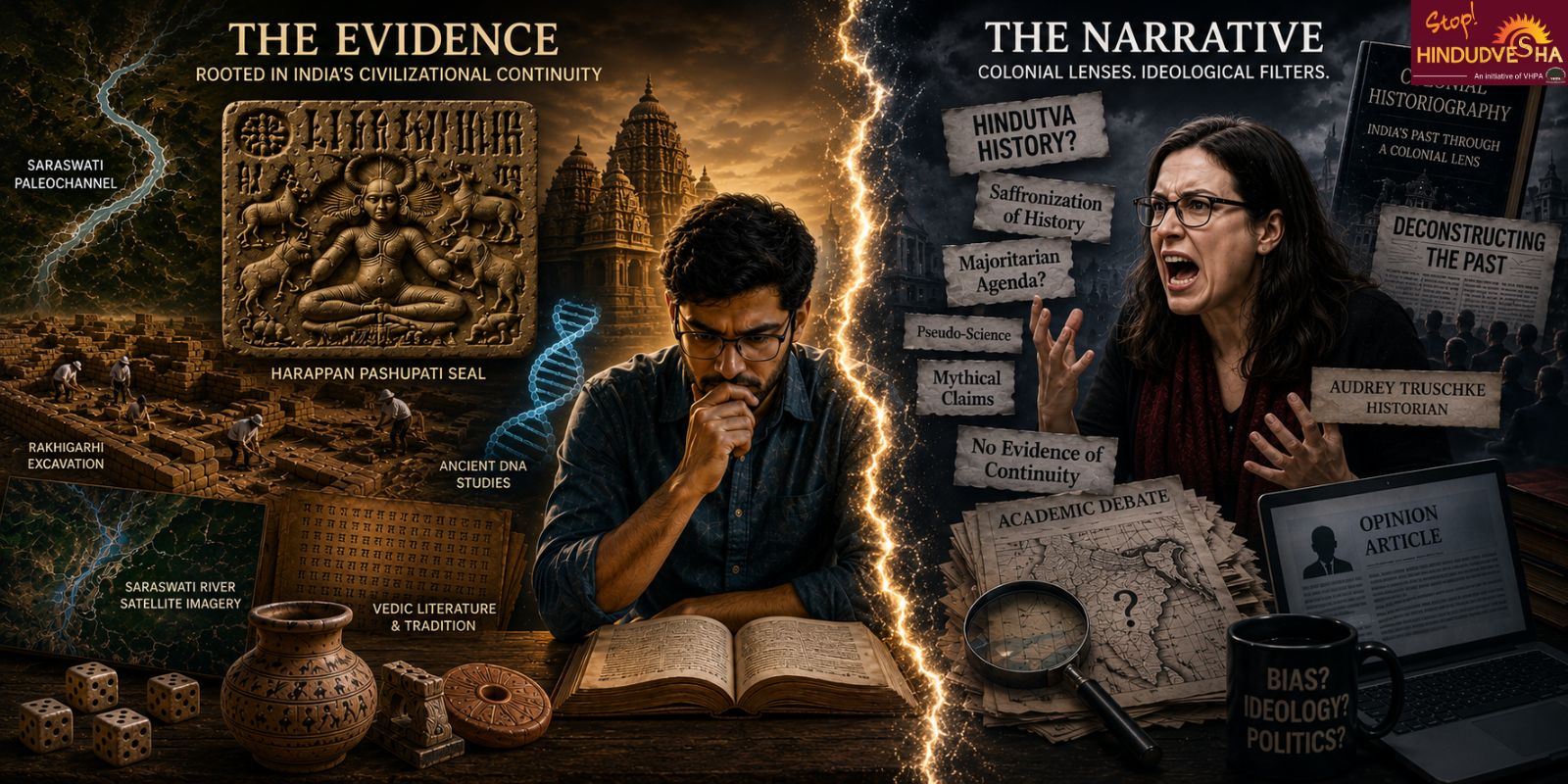
Summary
This article examines the growing contest over Bharat’s civilizational narrative as India increasingly emphasizes continuity between the ancient Sindhu Sarasvati Civilization and modern Indian culture. It explores how efforts to reclaim this narrative through archaeology, education, public outreach, and scholarly research have generated resistance from sections of Western academia, ideological activists, and neighboring Pakistan. The article analyzes debates surrounding the Harappan Pashupati seal, the evolving terminology for the Indus Valley Civilization, and emerging evidence from archaeology, genetics, and studies of the Saraswati River. It argues that many criticisms are rooted in intellectual frameworks shaped by colonial-era assumptions and civilizational hierarchies. Ultimately, the article contends that the debate is about more than history or archaeology; it is a struggle over who has the authority to define India’s past and civilizational identity.
India’s ongoing civilizational and cultural resurgence has attracted growing attention in the West, provoking reactions that range from curiosity to open hostility. At the center of many debates is India’s effort to reclaim and articulate a civilizational narrative rooted in its ancient Hindu heritage.
An important but often overlooked aspect of this discourse is India’s attempt to reassert a sense of civilizational continuity stretching across millennia. Concepts such as Akhand Bharat (Undivided India) and the legacy of the Sindhu Saraswati Civilization occupy an important place in India’s cultural imagination. For many Indians, the idea of Bhartiyata, or Indianness, is inseparable from the belief that India represents an unbroken civilizational tradition extending from the ancient Sindhu Saraswati era to the present day.
For much of the colonial and postcolonial period, mainstream scholarship advanced the notion that the Indus Valley Civilization was disconnected from Hindu civilization. The Aryan Invasion (latterly, Migration) Theory reinforced this myth, while some narratives went further, depicting Hinduism as a relatively late construct rather than an ancient and evolving tradition. Beneath these theories lay a persistent assumption that Indian civilization could not have developed as a continuous indigenous tradition and therefore required external origins, a superiority-infused colonial premise that shaped generations of scholarship on India’s past.
As India increasingly asserts civilizational continuity between the Sindhu Saraswati Civilization and modern Hindu culture, it has encountered predictable resistance. Recent criticism of a Ministry of Culture post featuring a Harappan Pashupati seal illustrates the broader contest over India’s civilizational narrative and historical self-understanding.
Why India’s Civilizational Claims Provoke Such Anxiety
A visible manifestation of this changing discourse has been the growing effort to bring India’s ancient heritage into the public sphere. Archaeological discoveries from Harappan-era sites are receiving greater attention, and evidence uncovered through excavations is being made more accessible through museums, exhibitions, educational initiatives, textbooks, and official outreach. These efforts highlight the sophistication, scale, and enduring significance of the civilization that flourished across northwestern India and present-day Pakistan thousands of years ago, while reinforcing the broader narrative of India’s civilizational continuity.
The evolving discourse is also reflected in terminology. The increasing use of “Sindhu Sarasvati Civilization” or “Indus Sarasvati Civilization” instead of “Indus Valley Civilization” signals a shift in emphasis. Proponents argue that these terms better reflect the civilization’s geographical spread, particularly given the large number of archaeological sites identified along the now-dry Sarasvati river system. Over the past several years, the phrase has increasingly entered official discourse.
This trend is not entirely new. In 2017, the Haryana Sarasvati Heritage Development Board proposed renaming the Indus Valley Civilization as the Sarasvati River Civilization, citing archaeological discoveries in Haryana and neighboring regions. [1] During India’s G20 presidency in 2023, the Culture Corridor exhibition also referred to the “Sindhu-Saraswati Civilization” while showcasing Harappan artifacts. [2]
India’s efforts to reclaim the civilizational narrative of the Sindhu Sarasvati Civilization have generated predictable criticism, with detractors often portraying such initiatives as attempts to impose a “Hindutva” interpretation of history, saffronize India’s pluralistic heritage, and define Indian culture solely through the prism of Hindu nationalism. [3] [4] [5]
The changing discourse is also reflected in education. NCERT’s revised 2024 Class 6 Social Science textbook, Exploring Society: India and Beyond, refers to the Harappan society as the “Sindhu-Sarasvati Civilization,” reflecting a greater emphasis on placing Harappa within the longer story of India’s civilizational development. [6]
The Ministry of Culture has likewise used social media and public outreach to highlight archaeological discoveries from Sindhu Sarasvati sites, presenting them as evidence of a deep and enduring civilizational continuum. Together, these initiatives reflect India’s growing effort to shape how its ancient past is understood at home and abroad.
Politics of Civilizational Memory
One such post concerning the famous 4,500-year-old Harappan Pashupati seal sparked a heated debate over India’s civilizational heritage, with several Western scholars rushing to dismiss Bharat’s claims of continuity. In an X post, the Ministry of Culture described the seal as “one of the most powerful symbols of India’s civilizational continuity” and identified the figure seated in a yogic posture as “widely seen as Shiva-Pashupati.” [7] The post emphasized that although ancient sites may lie across modern borders, the spiritual consciousness embodied in the seal continues to thrive in India’s temples, Shiva worship, yogic traditions, and cultural life.
The post drew a response from Audrey Truschke, who argued that the image may instead represent a broader “Lord of Animals” motif found across Eurasian cultures and suggested it was “more likely adapted from proto-Elamite iconography.” [8] [9]
The issue is not that alternative interpretations exist. Competing historical perspectives are a normal part of scholarly inquiry. Rather, it is the dismissive certainty with which India’s civilizational claims are often treated. When a country’s Ministry of Culture presents a civilizational interpretation rooted in its own historical understanding, reflexive derision hardly appears disinterested. Such reactions are especially striking when they come from academics with a long record of criticism toward Hindu traditions and Indian civilizational claims.
Truschke did not merely argue that “this isn’t Shiva.” She also sought to lecture the Indian government on its own history, remarking that “Indian history is amazing, wonderful, and fantastic—it’s well worth getting it right.” Yet it is equally worth asking whether academic authority is sometimes being deployed to delegitimize emerging Indian perspectives rather than engage them on their merits.
The exchange triggered a broader social media debate. Many Indian scholars and commentators responded by citing evidence supporting the Shiva interpretation while pointing to a double standard: Greek and Roman claims to civilizational continuity are widely accepted, whereas India is often required to meet an unusually high evidentiary threshold. The underlying assumption frequently appears to be that Indian civilization must be explained primarily through external influences. [10] [11]
A similar controversy followed another Ministry of Culture post featuring 4,500-year-old terracotta dice from the Sindhu Sarasvati Civilization. The post described the artifact as part of India’s living heritage and noted references to dice games in the Rigveda and Atharvaveda, prompting yet another round of criticism from the same ideological quarters. [12]
When Christian Theology Masquerades as History
India is perhaps unique in the extent to which non-Indian scholars and intellectuals seek not only to define its civilizational heritage but also to challenge the country’s own understanding of that heritage.
As India seeks to dismantle colonial narratives and foreground its civilizational continuity, it increasingly encounters resistance from sections of Western academia, media, and civil society. At the heart of this contest lies a worldview shaped by Biblical assumptions and the long-standing belief in the superiority of the Abrahamic civilizational framework.
This hierarchy remains embedded in academic and public discourse. The Bible is rarely described as mythology, whereas Hindu scriptures are routinely categorized as such. The distinction reflects deeper assumptions about which traditions are regarded as history and which are treated as legend.
Biblical narratives also influenced Western understandings of non-Western societies. The story of Noah’s sons, commonly associated with the Curse of Canaan, was historically invoked to justify racial hierarchies and imperial domination. [13] Similarly, the Doctrine of Discovery, formalized through papal decrees in the late fifteenth century, provided theological justification for European expansion by declaring that lands not inhabited by Christians could be claimed, governed, and converted by Christian rulers. [14] [15]
These ideas helped shape the intellectual foundations of colonialism and contributed to a worldview that viewed non-Western civilizations through a lens of cultural and religious superiority. From this perspective, the clash over India’s civilizational narrative is not merely academic. It reflects competing conceptions of history, identity, and legitimacy.
Many of the narratives that have influenced perceptions of India, including the Aryan Migration Theory, colonial caste ethnography, and contemporary frameworks that portray Hindu civilization primarily through the lenses of caste and oppression, emerged within broader Eurocentric intellectual traditions. Critics argue that these frameworks continue to shape large segments of Indic studies and public discourse.
The persistence of hostility toward claims of Hindu antiquity and civilizational continuity reflects a deeper discomfort with the idea of Bharat as one of the world’s oldest living civilizations. A continuous civilizational narrative challenges long-standing assumptions about the origins, development, and hierarchy of civilizations that have often placed the West at the center of world history.
Viewed in this light, debates over the Sindhu Sarasvati Civilization, Hindu antiquity, and India’s civilizational continuity are about more than archaeology or historiography. They are part of a broader struggle over who has the authority to define India’s past and, by extension, its place in the world.
Archaeology’s Inconvenient Findings
While dismissing India’s claims of civilizational continuity, critics often overlook the growing body of archaeological evidence pointing to significant cultural and civilizational connections between the Sindhu Sarasvati Civilization and present-day India.
Rakhigarhi, one of the most important sites of the Sindhu-Sarasvati Civilization, has been the subject of extensive excavations since 1995. Located in Haryana’s Hisar district, it is widely regarded as the largest Harappan site in India. The analysis of DNA samples from skeletal remains discovered there, published in 2019, marked a significant milestone in understanding the ancestry of the site’s population and challenged several long-standing theories regarding India’s ancient past.
The study, titled An Ancient Harappan Genome Lacks Ancestry from Steppe Pastoralists or Iranian Farmers, found no evidence that the sampled individual derived ancestry from Steppe pastoralists or ancient Iranian farming populations. The findings challenged theories of large-scale migrations into South Asia during or before the Harappan period and suggested substantial genetic continuity between ancient South Asian populations and later inhabitants of the region. The researchers also argued that South Asian hunter-gatherer populations had an independent origin and played a central role in the development of settled life in the subcontinent. The DNA evidence further pointed to a long pattern of genetic continuity from ancient hunter-gatherer communities to modern populations in South Asia. [16] [17]
The study further indicated that Harappan populations contributed significantly to the ancestry of most present-day South Asians and pointed to population movements from east to west rather than the reverse. While the researchers cautioned against drawing sweeping conclusions from a single genome, the study opened new avenues for investigating ancient population history through DNA analysis. [18]
Scientific research has also produced evidence supporting the existence of the ancient Saraswati River. Using satellite imagery and remote-sensing technologies, geoscientists have identified paleochannels stretching from the Thar Desert toward the Rann of Kutch. [19] The discovery of a reservoir at Rakhigarhi in 2024 added fresh momentum to this line of research. Since the Drishadvati, regarded as a major channel of the Saraswati system, is believed to have begun drying around 3000 BCE, some researchers suggest the reservoir may have been constructed in response to declining river flows. [20]
These developments have contributed to the growing use of the term “Sindhu-Sarasvati Civilization” in India’s civilizational discourse. The inclusion of the phrase in NCERT textbooks has drawn criticism from some commentators who view it as politically motivated. Others, including scholar Michel Danino, argue that the terminology reflects archaeological scholarship rather than ideology. Danino notes that several respected archaeologists, including Jonathan Mark Kenoyer, Raymond Allchin, and Jane McIntosh, have used similar terminology in their work. [21]
Pakistan’s Attempt to Appropriate What It Once Sought to Erase
StopHindudvesha has previously documented Pakistan’s efforts to rebrand itself as a “Shantidoot” (messenger of peace) while simultaneously promoting narratives such as “saffron terror” to divert attention from its long-standing association with terrorism and extremist networks.
In recent months, another amusing trend has emerged: a growing number of social media posts by Pakistanis seeking to portray Pakistan as an ancient civilization by claiming elements of Bharat’s civilizational heritage.
The irony is striking. A country where religious identity occupies a central place in public life and where non-believers and religious minorities often face discrimination is now seeking to appropriate the Indus Valley Civilization and other elements of India’s ancient Hindu heritage.
These claims have generated mixed reactions, but they also reveal a broader narrative framework. Concepts such as “shared heritage,” “syncretism,” and “Ganga-Jamuni tehzeeb” are increasingly being promoted as alternatives to what is portrayed as “Hindu nationalism” or “Hindutva.” [22] While it is difficult to determine whether this represents a coordinated effort or an organic trend, the messaging appears designed to emphasize shared roots while downplaying religion’s role in shaping India’s civilizational identity.
Pakistani commentators and official voices have also challenged India’s articulation of civilizational continuity. Because many major Harappan sites lie within present-day Pakistan, they argue that India cannot make exclusive claims regarding a civilization that predates modern nation-states. Such arguments are frequently invoked to counter India’s efforts to link the Sindhu Sarasvati Civilization to the broader story of Indian civilization.[23]
Yet the debate is not merely about who can claim the Indus Valley Civilization. From the Sindhu-Sarasvati Civilization to Indian classical traditions such as Odissi [24], a recurring theme in Pakistan’s civilizational assertions is the attempt to separate Bharat’s heritage from its Hindu roots. By reframing distinctly Hindu civilizational traditions as generic, shared, or religiously neutral, these narratives seek to dilute the Hindu character of India’s historical inheritance while continuing to draw legitimacy from its cultural prestige.
Conclusion
The debate over the Sindhu Sarasvati Civilization is about far more than archaeology, terminology, or ancient history. At its core lies a larger struggle over who gets to define India’s past and interpret its civilizational legacy.
As India places greater emphasis on its civilizational continuity, it increasingly encounters competing narratives from sections of Western academia, ideological activists, and even neighboring Pakistan. While these narratives differ in form, they often converge in questioning the antiquity, continuity, or indigenous foundations of Indian civilization.
At the same time, archaeological discoveries, advances in scientific research, and renewed scholarly interest are expanding public discussion about the relationship between the ancient Sindhu Sarasvati Civilization and the cultural traditions of modern India. As new evidence emerges, long-standing assumptions are being revisited and debated with fresh intensity.
The growing prominence of India’s civilizational narrative reflects a broader desire to understand the subcontinent’s past through frameworks rooted in its own historical experience. Whether one agrees with every interpretation or not, the larger trend is unmistakable: India is increasingly reclaiming ownership of its civilizational story and presenting it to the world on its own terms.
Citations
[1] Haryana proposes to rename the Indus Valley civilisation as Sarasvati river civilisation – India News | The Financial Express; https://www.financialexpress.com/india-news/haryana-proposes-to-rename-the-indus-valley-civilisation-as-sarasvati-river-civilisation/572057/
[2] G20 Culture Corridor: A Glimpse At Member Countries’ Shared Heritage; https://special.ndtv.com/decoding-g20-ndtv-conclave-121/news-detail/g20-culture-corridor-a-glimpse-at-member-countries-shared-heritage-4380157/3
[3] Kanimozhi criticises Nirmala Sitharaman on ‘Saraswati Sindhu civilisation’ statement; https://www.thenewsminute.com/tamil-nadu/kanimozhi-criticises-nirmala-sitharaman-saraswati-sindhu-civilisation-statement-117667
[4] Why does India want to rename Indus Valley Civilization? – South Asia Times; https://southasiatimes.org/why-does-india-want-to-rename-indus-valley-civilization/
[5] 100 Years of the Discovery of the Indus Valley Civilization: How It Shaped Indian Politics – The Diplomat; https://thediplomat.com/2024/11/100-years-of-the-discovery-of-the-indus-valley-civilization-how-it-shaped-indian-politics/
[6] New NCERT Textbook Refers To Harappan Society As ‘Sindhu-Sarasvati Civilisation’; https://www.ndtv.com/education/new-ncert-textbook-refers-to-harappan-society-as-sindhu-sarasvati-civilization-6153158
[7] Ministry of Culture on X; https://x.com/MinOfCultureGoI/status/2059513219429826967
[8] US Historian Audrey Truschke Denies Shiva-Pashupati On Harappan Seal, Says It Represents ‘Lord of Animals’ | India News -News18; https://www.news18.com/india/us-historian-audrey-truschke-denies-shiva-pashupati-on-harappan-seal-says-it-represents-lord-of-animals-ws-l-10119841.html
[9] Not Shiva-Pashupati on Harappan seal? US historian Audrey Truschke sparks outrage – India Today; https://www.indiatoday.in/india/story/audrey-truschke-harappan-seal-row-mohenjo-daro-pashupati-shiva-debate-indian-history-explained-2919036-2026-05-29
[10] Kalina Arya on X; https://x.com/KalingaArya/status/2060281048391725524
[11] Amish Tripathi on X; https://x.com/authoramish/status/2059928549856006278
[12] Ministry of Culture on X; https://x.com/MinOfCultureGoI/status/2061015896118767743
[13] Fabrication of the History of India – Part 1 of 3; https://stophindudvesha.org/fabrication-of-the-history-of-india-part-1-of-3/
[14] Ibid.
[15] The Doctrine of Discovery, 1493 | Gilder Lehrman Institute of American History; https://www.gilderlehrman.org/history-resources/spotlight-primary-source/doctrine-discovery-1493
[16] 2500 BC Rakhigarhi skeletons have no traces of ‘Aryan gene’, finds DNA study; https://theprint.in/india/aryan-invasion-theory-gets-a-setback-from-dna-study-of-2500-bc-rakhigarhi-skeletons/287454/
[17] Press Note by Prof. Vasant Shinde, Director of the Rakhigarhi Project on behalf of all the authors; https://chapter.intach.org/pdf/press-note-prof-vasant-shinde.pdf
[18] Ibid.
[19] Unveiling the Ancient Saraswati: Tracing Paleochannels through Geological Signatures from foothills of Himalayas to Rann of Kutch | International Journal of Research in; https://journal.ijresm.com/index.php/ijresm/article/view/2979
[20] Rakhigarhi reservoir excavation gives clues on Saraswati River; https://theprint.in/ground-reports/massive-reservoir-found-at-rakhigarhi-is-giving-us-more-clues-on-saraswati-river/2447317/
[21] Calling Harappan Civilisation ‘Sindhu – Sarasvati’ Is ‘Not a Hindutva Thing’, It Is ‘Factual’: French-Indian Professor Who Headed NCERT Social Science Panel; https://swarajyamag.com/culture/calling-harappan-civilisation-sindhu-sarasvati-is-not-a-hindutva-thing-it-is-factual-french-indian-professor-who-headed-ncert-social-science-panel
[22] Nawab Asad Jutt on X; https://x.com/nawabasadjutt/status/2060818047469027370
[23] Syed Zulfikar Ali Shah on X; https://x.com/SyZulfiqarShah/status/2060685362750763076
[24] A masterclass in cultural piracy: Inside Sheema Kermani’s attempted historical heist of Odissi dance form | The Pamphlet; https://thepamphlet.in/a-masterclass-in-cultural-piracy-inside-sheema-kermanis-attempted-historical-heist-of-odissi-dance-form/

Donate to HINDUDVESHA
Our Mission is to explore and expose Hindudvesha through research analysis, education and response.
SUPPORT US