

Maha Kumbh 2025 – A Platform for Collective Discourse Against Anti-Sanatan Rhetoric
 Rati Agnihotri · 02/13/2025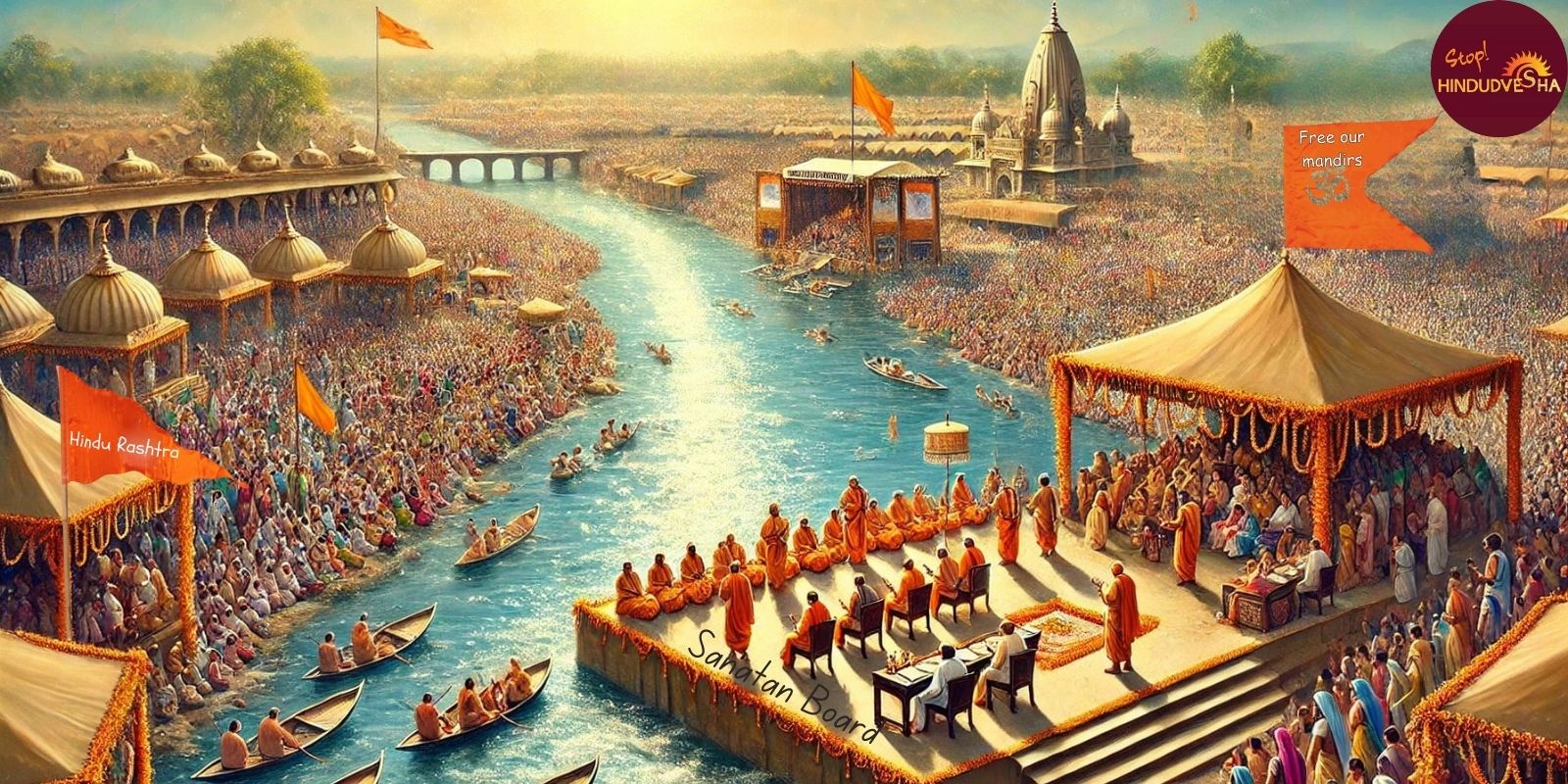
- Maha Kumbh 2025 serves as a crucial rallying point for Hindu society, uniting efforts to address existential and socio-cultural challenges.
- The festival’s vast scale and influence underscore its importance in safeguarding and promoting Sanatan Dharma and Hindu cultural heritage.
- Key Hindu concerns, such as establishing a Sanatan Board, liberating temples from government control, addressing demographic shifts, and building a grand Shri Krishna temple in Mathura, were spotlighted at Maha Kumbh 2025.
- The festival has sparked renewed conversations around India’s potential designation as a Hindu Rashtra, fostering deeper reflection on national identity and governance.
- While social media risks trivializing the event as a mere spectacle, Maha Kumbh’s real significance lies in providing a vital forum for serious discourse on pressing Hindu issues.
India is currently experiencing an unprecedented cultural and civilizational resurgence. This revival is characterized by a renewed emphasis on India’s Vedic heritage, the reclamation and restoration of abandoned temples, the enhancement of Hindu pilgrimage sites, and the promotion of Dharmic tourism. These initiatives are increasingly becoming emblematic of India’s cultural identity and a key element of its soft power on the global stage. However, this resurgence is not limited to mere optics or cultural diplomacy. It signifies a broader reawakening within Hindu society, where longstanding community issues are being highlighted and addressed nationally and internationally.
This transformation marks a significant paradigm shift from the past, where the mere mention of phrases like “Hindu issues” or “Hindu rights” would often provoke accusations of undermining secularism or promoting religious majoritarianism. Today, Hindus are asserting their collective identity and openly discussing matters that affect their community. Spiritual and religious gatherings are no longer confined to matters of personal enlightenment; instead, they are evolving into platforms that bring attention to complex and sensitive socio-political issues impacting Hindus.
The Maha Kumbh 2025 exemplifies this shift. It has become a focal point for rallying Hindu society around critical issues that shape their existence and future. The ongoing festival in Prayagraj has drawn a record number of participants. According to media reports[1], more than 12.5 million devotees attended the final Shahi Snan on Basant Panchami, a festival marking the onset of spring. The Mela, which began on January 13 and will continue until February 26, has already seen an extraordinary turnout, with over 97.3 million devotees taking a holy dip at the Sangam in the first 11 days alone[2]. On January 14, an astonishing 35 million people reportedly gathered on Makar Sankranti to perform the sacred ritual of bathing in the confluence of the rivers.[3]
These staggering numbers underscore the immense scale and significance of the festival. Few events worldwide can match the logistical and spiritual magnitude of the Maha Kumbh Mela. Its unparalleled reach makes it a crucial platform for fostering discourse on Sanatan Dharma and strategizing ways to address the Hindu community’s challenges.
Of course, the festival has not been without its challenges. A tragic stampede occurred on December 29, during the auspicious occasion of Mauni Amavasya, claiming 30 lives and injuring at least 60 others. In response, Akhadas postponed their Shahi Snan to prioritize the safety and access of pilgrims. Despite the tragedy, the authorities swiftly managed the situation, allowing a record number of pilgrims to continue participating in the holy rituals. Notably, the Basant Panchami Amrit Snan concluded on February 3 without any further incidents, much to the relief of devotees and organizers.
In the broader context of global challenges facing the Hindu community, including the persecution of Hindus in Bangladesh and Pakistan and rising anti-Hindu sentiment in Western countries, the Maha Kumbh Mela assumes a pivotal role. It serves as a spiritual and cultural milestone, fostering solidarity and enabling the Hindu community to assert its voice on the global stage.
In the following sections, we will explore how Maha Kumbh 2025 is shaping a multi-layered discourse on Sanatan Dharma and strengthening the resolve of the Hindu community in addressing contemporary challenges.
Demand for a Sanatan Board
The demand for establishing a Sanatan Board has been gaining traction within the Hindu community. One prominent figure championing this cause is Devkinandan Thakur, a revered Hindu spiritual leader. The issue was prominently raised during the Maha Kumbh 2025 at an on-site Dharma Sansad (religious parliament).
The Dharma Sansad, convened by Devkinandan Thakur, saw the participation of various Hindu religious leaders and spiritual thinkers. The assembly discussed the objectives and scope of the proposed Sanatan Board, emphasizing its necessity in safeguarding Hindu culture, identity, and religious institutions. A key concern raised was the aggressive activities of the Waqf Board, which has allegedly been making widespread claims on Hindu properties. Thakur highlighted that the Sanatan Board should serve as a unifying body for all Hindu traditions, rituals, and cultural symbols, including sacred entities like Gaumata (the cow), and protect them from encroachments and threats[4].
During the Dharma Sansad, the assembled religious leaders reportedly presented and approved a draft proposal for the creation of the Sanatan Board. This draft outlined that the board’s primary functions would include the protection, management, and oversight of Hindu temples and their associated properties and endowments. Furthermore, it was proposed that the board be established by an independent body, with membership limited to individuals deeply rooted in Hindu beliefs and the principles of Sanatan Dharma[5].
The spiritual leaders present at the gathering also stressed the urgency of addressing historical injustices faced by the Hindu community, many of which they attributed to the politics of minority appeasement in India. They asserted that creating the Sanatan Board would be crucial in reversing these injustices and safeguarding Hindu traditions, places of worship, and cultural heritage. Additionally, the leaders emphasized that this board should operate independently of government control, with Dharmic leaders from the Hindu community playing a central role in its formation and governance[6].
The demand for a Sanatan Board has been raised previously in multiple forums. However, such conversations often occur in limited settings with restricted public access, resulting in limited awareness of Hindu concerns. Including these discussions at a large-scale event like the Maha Kumbh amplifies visibility and facilitates broader engagement with the Hindu community on these pressing matters.
Renewed Focus on Protecting Temples, Heritage, and Rights
The Maha Kumbh 2025 served as a major platform for raising several critical issues concerning the Hindu community. Among the most prominent were the demand to free Hindu temples from government control and the call for constructing a grand temple dedicated to Bhagwan Krishna at Shri Krishna Janmabhoomi in Mathura.
The Vishwa Hindu Parishad (VHP) held its Kendriya Margdarshak Mandal meeting at the Maha Kumbh from January 25 to 27, drawing the participation of several saints and seers. One of the central concerns raised was the ongoing control of Hindu temples by the state. Acharya Avdheshanand Giri emphasized that temple donations amounting to ₹1.86 lakh crores were being directed to government coffers rather than being used for the welfare of the Hindu community. Many spiritual leaders also expressed concern over the declining Hindu birth rate, advocating that each Hindu family should aim to have at least three children to counteract demographic imbalances[7].
In addition, the attendees welcomed the government’s recent efforts to regulate the Waqf Board and curtail its expansive claims on properties. The meeting reiterated the VHP’s long-standing commitment—first made in 1994—to reclaim the sacred sites of Kashi, Mathura, and Ayodhya for Hindus. With the construction of the Ayodhya Ram Mandir nearing completion, attention has now shifted to securing the dharmic sites of Kashi Vishwanath and Krishna Janmabhoomi[8].
A special session focused on the Krishna Janmabhoomi movement was also convened at the Maha Kumbh. The Maha Samvad, organized at the Jagat Guru Mauli Sarkar camp, led to a consensus on forming an 11-member committee to advance the movement. Jagat Guru Mauli Sarkar stressed the need to raise awareness among Hindus about the significance of the movement. He announced that similar Maha Samvads would be organized in rural areas across India to educate the Hindu community about the importance of freeing Krishna Janmabhoomi and building a grand temple in Mathura[9].
Another crucial issue highlighted at the Maha Kumbh was the persecution of Hindu minorities in Bangladesh. In an extraordinary gesture, Yati Narsinghanand Giri, the Mahamandaleshwar of Juna Akhada, wrote a letter in his blood to Prime Minister Narendra Modi, urging him to take stronger measures to protect Hindu minorities in Bangladesh and Pakistan[10]. This issue was also extensively discussed during the VHP’s meeting at the Maha Kumbh[11].
Hindu Rashtra
Maha Kumbh 2025 has catalyzed renewed dialogue on the vision of India as a Hindu Rashtra. Rooted in the discourse of Hindu nationalism, the idea envisions India as a civilization bound by the core values and culture of Sanatan Dharma. However, unlike the concept of a theocratic Islamic state, the notion of a Hindu Rashtra does not advocate the imposition of a singular religious order. Instead, it proposes a governance model in which Sanatan Dharma functions as an inclusive framework, enabling all citizens to prosper regardless of their religious beliefs.
Unfortunately, sustained leftist propaganda has led to widespread misconceptions about the concept. Many Indian citizens view it with suspicion, often equating it with religious majoritarianism. Recognizing Maha Kumbh’s unique role as a gathering of millions of devotees from across the nation, Hindu leaders and advocates used the occasion to organize discussions to clarify the objectives and principles of a Hindu Rashtra.
A major event addressing this issue was the Hindu Rashtra Adhiveshan, organized by the Hindu Janajagruti Samiti in collaboration with Kali Sena at the Shambhavee Peeth camp. A draft of the proposed Hindu Rashtra Constitution was presented during the meeting. Swami Anandswaroop, the Peethadheeshwar of Shambhavee Peeth, declared that establishing Bharat as a Hindu Rashtra was his life’s mission. Sadguru Dr. Charudatta Pingale, National Guide of the Hindu Janajagruti Samiti, emphasized that the majority religious community enjoys priority protection of its rights in many other countries. In contrast, he argued, Hindus in India, despite being the majority, do not receive similar treatment, underscoring the need for a Hindu Rashtra to safeguard their interests[12].
The Dharmic leaders highlighted that the Hindu Rashtra Constitution would be modeled on Ram Rajya, a system grounded in justice, honesty, and efficiency. Dr. Pingale attributed the plight of Hindus in India to the secular governance framework, asserting that awareness about Hindu ideals and values must be raised to counter this systemic imbalance[13].
Currently, no centralized or universally accepted blueprint for a Hindu Rashtra exists. Various Hindu advocacy groups have developed governance models inspired by Hindu values since India’s independence. Central principles often cited in these frameworks include environmental conservation, Seva Bhav (social service), Vasudhaiva Kutumbakam (the world is one family), and protection of Gau Mata (the cow). Many experts argue that the Vedas and Upanishads offer guidance for creating a governance system rooted in Dharma that is relevant to modern times.
Hindu Rashtra encompasses more than just religion or politics. It is a holistic socio-religious and economic system that integrates India’s culture, history, art, literature, and traditions. According to its proponents, the vision of Hindu Rashtra emphasizes integrity, justice, and accountability as core principles of governance[14].
Despite the momentum generated by advocacy groups, the concept of Hindu Rashtra faces significant obstacles. Due to political resistance and entrenched leftist narratives, the idea has not yet reached a stage where it can be formally debated in Parliament. Nonetheless, Hindu organizations continue to advance related issues, such as the autonomy of Hindu temples, the protection of cows, and the reclaiming of sacred sites in Kashi and Mathura. These efforts aim to bring Hindu concerns into the mainstream political discourse.
The release of a draft Hindu Rashtra Constitution at Maha Kumbh 2025 marks a significant milestone in these efforts. It represents a crucial step toward aligning Dharmic and spiritual leaders around a shared vision for Hindu governance. Moreover, such initiatives help counter disinformation by providing direct exposure to the perspectives of spiritual leaders. With millions of pilgrims attending the Kumbh, many have the opportunity to engage in these discussions, gaining first-hand insights into the movement’s goals and values.
Ultimately, the growing dialogue on Hindu Rashtra at events like Maha Kumbh underscores a broader civilizational reawakening among Hindus. Through ongoing discourse and education, advocates aim to demystify and promote the concept of preserving and protecting India’s Dharmic heritage in the modern world.
Seers Adopting Innovative Ways to Highlight Hindu Issues
Sanatan Dharma, often misunderstood as rigid or dogmatic, is a vast and diverse tradition. It embraces multiple viewpoints, allowing space for reflection, experimentation, and even eccentric expressions of faith. At Maha Kumbh 2025, many spiritual leaders are adopting creative and unconventional methods to draw attention to pressing Hindu issues. While some of these methods may appear theatrical, they serve a crucial purpose given the widespread lack of awareness among Hindus about their cultural and spiritual concerns.
One of the key attractions at the Maha Kumbh is Mauni Baba’s camp, which features a replica of Shiv Nagari. The centerpiece of his camp is a stunning display of 12 Jyotirlingas crafted from 75.1 million Rudraksha beads[15]. Each Jyotirlinga stands at an impressive height of 11 feet, with a width of 9 feet and a thickness of 7 feet. These Rudraksha beads were gathered during a remarkable journey across 10,000 villages, adding a symbolic dimension to the display[16].
According to Mauni Baba, this exhibit aims to raise awareness about Hindu issues. He emphasizes that the eradication of terrorism, the protection of persecuted Hindus in Bangladesh, and the preservation of national security are among the causes he seeks to highlight[17]. Additionally, Mauni Baba aims to inspire discussions on reclaiming the Dharmic sites of Kashi and Mathura and reawakening national pride[18].
Another figure captivating the attention of pilgrims is Mahant Someshwar Giri, a Bal Yogi who has held one hand raised for the past 15 years[19]. This act of intense devotion exemplifies the spiritual depth of Sanatan Dharma, where practitioners strive to transcend the physical and mental limitations of the human condition through disciplined spiritual practices.
Swami Ananta Giri, another inspiring presence at the Maha Kumbh, exemplifies the synthesis of spirituality and social service. A former entrepreneur in the perfume industry, she renounced her material life to guide thousands of youths away from drug addiction and towards Sanatan Dharma[20]. Her work demonstrates how spiritual leaders can drive meaningful social change through Dharma-based values and practices.
In another effort to protect and promote Sanatan Dharma, 1,100 Brahmins performed a massive yagya (sacrificial ritual) to invoke divine blessings for the protection of cows (Gau Mata) and the preservation of Dharmic values[21].
Sanatan Dharma’s beauty lies in its lack of rigid uniformity. While some seers belong to traditional Akhadas governed by strict protocols, others, such as householders (Grihastha), engage with Dharma while balancing worldly responsibilities. On one end, there are highly learned Dharmacharyas steeped in scriptural knowledge, and on the other, there are unconventional seekers whose spiritual journeys reflect a blend of tradition and personal exploration.
An example of such innovation is Abhay Singh, popularly known as “IIT Baba.” Though he does not refer to himself as a Sadhu, his background as an alumnus of the Indian Institute of Technology (IIT) quickly turned him into a viral sensation. In his interviews, Abhay Singh discusses the intersections between science and Sanatan Dharma, urging that the ancient knowledge within Vedic scriptures should be examined with a scientific lens. According to Singh, events like the Maha Kumbh should transcend spectacle and become platforms for serious intellectual engagement with the core principles of Sanatan Dharma.
Abhay Singh’s approach underscores a growing movement within Hindu discourse that seeks to harmonize spiritual traditions with contemporary scientific inquiry. This perspective appeals to younger generations and urban intellectuals, offering a bridge between ancient wisdom and modern thought.
Wrapping Up
While social media has amplified the visibility of Hindu Dharma and its cultural heritage, it has also fostered a superficial portrayal that risks reducing Sanatan Dharma to mere spectacle. Despite India’s electronic media hosting serious discussions on crucial Hindu issues raised at the Maha Kumbh, social media trends often prioritized sensationalism. Gimmicky hashtags like “Monalisa” and “IIT Baba” overshadowed the deeper significance of the festival, particularly in light of pressing concerns such as the persecution of Hindus in Bangladesh.
Social media algorithms thrive on sensational trends, encouraging content creators to replicate dramatic themes for greater reach and monetization. Consequently, the core purpose of events like the Maha Kumbh is often diluted, with viral content sidelining meaningful discourse. This pattern highlights a disconnect between social media trends and the true essence of religious gatherings that aim to protect and promote Dharmic values.
However, social media still plays a crucial role in raising awareness among the youth, albeit through oversimplified narratives. Balancing this digital engagement with thoughtful discussions that foster a comprehensive understanding of Sanatan Dharma is essential. The Maha Kumbh, with its unparalleled reach, should focus on shaping a Dharmic discourse that addresses issues such as Hindu rights, the ideal of a Hindu Rashtra, and curbing religious conversions.
As Dhirendra Shastri aptly noted[22], the aim of Maha Kumbh must transcend social media reels to become a powerful center for propagating Sanatani culture and values in the face of ongoing challenges.
Citations
[1] Maha Kumbh: Over 12.5 million devotees participate in final snan on Basant Panchami | latest News India – Hindustan Times; https://www.hindustantimes.com/india-news/maha-kumbh-over-12-5-million-devotees-participate-in-final-snan-on-basant-panchami-101738577280530.html
[2] Mahakumbh 2025: 97.3 million devotees take holy dip at Sangam in first 11 days | Latest News India – Hindustan Times; https://www.hindustantimes.com/india-news/mahakumbh-2025-97-3-million-devotees-take-holy-dip-at-sangam-in-first-11-days-101737618680057.html
[3] Maha Kumbh 2025 breaks records with 10 crore visitors; https://ddnews.gov.in/en/maha-kumbh-2025-breaks-records-with-10-crore-visitors/
[4] Sanatana Dharma Sansad Calls For Formation of Sanatana Board At Mahakumbh 2025; https://english.jagran.com/india/sanatana-dharma-sansad-calls-for-formation-of-sanatana-board-at-mahakumbh-2025-10215133
[5] ibid
[6] Prayagraj Maha Kumbh Maha Dharm Sansad LIVE: YouTube; https://www.youtube.com/watch?v=KmiMnxdQFjI
[7] Free temples from government control, return holy sites to Hindus: Seers demand during VHP meet at Mahakumbh; https://www.newindianexpress.com/nation/2025/Jan/25/free-temples-from-government-control-return-holy-sites-to-hindus-seers-demand-during-vhp-meet-at-mahakumbh
[8] https://organiser.org/2025/01/30/275778/bharat/mahakumbh-vhp-sants-bat-for-temple-autonomy-family-growth-and-cultural-protection/
[9] https://navbharattimes.indiatimes.com/state/uttar-pradesh/allahabad/mahakumbh-special-discussion-on-shri-krishna-janmbhoomi-mukti-this-decision-to-speed-up-movement/articleshow/117854557.cms
[10] https://www.abplive.com/news/india/mahakumbh-yati-narsinghanand-writes-letter-with-blood-to-pm-modi-to-protect-hindus-in-bangladesh-pakistan-2874104
[11] Mahakumbh: VHP, sants bat for temple autonomy, family growth, and cultural protection; https://organiser.org/2025/01/30/275778/bharat/mahakumbh-vhp-sants-bat-for-temple-autonomy-family-growth-and-cultural-protection/
[12] Hindu Nation Conference Held at Shambhavi Peeth Camp Discussing Hindu Rights and Security Issues, Prayagraj Hindi News – Hindustan; https://www.livehindustan.com/uttar-pradesh/prayagraj/story-hindu-nation-conference-held-at-shambhavi-peeth-camp-discussing-hindu-rights-and-security-issues-201738685974675.html
[13] Unveiling of the Constitution of the Hindu Rashtra by Saints at the Mahakumbh Mela! – Hindu Janajagruti Samiti; https://www.hindujagruti.org/news/202009.html
[14] Hindu Rashtra – A nation for the welfare of the world – Hindu Janajagruti Samiti; https://www.hindujagruti.org/hindu-rashtra
[15] Maha Kumbh 2025: 12 Jyotirlingas Crafted From Over 7 Crore ‘Rudraksha’ Beads Draws Devotees To Shiv Nagari; https://news.abplive.com/cities/maha-kumbh-2025-12-jyotirlingas-crafted-from-over-7-crore-rudraksha-beads-draws-devotees-to-shiv-nagari-1745094
[16] Maha kumbh 2025: 12 Jyotirlingas crafted with 7 crore Rudraksha beads attract devotees (Financial Express); https://www.financialexpress.com/trending/maha-kumbh-2025-12-jyotirlingas-crafted-with-7-crore-rudraksha-beads-attract-devotees/3718940/
[17] ibid
[18] Mouni Baba Mahakumbh, 12 Jyotirlingas made 5 crore Rudraksha; https://dainiksaveratimes.com/dharam/mouni-babas-grand-camp-became-the-center-of-attraction-in-mahakumbh-12-jyotirlingas-made-with-5-51-crore-rudraksha-and-11000-trishul/
[19] Mahant someshwar giri lifting hand since 15 years as urdhva bahu practice; https://zeenews.india.com/hindi/religion/mahant-someshwar-giri-lifting-hand-since-15-years-as-urdhva-bahu-practice/2576586#
[20] Swami Ananta Giri leads youth away from drugs; Left perfume industry worth crores to free 10,000 youths from addiction; https://organiser.org/2025/02/01/276119/bharat/swami-ananta-giri-leads-youth-away-from-drugs-left-perfume-industry-worth-crores-to-free-10000-youths-from-addiction/
[21] Mahakumbh Mela 2025: Saints perform ‘yagya’ to promote cow protection, Sanatan Dharma, mahakumbh mela 2025, prayagraj, sanatan dharma, cow protection,significance of maha; https://english.mathrubhumi.com/news/india/mahakumbh-mela-2025-cow-protection-yagya-1.10255087
[22] बाबा बागेश्वर भटके लोगों की घर वापसी पर चाहते चर्चा, बोले – ‘महाकुंभ का उद्देश्य Reel नहीं, आदिवासियों को सनातन पढ़ायेंगे’ VIDEO| Republic Bharat; https://www.republicbharat.com/india/purpose-mahakumbh-not-reel-discussion-astray-can-return-home-teach-lessons-sanatan-tribals-bageshwar-dham-sarkar#google_vignette

Donate to HINDUDVESHA
Our Mission is to explore and expose Hindudvesha through research analysis, education and response.
SUPPORT US