

Bhojshala Verdict: Reclaiming Civilizational Justice in Bharat
 Rati Agnihotri · 07/21/2026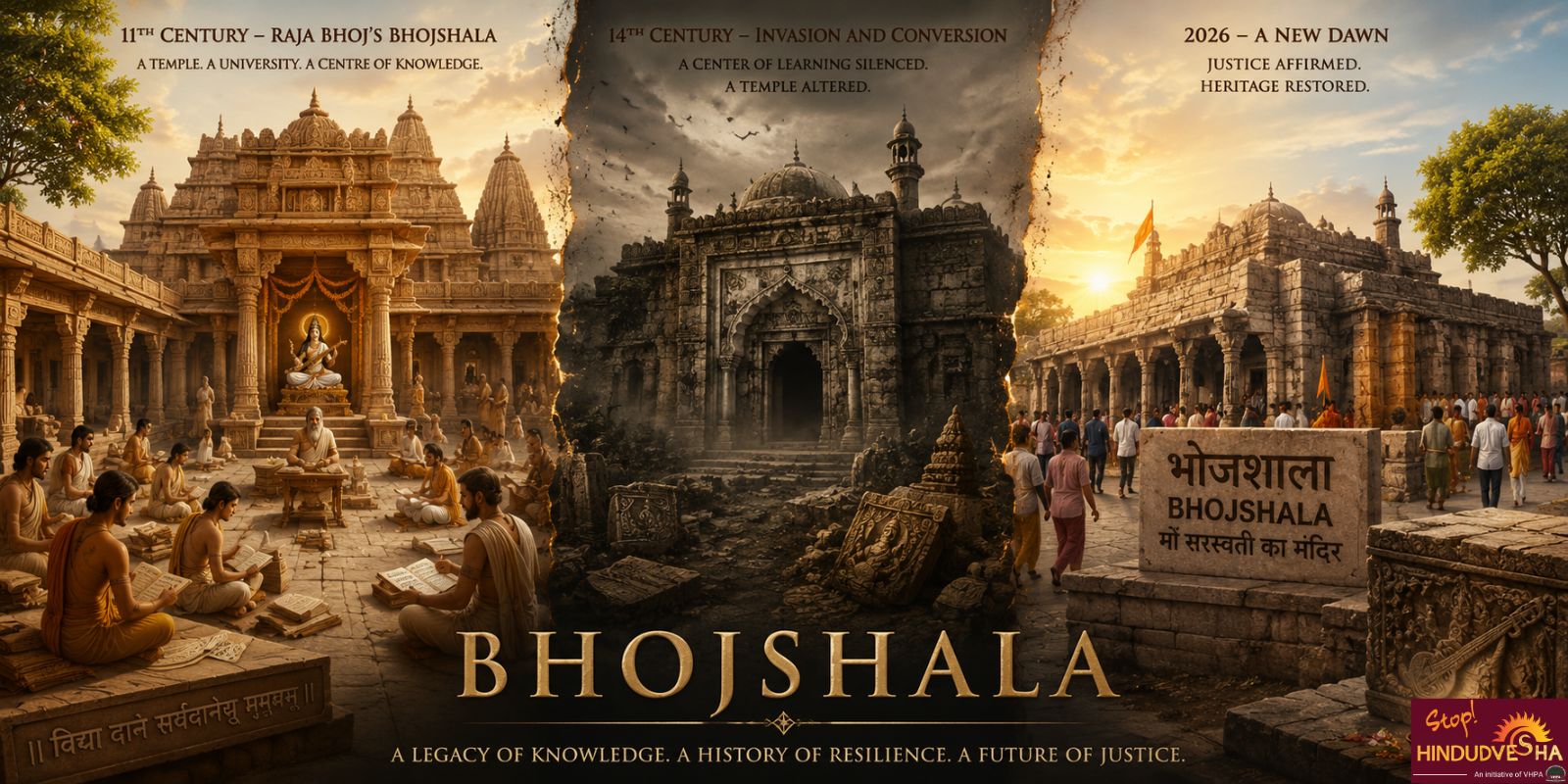
Summary
The Madhya Pradesh High Court’s Bhojshala verdict marks a significant moment in India’s evolving debate over civilizational justice and historical continuity. By recognizing Bhojshala in Dhar as a temple dedicated to Maa Saraswati and granting Hindus sole access to the site, the judgment has revived broader discussions surrounding temple reclamation and the constitutional limits of the Places of Worship (Special Provisions) Act, 1991. The ruling relied heavily on archaeological findings, historical records, inscriptions, and evidence from an ASI survey, reinforcing the growing role of scientific inquiry in resolving disputed heritage claims. Beyond its legal implications, the Bhojshala case highlights deeper questions about India’s civilizational inheritance, historical memory, and whether communities should have greater constitutional avenues to seek redress for historically contested sacred sites.
The principle of civilizational justice lies at the heart of genuine decolonization. A balanced process of cultural and civilizational reclamation requires addressing the large-scale desecration, vandalism, and appropriation of heritage inflicted by historical invaders and colonizers. Reclaiming sacred spaces and restoring historical continuity is therefore not merely symbolic, but central to restoring historical continuity disrupted over centuries.
For decades, any effort to reclaim ancient Hindu sites in India that were destroyed, altered, or converted into Islamic religious structures during periods of invasion was often portrayed as communal and antithetical to secularism. The Nehruvian elite and sections of the left-liberal establishment cultivated a selective discourse around secularism that, critics argue, frequently excluded Hindu civilizational concerns from legitimate public consideration.
India’s ongoing cultural and civilizational reawakening has gradually altered this dynamic. The landmark 2019 Supreme Court judgment in the Ayodhya dispute, which paved the way for the construction of the Ram Mandir, opened new legal and intellectual space for efforts to restore India’s ancient Dharmic heritage through constitutional means.
A significant milestone in this broader process came with the recent Madhya Pradesh High Court verdict recognizing Bhojshala in Dhar as a temple dedicated to Maa Saraswati and granting the Hindu community sole access to the site. The judgment has been widely viewed by many Hindus as an important civilizational and Dharmic victory.
Central to many such disputes is the contentious Places of Worship (Special Provisions) Act, 1991. Criticized by several Hindu organizations and legal scholars, the Act is seen as restricting the ability of Hindus, Jains, and Sikhs to seek judicial remedies for historical religious disputes by freezing the religious character of sites as they existed in 1947.
While the Act continues to constrain claims in disputes such as Kashi-Gyanvapi, one important exception remains: ASI-protected monuments fall outside its purview, allowing courts to consider archaeological evidence in determining a site’s historical character. [1] The Bhojshala judgment has therefore renewed debate about the scope of civilizational restoration within India’s constitutional framework.
The Bhojshala Verdict: A Landmark for Civilizational Continuity
In May 2026, the Madhya Pradesh High Court delivered a landmark verdict recognizing the disputed Bhojshala complex in Dhar as the ancient temple of Vagdevi, also known as Goddess Saraswati. The court quashed the Archaeological Survey of India’s (ASI) 2003 order permitting the Muslim community to offer Namaz inside the complex every Friday. It further observed that the Government of India should consider repatriating the Murti of Vagdevi from a London museum, where it has remained for decades. The High Court also suggested that the Maulana Kamaluddin Welfare Society or another Waqf body may seek alternate land in Dhar for constructing a mosque. Following the ruling, the ASI granted the Hindu community unrestricted access to the site for worship and other religious purposes. [2] [3]
The High Court’s judgment placed considerable emphasis on historical literature, archaeological evidence, inscriptions, and documentary records in adjudicating this sensitive dispute. Findings relating to ancient Hindu inscriptions, recovered idols, distinctive temple architecture, and artifacts from the Paramara period played an important role during the proceedings. In its detailed judgment, the court observed that Hindu worship at the Bhojshala complex had never ceased. It also gave significant weight to historical texts identifying the site as a major center of Sanskrit learning during the reign of Raja Bhoj of the Paramara dynasty. [4]
For decades, Bhojshala remained a site of competing religious claims between the Hindu and Muslim communities. Hindus have consistently maintained that the complex was originally an ancient temple dedicated to Goddess Saraswati and represented an important part of India’s Dharmic heritage. The Muslim side, meanwhile, asserted that the structure functioned as the Kamal Maula Mosque, citing their continued practice of offering Namaz at the site. [5]
Bhojshala is officially recognized as a protected monument under the Ancient Monuments and Archaeological Sites and Remains Act, 1958. [6] As a result, the Places of Worship (Special Provisions) Act, 1991, does not apply to the site. This exemption created the legal opening through which the High Court was able to adjudicate the dispute on the basis of historical and archaeological evidence.
The Places of Worship (Special Provisions) Act, 1991, remains a subject of deep contestation within the Hindu community. The Act freezes the religious character of places of worship as they existed on August 15, 1947. While the Ayodhya dispute was explicitly exempted at the time of enactment, several disputed sites, including Bhojshala, are ASI-protected monuments. This has enabled courts to order scientific archaeological surveys to examine the antiquity and original religious character of such sites. In the Bhojshala case, the Madhya Pradesh High Court directed the ASI in March 2024 to conduct a comprehensive scientific survey. The resulting 2,000-page report, submitted in July 2024, became a major evidentiary foundation for the final ruling. [7]
More Than a Temple: Bhojshala as a Center of Learning
Raja Bhoj of the Paramara dynasty (1000–1055 CE) established Bhojshala in Dhar, then the capital of his kingdom, as a temple academy dedicated to Devi Saraswati. Historical literature and scriptural references indicate that Bhojshala emerged as a highly regarded center of learning, reportedly hosting nearly 1,400 poets, scholars, and theologians at its height.
Raja Bhoj, among the most renowned scholar-kings in Indian history, is believed to have authored more than eighty works across diverse disciplines, including grammar, philosophy, astronomy, Ayurveda, military science, and architecture. Dhar, home to Bhojshala, developed into one of the leading intellectual centers of its era. Seminal Sanskrit works such as Saraswati Kanthabharana (a treatise on classical Sanskrit grammar), Rajamartanda (a medical text), and Avani Koormashatam are associated with the scholarly tradition linked to Bhojshala. [8]
The history of the Bhojshala complex also offers important insight into the broader temple ecosystem of ancient and early medieval India. Sustained by a flourishing temple economy, temples frequently functioned not only as spaces of worship but also as vibrant centers of education, intellectual exchange, artistic patronage, and civilizational continuity.
In this sense, Bhojshala represented more than a religious structure. It embodied a wider Dharmic model in which scholarship, spirituality, governance, and cultural production were deeply interconnected. The historical significance of the site therefore extends beyond questions of worship alone, touching upon the preservation of an important strand of India’s intellectual and civilizational heritage.
Bhojshala Across Invasions, Rule, and Resistance
According to ASI survey findings, historical literature, and other documentary evidence, the Bhojshala complex underwent repeated attacks, occupations, and structural alterations during successive phases of Islamic rule, beginning with the Delhi Sultanate. Historical accounts indicate that one of the earliest major attacks on Bhojshala took place during the reign of Alauddin Khilji in 1305. During this period, Hindu ruler Mahakaldev and several of his soldiers are believed to have been killed while resisting the invasion. Some historical accounts further claim that nearly 1,200 Hindu teachers and students associated with Bhojshala lost their lives after refusing conversion, reflecting the intensity of the conflict surrounding the site.
Another major turning point in the Bhojshala dispute emerged in 1514 during the reign of Mahmud Shah Khilji II. During this period, land adjoining the temple complex came to be occupied and a structure identified as the Kamal Maula Dargah was constructed. Over time, the Dargah became central to the conflict, as the Hindu side argued that the Bhojshala complex was gradually being reidentified as a Dargah in ways that altered or obscured its original historical and religious identity. [9]
The dispute entered a new phase during British rule. In 1907, an administrative arrangement permitted Friday Namaz at the complex while allowing limited Hindu worship during Basant Panchami. Two years later, in 1909, the Dhar princely state declared the site a protected monument. Following India’s independence, Bhojshala came under the control of the Archaeological Survey of India in 1952. [10]
Post-independence political developments further complicated the dispute as the worship rights of the Hindu community gradually came under increasing restriction. Another major development occurred in 1997, when the Madhya Pradesh government permitted Friday Namaz at the complex while restricting Hindu entry except during Basant Panchami, when Saraswati Puja was allowed under prescribed conditions. The dispute intensified in 2003 as the Hindu community increasingly asserted its claims over the site, and Basant Panchami celebrations drew more than nine lakh devotees. Section 144 prohibitory orders were subsequently imposed, leading to the detention of several activists and reported injuries to others.
Tensions resurfaced repeatedly in 2006, 2013, and 2016, particularly when Basant Panchami coincided with Friday prayers, resulting in confrontations and reported police use of force against Hindu devotees gathered for worship. A major legal shift finally came in March 2024, when the Madhya Pradesh High Court directed the ASI to undertake a comprehensive scientific survey of the Bhojshala complex, an exercise that would later play a decisive role in shaping the final judgment. [11]
How Archaeology Shaped the Bhojshala Verdict
The findings of the scientific survey of the Bhojshala complex played a pivotal role in shaping the final verdict of the Madhya Pradesh High Court.
According to the ASI’s comprehensive 2,000-page report submitted to the court, more than 1,700 relics were recovered from the site, including a damaged Murti of Vagdevi (Goddess Saraswati). The survey cataloged at least 94 architectural artifacts, while 37 intact or fragmented Murtis of Hindu deities — including Brahma, Krishna, Shiva, Ganesha, Parvati, Hanuman, and Narasimha — were reportedly found embedded within the walls of the mosque. Additional findings included thirty-one coins spanning from the Indo-Sassanian period to the British era, along with a significant inscription referencing King Naravarman of the Paramara dynasty (1094–1133 CE).
In its judgment, the Madhya Pradesh High Court observed that the cumulative weight of architectural analysis, ASI findings, inscriptions, and historical literature strongly supported the conclusion that Bhojshala functioned as a center of Sanskrit learning and a temple associated with Raja Bhoj. [12]
The Bhojshala judgment is likely to strengthen the role of court-directed scientific surveys in disputes concerning the historical character of contested religious structures. The Supreme Court’s 2023 decision permitting the ASI survey of the Gyanvapi complex — despite it not being an ASI-protected monument — provided important legal space for the Hindu side even within the constraints imposed by the Places of Worship (Special Provisions) Act, 1991. ,[13] [14] The ruling reinforced the discretionary authority of courts to direct scientific surveys to examine a site’s antiquity and historical religious character.
However, this approach has important limitations. Even where survey findings strongly favor the Hindu side, the restrictive provisions of the 1991 Act may still prevent a final legal resolution, as seen in the continuing uncertainty surrounding the Gyanvapi dispute.
Nevertheless, the growing reliance on archaeological surveys represents a notable shift toward evidence-based adjudication. Critics argue that such surveys were often resisted in the past, particularly during the Ram Janmabhoomi dispute, when sections of the left-leaning academic establishment mounted sustained criticism of the ASI findings, arguing methodological bias. Yet following the 2019 Ayodhya judgment and growing public interest in historical evidence, archaeological inquiry is increasingly emerging as a central mechanism in determining the historical origins of disputed sites.
Beyond Worship: The Civilizational Meaning of Sacred Sites
Many disputed sites in India, while intrinsically linked to specific deities and historically functioning as places of worship, are also deeply civilizational in character. They represent far more than religious spaces alone; they embody multiple layers of India’s cultural, scholarly, and historical continuity.
India’s Hindu heritage extends beyond the Hindu community itself. It forms an important part of Bharat’s broader civilizational inheritance, and many argue that every citizen, irrespective of religious affiliation, has a legitimate stake in its preservation, study, and revival.
Welcoming the Madhya Pradesh High Court’s Bhojshala verdict, VHP International President Alok Kumar emphasized the need for a broader revival of the site. He called for restoring its historic scholarly character and urged both the government and civil society to re-establish Dhar, where Bhojshala is located, as a major center of Vedic learning alongside the study of Buddhist, Jain, and Sikh traditions. Kumar further urged the Government of India to pursue the repatriation of the Murti of Maa Saraswati, currently housed in a museum in London, and reinstall it at Bhojshala through a formal Pran Pratishtha. [15]
Critics of the Places of Worship (Special Provisions) Act, 1991, have long argued that the legislation weakens the possibility of historical redress. Senior lawyer and author J. Sai Deepak has argued that the Act was enacted in 1991 “without any kind of consultation with the affected Indic communities.” He further contends that “there was no credible discussion on the impact of the legislation on the rights of the affected Indic communities under Article 25 of the Constitution.” According to him, the Act effectively forecloses judicial remedies for continuing historical grievances and therefore warrants constitutional reconsideration. [16]
Another prominent critic, Advocate Ashwini Upadhyay, argues that the 1991 Act effectively legitimizes the historical consequences of actions undertaken by invaders and rulers such as Tughlaq, Babar, and Humayun. He maintains that the historical character of disputed religious sites should be determined through scientific surveys and archaeological evidence. [17]
Upadhyay has also advocated repealing the Places of Worship Act and replacing it with a Bharatiya Dharohar Sanhita (Indian Civilizational Code), which would establish clear provisions for conducting scientific surveys of disputed religious sites to determine their historical and religious origins. [18]
The Places of Worship Act and the Road Ahead
The discourse surrounding the Places of Worship (Special Provisions) Act, 1991, appears to be entering a new phase. Once viewed by many as an unassailable legal barrier, the Act is now being actively challenged through multiple petitions before the Supreme Court. The apex court’s decision to admit these petitions signals an important shift in both legal and civilizational discourse.
Petitioners have raised several constitutional objections to the Act:
- It is unconstitutional because it restricts judicial review, which forms part of the Constitution’s basic structure and cannot be curtailed.
- It undermines the principle of secularism by allegedly privileging one historical status quo over competing religious claims.
- It infringes upon the principles of equality and non-discrimination under Articles 14 and 15 by freezing the religious character of places as they stood on August 15, 1947, thereby preventing Hindus, Jains, Buddhists, and Sikhs from seeking legal restoration of sites they regard as historically significant.
- It violates the religious freedoms guaranteed under Articles 25, 26, and 29 of the Constitution. [19]
Several prominent disputed sites, including Kashi Gyanvapi, Sambhal Shahi Jama Masjid, and Shahi Idgah in Mathura, remain entangled in prolonged legal uncertainty due to the restrictive provisions of the 1991 Act. In cases such as Kashi Gyanvapi, ASI surveys have reportedly uncovered evidence that is considered compelling by supporters of the Hindu claim. However, the Act continues to limit any substantive alteration to the legal status quo. Legal commentators also note that historical records, including accounts attributed to some of the invaders themselves, are frequently cited as evidence of temple desecration, yet affected communities remain legally constrained in their efforts to seek judicial redress.
With the Supreme Court now set to examine the constitutional validity of the Places of Worship Act, 1991, many within the Hindu community hope that the constitutional rights tied to historical continuity and religious freedom will receive fuller judicial protection. [2]
Citations
[1] The Places of Worship ( Special Provisions) Act, 1991; https://www.mha.gov.in/sites/default/files/2022-10/ThePlaceofWorshipSpecialProvisionsAct1991%5B1%5D.pdf
[2] Bhojshala complex is temple of Goddess Vagdevi, Hindus have right to worship: Madhya Pradesh high court; https://timesofindia.indiatimes.com/city/bhopal/bhojshala-complex-is-temple-of-goddess-vagdevi-hindus-have-right-to-worship-madhya-pradesh-high-court/articleshow/131110112.cms
[3] ASI allows Hindus unrestricted access to Bhojshala temple after Madhya Pradesh High Court verdict | Akashvani News; https://newsonair.gov.in/asi-grants-hindus-unrestricted-access-to-monument-at-bhojshala-complex-in-dhar-madhya-pradesh/
[4] Bhojshala Verdict 2026: ASI findings, historical evidence & more; https://organiser.org/2026/05/17/353808/bharat/bhojshala-case-know-all-about-bhojshala-kamal-maula-dispute-from-raja-bhoj-to-2026-verdict/
[5] Ibid.
[6] Breaking | MP High Court Declares Bhojshala A Saraswati Temple, Directs State To Consider Alternate Mosque Land | BREAKING | MP High Court Declares Bhojshala A Saraswati; https://lawbeat.in/news-updates/breaking-mp-high-court-declares-bhojshala-a-saraswati-temple-directs-state-to-consider-alternate-mosque-land-1591744
[7] Ayodhya to Bhojshala: ASI unearths Bharat’s temple legacy; https://organiser.org/2026/05/23/354422/bharat/from-ayodhya-to-bhojshala-how-asi-reports-are-reclaiming-bharats-buried-mandir-civilisation/
[8] Ibid.
[9] Bhojshala Verdict 2006: ASI findings, historical evidence & more; https://organiser.org/2026/05/17/353808/bharat/bhojshala-case-know-all-about-bhojshala-kamal-maula-dispute-from-raja-bhoj-to-2026-verdict/
[10] Ibid.
[11] Ibid.
[12] Ayodhya to Bhojshala: ASI unearths Bharat’s temple legacy; https://organiser.org/2026/05/23/354422/bharat/from-ayodhya-to-bhojshala-how-asi-reports-are-reclaiming-bharats-buried-mandir-civilisation/
[13] Energy: Gyanvapi survey to go on in non-invasive way: Supreme Court | India News – Times of India; https://timesofindia.indiatimes.com/india/gyanvapi-survey-to-go-on-in-non-invasive-way-supreme-court/articleshow/102435424.cms
[14] Gyanvapi case: Supreme Court says ASI survey a “report”, refuses to stay it; https://theleaflet.in/due-process/gyanvapi-case-supreme-court-says-asi-survey-a-report-refuses-to-stay-it
[15] VHP welcomes Bhojshala verdict, seeks Vagdevi murti return; https://organiser.org/2026/05/16/353691/bharat/bhojshala-vhp-hails-madhya-pradesh-hc-verdict-calls-for-return-of-vagdevi-murti/
[16] Places of Worship Act impedes civilizational justice: J Sai Deepak – Saurabh Sharma | BHARATA BHARATI; https://bharatabharati.in/2021/04/23/places-of-worship-act-impedes-civilizational-justice-j-sai-deepak-saurabh-sharma/
[17] ‘No law can legalise work of Babar, Ghazni’: Advocate Ashwini Upadhyay who moved plea in SC against Places of Worship Act | India News – Times of India; https://timesofindia.indiatimes.com/india/no-law-can-legalise-work-of-babar-ghazni-advocate-ashwini-upadhyay-who-moved-plea-in-sc-against-places-of-worship-act/articleshow/116255557.cms
[18] (27) भोजशाला केस में हिंदुओं की बड़ी जीत! – YouTube; https://www.youtube.com/watch?v=tc8eQnKqbqM
[19] Constitutionality of the Places of Worship Act – Supreme Court Observer; https://www.scobserver.in/cases/constitutionality-of-the-places-of-worship-act-case-background-ashwini-kumar-upadhyay-union-of-india/

Donate to HINDUDVESHA
Our Mission is to explore and expose Hindudvesha through research analysis, education and response.
SUPPORT US