

Pakistan’s Nuclear Meltdown Over River Waters — And How India is Calling the Bluff
 Som Misha · 07/23/2026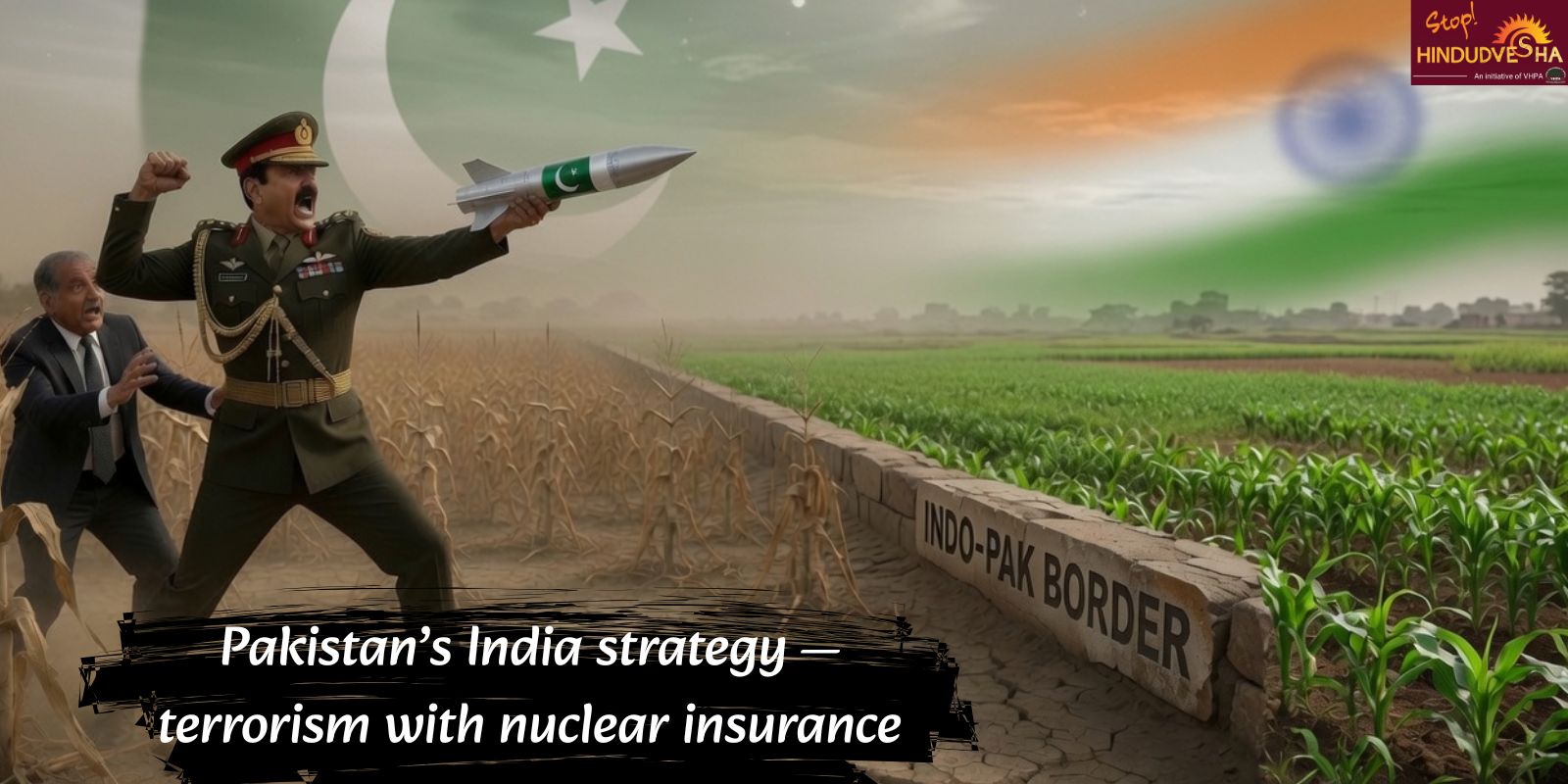
Summary
Pakistan’s repeated nuclear threats over the Indus Waters Treaty have become a familiar pattern of coercive diplomacy rather than a credible strategy for war. Since India suspended the treaty after the 2025 Pahalgam terrorist attack, Islamabad has warned that any disruption of water flows could trigger armed conflict. Yet each crisis has ended with Pakistan stepping back while India has steadily expanded its legal, diplomatic, and infrastructure options. Decades of Western alarmism and India’s own restraint helped sustain the perception that Pakistan’s nuclear threats were decisive. At the same time, using water as strategic leverage carries genuine legal, humanitarian, and geopolitical risks. The central question is whether Pakistan’s recurring nuclear rhetoric should continue to constrain India’s response to cross-border terrorism.
In August 2025, at a formal dinner for Pakistani expatriates in Tampa, Florida, Pakistan’s army chief, Asim Munir, told the room that his country was “a nuclear nation” and that “if we think we are going down, we’ll take half the world down with us.” It reinforced the adage that Pakistan is the only country that negotiates with a gun to its head. He went further, comparing India to “a shining Mercedes” and Pakistan to “a dump truck full of gravel” on a collision course [1]. Within a day, former foreign minister Bilawal Bhutto-Zardari was warning that continued suspension of the Indus Waters Treaty (IWT) would leave Pakistan “no choice but to consider war,” while Prime Minister Shehbaz Sharif vowed the “enemy” would not be allowed to take “even one drop” of Pakistani water. [2]
Most recently, on June 22, 2026, Pakistan’s defense minister said his country is willing to go to war with India if it feels its water security is threatened, as the fate of the IWT governing rivers between the two countries hangs in the balance. “The moment we feel that our national security, and water is part of our national security, is being threatened, we will go to war against India,” Asif Khwaja told a local news outlet. [3]
The statements followed a familiar pattern of nuclear signaling that Pakistan has repeatedly employed during periods of heightened tension. And it is worth asking, fourteen months after India placed the IWT in abeyance following the April 2025 Pahalgam massacre of 26 Hindu men in front of their families [4], why a country whose own civilian and military leadership cannot agree on basic facts keeps getting taken at its word when it reaches for the nuclear card over a river dispute.
Nehru’s Strategic Blunder on the Indus
The IWT, signed in Karachi in 1960 by Indian Prime Minister Jawaharlal Nehru and Pakistani dictator Ayub Khan under World Bank mediation, split the six rivers of the Indus system: India got the three eastern rivers (the Ravi, Beas, and Sutlej) while Pakistan got the three western rivers (the Indus, Jhelum, and Chenab). [5] Viewed purely in terms of water allocation, the treaty appears strikingly lopsided. Of the Indus basin’s approximately 200 million acre-feet of annual flow, 100 million Indians receive only 40 million acre-feet (20%). Pakistan’s 200 million basin residents, by contrast, receive 160 million acre-feet (80%). A country with only twice the basin population was allocated four times the water, making the treaty one of the most unequal international river-sharing arrangements from India’s perspective. [6]
That lopsided allocation has become a central argument in India’s reassessment of the treaty. Since suspending the IWT, New Delhi has maintained that it has no plans to restore the agreement, arguing that its provisions disproportionately favored Pakistan. [7] For decades, the argument goes, India honored a treaty that handed away the lion’s share of a river system flowing largely through its own territory, while Pakistan used the predictability that treaty provided to invest nothing in its own water storage and everything in cultivating cross-border militancy against the very neighbor it depended on for water security. Pakistan’s total reservoir capacity today holds barely four weeks’ worth of water against the 120 days recommended by international standards. [8] That is not India’s failure of planning. It is Pakistan’s.
The Ritual of Nuclear Signaling
What followed Pahalgam was not a new Pakistani strategy — it was the oldest one in the playbook, simply turned up louder. Every time India has signaled it might use water as leverage, Islamabad has reached for the bomb. After the 2016 Uri attack, Prime Minister Narendra Modi declared that “blood and water cannot flow together,” [9] and Pakistani commentators immediately framed any tinkering with the treaty as an existential threat. In 2025, after Pahalgam, the script repeated with more menace: Pakistan’s National Security Committee declared that “any diversion of Pakistan’s water is to be treated as an act of war,” [10] and within weeks the two nuclear-armed neighbors were exchanging missile and drone strikes in a four-day conflict before Pakistan used the military hotline to request an end to the fighting.[11] [12]
Critics point to a familiar pattern in Pakistan’s crisis behavior: escalating its rhetoric to the nuclear threshold, waiting for international concern and calls for restraint to build, and then, having extracted maximum diplomatic leverage from the resulting anxiety, quietly standing down. Kargil in 1999, the 2001-02 standoff after the Parliament attack, and the 2008 Mumbai attacks all followed much the same trajectory: increasingly aggressive nuclear signaling from Rawalpindi, heightened international alarm, and eventual de-escalation before Pakistan’s military leadership crossed a threshold it understood would be suicidal for the state itself.
Limits of Nuclear Blackmail
Pakistan’s nuclear doctrine is built around what strategists call “asymmetric escalation” [13] — the threat of early, tactical nuclear use to offset its conventional inferiority against India. It is meant to look like deterrence. In practice, India’s much larger landmass, its declared no-first-use posture, and its developing sea-based second-strike capability mean that any Pakistani nuclear first use would invite retaliation that Pakistan, as a far smaller and more geographically concentrated state, simply could not absorb. India’s greater geographic depth and dispersed population provide significantly greater resilience than Pakistan’s much smaller territorial and demographic footprint.
That asymmetry is precisely why, in crisis after crisis, Pakistan’s generals have talked apocalyptically in public while choosing de-escalation in private. Even during Operation Sindoor — by far the most serious shooting conflict between the two countries in over two decades — neither side crossed the nuclear threshold, and Pakistan’s defense minister, after warning that water “is part of our national security” and could trigger war, immediately qualified that “current developments do not warrant military action.” [14] That is the tell. The threats are calibrated for an audience — Western capitals nervous about a “nuclear flashpoint,” and Indian liberals eager to urge restraint on their own government — not for actual battlefield use.
Ever since Pakistan acquired the atom bomb in the late 1980s, it has been quite vocal about its low nuclear threshold. But according to Subhash Kapila, an international relations and strategic affairs analyst, Pakistan’s low nuclear threshold is a myth — perpetuated and planted by Western academia and think tanks. “Nuclear warfare is not a commando raid or commando operation with which Pakistan is more familiar,” says Kapila. “Crossing the nuclear threshold is so fateful a decision that even strong American Presidents in the past have balked at exercising it or the prospects of exercising it.” Pakistan cannot expect India to sit idly and suffer a Pakistani nuclear strike without a massive nuclear retaliation. [15]
For decades, India’s political leadership, media, and academia bought into this myth.
There is also a domestic logic to the bluster that has nothing to do with India at all. Nuclear signaling buys Pakistan’s military establishment legitimacy at home, reassurance for anxious allies, and continued relevance for an army that increasingly justifies its outsized claim on the national budget through the India threat. Repeating the nuclear card on the water issue lets Rawalpindi turn a self-inflicted economic and infrastructure failure — decades of underinvestment in storage and irrigation efficiency — into a story about Indian aggression instead.
How the West Amplifies Nuclear Blackmail
Much of the Western press has reflexively reached for the same framing for years: India and Pakistan as “nuclear-armed rivals” perpetually on the brink, with every treaty dispute treated as a potential trigger for Armageddon. Coverage of the 2025-26 IWT standoff followed the formula closely — pieces stressing that the basin is “a lifeline for more than 300 million people,” that water is “emerging as a geopolitical lever” between “two South Asian nuclear powers,” and that the suspension risks “exacerbating tensions” between them. [16]
All of this is true as far as it goes, but the framing tends to flatten an asymmetric dispute — one party using legitimate treaty leverage in response to terrorism, the other responding with war talk — into a symmetrical “both sides” nuclear flashpoint story that does most of its work for Islamabad.
Inside India, the same alarm gets a domestic echo. The liberal media and the Left have periodically urged New Delhi to keep the treaty intact regardless of provocation, framing any linkage between water and terrorism as a reckless escalation that risks “instrumentalizing” a humanitarian resource. [17] But those backing India’s harder line argue this instinct, however well-intentioned, has historically functioned as exactly the pressure valve Pakistan’s military establishment is counting on — a domestic constituency arguing Pakistan’s case for de-escalation so that Pakistan’s own government doesn’t have to.
How India Changed the Rules
The case for treating Pakistan’s threats as bluster rests on what India has actually done since April 2025, not just what it has said. New Delhi:
- Placed the treaty in abeyance within 24 hours of the Pahalgam attack and has steadfastly refused Pakistani and international calls for its restoration. [18]
- Rejected the jurisdiction of the Hague-based Court of Arbitration, including its May 2026 award on dam “pondage” limits, calling the tribunal “illegally constituted.” [19]
- Accelerated dam and hydropower construction on the western rivers, along with measures to increase usable storage, projects expected to raise Jammu & Kashmir’s installed hydropower capacity by 46% by the end of 2026. [20]
- Launched new diversion infrastructure, including tunnel and canal projects designed to redirect water from the western rivers for greater domestic use, with work expected to be completed within three years. [21]
- Stopped sharing flood and flow data with Pakistan, leaving Pakistani farmers reporting unpredictable swings in Chenab water levels during the critical winter wheat season, with Pakistan’s own farmer bodies describing it as “water aggression.” [22]
Yet none of this has produced the war Pakistan keeps threatening. Each escalatory step has been met with another round of statements from Rawalpindi and Islamabad — and no military response targeting Indian water infrastructure. Pakistan’s defense and foreign ministries continue to insist the treaty remains “fully operational and effective” from their side even as India treats it as suspended [23] — a legal fiction maintained because Pakistan has no actual lever to force India back to the table beyond rhetoric and arbitration rulings India has already said it will not honor.
Water as Strategic Lever
The strategic logic India’s government has articulated is straightforward: for decades, Pakistan’s military and intelligence establishment ran a policy of low-cost, high-yield militancy against India — Kashmir insurgency, the 2001 Parliament attack, the 2008 Mumbai attacks, Pathankot, Uri, Pulwama, Pahalgam — confident that the IWT, like most other channels of cooperation, would remain untouched regardless of provocation. Treating water as off-limits, no matter what Pakistan’s proxies did, effectively rewarded that strategy: Pakistan got the assured benefits of the treaty and the asymmetric benefits of terrorism, with no linkage between the two.
By tying the IWT’s restoration explicitly to Pakistan’s “irrevocably” ending cross-border terrorism, India has tried to close that gap. As one South Asia analyst told CNBC, Pakistan’s dependence on the Indus is profound. Nine out of ten Pakistanis live within the Indus basin. It irrigates more than 90% of the country’s crops, and all 21 of its hydroelectric plants are located there. The analyst described the basin as the “load-bearing pillars of a fragile economy already in IMF bailout territory.” [24] That dependence is precisely why India’s current approach is the most credible non-military pressure point New Delhi has ever held over Rawalpindi — and why it should have been used decades ago.
The Other Side of the Ledger
None of this is risk-free, and the case above is not the only one being made. Several aspects are worth weighing against it.
- The legal position is genuinely contested. The IWT has no exit clause; under Article XII, it can only be modified or terminated by mutual agreement, which Pakistan has refused to give. [25] The Court of Arbitration has already ruled, against India’s objections, that unilateral “abeyance” has no basis in the treaty text. Whether “abeyance” is a meaningful legal category or simply a unilateral suspension dressed in softer language is unresolved.
- The stakes are real, not rhetorical. The Indus basin sustains an estimated 270-320 million people, the large majority in Pakistan. Normalizing water as a tool of conflict sets a precedent that other upstream states, including in far less stable basins, might be tempted to follow.
- Confidence that Pakistan will always back down is not the same as certainty. Pakistan’s defense minister has explicitly said water is “part of our national security” and could become “a cause for war.” [26] Full-scale war, let alone nuclear war, is a remote outcome, given how much both militaries have to lose — but “remote” is not “zero,” and the four-day Operation Sindoor exchange in 2025 was itself a sharp reminder of how quickly rhetoric can translate into real strikes, even short of the nuclear threshold. [27]
Whether one reads the last fourteen months as India finally refusing to be intimidated, or as two nuclear-armed states normalizing ever-higher brinkmanship over a shared river, likely depends on which risk worries you more: another decade of subsidized terrorism, or the slow weaponization of water in one of the world’s most densely populated river basins. What is difficult to dispute, however, is that Pakistan’s recurring nuclear rhetoric has thus far produced no military response beyond conventional signaling, while generating disproportionate international alarm.
Citations
[1] Outlook India. “Pak PM Shehbaz Sharif Threatens India Over Indus Waters Treaty, Joins Asim Munir, Bilawal Bhutto.” https://www.outlookindia.com/international/pak-pm-shehbaz-sharif-threatens-india-over-indus-waters-treaty-joins-asim-munir-bilawal-bhutto
[2] NDTV. “After Pakistani Army Chief Asim Munir, Pakistani Politician Bilawal Bhutto’s War Threat to India: ‘Won’t Bow Down.’” https://www.ndtv.com/world-news/after-pakistani-army-chief-asim-munir-pakistani-politician-bilawal-bhuttos-war-threat-to-india-wont-bow-down-9067265
[3] The Independent. “India-Pakistan War: Indus Water Treaty.” https://www.independent.co.uk/asia/south-asia/india-pakistan-war-indus-water-treaty-b3000341.html
[4] YouTube. Video. https://www.youtube.com/watch?v=miD8brYSjqA
[5] Stop Hindudvesha. “Indus Waters Treaty: How Team Nehru Sold India Down the River.” https://stophindudvesha.org/indus-waters-treaty-how-team-nehru-sold-india-down-the-river/
[6] Institute of South Asian Studies (ISAS), National University of Singapore. “The Indus Waters Treaty: A Year After the Pahalgam Terror Attack.” https://www.isas.nus.edu.sg/papers/the-indus-waters-treaty-a-year-after-the-pahalgam-terror-attack/
[7] NPR. “Pakistan, India and the Indus Waters Treaty.” https://www.npr.org/2025/07/08/g-s1-73122/pakistan-india-indus-waters-treaty
[8] Al Jazeera. “Can India Stop Pakistan’s River Water, and Will It Spark a New Conflict?” https://www.aljazeera.com/features/2025/7/9/can-india-stop-pakistans-river-water-and-will-it-spark-a-new
[9] Swarajya. “PM Modi Calls Indus Water Treaty One-Sided, Says India Will No Longer Tolerate Depriving Farmers of Their Share.” https://swarajyamag.com/news-brief/pm-modi-calls-indus-water-treaty-one-sided-says-india-will-no-longer-tolerate-depriving-farmers-of-their-share
[10] Institute for Economics & Peace. Ecological Threat Report 2025. https://www.economicsandpeace.org/wp-content/uploads/2025/10/Ecological-Threat-Report-2025.pdf
[11] NDTV. “Asked India for Ceasefire When? Pakistan Deputy Prime Minister Ishaq Dar’s Viral Admission on Operation Sindoor.” https://www.ndtv.com/world-news/asked-india-for-ceasefire-when-pakistan-deputy-prime-minister-ishaq-dar-viral-admission-on-operation-sindoor-8713973
[12] CSDR Online. “The Hotline That Prevented War: India-Pakistan Crisis Management Through Military Diplomacy.” https://csdronline.com/blind-spot/the-hotline-that-prevented-war-india-pakistan-crisis-management-through-military-diplomacy/
[13] Observer Research Foundation. “Pakistan’s Sea-Based Nuclear Deterrent and Its Asymmetric Escalation Strategy.” https://www.orfonline.org/research/pakistan-s-sea-based-nuclear-deterrent-and-its-asymmetric-escalation-strategy
[14] CNBC. “India-Pakistan Indus Waters Treaty Water Dispute Raises War Risk.” https://www.cnbc.com/amp/2026/06/22/india-pakistan-indus-waters-treaty-water-dispute-war-risk.html
[15] Indian Defense News. “Why Imran Khan’s Nuclear Threat Is Significant.” https://www.indiandefensenews.in/2019/09/why-imran-khans-nuclear-threat-is-sign.html
[16] Chatham House. “India and Pakistan Still Cannot Agree to Restore the Indus Waters Treaty. Re-engagement Could Help.” https://www.chathamhouse.org/2026/04/india-and-pakistan-still-cannot-agree-restore-indus-waters-treaty-re-engagement-could-help
[17] OpIndia. “Newslaundry Wants Modi Govt to Woo Pakistan’s Imaginary Liberal Class: Why India Must Reject the New-Age Aman Ki Asha Delusion.” https://opindia.com/2025/07/newslaundry-wants-modi-govt-to-woo-pakistans-imaginary-liberal-class-why-india-must-reject-the-new-age-aman-ki-asha-delusion/
[18] NPR. “Pakistan, India and the Indus Waters Treaty.” https://www.npr.org/2025/07/08/g-s1-73122/pakistan-india-indus-waters-treaty
[19] The Crossbill. “India Rejects Hague Arbitration Award on Indus River Projects.” https://www.thecrossbill.in/politics/diplomacy/india-rejects-hague-arbitration-award-on-indus-river-projects-3571
[20] Institute of South Asian Studies (ISAS), National University of Singapore. “The Indus Waters Treaty: A Year After the Pahalgam Terror Attack.” https://www.isas.nus.edu.sg/papers/the-indus-waters-treaty-a-year-after-the-pahalgam-terror-attack/
[21] NDTV. “A 113-km-Long Canal Inside India’s Big Indus Waters Treaty Plan.” https://www.ndtv.com/india-news/a-113-km-long-canal-inside-indias-big-indus-waters-treaty-plan-8683486
[22] Daily Times. “Farmers Join Hands to Foil Indian Water Aggression.” https://dailytimes.com.pk/28583/farmers-join-hands-to-foil-indian-water-aggression/
[23] Institute of South Asian Studies (ISAS), National University of Singapore. “The Indus Waters Treaty: A Year After the Pahalgam Terror Attack.” https://www.isas.nus.edu.sg/papers/the-indus-waters-treaty-a-year-after-the-pahalgam-terror-attack/
[24] CNBC. “India-Pakistan Indus Waters Treaty Water Dispute Raises War Risk.” https://www.cnbc.com/amp/2026/06/22/india-pakistan-indus-waters-treaty-water-dispute-war-risk.html
[25] The Diplomat. “India’s Indus Waters Treaty Suspension: What Happens Next?” https://thediplomat.com/2025/05/indias-indus-waters-treaty-suspension-what-happens-next/
[26] CNBC. “India-Pakistan Indus Waters Treaty Water Dispute Raises War Risk.” https://www.cnbc.com/amp/2026/06/22/india-pakistan-indus-waters-treaty-water-dispute-war-risk.html
[27] Stop Hindudvesha. “From Sindh to Sindoor: The End of Hindu Restraint and the Rise of a New War Doctrine.” https://stophindudvesha.org/from-sindh-to-sindoor-the-end-of-hindu-restraint-and-the-rise-of-a-new-war-doctrine/

Donate to HINDUDVESHA
Our Mission is to explore and expose Hindudvesha through research analysis, education and response.
SUPPORT US