

From Sindh to Sindoor: The End of Hindu Restraint and the Rise of a New War Doctrine
 Rakesh Krishnan Simha · 06/10/2025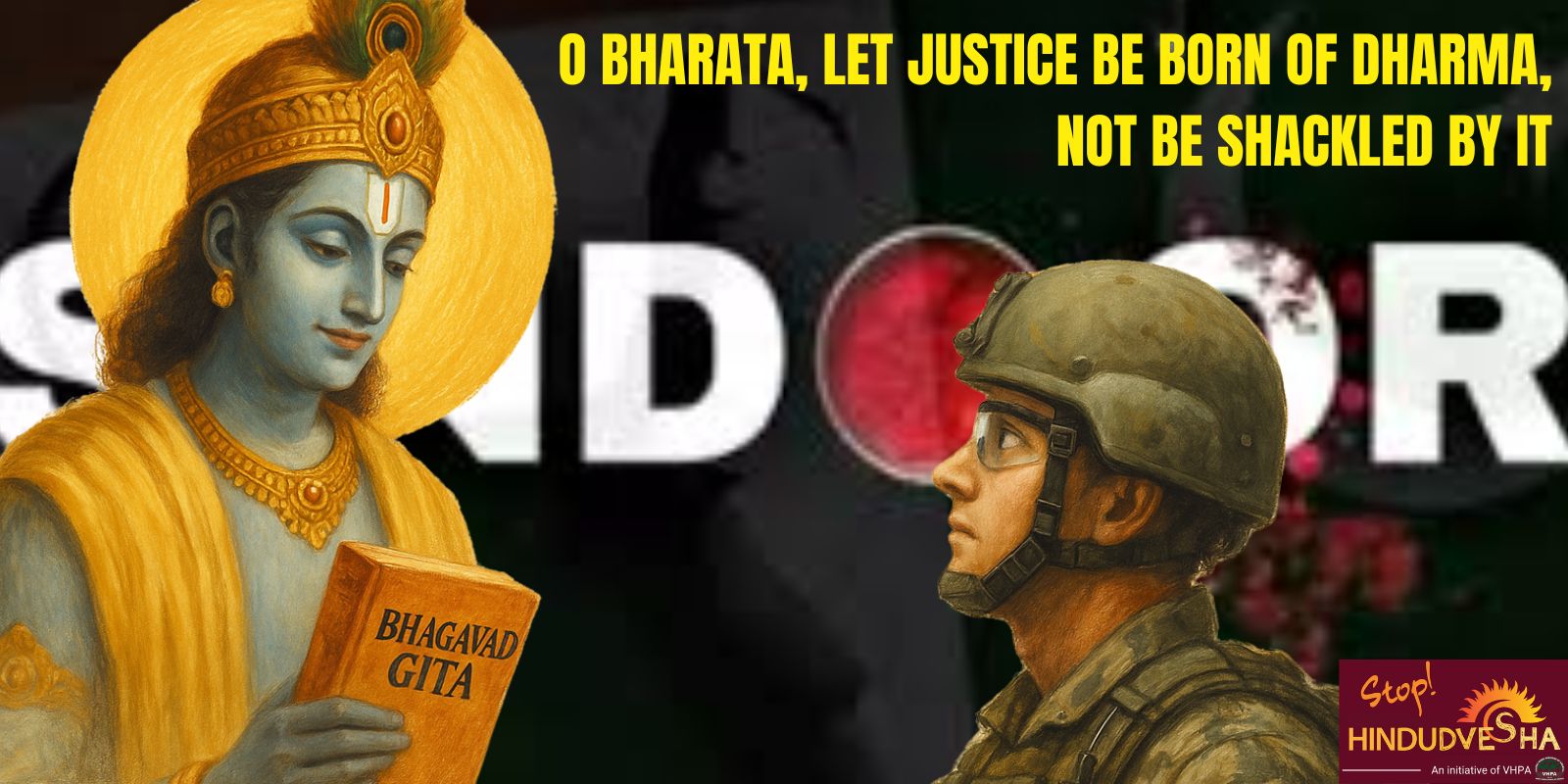
- Historic Restraint: India’s rich civilization repeatedly fell to invaders due to excessive mercy and adherence to righteous war ethics.
- Shift in War Philosophy: Ancient Hindu texts support moral and strategic warfare; modern India must adapt this blend.
- Failure of Pacifism: Colonial influence and Gandhian ideals institutionalized inaction, weakening India’s defense.
- Operation Sindoor: A decisive military shift showcasing preemptive strikes and strategic finality against threats.
- New War Doctrine: Advocates a modern Hindu war ethic — firm, preemptive, and narrative-driven, rooted in ancient principles.
For millennia, Indian civilization has been haunted by a paradox: it was rich, valorous, and spiritually profound — yet repeatedly defeated by smaller, more aggressive forces. From ancient Assyrian incursions to Islamic conquests and European colonization, the story has been one of lost opportunities and unfinished victories. With Operation Sindoor, that story has entered a new chapter — one in which restraint is no longer mistaken for virtue and mercy is no longer extended to enemies that have sworn to destroy India.[1]
Before we jump into the pacifism that has emasculated many Hindus and caused decision-making paralysis in the Hindu political and military leadership, let’s take a quick detour into what our ancestors said about self-defense and national security.
The ancient Hindu sages recommended and justified the cost of war for the preservation of good. The Rig Veda, the oldest text in the world, describes the fierce battles that the ancient kings of India fought against their enemies.[2]
In the third century CE, the Tamil sage Thiruvalluvar wrote in the Thirukural: “The army which is complete in its parts and conquers without fear of wounds is the chief wealth of the king.” And he added: “Both efforts and enemies, if left unfinished, can destroy like an unextinguished fire.”[3]
Kamandaka, the fourth-century strategist, wrote in the Nitisara: “Even the foes of a king, possessing an efficient army, are turned into friends; a king with a strong army rules the earth unhampered.”[4]
Indeed, there is nothing wrong with waging war to secure peace. Krishna declared in the Bhagavad Gita that if there is no alternative to war, it is an opportunity for the righteous to destroy their enemies: “Considering your duty as a warrior, you should not waver. Indeed, for a warrior, there is no better engagement than fighting for the upholding of righteousness.”[5]
Before Krishna, the sage Parashara wrote in the Parashara Smriti approximately 7,700 years ago: “The duty of a Kshatriya warrior is to protect the citizens of the country from all kinds of oppression. This requires the application of violence in appropriate cases to maintain law and order. He should thus defeat the soldiers of enemy kings and help rule the country according to the principles of righteousness.”[6]
Even Gautama Buddha, the most pacifist of Indians, did not shirk from warfighting. In the Pali Canon, he says army recruitment should be based on merit and fighting skill rather than birth. In the sixth century BCE, he advised King Prasenjit of the Kosala kingdom that untrained and inexperienced youth would be a liability in his army, and recommended that he recruit soldiers from all classes of society.[7] The Buddha knew what he was talking about – he was the son of a powerful Hindu king.
Hindu lawgivers have never dodged the question of defense. Comments author Pathmarajah Nagalinkam: “The consciousness exemplified in the Thirukkural on war and statecraft is strategic, tactical, realistic, and proactive or offensive. It is not a surprise that the most popular God among the Tamils is Lord Skanda Muruga, the God of war.”[8]
Roots of Restraint
So, what happened in the modern era? How did India become synonymous with peace and colonization? How did decision-making paralysis and civilizational restraint afflict the Indian leadership? Why did they not throw out foreign invaders who committed genocide against Indians?
India’s long history of military restraint, despite repeated foreign invasions, is exemplified by three key events: the Arab invasions of Sindh between 638 and 711 CE;[9] the First Battle of Tarain in 1191 CE;[10] and the total rout of the Pakistan Army and the capture of 93,000 enemy troops in the 1971 War.[11]
In each case, India won major victories but failed to destroy the enemy completely. The Indian tendency to show mercy, heed omens, and avoid offensive war became a fatal flaw. Despite Sindh’s deep cultural and political ties to India, its loss was never avenged. Later, Prithviraj Chauhan’s fatal error in sparing Muhammad Ghori and not mobilizing fully led to India’s subjugation.
Time and again, India fought heroically and defeated powerful invaders, yet failed to finish its wars. Again and again, its kings won initial battles only to cede the advantage, often shackled by a sacred war code known as Dharma Yuddha — the righteous war.[12]
India’s chronic military restraint was not just philosophical. It was institutionalized. Muslim invaders systematically disarmed the population. Only Rajputs could bear arms, and even they were regulated. When the British arrived, they embedded this disarmament into law through the Indian Penal Code. Owning a weapon became a crime.
Then came a deeper psychological colonization. British Orientalists repackaged India as the land of ahimsa and peace. They elevated Emperor Ashoka, who embraced pacifism, as the ideal Indian ruler. The martial heritage of the Mauryas, Guptas, and Marathas was whitewashed in favor of nonviolence.
The final nail was Gandhism — or what critics call Gandhigiri. Its fetish for peace led to tragic strategic failures: not dismembering Pakistan in 1948 or 1965, not pressing advantage after the 1971 war, and refusing to reform the military before the 1962 China debacle.
This idealism left India vulnerable — its enemies emboldened by its restraint.
Dharma Yuddha: Noble but Naïve?
Many Indians feel a sense of pride when they talk about Dharma Yuddha—the Hindu Code of War, which lays out strict rules for fighting for both sides. Unlike the Christian concept of crusade and its counterpart, jihad in Islam, Hinduism does not justify war against foreigners or people of other faiths.
Surya P. Subedi, a British-Nepali jurist and professor of international law, writes in The Concept in Hinduism of Just War, “The concept of Dharma in its original sense means the maintenance of peace and security through law and order within the larger cosmic order. Thus, the concept of just war in Hinduism is against the evil characters of the day, whether national or alien.”[13]
The Hindu code of war is thus based on right and wrong and on justice and injustice in the everyday lives of all mortals, whether Hindus or non-Hindus.
Also, when it came to fighting a war, certain laws had to be observed. “A ruler or a king who did not observe the laws of war had no place in the galaxy of virtuous and victorious kings. As are the laws of war in modern international law, the laws of war in Hinduism were designed to make the conduct of war as humane as possible. The Hindu laws of war included rules to ensure that warfare was conducted in a fair manner and by open means.”[14]
However, no law, however beautiful, can be for all times. The laws of Sat Yuga (Age of Righteousness) cannot be expected to work in Kali Yuga (Age of Quarrel and Strife). Our kings failed to accept the fact that Dharma Yuddha was unsuitable for fighting barbaric Islamic and Christian hordes that did not follow the same rules. These two faiths had to be fought on their terms.
Kamandaka wrote that in the real world, both Dharma Yuddha and Kuta Yuddha (crafty warfare) are desirable types of war.[15] As the cliche goes, all is fair in love and war. The Nitisara is supported by Bana’s Harshacharita, which developed a theory where, depending on the situation, it could be judged necessary even for a righteous ruler to wage some form of Kuta Yuddha. How much tragedy and territorial loss could India have avoided had we internalized this truth?
The failure to pursue, punish, and permanently neutralize invading forces meant that despite its wealth, size, and martial prowess, India became a land of broken dynasties and shattered temples.
Had the Hindu rulers chased the Islamic hordes back to Baghdad, Syria, Persia, Turkey, and Samarkand, there would have been no way India would have been conquered. Those places did not have the wealth or the population to mount frequent attacks on India. In the seventh century CE, Caliph Usman was so upset by the Arab defeats in Sindh that he forbade any more attempts on the Indian kingdom.[16]
Caliph Walid-I wrote: “The people (of India) are cunning, and the country itself is very distant. It will cost us huge sums of money to provide a sufficient number of men, arms, and instruments of war. This affair will be a source of great anxiety, and so we must put it off, for every time the army goes (on such an expedition to India), vast numbers of Muslims are killed. So think no more of such a design.”
It was the plunder of India that helped the Islamic world stage invasion after invasion. Again, the wealth looted from Bengal after the Battle of Plassey in 1757 allowed the British the bandwidth to conquer such a large country as India. Therefore, by allowing the foreigners to raid India repeatedly, Indian rulers facilitated their own demise.
While noble, the philosophy of Dharma Yuddha was tragically unsuited for the clash of civilizations India faced against the Muslims and Christians. In Kali Yuga, Dharma Yuddha became a liability.
Operation Sindoor: A Strategic Shift
Operation Sindoor is not just a military campaign. It is a tectonic shift in India’s approach to war. For the first time in its history, India has demonstrated a willingness not just to repel aggression but to pursue, punish, and permanently dismantle threats at their source.
Though officially classified, Operation Sindoor is widely understood to have involved deep strikes into hostile territory, targeting terror launchpads, logistics bases, and enemy command centers. Unlike the 2016 surgical strikes or the 2019 Balakot air raid, this was not a hit-and-run operation. It was strategic finality in action.
Civilian-military dual-use facilities were destroyed, high-value targets were eliminated, and no scope was left for regrouping or retaliation. The operation didn’t aim to send a message; it aimed to end a cycle.
According to John Spencer, executive director of the Urban Warfare Institute, the nine precision strikes on major terror training camps, particularly Pakistan’s Bahawalpur and Muridke, on May 7; the damage done to the 11 Pakistani military airbases and the nuclear weapons storage depot in the Kirana Hills; and the “temporary halt” in firing weren’t just a tactical success but were a “doctrinal execution” under live fire. These actions redefined India’s stance against terrorism by drawing and enforcing a new red line: terror attacks from Pakistani soil will now be met with military force. Additionally, combined with a display of overwhelming military superiority, it has restored deterrence and asserted India’s strategic independence.[17]
The very name — Sindoor, referring to the sacred vermilion mark worn by Hindu married women — is symbolically rich. It represents commitment, continuity, and cultural pride. In this context, it is the mark of a civilization no longer ashamed of its power, no longer bound by the outdated ethics of restraint.
Operation Sindoor thus marks a clean break from over a millennium of cultural diffidence.
Towards a New Hindu War Doctrine
Operation Sindoor’s results are the seeds of a new Indian war doctrine—one that blends the ethical depth of Hindu civilization with the ruthless logic of modern statecraft. This doctrine doesn’t discard Dharma; it reinterprets it.
- No Retreat After Victory: Victory must be decisive, not diplomatic. Like the Romans razed Carthage, India must ensure its enemies cannot rise again from the ruins of their defeat.
- Hot Pursuit Is Justified: Those preparing to destroy you are already your enemies, so you must destroy them preemptively. The notion that India must fight only within its borders is an illusion that benefits only its adversaries.
- Preemption Is Not Aggression: Anticipatory defense — striking before the enemy strikes — is necessary, not a crime. National security cannot be reactive; it must be predictive.
- End the Myth of the Virtuous Enemy: Not all enemies are worthy of mercy. If the opponent’s ideology is genocidal or supremacist, sparing them is not compassion — it’s national suicide.
- Narrative Supremacy: No military campaign is complete without dominating the narrative. India must control the story of its conflicts, not let the media or academics do it for it.
Reintroducing the Martial Spirit
In ancient India, military service was embedded into daily life. There was an ecosystem that nurtured and groomed future military leaders and thinkers for the entire country. Referring to the 4th century BCE, just before the formation of the Mauryan Empire, Kaushik Roy writes in Warfare in Pre-British India: “In Taxila, there was a military academy where boys entered at the age of eight and graduated at the age of 16. More than 500 students (including about 100 royal princes) were inducted annually into the academy. When a student graduated from the academy, he received a sword, bow, arrow, a coat of mail, and a diamond.”[18]
This spirit must return. India must introduce compulsory military training and restore military culture as a respected pillar of the nation. The army should not be an external tool of the state but a key decision-maker.
Under the current administration, a welcome shift has already occurred. Military decisions like the airstrikes on Pakistan and the standoff with China in Ladakh were handled directly by commanders on the ground, not micromanaged by politicians from Delhi. The return of military autonomy is crucial for tactical success.
Conclusion: Civilizational Full Circle
The name Operation Sindoor carries more profound symbolism than military rhetoric. Sindh — modern-day Pakistan — was the site of India’s first major civilizational defeat when, 1,314 years ago, the Arab invaders breached its western gates. Today, by reaching deep into enemy territory and turning sanctuaries and military bases into ruins, India symbolically reclaims its right to defend not just land but memory.
India must never abandon its spiritual heritage. But it must remember that Dharma without Danda (the rod of justice) is impotence. Operation Sindoor is the first true manifestation of that wisdom in the modern era. It signals that India is ready to finish what it starts. It redefines Indian war ethics not as submission to fate but as karmic finality — the idea that evil will be ended, not tolerated. To quote Thiruvalluvar, “Both efforts and enemies, if left unfinished, can destroy like an unextinguished fire.”
This is not a reckless or aggressive India. This is an India that acts from clarity, not confusion — one that understands deterrence must be credible to be effective. As India emerges as a global leader, it does so not by abandoning its values but by evolving them for a complex, volatile world. If Hindu civilization is to survive and thrive in the 21st century, restraint must be reserved for the innocent, never for the enemy.
Citations
[1] A vow to avenge 1971 (Frontline, 2003); (https://frontline.thehindu.com/the-nation/article30216857.ece
[2] Weapons and War in Vedas (Wisdom Library, 2016); https://www.wisdomlib.org/hinduism/essay/nitiprakasika-critical-analysis/d/doc1147768.html
[3] Verse 761, Tirukular, 3rd century CE, https://tamilnation.org/literature/kural/nagalinkam.pdf
[4] The Art of War in Ancient India, (Rare Book Society – Archives, 1941); https://rarebooksocietyofindia.org/book_archive/6141.pdf
[5] Bhagavad Gita Weekly – Chapter 2 – Sankhya Yoga – A Warrior Must Fight – Verses 31 to 38, Part 12; https://trueindology.com/bhagavad-gita-weekly-chapter-2-sankhya-yoga-a-warrior-must-fight-verses-31-to-38-part-12/#google_vignette
[6] ibid
[7] The Paradox of the Buddhist Soldier (Taylor & Francis Online, 2021); https://www.tandfonline.com/doi/pdf/10.1080/14639947.2021.2145683
[8] Tirukural on War, Defense and Foreign Affairs (Tamilnation, 2008); https://tamilnation.org/literature/kural/nagalinkam.pdf
[9] The Sindh Story – A Great Account of Sindh (Online archive, 1984); https://sanipanhwar.com/uploads/books/2024-08-29_13-05-56_9415e8449215959d01f22c94a43e6758.pdf
[10] Battle of Tarain: When Ghori fled and Prithviraj Chauhan gave the chase (The Times of India, 2021); https://timesofindia.indiatimes.com/blogs/voices/battle-of-tarain-when-ghori-fled-and-prithviraj-chauhan-gave-the-chase/
[11] The Unfinished Business of the 1971 War and Its Impact on Bangladesh Hindus (Stop Hindudvesha, 2025); https://stophindudvesha.org/the-unfinished-business-of-the-1971-war-and-its-impact-on-bangladesh-hindus/
[12] The difference between Dharma Yuddha and Jihad (India Facts, 2013); https://www.indiafacts.org.in/the-difference-between-dharma-yuddha-and-jihad/
[13] The Concept in Hinduism of ‘Just War’ (Research Gate, 2003); https://www.researchgate.net/publication/31478127_The_Concept_in_Hinduism_of_’Just_War‘
[14] ibid
[15] Hinduism and the Ethics of Warfare in South Asia: From Antiquity to the Present (Journal of Defence Studies, Vol. 7, No. 4, 2013); https://idsa.in/system/files/jds_7_4_JeanLanglois.pdf
[16] The Sindh Story – A Great Account of Sindh (Online archive, 1984); https://sanipanhwar.com/uploads/books/2024-08-29_13-05-56_9415e8449215959d01f22c94a43e6758.pdf
[17] Operation Sindoor: A Decisive Victory in Modern Warfare (John Spencer on X, 2025); https://x.com/SpencerGuard/article/1922492011526996012
[18] Warfare in Pre-British India 1500 BCE to 17 40 CE (Taylor and Francis Group – Online Archives, 2015); https://apnaorg.com/books/english/warfare-in-pre-british-india/warfare-in-pre-british-india.pdf

Donate to HINDUDVESHA
Our Mission is to explore and expose Hindudvesha through research analysis, education and response.
SUPPORT US