

Indus Waters Treaty: How Team Nehru Sold India Down the River
 Rakesh Krishnan Simha · 05/07/2025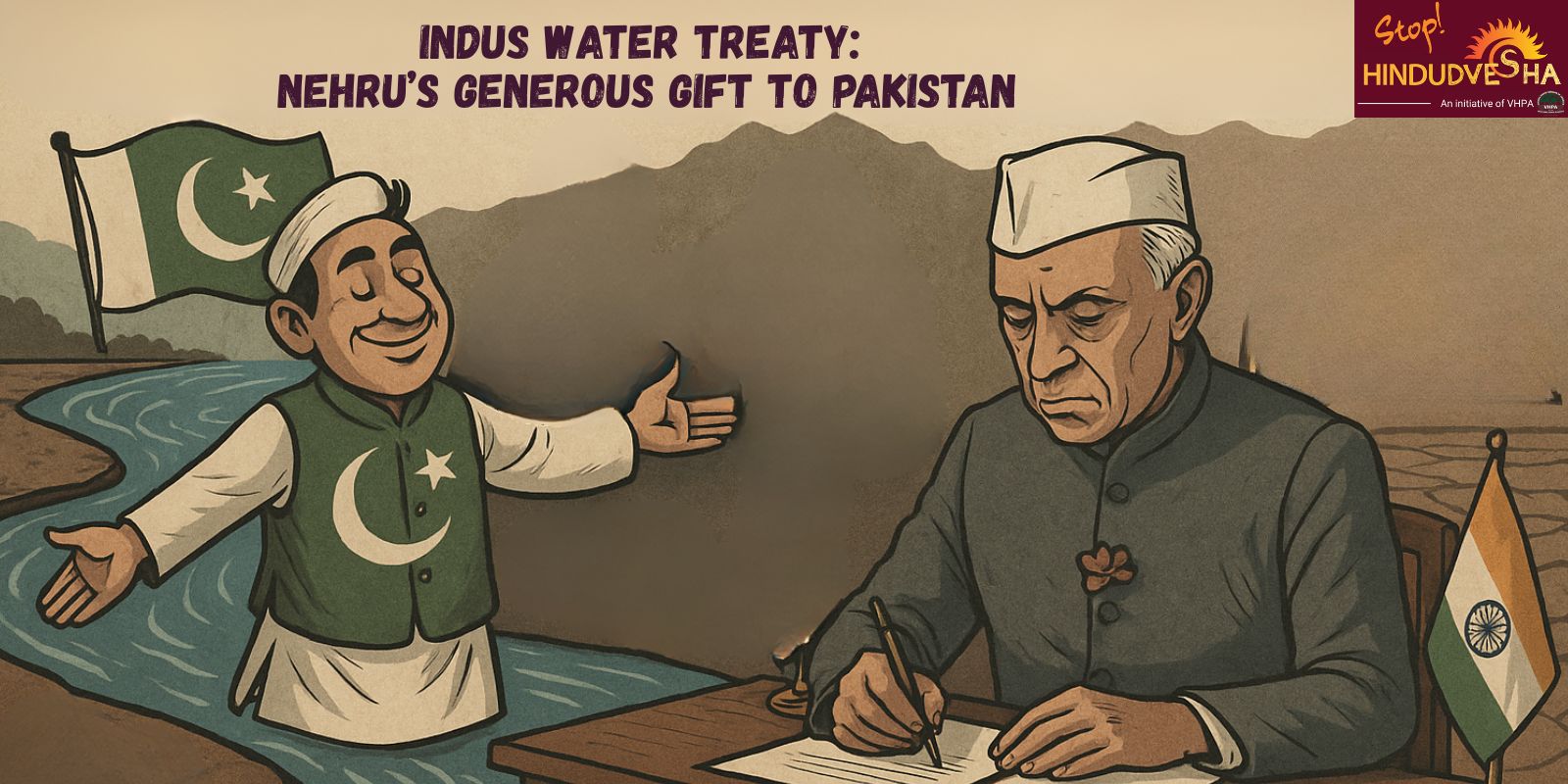
- Brokered by the World Bank in 1960, Nehru signed away control of 82% of the Indus basin waters to Pakistan, despite India being the upper riparian state with a larger population and greater irrigation needs.
- Nehru released water to Pakistan even during the 1947–48 Kashmir war, missing a crucial opportunity to pressure Pakistan into retreat and tying water-sharing to goodwill rather than strategic interest.
- Nehru foolishly de-linked the treaty from the Kashmir issue and welcomed third-party intervention, allowing Pakistan to exploit the situation diplomatically and legally.
- Northern Indian states like Punjab, Haryana, Rajasthan, and especially Jammu & Kashmir suffer water scarcity due to the treaty, while millions of acre-feet of water flow unused into Pakistan.
- With rising terror attacks and continued Pakistani hostility, India now has legal and geopolitical grounds to reconsider or exit the treaty under international law and reclaim its fair share of water resources.
“I would rather have a Pakistan full of desert rather than with fertile fields watered by the courtesy of the Hindus of India.” – Muhammad Ali Jinnah, founder of Pakistan[1]
India has about 16 percent of the global population but only 4 percent of total water resources, resulting in many parts of India facing water scarcity.[2] Population growth, rising incomes, rapid urbanization, and changing lifestyles are pushing up water consumption and demand. The freshwater crisis is emerging as a flashpoint in the politics and conflicts of the Indian subcontinent. Against this backdrop, the focus is on the Indus Waters Treaty. On April 23, 2025, India took an unprecedented step, announcing that the treaty was now in abeyance.[3] The move came just days after the terror attack in Pahalgam that left 26 civilians dead.[4]
Signed by Indian Prime Minister Jawaharlal Nehru and Pakistani dictator Ayub Khan in 1960 and brokered by the World Bank, the Indus Waters Treaty is arguably the most lopsided bilateral agreement in history. It divided the Indus river system between India and Pakistan, granting Pakistan control over the western rivers (Indus, Chenab, and Jhelum) and India the eastern ones (Satluj, Beas, and Ravi).
Despite having a population 10 times larger and a vastly greater area to irrigate, India conceded over 80 percent of the basin’s waters to Pakistan.[5] In addition, India footed the bill for diverting the waters so that the Pakistani canals and irrigation works could be fed from the three western rivers and left independent of India’s three eastern ones.[6] The IWT is the only pact in the world that compels the upper riparian state to defer to the interests of the downstream state.[7]
Misplaced Magnanimity
Pakistan’s sense of entitlement stands in stark contrast with India’s misplaced generosity.
The treaty was an extraordinarily generous gesture towards a country that had launched the 1948 War and grabbed two-thirds of the Indian state of Kashmir. And yet, as the bigoted Jinnah’s churlish words indicate, Pakistan wasn’t happy – it wanted more – or 90 percent of the waters of the Indus River basin. Pakistan’s sense of entitlement stands in stark contrast with India’s misplaced generosity. Had the waters of the Indus River basin been allocated based on population, drainage area, and state of cultivated lands, India would have qualified for a share of at least 42.8 percent.[8]
Ironically, the World Bank-appointed intermediary acknowledged India’s superior position that Nehru could not fathom.
India’s decision to accept less than 20 percent of the waters was an ill-judged move, considering the annual water flow of the western rivers is significantly higher than that of the eastern rivers. This is largely because the western rivers, especially the Indus and Jhelum, originate in regions with extensive glacial cover, ensuring a more consistent, year-round flow[9]. In contrast, the eastern rivers have limited glacial contribution and rely heavily on monsoonal rainfall, resulting in greater seasonal fluctuations. Among the eastern rivers, the Beas is relatively small and functions more as a tributary to the Satluj, while the Ravi has a limited flow within Indian territory.
The imbalance has long sparked debate over the treaty’s fairness, particularly given its economic and strategic impact on India’s northern states. Not only does Pakistan get a much larger share, even though its actual requirement is much less, it is egregious that about 40 million acre-feet of water flow into the Arabian Sea annually, absolutely unutilized.[10] If India were allowed to utilize some of these waters, the water crunch in the states of Haryana, Punjab, and Rajasthan could be partly alleviated. Further, the state most affected by the treaty is Jammu & Kashmir.
Ironically, the World Bank-appointed intermediary acknowledged India’s superior position that Nehru could not fathom. “No armies with bombs and shellfire could devastate a land so thoroughly as Pakistan could be devastated by the simple expedient of India’s permanently shutting off the source of waters that keep the fields and people of Pakistan alive,” said David Lilienthal, former chief of the Tennessee Valley Authority, US.[11]
Nehru’s Original Himalayan Blunder
However, Nehru did not leverage this advantage and let Pakistan get away with a large bite of Kashmir territory.
The ‘Aqua Bomb’ is India’s most potent weapon against Pakistan. As the upper riparian state, India can control the flow of the seven rivers that flow into the Indus River basin. However, Nehru did not leverage this advantage and let Pakistan get away with a large bite of Kashmir territory.
Nehru committed so many blunders in his lifetime that it would take a whole encyclopedia to list them.[12] Worse, these blunders continue to bite Hindus and India more than six decades after his death. The Indus Waters Treaty was his original Himalayan blunder.
On April 1, 1948, with India and Pakistan in the midst of a war for control of Jammu & Kashmir, engineers in Indian Punjab shut off water supplies from the Ferozepur headworks to the Depalpur Canal and Lahore. Around 8 percent of the cultivable command area in Pakistan was impacted during the critical kharif sowing season. The city of Lahore was deprived of the primary sources of municipal water, and the supply of electricity from the Mandi hydroelectric scheme was also cut off. Water rationing was introduced in Pakistan’s second-largest city.[13]
Pakistan was exceptionally vulnerable to India’s ability to punitively cut off or hold water supplies until the 1960s, given that Partition left the headworks of the main irrigation canals in India. India had the upper hand and could have turned off the taps anytime, especially when Pakistan launched the 1947-48 War and grabbed a third of Jammu & Kashmir—a piece it still holds.
But India didn’t pull that trigger. When India had its foot on Pakistan’s parched throat, when Indian soldiers were fighting on the battlefield to liberate Indian territory, and when a little more pressure would have forced Islamabad to retreat from Kashmir, Nehru decided to relax India’s chokehold on Pakistan. The water was released, and Pakistan was able to survive without having to vacate an inch of Indian territory. Call it cultural reticence or a political blind spot, but this disconnect between our security apparatus and national strategy has resulted in repeated catastrophes for the nation.
Under Nehru’s leadership, India inked the Indus Waters Treaty, giving away 82 percent of the total water to Pakistan. Niranjan D. Gulhati, India’s chief negotiator, exemplified India’s muddled thinking: “We had to keep in view the interests of the other side: they must live; we must live. They must have water; we must have water.”[14]
Nehru echoed those words. “The canal waters dispute has nothing to do with the Kashmir issue. We can’t stop Kashmir waters running into Pakistan; it’s an engineering matter and should be dealt (with) as such.”[15]
Nehru Acted Like Pakistan’s Prime Minister
In his book Indus Waters Treaty: An Exercise in International Media, Gulhati narrates Nehru’s reaction to the stoppage of the waters: “Officially, the provincial government had acted without the federal government’s prior approval, and were to elicit little sympathy from some sections of the Indian central government. Nehru is thought to have castigated the East Punjab government and their engineers in September 1949 for taking matters into their own hands.”[16]
However, the engineers in Indian Punjab had a valid reason for stopping the water from reaching Pakistani Punjab. While the borders of India and Pakistan were demarcated haphazardly by the British, hastily leaving India in the backdrop of the Indian Naval Mutiny, the distribution of water resources was not discussed at all. Therefore, as a stopgap measure, India and Pakistan signed the Standstill Agreement on December 20, 1947, which maintained the status quo till March 31, 1948.
According to the engineers, in the absence of any formal agreement, if East Punjab had not closed the water temporarily, it might have led to West Punjab acquiring legal rights to the canal waters in that area. In effect, East Punjab was concerned about allowing a precedent to arise that would prove detrimental to it at a later stage.
Delhi Agreement: Pakistan Wriggles Out
With Lahore screaming for water, Pakistan signed the May 1948 Delhi Agreement, which restored the water supply – but at a cost. Firstly, Pakistan was to pay for the transport of water through India. Secondly, India was to be allowed gradually to diminish this supply to Pakistan. India contended that colonial rulers had built the irrigation system in West Punjab but had neglected East Punjab completely. Such a state of neglect could not continue after independence, and therefore, it would need to draw some water that flowed into West Punjab.
The ink had barely dried on the Delhi Agreement when Pakistan started to dig a channel from the River Sutlej to circumvent the Ferozepur headworks.
The ink had barely dried on the Delhi Agreement when Pakistan started to dig a channel from the River Sutlej to circumvent the Ferozepur headworks. It justified its decision to dig as a precaution against India closing down the water supply in the future. India warned that it would take retaliatory action and dig a channel further upstream of Pakistan’s channel.[17]
Pakistan said the Delhi Agreement had been signed under duress, and gave notice of its expiry, in a note to the Indian government on August 23, 1950. With both countries embarking upon competing and conflicting river diversion projects, Nehru wrote to Liaquat Ali Khan, proposing a joint declaration that their countries would not go to war over any dispute.
Typical of how Nehru had always acted—and would do so over and over again to the detriment of India’s interests—he proposed that both countries seek peaceful means to resolve their differences, including third-party intervention in the form of mediation, agencies especially set up to resolve the matter, or an international body recognized by both countries. This was like free manna from heaven for the Pakistanis, who gleefully agreed.
Enter the World Bank
The World Bank—in reality, an American bank—waded into the dispute. While Pakistan was happy with the outcome, many in India doubted the Bank’s intentions, especially since the US and Pakistan had inked several defense pacts in the 1950s. They were right.
The World Bank hinted that funding for the Bhakra-Nangal project, which was to usher in India’s Green Revolution, depended on successfully settling river disputes. The Bank’s representative pointed out that the World Bank’s bond investors would hardly regard a country on the brink of war as a good investment opportunity.
The pressure worked. India agreed to World Bank mediation, surrendering all its advantages as the upper riparian state. Incredibly, Nehru refused to link the Indus River dispute to the settlement of the Kashmir issue. In a letter to the World Bank, the Prime Minister made it clear: “The canal waters dispute between India and Pakistan has nothing to do with the Kashmir issue; it started with and has been confined to the irrigation systems of East and West Punjab.”[18]
The Pakistanis couldn’t believe their luck. Liaquat Ali Khan concurred, stating that both countries should “refrain from using the negotiations in one dispute to delay progress in solving any other.”[19] How convenient!
Generous to a Fault
Knowing Nehru’s soft side, the World Bank Plan allocated 82 percent of the waters to Pakistan and a mere 18 percent to India. Nehru gave the thumbs up to the plan.
Nehru’s handpicked negotiators believed there was enough water within the entire Indus Basin to meet India’s requirements. Nehru, of course, agreed: “We are convinced that there is more than enough water in the Indus Basin to satisfy the needs of both India and Pakistan, provided it is properly exploited.”[20]
China on His Mind
There was another critical factor that contributed to the undue haste with which Nehru gifted the Indus River basin to Pakistan. In the early 1950s, China had begun its incursions, first into Tibet and then into the Indian border regions. For nearly two decades, Nehru had dismissed the Chinese threat and the warnings of Sardar Patel, sidelining and even rebuking loyal army officers who pointed out the fallacy of his pro-China policy. He even declined a permanent seat in the UN Security Council, saying it belonged to Beijing. With Chinese troops making provocative incursions across the Himalayan border, Nehru realized he now had more than the Pakistani boundary to defend. He believed he could buy peace with water.
Pakistan’s Mindset
For Pakistan, anything that involves India is the unfinished business of Partition, which is essentially the fundamentalist Indian Muslim’s dream to launch jihad or “holy war” on India and eliminate or convert the Hindus.
The treaty provides a peek into the Pakistani way of thinking. For Pakistan, anything that involves India is the unfinished business of Partition, which is essentially the fundamentalist Indian Muslim’s dream to launch jihad or “holy war” on India and eliminate or convert the Hindus. This is part of the subcontinental Muslims’ dream to re-establish ‘Mughal India.’
Islamabad’s constant cribbing is in keeping with that mindset. From Pakistan’s perspective, allocation of “only” 82 percent of water against 90 percent of irrigated land violated the principle of “appreciable harm,” says ex-Pakistan Navy officer Moin Ansari in the book ‘India’s Aqua Bomb.’[21]
Time for India to Reclaim Control
For decades, India has upheld the Indus Waters Treaty (IWT) in both letter and spirit, even as Pakistan repeatedly used it as a tool of obstruction. From blocking key infrastructure projects to dragging India into costly and time-consuming international arbitration, the Islamic nation has consistently weaponized the treaty to stall India’s development agenda.
Several projects — run-of-river hydel initiatives well within India’s rights — have suffered significant delays due to Pakistan’s objections. Meanwhile, an estimated 2 to 3 million acre-feet of water continues to flow into Pakistan unchecked simply because India is not allowed to build the infrastructure to utilize its share fully.
According to Punjab-based bureaucrat Rahul Bhandari, India has grounds to revisit or even withdraw from the treaty. Under Article 62 of the Vienna Convention on the Law of Treaties, a “fundamental change of circumstances” can justify terminating an international agreement. In the face of continued cross-border terrorism and hostile diplomacy, India can make a strong case that the original premise of peaceful cooperation has long been violated.[22]
Also, despite all his best efforts to help Pakistan and win a pat on the back from his white masters, Nehru “took a broad approach asking neither India nor Pakistan to give up any rights, deferring that decision to the future.”[23]
It’s time India reasserted its rights — not by turning off the taps, but by fully harnessing its entitled share.
It’s time India reasserted its rights — not by turning off the taps, but by fully harnessing its entitled share. A restructured or reimagined water-sharing framework, aligned with current geopolitical realities, could better serve India’s interests and regional stability.
To be sure, the Western media and academia – and their brown sepoys in India – will continue to stand by the “treaty that has survived four wars.” They will warn that Pakistan is the sixth most populous country, with nuclear weapons and one of the largest standing armies in the world, and therefore, tearing apart such a country could have dangerous ramifications. As Anatol Lieven warns in his book Pakistan – A Hard Country, “Those Indians who would be tempted to rejoice in Pakistan’s fall should therefore consider that it would almost certainly drag India down with it.”[24]
However, these words ring hollow now that Pakistan has become the Ivy League of terror.
Endgame
If India walks out of the treaty, Pakistan is in big trouble. Even with the plentiful waters of the Indus River basin, it remains a semi-arid country where drought has parched many parts. Its water table is falling rapidly. Pakistani Punjab, which has the largest canal density in the world, is getting waterlogged. Its vast reservoirs, which were built to offset the loss of the three eastern rivers to India, are silting up. India, which never quite stopped building dams and hydropower projects in Kashmir in keeping with the spirit and letter of the IWT, is ideally placed to divert water to its own parched cities.
The impact of the Aqua Bomb will indeed be greater than the impact of multiple nuclear explosions. India should use this leverage wisely to make Pakistan wind up its terror industry. If not, all bets are off.
Citations
[1] India’s Approach To Indus Water Treaty: National Security Perspective (Centre for Joint Warfare Studies, 2024); https://cenjows.in/indias-approach-to-indus-water-treaty-national-security-perspective/
[2] India has 16% of the Global Population but Only 4% of Total Water Resources, Resulting in Water Scarcity in Many Regions (Climate Scorecard, 2023); https://www.climatescorecard.org/2023/09/india-has-16-of-the-global-population-but-only-4-of-total-water-resources-resulting-in-water-scarcity-in-many-regions/
[3] India has 16% of the Global Population but Only 4% of Total Water Resources, Resulting in Water Scarcity in Many Regions (Hindustan Times, 2025); https://www.hindustantimes.com/cities/bengaluru-news/bengaluru-bjp-mp-claims-indus-water-treaty-halt-is-drying-up-pakistans-chenab-river-shares-images-101746004586066.html
[4] From Paris to Pahalgam: Why the World Must Unite to Defeat Radical Islam (StopHinduDvesha, 2025); https://stophindudvesha.org/from-paris-to-pahalgam-why-the-world-must-unite-to-defeat-radical-islam/
[5] Indus Water Treaty: An Appraisal (Vivekananda International Foundation, 2018); https://www.vifindia.org/sites/default/files/indus-water-treaty-an-appraisal.pdf
[6] Indus Waters Treaty 1960: Present Status of Development in India (Ministry of Water Resources, River Development and Ganga Rejuvenation, 2019); https://pib.gov.in/PressReleasePage.aspx?PRID=1565906
[7] India and Pakistan (The Atlantic, 1960); https://www.theatlantic.com/magazine/archive/1960/11/india-and-pakistan/306376/
[8] Indus Waters Treaty is unfair on India, scrapping it can’t be ruled out (Rishihood University, 2024); https://rishihood.edu.in/indus-waters-treaty-is-unfair-on-india-scrapping-it-cant-be-ruled-out/
[9] Guest column | Indus water treaty inherently unfair on India (Hindustan Times, 2025); https://www.hindustantimes.com/cities/chandigarh-news/guest-column-indus-water-treaty-inherently-unfair-on-india-101745522097587.html
[10] Glacial melt in Indus raises water concerns (Hindustan Times, 2023); https://www.hindustantimes.com/india-news/glacial-melt-in-indus-raises-water-concerns-101678094974028.html
[11] Indus Waters Treaty is unfair on India, scrapping it can’t be ruled out (Rishihood University, 2024); https://rishihood.edu.in/indus-waters-treaty-is-unfair-on-india-scrapping-it-cant-be-ruled-out/
[12] Puranik, Rajnikant ; Nehru’s 97 Major Blunders, First Kindle Digital Edition: July, 2016; https://nestambuy.com/wp-content/uploads/2020/06/BOOKs-nehrus-major-97-blunders.pdf
[13] India’s Approach To Indus Water Treaty: National Security Perspective (Centre for Joint Warfare Studies, 2024); https://cenjows.in/indias-approach-to-indus-water-treaty-national-security-perspective/
[14] Azhar Ahmad, Indus Waters Treaty A Dispassionate Analysis (JSTOR, 2011); https://www.jstor.org/stable/42909289?seq=3
[15] India and Pakistan (The Atlantic, 1960); https://www.theatlantic.com/magazine/archive/1960/11/india-and-pakistan/306376/
[16] Undala Z. Alain, WATER RATIONALITY: Mediating the Indus Waters Treat, University of Durham Doctoral thesis, 1998; http://etheses.dur.ac.uk/1053/1/1053.pdf
[17] India’s Approach To Indus Water Treaty: National Security Perspective (Centre for Joint Warfare Studies, 2024); https://cenjows.in/indias-approach-to-indus-water-treaty-national-security-perspective/
[18] ibid
[19] Muhammad Imran Mehsud, Retrospecting the Indus Mediation through Waltz’s levels of analysis, Official Journal of World Water Council, V 24, 2022; https://iwaponline.com/wp/article/24/9/1450/90165/Retrospecting-the-Indus-Mediation-through-Waltz-s
[20] Undala Z. Alain, WATER RATIONALITY: Mediating the Indus Waters Treat, University of Durham Doctoral thesis, 1998; http://etheses.dur.ac.uk/1053/1/1053.pdf
[21] Azhar Ahmad, Indus Waters Treaty A Dispassionate Analysis (JSTOR, 2011); https://www.jstor.org/stable/42909289?seq=3
[22] Guest column | Indus water treaty inherently unfair on India (Hindustan Times, 2025); https://www.hindustantimes.com/cities/chandigarh-news/guest-column-indus-water-treaty-inherently-unfair-on-india-101745522097587.html
[23] Undala Z. Alain, WATER RATIONALITY: Mediating the Indus Waters Treat, University of Durham Doctoral thesis, 1998; http://etheses.dur.ac.uk/1053/1/1053.pdf
[24] Kashmir: A Water War in the Making? (The Diplomat, 2016); https://thediplomat.com/2016/06/kashmir-a-water-war-in-the-making/

Donate to HINDUDVESHA
Our Mission is to explore and expose Hindudvesha through research analysis, education and response.
SUPPORT US