

India That Is Bharat: Reclaiming the Soul of a Nation from the Ruins of Coloniality
 Rati Agnihotri · 04/23/2025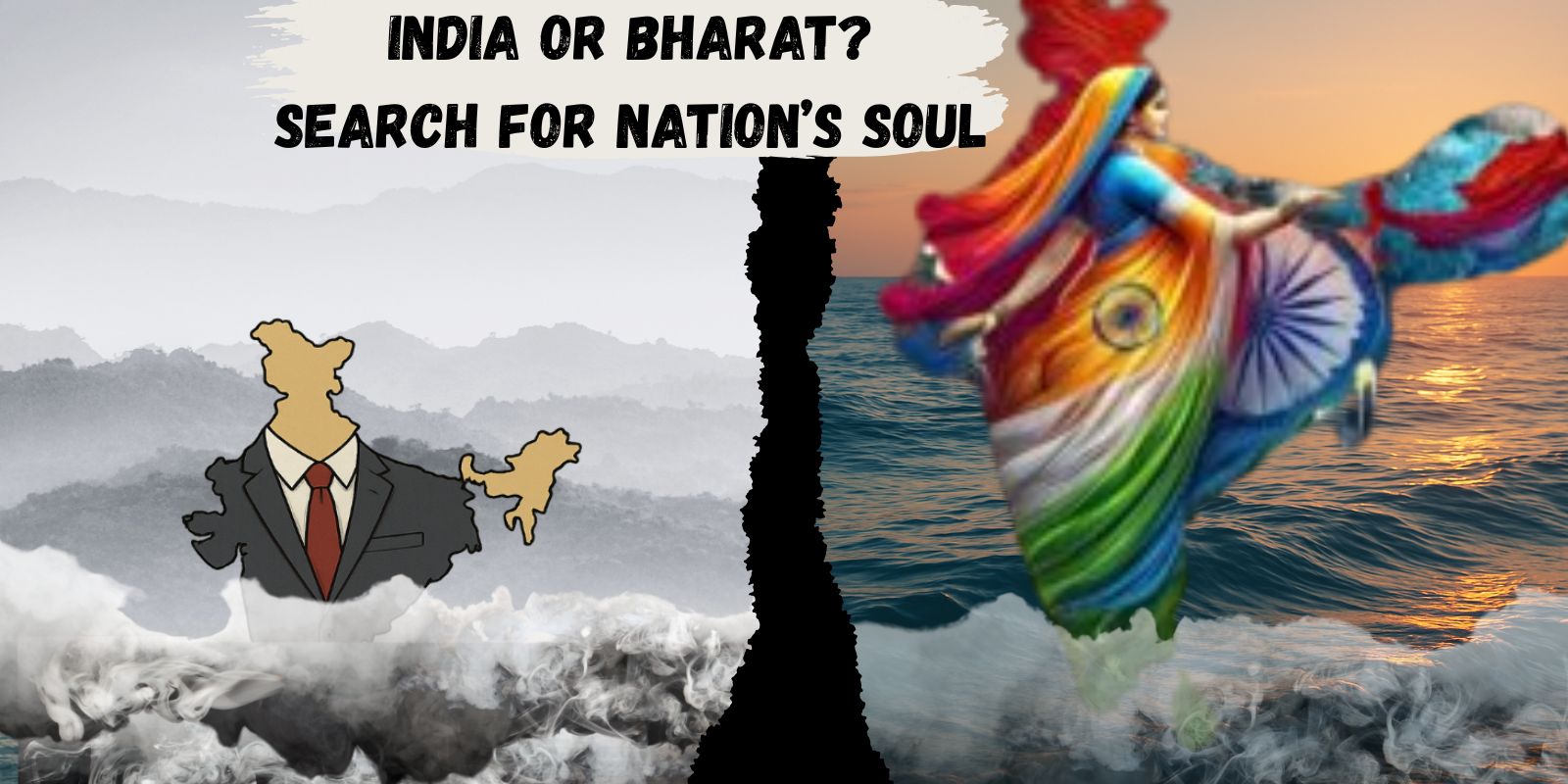
- While “India” has officially represented the country since independence in 1947, “Bharat” embodies its cultural and civilizational soul.
- Conceptually, “India” evokes a nation trapped in a timeless stupor, defined by its exoticization and appropriation by the West.
- The country has long been vulnerable to colonial narratives pushed by the left-liberal ecosystem, largely because it lacked a strong Bharatiya counter-narrative.
- As the nation undertakes cultural rejuvenation and reclaims its sacred heritage, it’s becoming clear that it can rise globally only by fully embracing Bharat.
- The “India” vs. “Bharat” debate matters because the left-liberal ecosystem is deeply unsettled by the idea of India embracing its Bharatiya identity.
A nation’s identity is much more than just a matter of names. Structural linguistics suggests that language reveals deeper layers—social, psychological, and cultural—that shape how we think and behave. In this light, a country’s name becomes a powerful symbol, shaping how it is seen globally and reflecting what aspects of its identity are celebrated or marginalized.
For nations that have endured colonization, this symbolism becomes even more vital. Reclaiming native names is part of a broader civilizational revival—a conscious effort to reconnect with pre-colonial roots. While history cannot be undone, redefining the present through Indigenous values is a powerful act of cultural assertion.
Constitutionally, “India, that is Bharat,” recognizes both names, yet they carry profoundly different connotations. “India” is an identity imposed by external forces, reflecting the post-independence political framework and modernity shaped through a borrowed outsider’s lens. In contrast, “Bharat” is an Indigenous identity rooted in the land’s ancient civilizational memory and spiritual heritage. For countless citizens, Bharat is far more than a name—it is the soul, the Atma, of the nation.
This resonance is subtly echoed in External Affairs Minister S. Jaishankar’s book, Why Bharat Matters. While the book explores foreign policy, its title signals a paradigm shift. Each chapter ends with a poetic flourish invoking “Bharat,” reinforcing the idea that India’s global rise is grounded in its civilizational essence—its identity as Bharat.
In the following sections, we will explore various dimensions of the Bharat-India dichotomy and discuss how the rise of “Bharat” contributes to India’s ascent on the global stage.
Decolonizing the Mind: The Return of Bharat
Bharat is synonymous with the nation’s ancient civilizational and cultural ethos, befitting its stature as a rising power, forging its own grand narrative. And moving ahead on the path of decolonization. Over the past decade, there has been a paradigm shift in India’s internal perception of itself and its projection on the world stage. Various developments, including the revival and reclamation of India’s Dharmic heritage,[1] the critical interrogation of the so-called legacy of colonizers and invaders, the restructuring of India’s education system in the light of its Indigenous knowledge systems,[2] etc., are signs of a rising Bharat. [3]
“India,” on the other hand, at a conceptual level, evokes images of a country stuck in a timeless stupor, forever defined and labeled by its exotic fetishization and appropriation by the West. If one were to look at the conception of “India” as a mythical entity, it carries immense baggage right from the period of colonial era narratives and atrocity literature propagated by European Indologists[4] to the present times characterized by the incessant demonization and distortion of Hindu culture and traditions, rejection of India’s Vedic past, the casting of India’s developmental paradigm from the yardstick of Western parameters, etc.
An insightful article published in Manushi[5] elucidates that India’s troubles began when it isolated itself from Bharat. The writer says that post-independent India “recorded a distorted history in a misguided attempt to maintain societal harmony.” Thus, by denying the excesses of colonization and invasion, India shrugged off the essence of Bharat and chose to define itself in the light of Secularism, a Western import. One gradually witnessed the painful phenomenon of “India turning against Bharat”:
“And now, we have no one to blame except ourselves. Furthermore, ongoing destructive chaos only fulfills the colonizer’s fantasy – that India would splinter due to its own folly. Therefore, it is incumbent on every citizen and well-wisher of India to be vigilant to this danger and take necessary corrective steps. Fortunately, India need not look for corrective measures elsewhere, just turn towards Bharat.” [6]
Rajiv Malhotra and Aravindan Neelakandan’s ‘Breaking India: Western Interventions in Dravidian and Dalit Faultlines’ provides a powerful peep into reasons India has been a consistent victim of Western colonial propaganda since it gained independence. The authors elucidate how India has become a frontier for Western intervention through the vast network of institutions that infiltrate the country and build a constant stream of atrocity literature targeting India. The book further argues that “scholars in various South Asian studies departments and liberal think tanks see India through a secular lens based on Western ideas of human rights.”[7]
One could argue that these liberal think tanks and academic institutions can successfully project such powerful, one-sided narratives on the global stage because they face no substantial counter-narrative. The alternative narrative here would be Bharat’s narrative, which studies India in the light of its ancient civilizational and cultural ethos, rooting the studies in its indigenous knowledge systems. However, for a long time, the nation did not assert its indigenous civilizational narrative to challenge the appropriation of its culture, society, and politics by Western frameworks. As a result, the narrative crafted by the West, in collaboration with the Nehruvian elite, became the default representation of the nation—both within and beyond its borders.
In his book, India That is Bharat,[8] J Sai Deepak delves deep into the modus operandi of the colonial discourse that shaped India’s identity, self-image, and global perception post-independence. He argues that the Indigenous resistance against the colonial onslaught in Bharat, a phenomenon that led the colonizer to fail in his mission to “significantly convert the Indigenous population to his faith,” unlike other Indigenous societies, whose pre-colonial identities have been either altogether annihilated or considerably marginalized, has hardly received the kind of scrutiny it should, barring the work of a few scholars:
“Unfortunately, barring the work of a handful of scholars, this aspect has not received the kind of rigorous and serious scrutiny in Bharat that it should have. The result is that the deep and innate strength of Bharat’s consciousness – which has resisted the tsunami of coloniality with a greater degree of success than most other indigenous societies, whose cultures, civilizations, and consciousness were nearly wiped out – is never recognized and acknowledged. This is not to deny that European coloniality did indeed make deep inroads even in Bharat, which is evident from the latter’s present tendency to secularise facts. This tendency has put to sleep a society that is in dire need of awareness of its own strength and consciousness to deal with the continued presence of coloniality of more than one kind.”
Sai Deepak’s analysis underscores Bharat’s conceptual and existential importance for India’s survival. India’s post-independence trajectory—framed within Western paradigms and shaped by secular ideals—has inflicted significant damage on the Atma of Bharat. This Atma includes its ancient philosophy, spiritual worldview, indigenous knowledge systems, Sanatani traditions, Vedic values, and cultural ethos. These elements are not only the foundation of Bharat’s resilience but also hold the potential to develop original frameworks—alternatives to Western models—that are organically rooted in the Indian context.
However, the past decade has brought about a notable shift that is reflected across a range of policy decisions, educational reforms, cultural initiatives, and diplomatic expressions. The use of “Bharat” in official contexts, the revival of Sanskrit and classical languages, the promotion of Bharatiya thought systems, and the rediscovery of India’s civilizational narratives all point toward a larger transformation.
Civilizational Struggle for the Nation’s Soul
Conceptually, India and Bharat seem to straddle two parallel worlds, perfectly echoing the adage “Never the twain shall meet.”
“India” is synonymous with the English-educated Lutyens’ elite, the Brown sahibs, as it were, in awe of everything English and Western, and wrinkling their noses at anything indigenous and Bharatiya. The world of “India” represents a nation perennially stuck in its desire to catch up with the West, eager to show off its acute internalization of Western culture and mannerisms and holding Western culture as the gold standard for sophistication while mocking and deriding its own culture, traditions, and customs.
“India” then symbolically represents the high-profile, Westernized, and fashionable world of the English-educated elite who quote Western philosophers, intellectuals, literary stalwarts, etc., at the drop of a hat and look surprised if asked a question about India’s contribution to the world’s cultural and intellectual history. “India” is also synonymous with the brown sepoys who weaponize English education and intellect to discredit the nation on the global stage and malign its cultural and civilizational values.[9] The left-liberal ecosystem of India, the Nehruvian legacy, as it were, also symbolizes “India” discursively, viciously attacking any attempt to revive the ancient and civilizational values of the land and decolonize its structures. In essence, this ecosystem and the cultural elite that sustain it aggressively oppose the resurgence of “Bharat.”
In stark contrast stands the worldview of Bharat—a worldview that may or may not be articulated in English but is deeply rooted in pride in its own heritage. Those who align with the Bharatiya perspective uphold the nation’s ancient civilizational values and timeless cultural wisdom, regardless of their religious affiliations or levels of formal education.
The Bharatiya worldview manifests in those who choose to anchor their identity in their indigenous traditions, not through the prism of Western validation. They represent a growing intellectual and cultural movement that seeks to reconstruct national narratives using frameworks grounded in indigenous thought. This rise of Bharat is now challenging the narratives long dominated by the Lutyens’ elite. The rise of nationalist media in India is one such example.[10] Other developments include attempts to revive Indian knowledge systems, restructuring of the Indian education system from an Indic perspective, restructuring of India’s global narrative from a non-Western perspective, inclusion of civilizational and cultural values in policy frameworks, and a focus on acknowledging the organic connection with the diaspora based on common cultural and civilizational ground.
As India embarks on the ambitious project of cultural rejuvenation, reclaiming its sacred spaces and heritage, the world is increasingly witnessing a country refashioning its identity while embracing the rich repository of its past values. It is thus getting increasingly clear that India can become a global power in the true sense only when it embraces “Bharat”:
Life is rarely a black-and-white choice, and appreciating the complexities of decision-making is essential to grasping international relations. A major rising power, however, needs more than just an accurate landscape analysis and the ability to act on it. First, it must be confident of its own values and beliefs and base its policies on those convictions. These will draw from the totality of its culture, heritage, and traditions. That is why India can only rise when it is truly Bharat. [11]
Crafting Bharat’s Grand Narrative
Perhaps the most significant point of divergence between the conceptual idea of “India” and “Bharat” lies in how each relates to narratives. Whereas “India” evokes images shaped by long-standing Western frameworks, “Bharat” steps away from that mold to craft original Bharatiya narratives.
In today’s world, perception management is fundamentally about narrative control. Narratives are the most powerful instrument of hegemony for civilizations. Thus, wars today are fought on ideological battlefields, and the tussle for domination unfolds in the world of narratives.
All major civilizations, including that of China, Europe, and the West, have their respective grand narratives defining their worldview and influencing the lens through which the world perceives them. However, as noted author Rajiv Malhotra argues that, in Inda’s case, there are multiple contenders for a grand narrative jostling for attention. One of the contenders is Bharat, which reflects an ancient country based on Vedic values and modern “India based on the open architecture of Hindu Dharma.” Another conflicting narrative is that of a secular nation based on modern Western ideals.[12]
The narrative of “India” furiously holds on to the remnants of colonialism and eulogizes its archaic and redundant signifiers. It is a narrative that simply copies and pastes the Western worldview in the Indian context. Rooted in a colonial mindset, it clings to a hyper-Western worldview of modernity, insisting that India can develop only if it ticks all the right boxes in the Western parameters’ checklist.
The grand narrative of “Bharat,” on the other hand, is more nuanced and imaginative. It doesn’t harp on the bucolic world of a pre-colonial Bharat, seeking instead to refashion a modern nation based on ancient civilizational and cultural values. Thus, Bharat’s modernity is not antithetical to its traditional value system and Indigenous knowledge traditions but rather complementary.
It would be perhaps apt to mention Indian Prime Minister Modi’s recent podcast with the American computer scientist and podcaster Lex Fridman. The conversation spanned many themes, but what stood out was the dexterous weaving of the Indian PM’s personal and public experiences with Bharat’s civilizational and cultural narrative. All the responses given by Modi originated from within a non-Western framework. He spoke in detail of his idea of India, redefined the India-China dynamic from the point of view of their ancient civilizational and cultural legacy, spoke of the significance of the RSS in nation-building, highlighted the elements of India’s civilizational narrative in its foreign policy, etc.[13]
Thus, the podcast was noteworthy precisely because the Indian Prime Minister completely bypassed Western frameworks in his conception of India and its terms of engagement with the world. That is, he spoke of “Bharat,” not the “anglicized India” of Western imagination. This signals a paradigm shift, as the global elite has long been defined through a Western lens—characterized by meticulous training in Western education systems and the ability to quote extensively from Western authors, philosophers, economists, and political scientists. Modi’s articulation challenges those assumptions and puts them under scrutiny.
Lex Fridman also recites Gayatri Mantra towards the end of the podcast. This moment felt symbolic—a subtle but powerful indication of the Bharatiya narrative entering global consciousness.
India vs. Bharat Political Debate
The India vs. Bharat political controversy first erupted in 2023 when the term “Bharat” was included in India’s official G20 invite. Opposition parties created a furor over the gesture, projecting it as a conspiracy to officially change the country’s name to Bharat. The whole episode also triggered a widespread debate on national identity and India’s historical nomenclature. [14]
The G20 invite—where the Indian President was designated as the President of Bharat—even triggered a slew of speculative reports in the Western media about the alleged possibility of the Indian government mulling an official name change.[15] The official use of the word Bharat in the invite gave rise to judgmental pieces insinuating that “Modi’s name change could be anti-Muslim prejudice in disguise.”[16]
Although it doesn’t seem likely the Modi government has any plans to officially change the country’s name in the near future, a conscious effort seems to be underway to popularize the use of Bharat in official contexts. In June 2024, the National Council of Educational Research and Training (NCERT) Director reportedly clarified that both “India” and “Bharat” will be used interchangeably in NCERT textbooks.[17] In a unique decision, Indore’s Devi Ahilya Vishwavidyalaya ( DAVV) passed a resolution in January 2025 stating that it will use only “Bharat” in all its official documents, mark sheets, and degrees instead of “India. “The name India was given to the country by the British at their convenience. We should use the original name of our country, Bharat, everywhere,” the University Vice-Chancellor reportedly said.[18]
The government’s approach in this regard seems rather subtle and understated. It emphasizes the constitutional position of “India that is Bharat” and thus implies that using Bharat instead of India at official forums doesn’t amount to a constitutional violation.
Nationalist organizations like the RSS, on the other hand, appear more direct in their categorical rejection of the name “India,” which they view as a vestige of colonial mentality, favoring Bharat—a name rooted in the nation’s Vedic heritage. In February 2025, Shiksha Sanskriti Utthan Nyas, an RSS-affiliated outfit, began a month-long campaign advocating for this change. A nationwide signature drive has reportedly been launched as a part of the campaign to rename the country as “Bharat.” [19] RSS General Secretary Dattatreya Hosabale also recently stated that if the country’s name is Bharat, it should be referred to as such and nothing else.[20]
However, whether or not the country is officially renamed Bharat is not a significant issue. What really matters is that India is finally initiating a difficult dialogue on the foundational elements of its national identity and, in the process, embarking on a long-overdue decolonization project.
Wrapping Up
Constitutionally speaking, the use of “Bharat” instead of “India” is not a significant legal issue. However, the optics of nomenclature do matter. The mere mention of “Bharat” rattles the left-liberal ecosystem. The government’s decision to add “Bharat” to official G20 invites sent the whole left-liberal media ecosystem into an overdrive mode, insinuating that the exercise was a “nationalist” conspiracy to derail the secular fabric of India.
That’s precisely why Bharat matters. Its deep symbolism, hiding within its layers of the cultural and civilizational soul of a nation ravaged by colonial depredation, is an eyesore for the modern-day colonization apologist.
“Bharat” holds the key to the direction in which India should be headed in the future, in a way that “India” never could.
Citations
[1] “Reclaiming India’s Heritage: Sambhal’s Key Discoveries”; https://stophindudvesha.org/reclaiming-indias-hindu-heritage-sambhal-discoveries-leading-the-way/
[2] JNU to establish centers for Hindu, Jain, and Buddhist studies under New Education Policy promoting Indian Knowledge System; https://organiser.org/2024/07/13/247139/bharat/jnu-to-establish-centers-for-hindu-jain-buddhist-studies-under-new-education-policy-promoting-indian-knowledge-system/
[3] “Temples spark India’s cultural reset”; https://stophindudvesha.org/beyond-mausoleums-temples-tourism-drives-indias-cultural-reset/
[4] Decolonising Bharatiya intelligentsia; https://organiser.org/2022/06/09/84834/opinion/decolonising-bharatiya-intelligentsia/
[5] Bharat – India: Continuity or Two Worlds? – Manushi; https://www.manushi.in/bharat-india-continuity-or-two-worlds/
[6] Ibid.
[7] Breaking India: Western Interventions in Dravidian and Dalit Faultlines, pp. 211-212.
[8] India, that is Bharat: Coloniality, Civilisation, Constitution by J Sai Deepak, Section II Civilization, Chapter 6 – Bharat, Coloniality and Colonial Consciousness
[9] Indian-Origin Journalists’ Role in Fueling Anti-India Bias; https://stophindudvesha.org/role-of-indian-origin-journalists-in-spreading-biased-narratives-against-india/
[10]“ Woke Agenda Targets Indian Nationalist Media”; https://stophindudvesha.org/label-demonize-erase-the-woke-ecosystems-coordinated-assault-on-indian-nationalistic-media/
[11] Why Bharat Matters by S. Jaishankar, p. 9
[12] Weaving India’s MAHAKATHA ( Grand Narrative ) for the 21st Century by Rajiv Malhotra; https://infinityfoundation.com/wp-content/uploads/2018/04/Weaving-Indias-MAHAKATHA-Grand-Narrative-for-the-21st-Century_RML-20Mar2018.docx.pdf
[13] (118) PM Modi’s podcast with @lex Fridman | #PMModiPodcast | YouTube; https://www.youtube.com/watch?v=RDUjTleS3Hk&t=3628s
[14] India vs Bharat: India vs Bharat: A look at 2023’s political controversy that stirred the dynamics of a nation’s name – The Economic Times; https://economictimes.indiatimes.com/news/politics-and-nation/india-vs-bharat-a-look-at-2023s-political-controversy-that-stirred-the-dynamics-of-nations-name/articleshow/106419467.cms?from=mdr
[15] Is India changing its name to Bharat? G20 invite controversy explained | Reuters; https://www.reuters.com/world/india/is-india-changing-its-name-bharat-g20-invite-controversy-explained-2023-09-06/
[16] Why does Modi want to change India’s name to ‘Bharat?’ | Fortune Asia; https://fortune.com/asia/2023/09/27/why-india-name-change-bharat-modi-muslim-hindus/
[17] NCERT to use ‘Bharat’ and ‘India’ interchangeably in its textbooks: Director Dinesh Saklani – NCERT to use ‘Bharat’ and ‘India’ interchangeably in its textbooks: Director Dinesh Saklani; https://www.businesstoday.in/education/story/ncert-to-use-bharat-and-india-interchangeably-in-its-textbooks-director-dinesh-saklani-433570-2024-06-17
[18] Indore’s Devi Ahilya Vishwavidyalaya to use ‘Bharat’ in place of ‘India’ | India News – Business Standard; https://www.business-standard.com/india-news/indore-s-devi-ahilya-vishwavidyalaya-to-use-bharat-in-place-of-india-125011100014_1.html
[19] RSS-led campaign wants India renamed as Bharat; https://sundayguardianlive.com/news/rss-led-campaign-wants-india-renamed-as-bharat
[20] ‘If country’s name is Bharat, it should only be called that way’: RSS leader | India News – The Times of India; https://timesofindia.indiatimes.com/india/should-be-rectified-rss-leader-revives-india-vs-bharat-row/articleshow/118868802.cms

Donate to HINDUDVESHA
Our Mission is to explore and expose Hindudvesha through research analysis, education and response.
SUPPORT US