

Demystifying Hinduism at Rutgers: Pushing Back Against Academic Hinduphobia
 Rati Agnihotri · 06/13/2026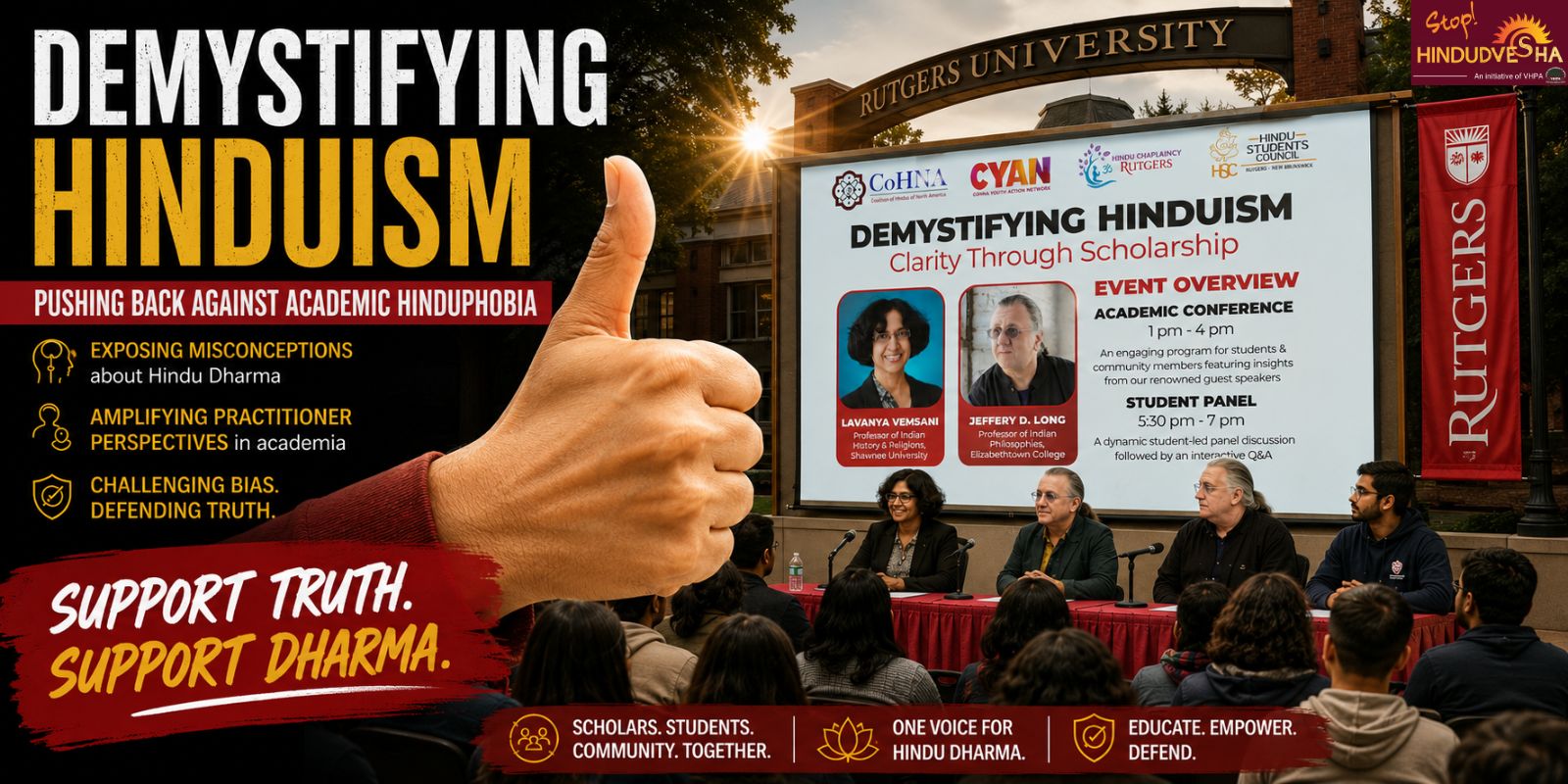
Summary
Despite Rutgers University’s reputation as a hub of academic Hinduphobia — highlighted by its hosting of the 2025 “Hindutva in America” panel and endorsement of the 2021 Dismantling Global Hindutva Conference — CoHNA and CYAN successfully organized the “Demystifying Hinduism” seminar on campus. The event brought together over 75 scholars, students, and community members to challenge widespread stereotypes, assert practitioner perspectives, and counter distorted portrayals of Hindu Dharma, women in Dharmic texts, and Hinduism’s positive influence on American society. Speakers like Dr. Lavanya Vemsani and Dr. Jeffrey D. Long exposed the dominance of non-practitioner narratives and institutional double standards.
The seminar marks a significant pushback and underscores the urgent need for greater Hindu-led scholarship and independent institutions.
The institutionalization of Hinduphobia in Western academia has become so normalized that anti-Hindu prejudice now often serves as the default lens for portraying Hindu Dharma, culture, and society. The demonization of Hinduism and its practitioners is frequently recognized yet rarely challenged, for fear of falling afoul of woke orthodoxy. Few institutions exemplify this trend more than Rutgers University, which critics view as ground zero for the academic mainstreaming of anti-Hindu narratives.
Against this backdrop, organizing a seminar that openly challenges academic Hinduphobia at its perceived epicenter is no small feat. Yet that is precisely what the Coalition of Hindus of North America (CoHNA), along with the Rutgers chapter of its youth wing CYAN (CoHNA Youth Action Network), recently accomplished at Rutgers. Organized in partnership with the Rutgers Hindu Students Council and the university’s Hindu chaplaincy, the Demystifying Hinduism seminar sought to challenge persistent misconceptions and foster a more balanced understanding of Hinduism.
The irony is hard to miss. This is the same Rutgers University that hosted a Hinduphobic panel in October 2025 centered on the report “Hindutva in America: An Ethnonationalist Threat to Equality and Religious Pluralism,” authored by faculty member Audrey Truschke, and which had previously endorsed the notorious 2021 Dismantling Global Hindutva Conference.
That such a pushback seminar could take place at this very institution is significant in itself.
Demystifying Hinduism – Hindu Scholars Strike Back
The “Demystifying Hinduism: Clarity Through Scholarship” seminar, organized by CoHNA and CYAN at Rutgers University, featured prominent academics, including Dr. Lavanya Vemsani, Professor of Indian History and Religions at Shawnee State University, and Dr. Jeffrey D. Long, Professor of Indian Philosophies at Elizabethtown College. More than 75 scholars, educators, students, and community members came together for the event, which focused on dispelling the most widespread misconceptions about Hindu Dharma and its practices.
The speakers deconstructed the dynamics of academic Hinduphobia, delving deep into its myriad manifestations. They also explained how this prejudice filters down into society, leading to the internalization of anti-Hindu biases by the general public. Neil Desai, a high school history teacher, spoke of how Hinduphobia has manifested in academic settings over the years and continues to permeate institutions that play a decisive role in shaping the minds and attitudes of young people in America. One of the major highlights of the seminar was a student-moderated panel discussion covering a range of contentious issues directly impacting Hindu identity in America — from textual representation of Hindu Dharma to issues directly affecting Hindu students on campus, such as the persistence of misconceptions around caste, the characterization of Hindu Dharma as anti-women and misogynist, and misconceptions surrounding Hinduism’s attitude towards menstruating women. [1]
Hindu students who helped organize the seminar explained that their primary aim was to clear up misinformation surrounding the basic tenets of Hinduism— the philosophy behind worshipping multiple Gods, why cows are sacred for Hindus, and other aspects of Hindu Dharma that often seem exotic or strange to Western sensibilities. [2]
Non-Hindus Dominating Hindu Discourse
One of the most important points raised at the seminar was the lack of practitioners’ perspectives in academic representations of Hindus and Hinduism.
The organizers emphasized that, amidst the growing pattern of academic Hinduphobia, non-Hindus framing conversations on Hindu Dharma and culture has become the de facto norm. This dominance inevitably results in stereotyping, misrepresentation, exoticization, and often hostile framing of Hindu traditions in academic settings. They stressed the urgent need for the Hindu community to engage more actively in shaping the academic discourse on Hinduism. [3]
The hegemony of non-practitioners has indeed led to large-scale distortions in even the most basic concepts of Hinduism. In his book What is Hinduism, David Frawley argues that Hinduism may be the only major religion where an insider’s perspective is systematically excluded, with virtually all academic discourse written by non-Hindus — Christians, Islamists, and communist intellectuals. He contrasts this with studies on Islam and Christianity, where critical accounts are balanced by positive perspectives from practitioners.
Various scholars systematically counter the distortive framing of Hindu history, scriptures, and civilizational issues by well-known academics in the rigorous anthology Ten Heads of Ravana: A Critique of Hinduphobic Scholars. Through case studies on prominent Western scholars known for anti-Hindu bias in their works on Hinduism, scholars depict how the hegemony of non-practitioners in the academic framing of Hinduism leads to the perpetuation of multiple distortions and falsehoods, such as that of Hinduism being a Western construct, Ramayana and Mahabharata not being Hindu texts per se, etc.
Distorted Portraits of Hindu Goddesses
The sole reliance on the perspective of non-practitioners leads to the deliberate mapping of Abrahamic frameworks and the Eurocentric worldview onto Hindu scriptures, invariably leading to superficial black-and-white generalizations regarding the supposed prevalence of patriarchy and misogyny in Hindu culture. The framing becomes especially distorted in the case of the characterization of female deities and other notable female characters from the epics, where a simplistic definition of Western feminism is forcefully applied to a radically different socio-cultural context.
The framing results in a sheer mockery of Hindu Dharma, where Mata Sita and Draupadi are portrayed relentlessly as poster women of Hindu patriarchy, and powerful women characters like Savitri get caricatured as powerless women lacking any agency of their own.
While speaking at the Demystifying Hinduism seminar, Dr. Lavanya Vemsani exposed the distorted lens through which prominent Hindu women figures, such as Draupadi, Kunti, Savitri, Ganga, Urvashi, and Satyavati, are portrayed in academia. Examining the representation of prominent Hindu women in academic texts, media, and popular culture, Vemsani noted how the stories of these remarkable women have been overwhelmingly flattened in contemporary representations and reduced to objects of sexual fascination. She further noted that the individual potencies of the stories of these powerful female figures have been altogether diluted by reductive labels, and that such distortions have a widespread impact on young Hindus’ appreciation of their own history. [4] [5]
Debunking the “Esoteric” Religion Myth
Sections of media, academia, and civil society often portray Hindu Dharma as an arbitrary external imposition — something strange, exotic, esoteric, and fundamentally opposed to American culture and values. This dehumanizing narrative rests on exclusivist tropes that depict Hinduism as a civilizational anomaly.
Nothing could be further from the truth. Hindu philosophy and culture have profoundly shaped American society, from the rise of vegetarianism and yoga to the rise of alternative medicine. The influence runs deeper still[6]: Advaita Vedanta’s philosophy of one all-pervading consciousness inspired physicists like Schrödinger and Tesla; Hindu thought guided the medical practice of Dr. Dean Ornish and Dr. Herbert Benson; and it left a lasting mark on Western arts and culture, from the Beatles’ transformative stay in Rishikesh to the writings of poets like Allen Ginsberg and Walt Whitman. [7]
At the Demystifying Hinduism seminar, Dr. Jeffrey D. Long traced the influence of Hindu thought in American cultural and intellectual life from the Founding Fathers to the present. He highlighted figures such as George Harrison, J.D. Salinger, and Julia Roberts, as well as cultural works such as Star Wars and *M*A*S*H*. [8] [9]
The Hinduphobia Factory at Rutgers
The 2025 seminar Hindutva in America, widely criticized by Hindu groups as Hinduphobic, was organized by the Center for Security, Race and Rights (CSRR), a unit housed within Rutgers Law School. A review of the center’s public programming and stated priorities suggests an institution that often operates less like a neutral academic body and more like an advocacy platform aligned with particular ideological perspectives. Indeed, it makes little effort to project institutional neutrality. Through its core research agenda, it foregrounds Islamophobia as a central concern while frequently framing Hindu activism and efforts to challenge Hinduphobia through the lens of “Hindutva supremacy.” [10]
The Center’s website functions as little more than a platform for Palestinian activism and anti-Hindu discourse. Far from neutral scholarship, its research output and events relentlessly promote anti-Hindu and anti-India narratives dressed up as academic inquiry. Highlighted programs such as “Hostile Homelands: The New Alliance Between India and Israel” and “Coming Out as Dalit: A Memoir of Surviving India’s Caste System” expose a clear ideological agenda with zero pretense of intellectual fairness or balance. [11]
In March 2024, the U.S. House Committee on Education and the Workforce investigated Rutgers University. The then-Committee Chair described CSRR as “notorious as a hotbed of radical antisemitic, anti-America, anti-Israel, and pro-terrorist activity.”
The Egypt-born founder of CSRR, Sahar Aziz, has faced repeated accusations of peddling antisemitism due to her one-sided advocacy for the Palestinian cause and her silence on acts of terrorism and violence against Jews. A Middle East Forum report labeled Aziz and Arizona State University Law Professor Khaled Beydoun as “high-profile representatives of the lucrative ‘Islamophobia’ industry.” [12] [13] [14]
The center’s direct involvement in releasing the dubious “Hindutva in America” report and its covert attempts at criminalizing Hindu advocacy in the US, while conveniently whitewashing radical Islamist extremism and terrorism in the garb of the Islamophobia victim card, warrant serious scrutiny vis-à-vis its funding mechanisms.
Audrey Truschke, Rutgers’ most notorious Hinduphobic faculty member, leads the academic cottage industry vilifying Hindutva. Her website proudly highlights her research on the so-called “Hindu Far-Right in the US.” [15] A review of her publications reveals an obsessive campaign to demonize Hindu advocacy in the West and normalize Hinduphobia in academia.
Truschke is also known for her extravagant glorification of Mughal rulers, especially Aurangzeb, while whitewashing the widespread temple destructions and atrocities committed against indigenous Hindus. Less publicized is her vulgar abuse of Hindu Gods and Goddesses under the pretext of academic freedom. In one X post, she crudely claimed that “Sita basically tells Rama he’s a misogynist pig and uncouth.” [16]
In March 2021, over 8,000 students, faculty, and community members signed an open letter condemning Audrey Truschke’s blatant Hinduphobia in the classroom and on social media, demanding action against her. Rutgers University instantly rushed to her defense, citing “academic freedom.”
Rutgers’ double standard is glaring. While the university swiftly punished a faculty member for anti-Jewish and anti-Israel remarks, it rushed to defend Audrey Truschke’s Hinduphobia under the banner of “academic freedom.” This selective silence stands in stark contrast to its active endorsement of Hinduphobic events — including the “Hindutva in America” seminar — and its complete lack of support or even a simple statement for the “Demystifying Hinduism” seminar held on its own campus. [17]
The Road Ahead – Reclaiming the Narrative
The pervasive grip of academic Hinduphobia can only be broken by actively promoting scholarship that presents Hindu Dharma and culture through a nuanced, practitioner-informed lens.
The recent Demystifying Hinduism seminar at Rutgers University marks a promising start. Hindu organizations successfully pressured the institution into hosting this counter-event despite its long record of enabling Hinduphobic programming. The community must now build on this momentum: organize similar events at other universities, launch sustained campaigns exposing biased panels, and demand greater inclusion of practitioner perspectives in academic discourse.
Ultimately, however, long-term change requires more than pushback. The Hindu community must invest in building its own modern educational institutions — ones that combine rigorous scholarship with a rooted Hindu ethos. Relying solely on reforming deeply hostile Western academia is unrealistic. While exposing Hinduphobic networks remains essential, the most effective path forward is creating independent platforms that confidently articulate and defend Hindu civilizational heritage.
Citations
[1] Landmark Academic Event at Rutgers Challenges Misconceptions about Hinduism – Coalition of Hindus of North America; https://cohna.org/landmark-academic-event-at-rutgers-challenges-misconceptions-about-hinduism/
[2] (38) Rutgers Students Speak on “Demystifying Hinduism” Conference Aimed at Education and Dialogue – YouTube; https://www.youtube.com/watch?v=f4EN4bhbTYE
[3] CoHNA’s Seminar Examines Hinduism Through a Scholarly Lens – South Asian Herald; https://southasianherald.com/cohnas-seminar-examines-hinduism-through-a-scholarly-lens/
[4] Ibid.
[5] Demystifying Hinduism’: Hindu Students Host a Landmark Conference at Rutgers University – American Kahani; https://americankahani.com/perspectives/demystifying-hinduism-hindu-students-host-a-landmark-conference-at-rutgers-university/
[6] Hinduism Influences U.S. Culture, Customs | The Pluralism Project; https://pluralism.org/news/hinduism-influences-us-culture-customs
[7] How Hindu Dharma Transformed America | HUA Perspectives; https://www.hua.edu/blog/how-hindu-dharma-transformed-america-a-reflective-essay/
[8] Demystifying Hinduism’: Hindu Students Host a Landmark Conference at Rutgers University – American Kahani; https://americankahani.com/perspectives/demystifying-hinduism-hindu-students-host-a-landmark-conference-at-rutgers-university/
[9] CoHNA’s Seminar Examines Hinduism Through a Scholarly Lens – South Asian Herald; https://southasianherald.com/cohnas-seminar-examines-hinduism-through-a-scholarly-lens/
[10] Hindutva in America – Rutgers Center for Security, Race and Rights; https://csrr.rutgers.edu/issues/hindutva-america/
[11] Ibid.
[12] Editorial: It’s Time for Sahar Aziz to Resign; https://www.goleader.com/2023/10/11/time-sahar-aziz-resign/
[13] The ‘islamophobia’ Industry Shills for Hamas – Middle East Forum; https://www.meforum.org/campus-watch/the-islamophobia-industry-shills-for-hamas
[14] Rutgers University’s Anti-Israel Bunch – Middle East Forum; https://www.meforum.org/campus-watch/rutgers-universitys-anti-israel-bunch
[15] Research on the US Hindu Far Right – Audrey Trushcke; https://www.audreytruschke.com/ushindutvaresearch
[16] Rutgers Punishes Jew-Hater while Defending Hindu-Hater; https://stophindudvesha.org/rutgers-punishes-jew-hater-while-defending-hindu-hater/
[17] Ibid.

Donate to HINDUDVESHA
Our Mission is to explore and expose Hindudvesha through research analysis, education and response.
SUPPORT US