

Label, Demonize, Erase: The Woke Ecosystem’s Coordinated Assault on Indian Nationalistic Media
 Rati Agnihotri · 01/13/2025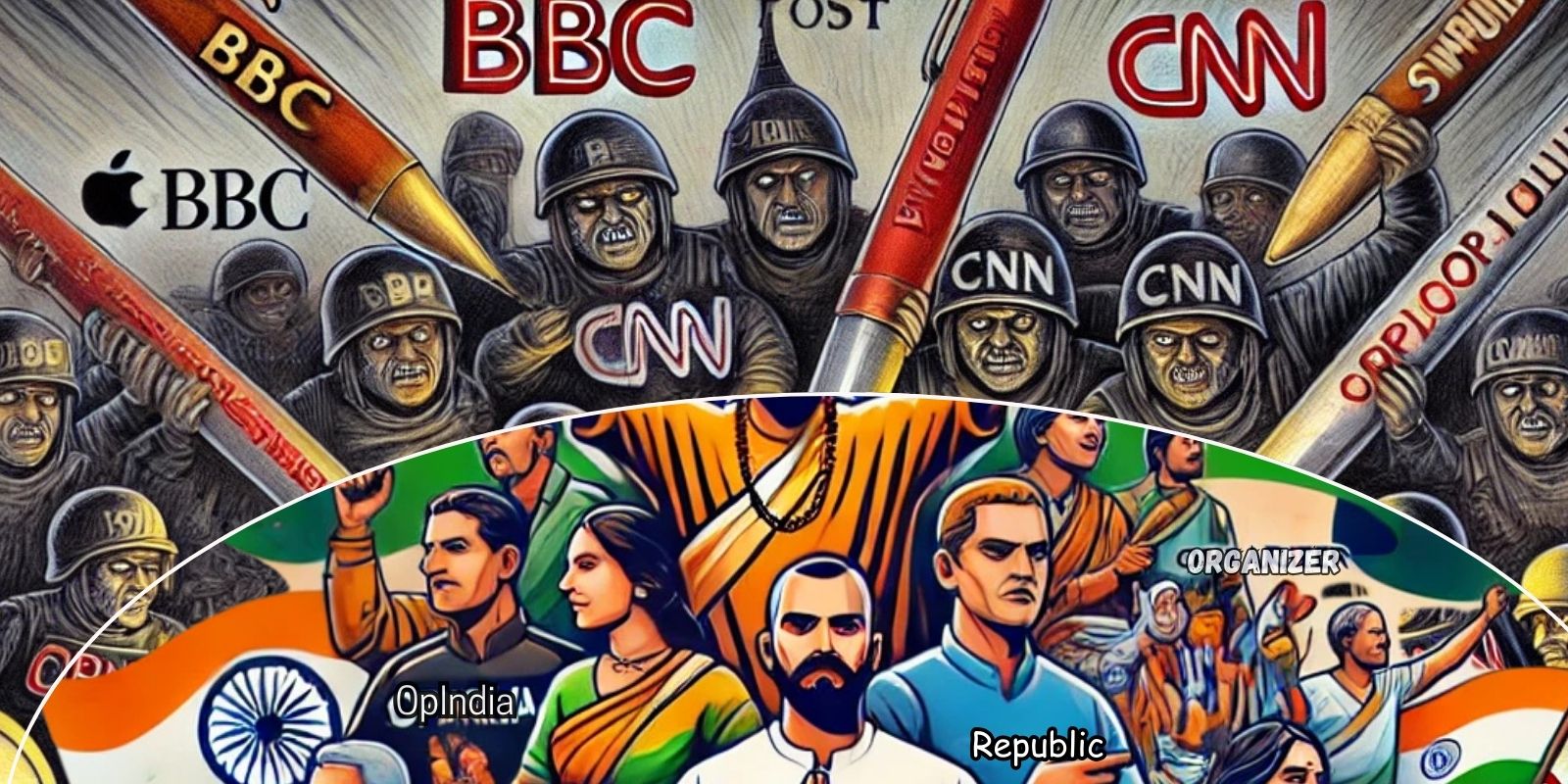
- India’s nationalist media often portrayed as biased, far right-wing and politically partisan by the Western media and think tank ecosystem.
- Woke ecosystem acts as a self-anointed ombudsman, labeling and categorizing Indian media publications at its whims and fancies.
- India’s nationalist media publications hounded by the woke ecosystem because they cover issues ignored and gaslighted by the left-liberal press.
- Maligning India’s image vis-à-vis press freedom part of a larger toolkit to target the country’s nationalist media.
- Deep seated Hinudphobia and anti-India sentiment at the root of the woke ecosystem’s systematic targeting of India’s nationalist media.
In modern societies, hegemony often operates subtly through concealed structures of power such as media, academia, and civil society organizations. Traditionally, the concept of hegemony as envisaged in Marxist thought have focused on critiquing governmental control over cultural and intellectual institutions. However, in the contemporary context of a sharply divided world marked by the North-South power dynamic, the concept of hegemony provides a useful lens to examine how power and geopolitics intersect. Elite media organizations, think tanks, and similar entities wield disproportionate influence in shaping intellectual discourse and public opinion on global issues.
This cultural hegemony is particularly visible in the patronizing approach of Western media toward media outlets in the Global South. An implicit assumption prevails that Western journalistic practices represent the gold standard, to which non-Western media must conform. Consequently, Global South media entities that deviate from this liberal Eurocentric model are often labeled as biased or right-wing.
Technically, Western and Indian media are peers, albeit with differences in financial resources, global reach, and power. Yet, Western media frequently positions itself as a judge over Indian media, particularly targeting non-left-wing or nationalist outlets. This hegemonic stance manifests in the woke ecosystem, comprising Western media, academia, and think tanks, which has self-anointed itself as a media watchdog. These entities habitually brand Indian media with nationalist or culturally rooted tones as “extreme right-wing.”
Indian media outlets that focus on issues concerning the Hindu community, advocate for decolonization, or emphasize India’s civilizational ethos are frequently dismissed as “Hindutvavadi” or “right-wing.” This phenomenon of demonization underscores a broader agenda to delegitimize nationalist voices in Indian media. The following sections explore the systematic targeting of India’s nationalist media, analyze its patterns and methods, and delve into the motivations driving this narrative.
Political neutrality- The left’s favorite masquerade!
Western media’s portrayal of India’s nationalist media outlets is heavily skewed, filled with unsubstantiated allegations that these platforms function as mouthpieces for the ruling BJP government. Phrases such as “Hindutva fascism,” “Hindu nationalism,” and “Hindu majoritarianism” are liberally used to delegitimize these media organizations, casting aspersions on their integrity without factual evidence.
Consider the following examples of headlines from reputed Western media outlets and think tanks that demonize India’s nationalist press:
- The Role of Far-Right Media Houses and Organizations in Disseminating Hindu Nationalist ‘Love Jihad’ Narratives on X – Global Network on Extremism & Technology, January 2024.[1]
- Atmosphere of Hate – OpIndia – The London Story.[2]
- Nationalism a Driving Force Behind Fake News in India, Research Shows – BBC, November 2018.[3]
- Fears for Independent Media in India as Tycoon Eyes Major News Channel – The Washington Post, August 2022.[4]
- Under Modi, India’s Press Is Not So Free Anymore – The New York Times, April 2020.[5]
- A Far-Right Indian News Site Posts Racist Conspiracies, US Tech Companies Keep Platforming It – Wired, May 2024.[6]
- Swarajya Magazine’s Dangerous Double-Speak on the Haridwar Conclave – Hindus for Human Rights.[7]
The recurring use of terms like “far-right” reflects a deliberate strategy to draw parallels between Indian nationalists and extremist ideologies, including Nazism. By framing nationalist media in this manner, the intent seems less about presenting facts and more about discrediting alternative perspectives.
Many of these pieces accuse nationalist media organizations of being extensions of the Indian government, but they fail to substantiate their claims. Instead they merely outline the content focus of these media outlets, then leap to conclusions branding them as the BJP and Sangh Parivar’s mouthpieces. Media organizations like OpIndia, Swarajya, and Organiser are frequently targeted with allegations of misinformation, despite little evidence to back these accusations. Wikipedia entries on these outlets also exhibit blatant bias, relying heavily on far-left sources while failing to present counterarguments, thereby reinforcing the narrative of Western media.[8] [9] [10]
The phrase “Godi media” has been popularized within the woke ecosystem to label Indian media outlets seen as sympathetic to the Modi government.[11] Even Wikipedia has an entry for this term, listing media organizations accused of bias. Ironically, many of these outlets focus on nationalist issues, provide balanced coverage of India’s international diplomacy, and highlight Hindu community concerns. These functions are neither unique to India’s media nor indicative of bias—Western media frequently aligns with their respective governments on matters of foreign policy and national security, often acting as cultural ambassadors of soft power. Why then is Indian media criticized for similar practices?
A significant factor driving the demonization of India’s nationalist media is their focus on topics neglected o gaslighted by left-liberal outlets. For instance, an article titled The Role of Far-Right Media Houses and Organisations in Disseminating Hindu Nationalist ‘Love Jihad’ Narratives on X [12] accuses nationalist media of Islamophobia. However, instead of presenting factual rebuttals to such coverage, these critiques rely on name-calling and labeling to discredit their perspectives.
Another example is The Washington Post’s 2022 article[13] raising concerns about “independent media” in India following Gautam Adani’s acquisition of NDTV. This critique conveniently ignores the fact that many so-called independent media outlets receive funding from international entities with vested anti-India interests. Conversely, small nationalist outlets like OpIndia and Swarajya, which rely on subscriber support, are labeled as government proxies.
The London Story[14] specifically targets OpIndia in a piece that masquerades as research. It alleges that the publication disregards journalistic norms, relies on fake information, and is funded by the BJP IT cell. The article even includes a cartoon series mocking OpIndia with derogatory punchlines like, “Your Wad of Cash Is On Its Way From The RSS Headquarters.” Such baseless targeting reveals the stark double standards of the woke ecosystem. Had such caricatures been directed at a major Western media outlet by an Indian publication, it would have been met with global condemnation.
Unfortunately, small nationalist media organizations in India lack the financial clout to counter such defamatory campaigns. Their limited resources make it nearly impossible for them to challenge these narratives effectively.
While nationalist media is subjected to relentless criticism, left-wing or far-left publications in India enjoy immunity from similar scrutiny. These outlets, despite engaging in openly vindictive propaganda against Hindus and the Indian state, are hailed as paragons of neutrality and ethical journalism. The woke ecosystem assumes that the left-liberal worldview represents the gold standard of media ethics, dismissing nationalist perspectives as inherently biased.
Interestingly, Indian left-wing media outlets echo the same criticisms as Western media, think tanks, and academia, creating a unified front against nationalist media. This alignment underscores a broader ideological agenda to delegitimize nationalist narratives in Indian journalism.
Jingoistic Labeling of Indian Electronic Media
India’s electronic media, particularly nationalist outlets, often faces criticism from Western media and the woke ecosystem, which frequently label channels like Republic Bharat, Republic World, Times Now Navbharat, and News 18 as jingoistic and government mouthpieces. These allegations are rooted in their refusal to conform to the left-liberal journalistic norms prevalent in Western media.
Channels like Republic Media Network have been singled out repeatedly in articles, commentaries, and academic papers. The primary reasons for this targeting include their focus on issues such as Hindu nationalism, cultural identity, and India’s global image. Their coverage challenges Western narratives about India and highlights topics often ignored by the left-leaning media.
For instance, a 2019 Foreign Policy article titled “Indian Media Can’t Speak Truth to Power”[15] accuses Indian media of towing the government’s line and failing to hold it accountable. The piece critiques nationalist media for covering sensitive issues differently than expected by Western standards. However, every media outlet globally has the right to set its own agenda. Western criticism often appears as dissatisfaction with Indian media’s refusal to follow the Western press’s agenda-setting norms.
The Indian media’s coverage of Indian Prime Minister Narendra Modi, particularly during his foreign visits, has been a recurring topic of contention. Western outlets often describe this coverage as overly dramatic or jingoistic. For example, a New York Times article in June 2023 titled “Indian TV Heaps Praise on Modi During His U.S. Trip”[16] critiques Indian channels for their positive portrayal of Modi’s diplomatic efforts, alleging that such coverage masks the Indian government’s supposed domestic shortcomings.
However, such criticism fails to recognize that foreign visits are significant diplomatic events, and it is unreasonable to expect media coverage of these occasions to focus on internal issues. Western media’s disproportionate interest in critiquing Indian media’s portrayal of Modi’s visits reveals a bias rooted in discomfort with India’s growing global stature.
A February 2024 New York Times article titled “Lights! Camera! Modi! It’s a One-Man Show on Indian Television”[17] takes aim at Indian channels for their coverage of the Ayodhya Ram Mandir inauguration. The piece criticizes what it perceives as an exaggerated focus on Modi’s role in the event while ignoring the historical and cultural significance of the temple for millions of Hindus.
The article accuses Indian media of promoting “Hindu nationalism” and furthering a divisive agenda, citing the contentious history of the Ayodhya site. However, such commentary often overlooks the broader cultural and religious sentiments tied to the event, reducing it to a simplistic political narrative.
The woke ecosystem’s disdain for India’s electronic media stems from the latter’s focus on stories that resonate with contemporary India’s aspirations and identity. Channels like Republic Bharat and Times Now Navbharat often cover topics such as decolonization, cultural nationalism, and Hindu community issues—subjects dismissed or sidelined by left-leaning outlets.
Unlike Western media, which frequently reinforces its own governments’ soft power narratives, Indian nationalist media takes a more assertive stance in projecting India’s culture and global relevance. This divergence from the left-liberal mold of journalism unsettles the woke ecosystem, which prefers a portrayal of India as a land burdened by poverty, hunger, and unemployment.
Indian nationalist channels, many of which are owned by Indian conglomerates or founded by Indian professionals like Republic Media’s Arnab Goswami, have charted their own course in journalism. They avoid clickbait narratives about India’s challenges and instead emphasize stories that align with the nation’s progress and evolving identity.
This independence in agenda-setting clashes with the woke ecosystem’s expectations of conformity. Western media’s discomfort with this autonomy is evident in their frequent critiques, which often lack factual substantiation and rely on stereotypes about Indian journalism.
Press Freedom Rankings: A Tool to Demonize Indian Nationalist Media
One of the tactics used by Western media and think tank ecosystems to demonize India’s nationalist media is the systematic fear-mongering about press freedom in the country. Articles, commentaries, and media reports frequently paint a grim picture of the Indian press, claiming an alarming decline in press freedom. However, the reality on the ground tells a different story. India remains a vibrant democracy where media organizations, social media influencers, and even individuals freely express their opinions, often making highly derogatory remarks about the Prime Minister and government. Despite this, there is no widespread crackdown on dissent. The contrast with nations like China, where speaking against the government invites severe consequences, underscores the robust nature of press freedom in India.
At the heart of this narrative is the Press Freedom Index published by Reporters Sans Frontiers (RSF). This index consistently ranks India abysmally low, raising concerns about its methodology and objectivity. In the 2024 edition, India was ranked 159th out of 180 nations[18], below countries like Pakistan, Sri Lanka, Palestine, and the Maldives. The index’s lack of transparency in its criteria, reliance on subjective assessments, and apparent biases render it highly questionable.
Indian media outlets have begun criticizing such motivated rankings, highlighting their inherent flaws. However, their attempts to challenge these narratives are met with predictable accusations of bias and intolerance by the woke ecosystem. This cycle of misinformation and delegitimization perpetuates the portrayal of India’s nationalist media as compromised and untrustworthy.
Western media frequently amplifies these flawed rankings, weaving narratives about India’s deteriorating press freedom. For instance, a 2022 Deutsche Welle article titled Why India’s Press Freedom Is Slipping laments the state of Indian media[19], claiming that since Narendra Modi’s rise to power, the press has undergone a radical transformation. The piece accuses the Indian media of being hyper-partisan, elitist, and socially conservative—a veiled critique of nationalist media outlets that refuse to conform to the left-liberal mold.
The methodology of RSF, as acknowledged even by Deutsche Welle, relies on vague indicators such as “press freedom violations” and “survey responses from press freedom experts.” Such subjective measures lack scientific rigor and fail to account for the diversity of contexts across nations. Questions about the neutrality and credibility of these so-called experts remain unanswered.
The woke ecosystem’s critique of India’s press freedom is replete with selective narratives and distorted linkages. Instances where media organizations are summoned for financial irregularities or journalists face legal scrutiny are weaponized to suggest a direct correlation between Hindu nationalism and the suppression of press freedom. Often, the context or background of these cases is conveniently omitted, such as visa refusals for foreign journalists or investigations into dubious funding, with broader claims of media suppression.
The overarching goal of these narratives is to delegitimize India’s nationalist media by associating it with the alleged decline of press freedom. This criticism, however, is deeply selective. While left-liberal media outlets are portrayed as paragons of virtue, nationalist media is vilified for challenging dominant Western narratives.
Indian media outlets that refuse to toe the woke ecosystem’s line—by focusing on nationalist issues, celebrating cultural pride, or resisting the cliched portrayal of India as a land of poverty and despair—are branded as biased. The real grievance of the woke ecosystem seems to lie in the refusal of nationalist media to conform to Western-defined journalistic norms.
A cursory glance at recent headlines highlights the repetitive themes used to attack India’s press freedom:
- India’s Not-So- Free Media – The Diplomat, January 2019 [20]
- Is India’s free press not so free after a decade of Modi? – CNN, May 2024 [21]
- Journalism in India is under assault – The Washington Post, May 2024[22]
- India’s Proud Tradition of a Free Press Is At Risk – The New York Times, February 2023[23]
- India Press Freedom at stake amid Growing ‘Narrative Management’ – Geopolitical Monitor, March 2024 [24]
- Journalists face increasing threats as India’s press freedom declines – France 24, November 2023[25]
These reports often draw unsubstantiated connections between Hindu nationalism and alleged curbs on press freedom, perpetuating a narrative that lacks nuance and factual backing.
Global Critiques of Indian Media – Hinduphobia in disguise
The systematic demonization of India’s nationalist media by the woke ecosystem reflects both Hinduphobia and Indophobia. Over the past decade, India’s foreign policy has become increasingly assertive, with a focus on projecting the country as a global power and leader of the Global South. Nationalist media outlets have aligned with this vision, amplifying India’s achievements and challenging outdated global narratives.
Another reason for the targeting of nationalist media is their exclusive focus on Hindu issues, which are largely ignored by left-liberal Indian media and dismissed by Western outlets. Topics like religious conversions, love jihad, anti-Hindu hate crimes, and violence are seldom covered outside nationalist platforms. Over the past few years, Indian news channels such as Republic Bharat, Republic World, and Sudarshan News have begun giving these issues prominent coverage, making them frequent targets of criticism.
For example, a New York Times article titled “Lights! Camera! Modi! It’s a One-Man Show on Indian Television” harshly criticized Sudarshan News for its coverage of the Ayodhya Ram Mandir inauguration.[26] The piece accused the channel of pushing a “divisive agenda” and disregarding government advisories on maintaining communal harmony, portraying the channel as unabashedly biased without providing balanced context.
Similarly, the Wikipedia entry on Republic TV showcases a pattern of selective citation, relying exclusively on left-leaning sources to label the channel as Islamophobic and a purveyor of misinformation.[27] There is no effort to include counterarguments or alternative perspectives, perpetuating a biased narrative.
Nationalist media in India is far from monolithic. It includes mainstream channels like Republic Bharat and Times Now Navbharat, as well as smaller niche outlets like OpIndia, Swarajya, and Hindupost. These smaller outlets often struggle for visibility within the Indian media hierarchy and are rarely featured in mainstream search results.
The woke ecosystem’s hostility stems from its resistance to narratives of cultural nationalism and decolonization, branding anyone who supports such ideas as “far-right” or aligned with the Sangh Parivar. This oversimplification dismisses the diversity of voices within the nationalist media spectrum, including those critical of the ruling BJP but still focused on Hindu issues.
Wrapping Up
The woke ecosystem’s systematic targeting of India’s nationalist media appears to be a deliberate attempt to establish a global monopoly of left-liberal narratives. It grooms outlets that echo its worldview while marginalizing those that challenge its dominance. This cancel culture stifles diverse viewpoints, reducing public discourse to an ideological echo chamber.
India’s nationalist media is not just about politics; it represents a broader aspiration to reclaim cultural identity and challenge outdated perceptions of the country. The ongoing demonization of these outlets by the woke ecosystem reveals the lengths to which it will go to suppress alternative narratives and maintain control over the global discourse.
Citations
[1] The Role of Far-Right Media Houses and Organisations in Disseminating Hindu Nationalist ‘Love Jihad’ Narratives on X – GNET; https://gnet-research.org/2024/01/05/the-role-of-far-right-media-houses-and-organisations-in-disseminating-hindu-nationalist-love-jihad-narratives-on-x/
[2] Atmosphere of Hate – OpIndia – The London Story; https://thelondonstory.org/wp-content/uploads/Atmosphere-of-hate.pdf
[3] Nationalism a driving force behind fake news in India, research shows; https://www.bbc.com/news/world-46146877
[4] Gautam Adani, Modi ally, makes hostile bid for Indian news channel NDTV – The Washington Post; https://www.washingtonpost.com/world/2022/08/24/india-ndtv-adani-media-takover/
[5] Under Modi, India’s Press Is Not So Free Anymore – The New York Times; https://www.nytimes.com/2020/04/02/world/asia/modi-india-press-media.html
[6] A Far-Right Indian News Site Posts Racist Conspiracies. US Tech Companies Keep Platforming It | WIRED; https://www.wired.com/story/india-opindia-google-facebook-advertising/
[7] Swarajya magazine’s dangerous double-speak on the Haridwar conclave – Hindus for Human Rights; https://www.hindusforhumanrights.org/en/blog/swarajya-magazines-criticism-of-the-haridwar-conclave
[8] Organiser ( magazine) – Wikipedia; https://en.wikipedia.org/wiki/Organiser_(magazine)
[9] OpIndia – Wikipedia; https://en.wikipedia.org/wiki/OpIndia
[10] Swarajya (magazine) – Wikipedia; https://en.wikipedia.org/wiki/Swarajya_(magazine)
[11] Godi media – Wikipedia; https://en.wikipedia.org/wiki/Godi_media
[12] The Role of Far-Right Media Houses and Organisations in Disseminating Hindu Nationalist ‘Love Jihad’ Narratives on X – GNET; https://gnet-research.org/2024/01/05/the-role-of-far-right-media-houses-and-organisations-in-disseminating-hindu-nationalist-love-jihad-narratives-on-x/
[13] Gautam Adani, Modi ally, makes hostile bid for Indian news channel NDTV – The Washington Post; https://www.washingtonpost.com/world/2022/08/24/india-ndtv-adani-media-takover/
[14] Atmosphere of Hate – OpIndia – The London Story; https://thelondonstory.org/wp-content/uploads/Atmosphere-of-hate.pdf
[15] India’s Media Can’t Speak Truth to Power – Foreign Policy; https://foreignpolicy.com/2019/08/02/indias-media-cant-speak-truth-to-power-modi-bjp-journalism/
[16] Indian TV Praises Modi During His U.S. Trip – The New York Times; https://www.nytimes.com/2023/06/22/us/politics/india-television-modi-us.html
[17] Lights! Camera! Modi! It’s a One-Man Show on Indian Television – The New York Times; https://www.nytimes.com/2024/02/03/world/asia/india-modi-ayodhya-media.html
[18] India’s press freedom has rapidly declined in recent years – Data – The Hindu; https://www.thehindu.com/data/india-press-freedom-has-rapidly-declined-in-recent-years-data/article68160411.ece
[19] Why India’s press freedom is slipping – DW – 05/05/2022; https://www.dw.com/en/why-is-india-falling-in-the-world-press-freedom-index/a-61697180
[20] India’s Not-So-Free Media – The Diplomat; https://thediplomat.com/2019/01/indias-not-so-free-media/
[21] India’s free press is not so free after a decade of Modi | CNN Business; https://edition.cnn.com/2024/05/22/media/india-elections-press-freedom-decline-intl-hnk/index.html
[22] Opinion | Journalism in India is under assault – The Washington Post; https://www.washingtonpost.com/opinions/2024/05/03/india-journalists-under-attack/
[23] Opinion | India’s Proud Tradition of a Free Press Is at Risk -The New York Times; https://www.nytimes.com/2023/02/12/opinion/modi-bbc-documentary-india.html
[24] India’s Press Freedom at Stake amid Growing ‘Narrative Management’ | Geopolitical Monitor; https://www.geopoliticalmonitor.com/india-press-freedom-at-stake-amid-growing-narrative-management/
[25] Journalists face increasing threats as India’s press freedom declines – Focus; https://www.france24.com/en/tv-shows/focus/20231102-india-s-declining-press-freedom-journalists-face-increasing-threats
[26] Lights! Camera! Modi! It’s a One-Man Show on Indian Television – The New York Times; https://www.nytimes.com/2024/02/03/world/asia/india-modi-ayodhya-media.html
[27] Republic TV – Wikipedia; https://en.wikipedia.org/wiki/Republic_TV

Donate to HINDUDVESHA
Our Mission is to explore and expose Hindudvesha through research analysis, education and response.
SUPPORT US