

Role of Indian-Origin Journalists in Spreading Biased Narratives against India
 Rati Agnihotri · 09/11/2024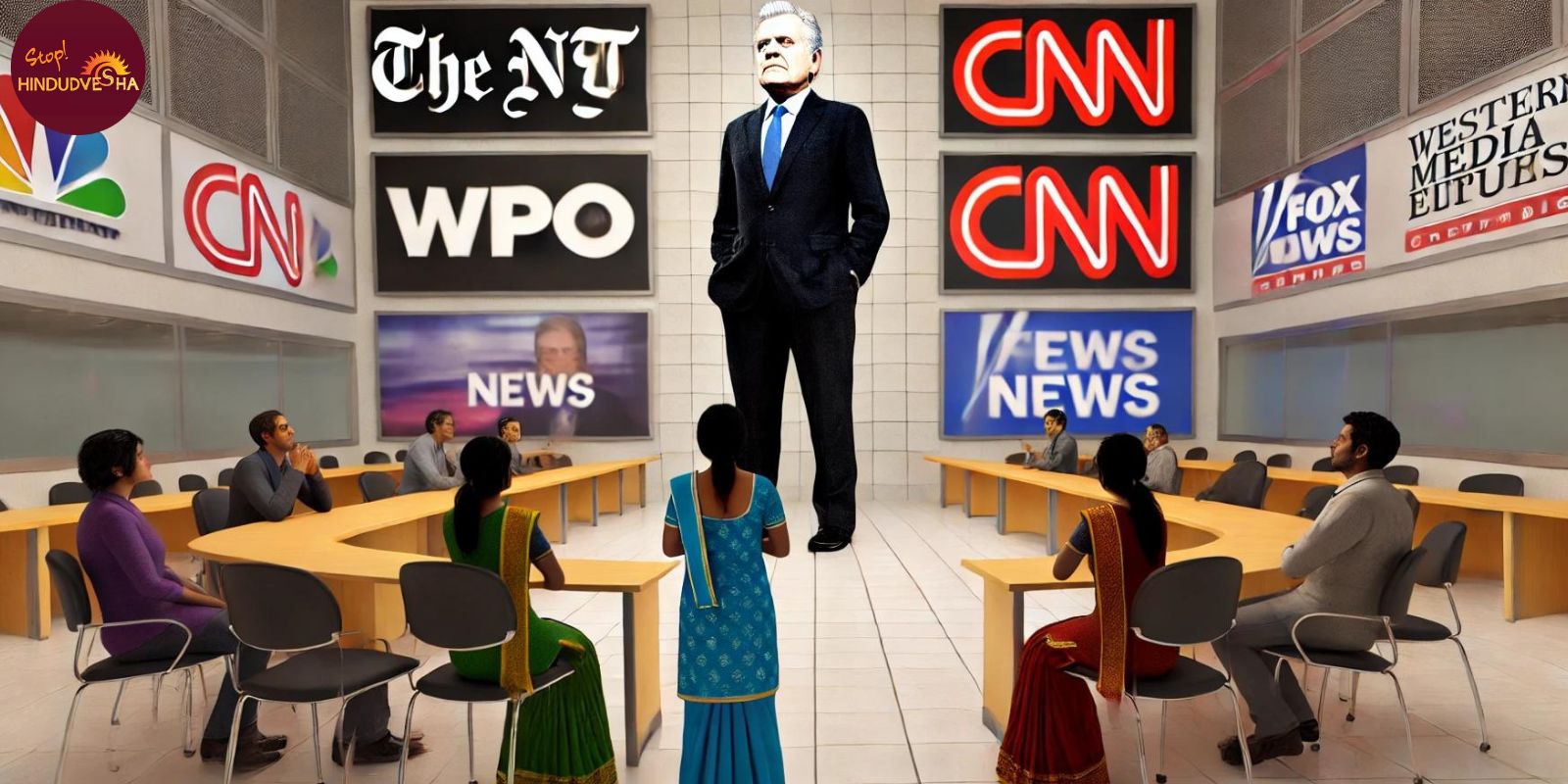
- The phenomenal rise in “web-only stories” with the proliferation of digital media has led to the rise of “opinion columnists” and “Brown sepoys” rushing in to fill these pages with vitriolic anti-India rants.
- Using journalists and writers with “Indian” names to peddle anti-India propaganda absolves the Western media of any moral and ethical responsibility as they pass on the buck to the “Indian journalists.”
- The West grooms “brown sepoys” in the glorious tradition of literary icon-activist-intellectual, all rolled into one.
- The West uses literature and culture as a geopolitical tool and generously promotes the “brown sepoys” who toe its political line in non-political spheres as well.
- A deep-seated neocolonial complex and a lack of appreciation for one’s culture and civilization further contribute to the “brown sepoys.”
Lutyens Media refers to a section of the Indian media that is seen as overly influenced by Western biases, particularly those rooted in India’s colonial past. The phrase comes from “Lutyens Delhi,” an elite part of Delhi where many English-speaking upper-class Indians live. These individuals are often perceived as disconnected from Indian culture, dismissing anything Indian as backward or regressive while maintaining a strong affinity for Anglo-Saxon norms.
The term “Khan Market Gang” has recently replaced “Lutyens Media” in popular usage. Prime Minister Narendra Modi popularized the phrase in 2019, referring to a specific elite group in Delhi who, he argued, had no role in shaping his public image, which he has built over decades of hard work. Although named after the well-known shopping area in Delhi, “Khan Market Gang” symbolizes a particular mindset rather than the actual location.
Journalist Ashok Shrivastav delves into this concept in his book “Modi vs Khan Market Gang.” He explains that the term refers to a wealthy, influential group that has held power in India for generations. This elite class includes politicians, bureaucrats, media personalities, historians, and activists, all deeply entrenched in English-speaking circles. Shrivastav argues that many in this group act as modern-day “sepoys,” promoting anti-India narratives in Western media. [1]
While not all are consciously anti-India, many are seen as contributing to a negative portrayal of the country, whether due to external pressures or for personal gain, posing a threat to India’s national integrity.
This analysis draws on Stop-Hindudvesha’s research. It reviews over 50 Western media pieces on Indian elections, highlighting the most toxic headlines. Many of these articles were written by journalists with Indian names, revealing their role in spreading anti-India narratives globally under the guise of intellectual critique.
How Western Media uses “Brown Sepoys” to push anti-India narrative
Here are some of the toxic headlines analyzed by Hindudvesha, chosen from Western media’s coverage of India’s general elections:
- “Narendra Modi is Preparing New Attacks on Democratic Rights” (Jacobin, April 2024)[2]
- “With democracy under threat in Narendra Modi’s India, how free and fair will this year’s election be?” (The Conversation, April 2024) [3]
- “India can grow fast with or without Narendra Modi” (Reuters, April 2024)[4]
- “Modi is Making India’s Polls All About Himself” (Bloomberg, April 2024)[5]
- “Narendra Modi Fell to Earth After Making it All About Himself” (The New York Times, June 2024)[6]
- “Modi’s Temple of Lies” (New York Times, April 2024)[7]
- “Will the outcome of the world’s biggest increase intolerance?” (Deutsche Welle News, April 2024)[8]
What stands out in all these headlines? First, the use of opinionated and exaggerated language abandons journalistic ethics by sacrificing objectivity and neutrality in favor of biased attacks against India. Second, most of these pieces are written by authors with “Indian-sounding” names.
The Western media’s strategy is clear: To sidestep ethical responsibility by enlisting Indian writers, journalists, and columnists to spread anti-India rhetoric on the global stage. By marketing these opinions as an “insider’s perspective,” they add a veneer of authenticity to these biased narratives.
These articles also highlight the troubling decline in journalistic standards. In the race to constantly generate content for online platforms, Western media often pass off opinionated rants as legitimate journalism. For these “brown sepoys,” it’s a profitable opportunity to write for “prestigious” Western outlets and advance their careers. Sadly, what they produce falls far short of genuine journalism.
Shining the light on “cockroaches”
Achin Vanaik, writing for Jacobin in April 2024, claims in his article “Narendra Modi Is Preparing New Attacks On Democratic Rights” that Modi and his allies are planning repressive policies to further their “Hindu chauvinist project” after the elections. The article appears to criticize the Modi government simply for its own sake, spinning conspiracy theories around almost everything, including the BJP’s aim for a two-thirds majority in the Lok Sabha.
The article echoes the criticisms often raised by India’s political opposition, such as the potential hacking of EVM machines, arrests of opposition leaders like Arvind Kejriwal, and the BJP’s “Hindutva agenda.” It also highlights the supposed threat to minorities posed by the Citizenship Amendment Act (CAA). This narrative aligns with the global left-liberal agenda, which often criticizes India and its democracy under the guise of opposing the Modi government.
The article is rife with inaccuracies. For example, it falsely claims that the CAA introduces religious discrimination against Muslims in citizenship laws. Vanaik dismisses the persecution of minorities in Afghanistan, Pakistan, and Bangladesh, whom the CAA aims to protect, as merely “assumed.” This selective presentation of facts reveals the writer’s biased motivations. The CAA is designed to offer refuge to persecuted minorities from Muslim-majority countries, making it illogical to include Muslims within its scope. [9]
Achin Vanaik, the author of this piece, is a former professor at the University of Delhi, a social activist, and a Fellow of the Transnational Institute in Amsterdam. He has written two books: “The Painful Transition: Bourgeois Democracy in India” and “The Rise of Hindu Authoritarianism.” [10]
A quick Google search shows that Achin Vanaik frequently contributes to several well-known left-liberal outlets for pushing anti-India narratives, such as The Wire, The Caravan, Open Democracy, and The Hindu. He regularly writes for Jacobin, and a glance at his headlines makes it clear that his “journalistic scholarship” revolves around criticizing India’s democratically elected Prime Minister, Narendra Modi. Articles like “Narendra Modi Has Lost His Aura of Political Invincibility,” “Narendra Modi Is Preparing New Attacks On Democratic Rights,” and “Why the Far Right Rules Modi’s India” are just a few examples of his work for Jacobin over the past few years. [11]
If one were to analyze the frequency of terms like “Modi” and “Hindutva” in Vanaik’s articles, the results would likely highlight his focus on these subjects. This underscores his significant role among the “brown sepoys” who seem to align with Western media agendas. While a comprehensive analysis of Vanaik’s work is beyond this overview, it’s clear that his output contributes to the ecosystem that promotes “anti-India experts.”
Vanaik’s controversial reputation extends beyond his writing. In November 2023, IIT Bombay reportedly canceled his talk on the Israel-Palestine conflict due to strong student opposition. This opposition stemmed from an earlier lecture at Ashoka University, where Vanaik allegedly made anti-Hindu and antisemitic comments, including labeling Hindu Dharma as fundamentally anti-Muslim and Zionism as anti-Palestinian. He even controversially praised suicide bombing, describing it as a determined act of both killing and dying. [12]
Amrit Dhillon is another example of a “brown sepoy” who regularly pushes extreme anti-India rhetoric under the guise of journalism. In this piece for the Guardian, “The Hindujas made UK headlines for mistreating their servants. In India no one batted an eye – here’s why” (July 2024), [13] Dhillon discusses the case of the Hindujas, one of Britain’s wealthiest families, who faced trial in Swiss courts for mistreating domestic staff. While this case is significant, Dhillon uses it to perpetuate damaging stereotypes, suggesting that Indians, in general, mistreat their domestic staff. This is a classic case of internalizing colonial biases; despite the Hindujas being British citizens, their Indian origins are used to generalize all Indians as abusers. Imagine the reverse: labeling all British citizens as criminals if one Briton is caught in a crime in India.
The following small sample of her writings for the Times should give the reader a more complete picture of how she contrives to propagate stereotypes and falsehoods about India, all under the pretense of journalism:
- “India’s ‘ticking time bomb’ as educated youth remain unemployed” (The Times; March 2024) [14].
- “Outcry as Narendra Modi calls Indian Muslims ‘infiltrators’” (The Times; April 2024) [15]
- “Modi accused of threatening democracy after latest critic arrested” (The Times; March 2024) [16].
- “Why dead leaders are hitting the campaign trail in India ‘s election” (The Times; April 2024).[17]
- ‘Secret meat eaters’ force veggie delivery service to ditch green uniforms” (The Times, March 2024)[18]
- “Narendra Modi labeled a ‘clown’ for Maldives holiday pictures” (The Times, January 2024)[19]
According to her bio on The Times website, Amrit Dhillon is a freelance journalist from New Delhi who started her career with BBC Radio in London. Though she grew up in the UK, she has lived in India for over 25 years, reporting on what she describes as an “alternately fascinating and mystifying country.” Her bio claims she has traveled extensively across India, validating clichés about the country’s simultaneous existence over centuries.[20] Dhillon’s tone reflects a colonial mindset, casting her as an explorer unraveling the mysteries of an exotic land. This aligns with the Western media’s tendency to “exoticize” and “romanticize” India’s challenges. Ironically, in distancing themselves from their Indian identity, writers like Dhillon become subjects of the very stereotypes they perpetuate.
Salil Tripathi is yet another name that is prominently featured on the list of “brown sepoys.” A writer based in New York, Salil Tripathi is a Contributing Editor to the Caravan and is also on the board of PEN International. The Cambridge Institute for Sustainability Leadership (CISL) website provides a detailed bio of Tripathi – he is a writer and a human rights practitioner, a Senior Adviser at the Institute for Human Rights and Business, and a Board Member of the Commonwealth Human Rights Initiative (CHRI) UK. Tripathi is also on the human rights advisory panel for Meta, according to the website.
Tripathi’s “journalistic scholarship” is characterized by the typical Modi-bashing frame. He is a prominent figure in the ever-burgeoning galaxy of “brown sepoys’ who echo the Western worldview on everything and act as de-facto agents of the transnational deep state perpetually demonizing and vilifying everything about India and Indians.
“With India’s election in full swing, Narendra Modi is getting desperate- and dangerous,” Tripathi for The Guardian (April 2024) writes. With every write-up, the author gets more desperate and dangerous, going by his propensity to peddle prejudiced and value-laden rhetoric. “Modi’s Long Game: New restraints on the prime minister’s mandate can’t undo his transformation of India”, says the Foreign Policy headline (July 2024) of a piece by Salil Tripathi. His work is known for its consistent criticism of Prime Minister Narendra Modi. He is a key figure among those who echo Western perspectives, often portraying India in a negative light. His articles, such as “With India’s election in full swing, Narendra Modi is getting desperate—and dangerous” (The Guardian, April 2024) [21] showcase his approach to criticizing India while aligning with Western narratives.
Other examples of his handiwork include:
- “Modi’s Long Game: New restraints on the prime minister’s mandate can’t undo his transformation of India” (Foreign Policy; July 2024)[22]
- “Why Narendra Modi’s heavy losses in India’s election could be a red herring” (Middle East Eye)[23]
- “India’s Worsening Democracy Makes It an Unreliable Ally” (The Time; June 2023)[24]
- “Modi is not making India a world power” (East Asia Forum; June 2019) [25]
- “The hounding of Arundhati Roy shows there’s still no room for dissent in India” (The Guardian; June 2024) [26]
Wokeism and the rise of politicized litter-ary figure
Wokeism is increasingly dominating the cultural and literary landscape. Today, being a successful writer isn’t just about writing well; it’s about projecting yourself as deeply engaged with specific issues and advocating certain viewpoints. In essence, you need to be “political” in a particular way to join the elite circle of literary figures.
But who sets the standards for this elite literary status? It’s largely the left-liberal Western ecosystem, which often equates “good writing” with “Modi bashing,” “India bashing,” and “Hindutva bashing.” Many “brown sepoys” have been groomed within this system as multi-talented intellectuals and experts. These individuals are frequently invited to prominent conferences, talks, and literary festivals, wearing multiple hats as writers, activists, critics, and commentators. To an average Indian, these figures may appear as shining stars to aspire to, but a closer look reveals a different story. Perhaps initially without malice, many of them chose the well-trodden path to fame and became willing tools of the Western ecosystem.
Arundhati Roy, author of The God of Small Things, is a prime example. She achieved phenomenal success at a young age, winning the Booker Prize, one of the world’s most prestigious literary awards. In India, gaining instant recognition from the Western ecosystem can catapult you to fame, and Roy became an overnight celebrity. Over time, she transformed into an all-purpose expert—human rights activist, political commentator, and social critic.
However, this role led her into controversy as she increasingly maligned India on the global stage, making extreme and inflammatory remarks about the country’s democracy and political system. Her comments became more severe over time, culminating in her claim that Kashmir is not an integral part of India. In June 2024, the Lieutenant Governor of Delhi approved her prosecution under the Unlawful Activities Prevention Act (UAPA) for her 2010 speech in Delhi, where she allegedly stated that Kashmir was never a part of India and was forcibly occupied by the Indian Armed Forces, urging for its independence.[27]
Arundhati Roy’s dangerously provocative speech from a 2010 event is widely available in the public domain and has circulated extensively on social media. Despite this, the Western ecosystem continues to promote Roy as the “savior of India’s democracy.” After the Indian government decided to prosecute Roy under the Unlawful Activities Prevention Act (UAPA), Western media launched a propaganda blitz, framing the move as an attack on freedom of expression and the suppression of dissent. Coincidentally, right after the announcement of her prosecution, Roy was awarded the “PEN Pinter Prize” for her “powerful voice.” English PEN Chair Ruth Borthwick praised her for telling “urgent stories of injustice with wit and beauty.” [28]
The timing of the PEN Pinter Prize, deeply rooted in the Western literary ecosystem, seems intentional. It sends a subtle message to India not to challenge the “West-anointed” human rights activists and intellectuals. This incident also highlights how the West frequently uses literature as a geopolitical tool. When someone who openly advocates for the disintegration of a sovereign nation and makes inflammatory remarks about their own country is awarded such a prize and celebrated as a “powerful voice,” it reveals the hollow nature of these accolades.
Arundhati Roy occupies a prominent position in the hierarchy of “brown sepoys.” It is crucial to call her out because many impressionable, educated young Indians end up idolizing figures like Roy, who instill in them a sense of hatred and disdain for their own country and civilization. These Western-created icons perpetuate an “inferiority complex” among generations of Indians, where the West is viewed as something to aspire to, while India is seen as something to criticize and despise. This creates a vicious cycle where figures like Roy, sitting at the top of the pyramid, indoctrinate and brainwash more “brown sepoys.” The Indian media, by over-glorifying such figures, further weakens future generations, making them even more susceptible to this toxic narrative.
Siddhartha Deb is another literary intellectual activist nurtured by the West. In April 2024, he authored an article for The New York Times titled “Modi’s Temple of Lies,” written in a so-called “literary narrative” style. The piece attempts to depict Modi as a Hindutva ideologue, portraying the inauguration of the Ayodhya Ram Temple as a Hindu conspiracy, using language and imagery that is blatantly offensive to Hindu sentiments. For instance, Deb describes the temple’s souvenir shops as displaying “toxic-Hindu masculinity,” featuring “garish shirts with images of a steroid-fed Ram, all bulging muscles and chiseled six-packs.” He also references the “Angry Hanuman” imagery, claiming it symbolizes a more aggressive version of Hinduism in the Modi era. [29]
While a full critique of Deb’s article is beyond the scope of this discussion, the quoted lines alone reveal his deep-seated anti-India and anti-Hindu biases. It’s hard to imagine such derogatory language being used to describe religious figures or practices from Christianity or Islam without significant backlash. But in the case of Hinduism, Deb and others like him face little resistance, as Hinduphobia is often exploited as a means to gain acclaim in Western circles. The more venom they direct towards Hindu Dharma, the more the Western establishment celebrates them.
Siddhartha Deb, an Indian writer based in New York, is the author of the novel The Light At The End Of The World. He recently published a non-fiction book titled Twilight Prisoners: The Rise Of The Hindu Right And The Fall Of India. According to Deb’s website, his work has appeared in numerous publications, including The New York Times, The Guardian, The New Republic, Dissent, and Caravan.[30]
Concluding remarks
While there is no simple solution to the “brown sepoy” syndrome, it is important to call out and shine light on such individuals. By sharing their biased articles and exposing their prejudiced views, especially on social media, we can raise awareness among Indians about the harmful propaganda spread by such intellectual imposters.
Another measure is to build a strong indigenous media ecosystem in India. We urgently need to decolonize our media, particularly the English-language press. By developing a robust, homegrown media supported by the government and Indian businesses, we can create more employment opportunities and potentially prevent English-educated Indians from becoming “brown sepoys” for the West.
Lastly, holding the global media accountable to universal standards of objectivity and journalistic ethics is essential. While the West often claims to uphold these principles, they are frequently ignored when covering “third-world countries.” Establishing global mechanisms to ensure Western media organizations adhere to these ethics is long overdue.
Citations
[1] Modi vs Khan Market Gang by Ashok Shrivastav, Ch1. ‘नयी दिल्ली से न्यूयॉर्क तक “ख़ान मार्केट गैंग”’
[2] Narendra Modi Is Preparing New Attacks On Democratic Rights; https://jacobin.com/2024/04/narendra-modi-india-bjp-hindutva
[3] With democracy under threat in Narendra Modi’s India, how free and fair will this year’s election be?; https://theconversation.com/with-democracy-under-threat-in-narendra-modis-india-how-free-and-fair-will-this-years-election-be-226321
[4] Breakingviews: India can grow fast with or without Narendra Modi; https://www.reuters.com/breakingviews/india-can-grow-fast-with-or-without-narendra-modi-2024-04-10/
[5] Modi Is Making India’s Election All About Himself – Bloomberg; https://www.bloomberg.com/opinion/articles/2024-04-16/modi-is-making-india-s-election-all-about-himself
[6] Narendra Modi Fell to Earth After Making it All About Himself – The New York Times; https://www.nytimes.com/2024/06/05/world/asia/india-election-modi.html
[7] Opinion | Modi’s Hindu Utopia is a Tawdry Mirage – The New York Times; https://www.nytimes.com/2024/04/18/opinion/india-election-modi-religion.html
[8] India: Will the outcome of the world’s biggest election increase intolerance? | DW News – YouTube; https://www.youtube.com/watch?v=qKinj6SzXEI
[9] Narendra Modi Is Preparing New Attacks on Democratic Rights; https://jacobin.com/2024/04/narendra-modi-india-bjp-hindutva
[10] Achin Vanaik; https://jacobin.com/author/achin-vanaik
[11] Ibid
[12] IIT Bombay Cancels Hamas Sympathizer Prof Achin Vanaik’s Talk On Israel-Palestine Conflict After Students Oppose; https://swarajyamag.com/news-headlines/iit-bombay-cancels-hamas-sympathiser-prof-achin-vanaiks-talk-on-israel-palestine-conflict-after-students-oppose
[13] The Hindujas made UK headlines for mistreating their servants. In India, no one batted an eye – here’s why | Amrit Dhillon in Delhi; https://www.theguardian.com/global-development/article/2024/jul/09/the-hindujas-made-uk-headlines-for-mistreating-their-servants-in-india-no-one-batted-an-eye-heres-why
[14] India’s ‘ticking time bomb’ as educated youth remain unemployed; https://www.thetimes.com/world/asia/article/india-ticking-time-bomb-educated-youth-unemployed-q0h8wjbd0
[15] Outcry as Narendra Modi calls Indian Muslims ‘infliltrators’; https://www.thetimes.com/world/asia/article/outcry-as-narendra-modi-calls-indian-muslims-infiltrators-lfjkr5vqp
[16] Modi accused of threatening democracy after latest critic arrested; https://www.thetimes.com/world/asia/article/modi-accused-of-threatening-democracy-after-latest-critic-arrested-jj7vnm5bp
[17] Why dead leaders are hitting the campaign trail in India’s election; https://www.thetimes.com/world/asia/article/india-elections-2024-ai-campaigning-6mhfljf2w
[18] ‘Secret meat eaters’ force veggie delivery service to ditch green uniforms; https://www.thetimes.com/world/asia/article/secret-meat-eaters-force-veggie-delivery-service-to-ditch-green-uniforms-fht23c37f#:~:text=’Secret%20meat%20eaters’%20force%20veggie%20delivery%20service%20to%20ditch%20green%20uniforms,-Zomato%20wanted%20meat&text=A%20food%20delivery%20service%20in,criticised%20for%20reinforcing%20caste%20differences.
[19] Narendra Modi labeled a ‘clown’ for Maldives holiday pictures; https://www.thetimes.com/world/asia/article/modi-clown-terrorist-maldives-ministers-island-getaway-jtdl9ks2t
[20] Amrit Dhillon | The Times & The Sunday Times; https://www.thetimes.com/profile/amrit-dhillon#:~:text=Her%20career%20began%20with%20BBC,%2C%20caste%2C%20education%20and%20health.
[21] With India’s election in full swing, Narendra Modi is getting desperate – and dangerous | Salil Tripathi | The Guardian; https://www.theguardian.com/commentisfree/2024/apr/29/india-election-narendra-modi-anti-muslim-rhetoric
[22] How Modi Has Permanently Transformed India; https://foreignpolicy.com/2024/07/28/modi-indian-politics-elections-third-term-democracy-history/
[23] Why Narendra Modi’s heavy losses in India’s election could be a red herring | Middle East Eye; https://www.middleeasteye.net/news/analysis-india-narendra-modi-heavy-losses-election-red-herring
[24] India’s Worsening Democracy Makes It An Unreliable Ally | TIME; https://time.com/6288505/indias-worsening-democracy-makes-it-an-unreliable-ally/
[25] Modi is not making India a world power | East Asia Forum; https://eastasiaforum.org/2019/06/29/modi-is-not-making-india-a-world-power-2/
[26] PressReader.com – Digital Newspaper & Magazine Subscriptions
[27] Delhi LG approves the prosecution of Arundhati Roy under UAPA | Latest News India – Hindustan Times; https://www.hindustantimes.com/india-news/delhi-lg-gives-prosecution-sanction-against-arundhati-roy-under-uapa-101718371339683.html
[28] Arundhati Roy wins PEN Pinter Prize for her ‘powerful voice’; https://www.bbc.com/news/articles/cp4w8x4wypeo
[29] Opinion | Modi’s Hindu Utopia is a Tawdy Mirage – The New York Times; https://www.nytimes.com/2024/04/18/opinion/india-election-modi-religion.html
[30] Home – Siddhartha Deb; https://siddharthadeb.com

Donate to HINDUDVESHA
Our Mission is to explore and expose Hindudvesha through research analysis, education and response.
SUPPORT US