

Beyond Mausoleums: Temples Tourism Drives India’s Cultural Reset
 Rati Agnihotri · 01/19/2025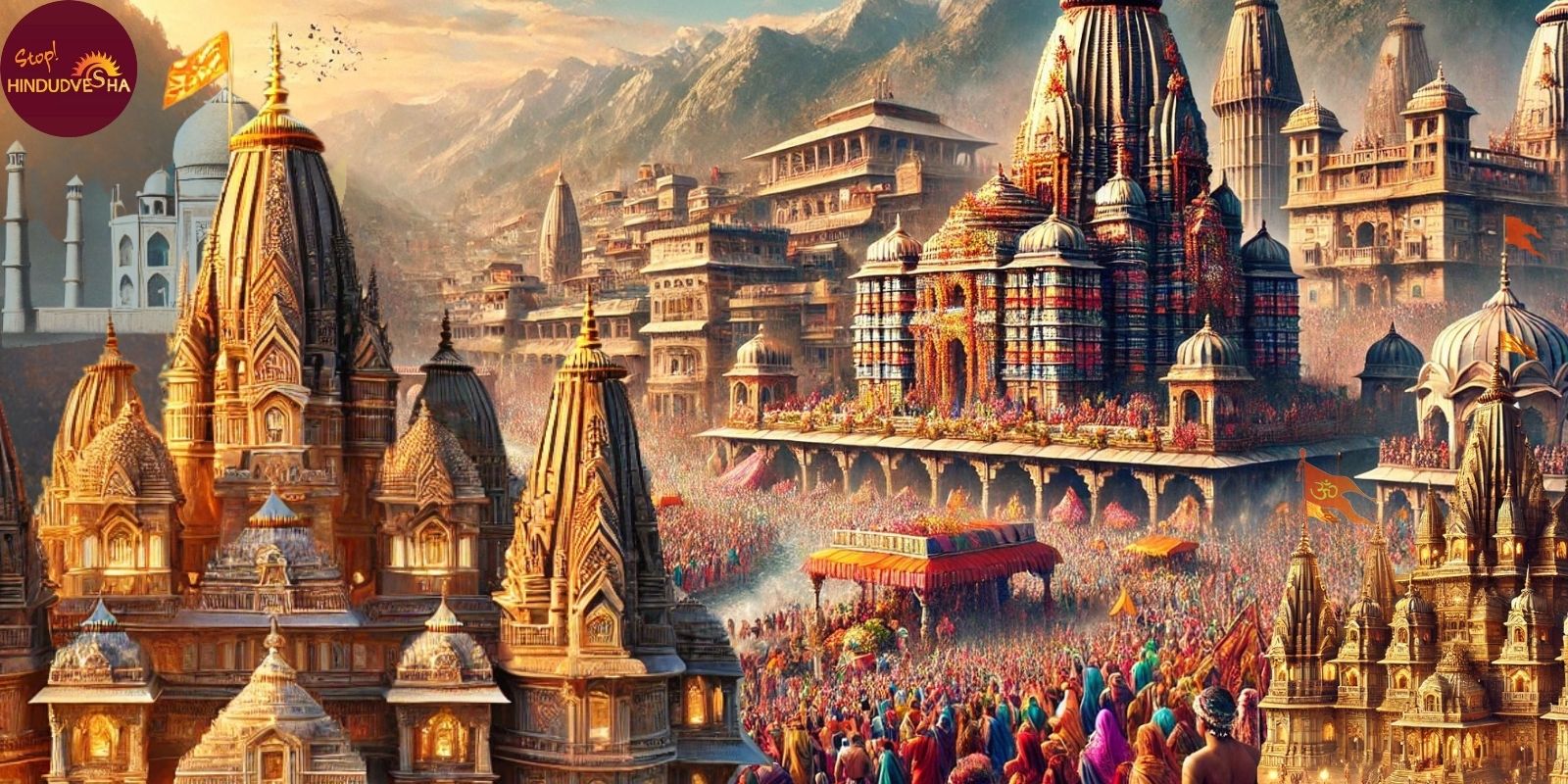
- India’s cultural identity has long been framed by Islamic heritage, which became the de facto symbol of its soft power post-independence.
- The construction and inauguration of Ayodhya Ram Mandir mark a pivotal moment in revitalizing Dharmic consciousness and initiating a cultural reset.
- The recent surge in Dharmic tourism has the potential to challenge left-liberal narratives that glorify the legacy of invaders and colonizers.
- The government’s modernization of the temple ecosystem must integrate the perspectives of Dharmic leaders, spiritual authorities, and local communities.
- A combination of macro-level initiatives and grassroots efforts is essential to protect, preserve, and promote Sanatan Dharma alongside the rise of Dharmic tourism.
When India gained independence in 1947, it was presented with a unique opportunity to redefine its cultural narrative. The country could have chosen to embark on a journey of decolonization by embracing and promoting the rich heritage of its ancient Vedic culture and value system. However, India adopted a markedly different approach, emphasizing the so-called cultural legacy of its colonizers and invaders as the defining essence of its civilization. This decision fostered a persistent tendency akin to Stockholm Syndrome, wherein India not only felt compelled to forgive the atrocities committed by foreign powers but also sought to whitewash these events, incorporating them into its identity and presenting them as symbols of its cultural essence.
Since independence, Islamic culture has been portrayed as the de facto representation of India’s soft power. Until recently, India’s architectural heritage was essentially synonymous with monuments such as the Taj Mahal, Humayun’s Tomb, and the Qutab Minar. Among these, the Taj Mahal—a structure built by an Islamic ruler—has long been a central emblem of India’s cultural diplomacy. For decades, it became a near-obligatory backdrop for visiting foreign dignitaries, symbolizing India’s cultural heritage to the global community.
It is ironic that in a nation marked by a painful history of invasions and prolonged subjugation under colonial rule, a monument erected by invaders became the foremost symbol of its cultural identity. The systematic glorification of the Mughal era, coupled with the academic whitewashing of their often-brutal legacy by left-leaning historians, has obscured the historical reality that the Mughals were invaders who caused significant harm to the Dharmic and cultural fabric of India.
However, the recent surge in Dharmic tourism, or temple tourism, is challenging the historical dominance of these narratives. For instance, recent reports indicate that the Ayodhya Ram Mandir has emerged as Uttar Pradesh’s top tourist destination in 2024, surpassing the Taj Mahal.[1] Ayodhya attracted 135.5 million domestic tourists and 3,153 international visitors during this period, compared to Agra’s 125.1 million visitors. This surge, following the inauguration of the Ram Mandir, represents a 70 percent increase in religious tourism in Ayodhya. [2]
As the Indian government continues to revamp infrastructure at major temples and Hindu pilgrimage sites, these developments suggest the potential for a cultural reset. The burgeoning interest in Dharmic tourism might eventually overshadow the Taj Mahal as a cultural symbol, heralding a significant transformation in India’s cultural narrative.
Ayodhya Reshaping India’s Spiritual Identity
The construction of Ayodhya Ram Mandir, followed by the inauguration ceremony, proved to be a turning point in India’s civilizational and cultural narrative. According to media reports,[3] Ayodhya’s local economy got a huge boost merely two months after the opening ceremony of the Ram Temple. Both organized and unorganized sectors, including retailers, the hospitality industry, craftspersons, flower sellers, etc., witnessed a three-to-fourfold increase in their profits during the period.
The inauguration of the Ayodhya Ram Mandir has catalyzed a significant rise in Dharmic tourism across India. In 2024, Prayagraj and Mathura also emerged as prominent spiritual destinations, attracting 45.3 million and 30.7 million visitors, respectively.[4] Media reports highlight a growing interest in spiritual tourism, with notable increases in searches for “spiritual destinations in India” and a surge in both domestic and international visitors to sacred sites, further amplified by the Ram Mandir’s inauguration.[5]
The online travel platform MakeMyTrip reported a 97% increase in searches for spiritual destinations in India from 2021 to 2023, with Ayodhya experiencing an unprecedented 585% surge ahead of its January 22, 2024, inauguration ceremony. Other Hindu spiritual destinations also saw significant growth, including Ujjain (359%), Badrinath (343%), Amarnath (329%), Kedarnath (322%), Mathura (223%), Dwarkadhish (193%), Shirdi (181%), Haridwar (117%), and Bodh Gaya (114%).[6]
New Year celebrations in 2024 revealed a notable shift, with many Indians choosing to visit temples and other Dharmic sites. On January 1, 2025, temple tourism surged nationwide, with devotees thronging major sites such as the Ayodhya Ram Mandir, Akshardham Temple in Delhi, and Jagannath Temple in Puri. The Ayodhya Ram Mandir alone drew over 200,000 devotees, many standing in long queues to participate in the year’s first aarti. [7] [8]
While traditional New Year celebrations at restaurants, malls, and entertainment venues persisted, a novel trend of beginning the year with darshan at prominent temples has emerged in India. Devotees flocked to renowned temples in metropolitan cities like Delhi and Mumbai, as well as in states such as Odisha, Telangana, Karnataka, and Uttar Pradesh, marking a significant cultural shift. [9]
The Gregorian New Year has traditionally held little relevance in India’s Dharmic ecosystem, which celebrates multiple New Years based on the Vedic lunar calendar. However, globalization has fostered a homogenized, consumer-driven culture, making occasions like New Year performative spectacles. While the Western New Year in India has been synonymous with parties, shopping, and luxury travel, the growing trend of marking it with temple visits signals a meaningful shift. This reflects the non-Western world’s active resistance to cultural hegemony, with India asserting its civilizational identity. The surge in Dharmic tourism during New Year’s Eve highlights a grassroots effort to redefine India’s cultural narrative.
The construction of the Ayodhya Ram Mandir has fostered a positive narrative around Hindu temples in India, challenging misconceptions often perpetuated by left-liberal perspectives that portray temples as exotic or irrational. This shift has the potential to facilitate a course correction, encouraging a more respectful, sensitive, and authentic understanding of Hindu temples and Hinduism.
Social Media’s Role
With its extensive reach and influence in India, social media has been instrumental in promoting Hindu religious tourism. Gen Z, in particular, is shaping a fresh Dharmic narrative by creatively showcasing temples and pilgrimage sites through reels, memes, and videos.
Popular hashtags such as #Ayodhya (5.3 million posts), #ayodhyarammandir (1.4 million posts), #hindutemple (3.2 million posts), #Kashi (3 million posts), #kashivishwanath (1 million posts), #Mathura (3.6 million posts), #Vrindavan (9 million posts), and #jagannath (1.4 million posts) highlight the widespread interest in India’s Dharmic heritage on Instagram.
The rise of Dharmic influencers is particularly notable. These young creators combine engaging captions, music, and visual storytelling to present Hindu pilgrimage sites in a compelling manner. This trend not only reflects a renewed connection among India’s youth to their Dharmic roots but also positions them as leaders in promoting and preserving cultural heritage.
The Indian government has also encouraged this trend; well-known social media influencers promoting Hindu culture and Dharmic tourism have been awarded. In 2024, many Dharmic influencers bagged the National Creators Award, an initiative by the Indian government to encourage youth involvement in nation-building and cultural reawakening. Aridaman (Instagram / @vedic_siddhanta) won the Best Micro Creator Title at the Award. Similarly, Keerthika Govindhasamy who takes up topics related to Vedic culture and civilization through her immensely popular YouTube channel, bagged the Best Storyteller Award.[10]
While using social media to showcase India’s Dharmic heritage effectively appeals to Gen Z globally, it comes with benefits and drawbacks. On one hand, it presents Hinduism in a contemporary and relatable manner; on the other, it risks crossing the line between meaningful promotion and superficial gimmickry. Instances of influencers disrupting Puja rituals, inconveniencing visitors, or disturbing the sanctity of temple spaces for video content have raised concerns. To address this issue, the Uttarakhand government has banned videography and social media reels within a 50-meter radius of the Char Dhams to preserve the sanctity of these sacred sites.[11]
In July 2023, the Badrinath Kedarnath Temple Committee issued a letter raising objections to the increasing trend of social media influencers making reels inside the temple premises, arguing that it amounts to hurting religious sentiments. The temple committee’s comments were sparked by a viral social media reel featuring a woman proposing to her boyfriend in the temple premises.[12]
Hindu temples must enforce boundaries while avoiding hyper-traditionalist measures that risk alienating youth. A balanced approach requires constructive dialogue between temple authorities and Gen Z influencers to harmonize tradition and modern engagement.
Hindu temples were once seen as less appealing for social media content, unlike Islamic cultural elements like dargahs, qawwalis, and Sufi traditions, which gained traction through popular reinterpretations that lent them a “secular” appeal. The growing positive media focus on India’s Dharmic heritage now has the potential to transform cultural narratives significantly.
Government’s Role in Revitalizing Dharmic Heritage
For the past couple of years, the Indian government has been focusing on modernizing the temple ecosystem. Various projects have been introduced to revamp well-known temples and boost infrastructure and connectivity.
The work on the government’s ambitious Kashi Vishwanath Corridor project began in 2019 when around 400 buildings and houses were acquired to reconstruct the Kashi Vishwanath Temple to boost tourism. The corridor, inaugurated in 2021, connects the Kashi Vishwanath Temple and the ghats along the Ganga River. Spanning an area of 5.5 acres, the corridor comprises numerous features, including a ghat, a museum, and a four-lane road. The project aims to boost local employment and improve Varanasi’s overall economic profile.[13]
The Indian government has also undertaken numerous other temple restoration projects in the past couple of years, including the Somnath Temple ( Gujarat) Renovation Project, the Kedarnath Temple Renovation Project in the aftermath of the 2013 Uttarakhand floods that had devastated the temple premises, the Char Dham Project for connecting the four pilgrimage sites of Gangotri, Yamunotri, Badrinath and Kedarnath, and various projects in Jammu and Kashmir for the revival of Hindu temples, following the abrogation of Article 370 in 2019.[14]
A 2022 OpIndia report highlighted a significant rise in visitors to major Hindu pilgrimage sites driven by government temple revitalization projects. Varanasi alone saw eight times the number of tourists compared to Goa, while Ayodhya, Mathura, and Prayagraj also surpassed Goa’s tourist figures, marking a substantial surge in Dharmic tourism.[15]
In the 2024 Union Budget, the Indian Finance Minister allocated funds for developing the Vishnupad Temple Corridor and the Mahabodhi Temple Corridor in Bihar. The Vishnupad Temple, dedicated to Bhagwan Vishnu, is situated along the Phalgu River, while the Mahabodhi Temple in Bodh Gaya holds UNESCO World Heritage status.[16]
However, the Modi government’s temple revamping projects have faced their fair share of criticism from both left-liberal and Dharmic circles. Left-liberals view these efforts to reclaim India’s civilizational ethos as divisive, while some within the Dharmic community, particularly regarding the Kashi Vishwanath Corridor, argue that it disrupted the sanctity of the original spaces by demolishing small temples. Additionally, reports highlight that the early phase of the project displaced families by demolishing residential and commercial structures near the temple.[17] Restoring ancient structures is complex and fraught with moral dilemmas and contentious issues. A balanced approach requires involving the broader Hindu community and Dharmic leaders to consider diverse perspectives.
For decades, the left-liberal ecosystem has sought to undermine India’s Hindu heritage while promoting the cultural legacy of Islamic invaders as India’s soft power symbol. The portrayal of Islamic culture as India’s secular heritage, often termed Ganga-Jamuni Tehzeeb, overshadowed India’s Vedic legacy, reducing its cultural narrative to Mughal and Sufi influences.
Delhi’s cultural spaces have been heavily dominated by narratives celebrating its so-called Islamic heritage, reducing its history to a glorification of Islamic legacy. This distortion has led to a youth culture more emotionally connected to sites like Lodhi Gardens, Humayun’s Tomb, and Delhi’s numerous dargahs than to their Sanatani roots. The polished promotion of cultural forms like Shayari, Ghazals, and Sufi music, combined with heritage walks that romanticize Islamic architecture, has systematically overshadowed India’s Hindu heritage. This trend mirrored across the country, is a result of the left-liberal dominance over India’s cultural narratives, which glorifies invaders’ legacies while ignoring their exploitative impact.
India’s renewed emphasis on Dharmic tourism holds significant potential to reshape narratives domestically and globally. Following the development of Kashi and Ayodhya, the Uttar Pradesh government is now prioritizing Mathura to enhance spiritual tourism further. With improved infrastructure and connectivity, the Kashi-Mathura-Ayodhya corridor has the potential to become a major international tourist destination, possibly surpassing the popularity of the Delhi-Agra-Jaipur corridor.
Wrapping up
Boosting temple tourism is an effective starting point for resetting India’s cultural narrative, but reigniting Dharmic consciousness among Indian citizens requires a deeper, multifaceted approach.
This effort should combine macro and micro-level strategies. While promoting Dharmic tourism serves as a strong macro-level initiative, grassroots community programs in small towns and villages are essential to reconnecting the youth with their Vedic heritage. This is especially vital given the increasing influence of Christian missionaries in rural areas and smaller cities and challenges such as proselytization, love jihad, and land jihad.
Community-driven efforts to foster Dharmic awareness, particularly among the youth, are therefore critical. Implementing innovative ideas, such as those proposed by writer and researcher Stephen Knapp for “creating a spiritual revolution in India” [18] could provide valuable direction for this endeavor:
- Frequent village padyatras by Swamis and Acharyas.
- Building little temples in every village.
- Organizing villagers and teaching them to protect their culture.
- Establishing an open-door policy of sharing traditions and culture.
- Step up the involvement of common people in temple activities to keep religious conversion in check.
- Temples should become centers of Vedic learning; regular classes on various aspects of Vedic culture and philosophy should be held at temples.
- Various Dharmic stakeholders should come forward to fulfill the educational and medical needs of the poor.
Citations
[1] Ayodhya overtakes Taj Mahal, becomes UP’s top tourist destination in 2024 | India News – Business Standard; https://www.business-standard.com/india-news/uttar-pradesh-tourism-ayodhya-record-visit-spiritual-tourism-2024-124122000418_1.html
[2] Ayodhya Ram Mandir becomes UP’s most visited attraction of 2024; outshines the Taj Mahal | – Times of India; https://timesofindia.indiatimes.com/life-style/travel/ayodhyas-ram-mandir-becomes-ups-most-visited-attraction-of-2024-outshines-the-taj-mahal/articleshow/116851743.cms
[3] Ayodhya’s economy gets huge boost 2 months after Ram Mandir opening – India Today; https://www.indiatoday.in/india/story/ayodhya-economy-ram-temple-inauguration-pran-pratishtha-boost-property-rates-2518775-2024-03-24
[4] Ayodhya Leads Tourist Surge in Uttar Pradesh, Surpasses Varanasi With 11 Crore Visitors in First Six Months of 2024; https://swarajyamag.com/news-brief/ayodhya-leads-tourist-surge-in-uttar-pradesh-surpasses-varanasi-with-11-crore-visitors-in-first-six-months-of-2024
[5] Ayodhya Ram Mandir, Varanasi, Tirupati: India Witnesses Rise Of Spiritual Tourism; https://www.india.com/travel/articles/ayodhya-ram-mandir-varanasi-tirupati-india-witnesses-rise-of-spiritual-tourism-6683172/
[6] MakeMyTrip sees 97% surge in spiritual tourism, Ayodhya in limelight ahead of Ram Mandir inauguration – India Today; https://www.indiatoday.in/business/story/makemytrip-spiritual-tourism-rise-ram-mandir-consecration-ceremony-ayodhya-pm-modi-2488029-2024-01-12
[7] Ayodhya Devotees throng Ram Janmabhoomi temple on first day of New Year 2025 Video latest updates – India TV; https://www.indiatvnews.com/uttar-pradesh/ayodhya-devotees-throng-to-ram-janmabhoomi-temple-on-first-day-of-new-year-2025-video-prayers-wishes-greetings-images-latest-updates-2025-01-01-968934
[8] Ayodhya: Over 2 lakh devotees visit Ram Temple on first day of 2025 | Today News; https://www.livemint.com/news/india/ayodhya-ram-temple-witness-huge-rush-of-devotees-on-first-day-of-2025-11735738367124.html
[9] Religious places most visited by people on New Year’s Day – CNBC TV18; https://www.cnbctv18.com/travel/culture/religious-places-most-visited-by-people-on-new-years-day-19533237.htm
[10] National Creators Award 2024: Discover the Winning Creators List; https://www.deccanherald.com/india/national-creators-award-2024-check-out-the-winners-2928177#20
[11] Uttarakhand bans use of mobile phones to shoot reels near Char Dham temples – India Today; https://www.indiatoday.in/india/story/uttarakhand-bans-use-of-mobile-phones-near-chardham-temples-yamunotri-gangotri-kedarnath-badrinath-2540857-2024-05-18
[12] Kedarnath temple committee objects to influencers using the premises for creating Insta Reels and YouTube shorts; https://www.opindia.com/2023/07/kedarnath-temple-committee-proposal-video-insta-reels-influencers-phone-ban-devotees/
[13] Shri Kashi Vishwanath Corridor Project | Kashi Official Web Portal; https://kashi.gov.in/project-details/shri-kashi-vishwanath-corridor
[14] From Kashi to Kashmir: How PM Modi has focused on temple renovation – India Today; https://www.indiatoday.in/india/story/from-kashi-to-kashmir-how-pm-modi-has-focused-on-temple-renovation-1887210-2021-12-13
[15] Varanasi’s tourist footfall was 8 times that of Goa in 2022; https://www.opindia.com/2023/07/varanasis-tourist-footfall-was-8-times-that-of-goa-in-2022/#google_vignette
[16] Budget boost for temple tourism as Sitharaman announces world-class corridors; these temples will see revamp; https://www.moneycontrol.com/news/business/budget-boost-for-temple-tourism-as-sitharaman-announces-world-class-corridors-these-temples-will-see-revamp-12775898.html
[17] Varanasi locals unhappy with demolitions taking place in temple town due to ongoing Corridor project – Firstpost; https://www.firstpost.com/india/varanasi-locals-unhappy-with-demolitions-taking-place-in-temple-town-due-to-ongoing-corridor-project-6657781.html
[18] Creating a Spiritual Revolution in India; https://www.stephen-knapp.com/creating_a_spiritual_revolution_in_india.htm

Donate to HINDUDVESHA
Our Mission is to explore and expose Hindudvesha through research analysis, education and response.
SUPPORT US