

Why Hindu Americans Need a Legal Network
 Dr. Jai G. Bansal · 05/23/2026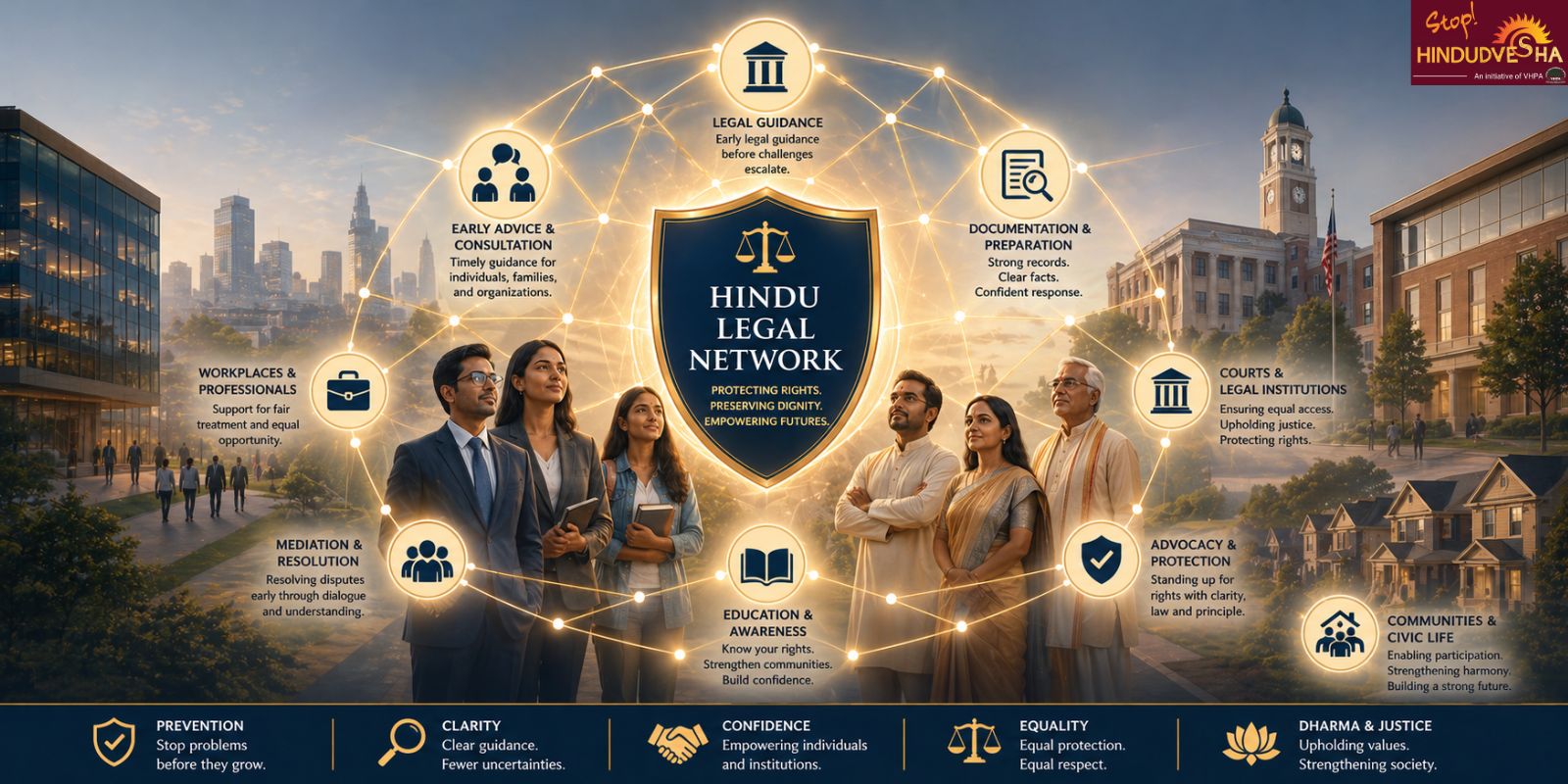
Summary
This article argues that legal vulnerability within Hindu American communities often emerges long before formal litigation, through reputational pressure, institutional hesitation, and uncertainty surrounding religious expression. Using examples such as the Deepa Karthik controversy, the Cisco caste lawsuit, temple zoning disputes, and the BAPS federal investigation, the article identifies a recurring pattern in which allegations and public narratives lead to consequences before legal resolution. These dynamics can encourage self-censorship, reduce institutional visibility, and weaken confidence in civic participation. The article proposes a proactive Hindu legal network as a practical solution. Modeled on legal-response systems used by other minority communities, such a network would provide early consultation, mediation, documentation support, and targeted intervention. Its purpose would not be confrontation, but prevention, clarity, and equal access to legal confidence.
Legal vulnerability in minority communities rarely begins with a dramatic courtroom battle. More often, it emerges quietly through uncertainty, reputational pressure, and institutional hesitation that accumulate long before any formal dispute reaches a judge. Individuals begin adjusting their behavior not because they have violated any rule, but because they are unsure how their identity, beliefs, or associations will be interpreted in increasingly sensitive public environments.
In May 2025, Deepa Karthik, Vice President of the South Brunswick Board of Education in New Jersey, posted a personal social media comment expressing religious concerns about the widespread use of Halal certification on consumer products. The response was swift. She was removed from committee assignments, publicly criticized, and later filed a complaint with the Foundation Against Intolerance & Racism (FAIR), alleging viewpoint discrimination. As documented in the Stop Hindu Dvesha article “The Silencing of Deepa Karthik—and the Collapse of Equal Protection,” [1] the controversy raised broader questions about whether similar expressions by members of other faith communities would have produced the same institutional consequences.
Cases like this reveal a recurring dynamic that extends beyond any single controversy. Across schools, workplaces, universities, and local institutions, Hindu Americans increasingly encounter environments where cultural or religious expression may carry reputational risk. The result is rarely immediate litigation. Instead, it produces hesitation, softened visibility, and a growing tendency toward self-censorship. Community members begin weighing whether public participation, institutional involvement, or visible religious identity may invite scrutiny that others do not face.
When early legal guidance is absent, these pressures rarely remain isolated. Small incidents become precedents, uncertainty becomes normalized, and communities gradually adapt by becoming less visible. A standing Hindu legal network is not designed primarily for courtroom battles. Its value lies earlier in the process: providing guidance, clarification, and institutional confidence before minor conflicts evolve into lasting exclusion or reputational harm.
Documented Patterns – Where Legal Protection Falls Short
These concerns are not hypothetical. Over the past several years, a series of high-profile incidents has revealed a recurring pattern in which Hindu Americans experience reputational harm, institutional friction, or unequal scrutiny long before any formal legal resolution occurs. The cases differ in context, but they share a common feature: the most severe consequences often arise during the period between accusation and adjudication.
In the workplace, the caste discrimination lawsuit involving Cisco Systems became one of the most visible examples. [2] The California Civil Rights Department publicly pursued claims against two Indian-origin engineers, framing the dispute within a broader narrative linking Hindu identity and caste hierarchy. Although claims against the individuals were dismissed in 2023, the reputational impact had already taken hold. Media coverage and advocacy narratives extended far beyond the specifics of the case, reinforcing generalized assumptions about Hindu social identity.
Similar institutional dynamics appear in civic and public-facing environments, where reputational concerns can quickly override procedural neutrality.
Temple development disputes reveal a different but equally significant pattern. In places such as Chino Hills, California; Paramus, New Jersey; and Bridgewater, New Jersey, Hindu temple projects faced prolonged zoning battles, repeated hearings, and years of administrative delays. [3] [4] [5] While land-use conflicts are not unique to Hindu institutions, the cumulative effect of repeated procedural resistance creates a perception that Hindu organizations must repeatedly justify their legitimacy in ways that comparable religious communities may not.
University environments present another layer of vulnerability. Hindu student organizations and cultural groups have increasingly reported informal labeling as “nationalist,” “extremist,” or “Hindutva-linked,” even when programming focuses on religion, language, festivals, or philosophy. These labels may not carry formal penalties, but they shape campus climate, speaker approvals, and institutional willingness to engage.
The 2021 federal investigation into the BAPS Swaminarayan Sanstha temple construction project in Robbinsville, New Jersey, illustrates how reputational narratives can outlast legal outcomes. Allegations of forced labor and trafficking generated widespread media attention. Yet after years of scrutiny, the criminal investigation concluded without charges. Despite that outcome, the public association between the institution and the allegations continued to persist. [6]
Across these examples, the most significant damage rarely comes from a final ruling. It occurs earlier, through public framing, institutional caution, and prolonged uncertainty. This gap between accusation and resolution is precisely where early legal guidance can matter most.
The Real Damage – Self-Censorship
The most lasting consequences of these incidents are often invisible. Legal disputes may end, headlines may fade, and institutions may move on, but the behavioral effects within communities remain. When people repeatedly observe reputational fallout attached to public religious identity, they begin adjusting their conduct long before any direct pressure reaches them personally.
This creates a gradual culture of self-censorship. Parents become hesitant to encourage visible expressions of faith in schools. Professionals avoid highlighting temple involvement or Hindu organizational affiliations in public-facing settings. Community leaders grow cautious about hosting speakers, expanding programs, or taking public positions on sensitive issues. Student groups simplify cultural events to avoid controversy, while institutions moderate their visibility to reduce scrutiny.
Unlike formal discrimination, self-censorship rarely produces a clear legal record. It emerges through anticipation rather than punishment. Individuals begin pre-screening their own behavior, weighing whether participation in religious or cultural life may invite misunderstanding, labeling, or professional risk. Over time, this turns ordinary civic engagement into a strategic decision rather than a natural exercise of identity.
For minority communities, this effect is particularly significant because it reshapes behavior without requiring overt coercion. The fear of controversy often becomes more powerful than explicit restriction. Communities adapt by becoming quieter, less assertive, and more reluctant to occupy public space. Religious expression remains technically protected, but confidence in exercising that freedom steadily declines.
The long-term cost is institutional as much as personal. Temples scale back expansion efforts. Organizations reduce public programming. Emerging leaders hesitate to step into visible roles. A community that expects scrutiny begins organizing around caution rather than confidence. In this environment, legal vulnerability is not defined only by cases won or lost. It is measured by how much participation quietly disappears before conflict ever becomes visible.
The Solution – A Proactive Hindu Legal Network
If the central problem is delayed protection, then the solution must begin earlier than litigation. A Hindu legal network would not exist primarily to file lawsuits or pursue large court battles. Its purpose would be preventive: offering timely guidance when uncertainty first appears, before reputational harm, institutional escalation, or prolonged conflict takes hold.
The proposed model would consist of a nationally coordinated network of approximately 20 to 30 attorneys with expertise in civil rights, employment law, education, land use, religious liberty, and nonprofit governance. Rather than functioning as a traditional advocacy organization, the network would operate as an accessible first-response system. Individuals, temples, student organizations, and community leaders could seek early consultation when facing institutional pressure, policy disputes, or potential discrimination.
Its role would remain intentionally practical. Many situations do not require litigation. Often, a clarifying legal letter, policy explanation, mediation effort, or early documentation strategy can prevent escalation. A teacher’s restriction on religious expression, an employer’s questionable request, a zoning dispute, or a university labeling controversy may be addressed more effectively through rapid intervention than through years of adversarial proceedings.
The value of such a network extends beyond the cases it handles directly. Its existence changes incentives. Institutions are more likely to proceed carefully when they know affected communities have organized legal guidance available. Community members gain confidence when they know uncertainty does not have to be navigated alone. Access to early expertise reduces fear-driven withdrawal and helps individuals respond from a position of clarity rather than hesitation.
Importantly, this model does not depend on constant confrontation. Its strength lies in quiet competence. Many disputes can be resolved through early communication, procedural correction, or policy clarification long before public escalation becomes necessary. A proactive legal network, therefore, serves not only as defense but as a stabilizing mechanism that allows communities to remain visible, engaged, and institutionally confident.
Proven Models from Other Communities
The idea of an organized legal support network is not novel. Several minority communities in the United States have built durable legal infrastructures that focus on early intervention, rapid response, and institutional engagement rather than relying solely on high-profile litigation. These models demonstrate that consistent legal presence often prevents escalation more effectively than reactive lawsuits alone.
The Anti-Defamation League (ADL), founded in 1913, has long combined monitoring, education, and rapid legal intervention to combat antisemitism. Through clarifying letters, mediation, public advocacy, and strategic amicus briefs, it resolves many incidents before they escalate into costly litigation.[7]
The Council on American-Islamic Relations (CAIR) operates a nationwide civil rights infrastructure that handles thousands of cases annually. It provides free referrals, negotiates with institutions, and applies targeted pressure — successfully resolving the majority of matters through clarification and mediation rather than court battles.[8]
The Sikh American Legal Defense and Education Fund (SALDEF) similarly offers rapid-response and pro bono support for Sikhs facing workplace and school bias, particularly regarding religious accommodations. Its focus on early intervention has built lasting resilience.[9]
These organizations differ in mission and scale, but they share a common principle: legal confidence is most effective when it exists before a crisis. Communities benefit not only from litigation capacity but also from accessible guidance, clear escalation pathways, and reassurance that they will not face institutional pressure in isolation.
For Hindu Americans, the absence of comparable infrastructure creates a significant gap. Existing advocacy organizations perform important work, but a dedicated legal-response network focused on early intervention would provide a distinct layer of support. It would normalize consultations, encourage documentation, and establish a framework for responding to recurring issues consistently rather than improvising.
Feasibility, Funding, and Challenges
Implementing this network is realistic with focused planning. Annual operating costs would likely range between $1–2 million, covering a national hotline, case management system, attorney training, and coordination. A phased rollout — starting in high-density states like New Jersey, California, and Texas — would allow refinement before national expansion.
Funding would come primarily from diaspora philanthropy, major donors, and community endowments. Hindu bar associations, alumni networks, and professional volunteers can provide substantial pro bono capacity and expertise.
Challenges include recruiting geographically and denominationally diverse attorneys, navigating variations in state law, ensuring confidentiality, and managing caseloads. These can be addressed through clear intake protocols, inclusive advisory councils, transparent guidelines, and digital self-help tools.
The objective is not to create a large bureaucracy. It is to establish a reliable first layer of legal support that communities can access quickly, before uncertainty becomes escalation.
Conclusion – Legal Confidence as Civic Foundation
In an era of rising anti-Hindu bias — from temple vandalism to subtle institutional pressures — legal confidence is not optional. It is foundational for full participation in American civic life.
Without early, accessible legal support, every cultural assertion, temple project, school board candidacy, or public expression of faith carries unnecessary risk. The patterns are clear. The costs of inaction are real.
A dedicated Hindu legal network, modeled on proven precedents and tailored to community needs, offers a practical, dignified path forward. It replaces fear and self-censorship with preparedness and resilience.
Hindu Americans increasingly possess institutional visibility, civic participation, and cultural confidence. What remains underdeveloped is the legal infrastructure needed to protect that presence when pressure emerges. A standing legal network would not create confrontation; it would create certainty. It would ensure that participation in American public life no longer depends solely on an individual’s willingness to absorb risk.
Citations
[1] Bansal, Jai G. “The Silencing of Deepa Karthik—and the Collapse of Equal Protection.” Stop Hindu Dvesha, April 25, 2026. https://stophindudvesha.org/the-silencing-of-deepa-karthik-and-the-collapse-of-equal-protection/
[2] “California CRD Repeatedly Violated the U.S. Constitution in the Cisco Caste Lawsuit.” Stop Hindu Dvesha. https://stophindudvesha.org/california-crd-repeatedly-violated-the-us-constitution-in-the-cisco-caste-lawsuit/
[3] Martin, Hugo. “Hindu Temple Plan Divides Chino Hills.” Los Angeles Times, October 7, 2004. https://www.latimes.com/archives/la-xpm-2004-oct-07-le-hindu7.1-story.html
[4] “Paramus Zoning Board Unanimously Rejects Hindu Temple Expansion,” NorthJersey.com, May 9, 2024, https://www.northjersey.com/story/news/bergen/paramus/2024/05/09/paramus-zoning-board-unanimously-rejects-hindu-temple-expansion/73633175007/
[5] David Giambusso, “After Long Legal Battle, Hindu Temple in Bridgewater Wins Expansion Approval,” NJ.com / The Star-Ledger, May 3, 2009, https://www.nj.com/news/local/2009/05/after_long_legal_battle_hindu.html
[6] Bansal, Jai G. “Tried by the Media, Vindicated by DOJ: The BAPS Forced-Labor Case and a Failure of Fairness.” Stop Hindu Dvesha, October 12, 2025. https://stophindudvesha.org/tried-by-the-media-vindicated-by-doj-the-baps-forced-labor-case-and-a-failure-of-fairness/
[7] Anti-Defamation League, “Our Mission and History,” ADL.org, accessed April 29, 2026, https://www.adl.org/about/mission-and-history
[8] Council on American-Islamic Relations, “2026 Civil Rights Report: The Right to Be Different,” CAIR.com, March 10, 2026, https://www.cair.com/resources/cair-civil-rights-reports/
[9] Sikh American Legal Defense and Education Fund, “About SALDEF,” SALDEF.org, accessed April 29, 2026, https://saldef.org/about/

Donate to HINDUDVESHA
Our Mission is to explore and expose Hindudvesha through research analysis, education and response.
SUPPORT US