

Tried by the Media, Vindicated by DOJ: The BAPS Forced-Labor Case and a Failure of Fairness
 Dr. Jai G. Bansal · 10/12/2025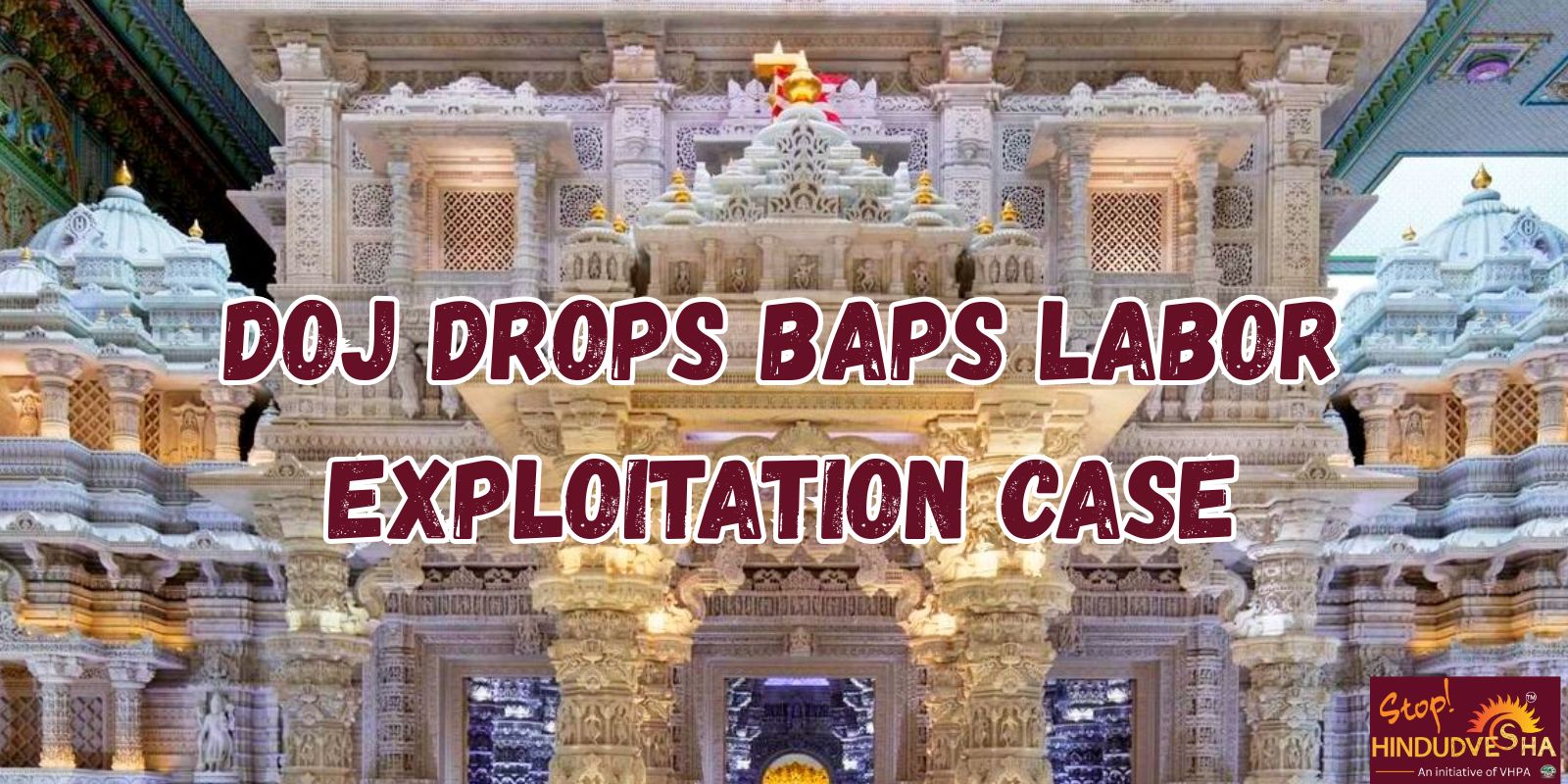
- The 2021 raid and lawsuit triggered headlines alleging “slavery” and “trafficking” at BAPS; the narrative quickly treated accusations as facts, framing a Hindu temple as a crime scene.
- Core Hindu practices like seva (selfless service) were misread as servitude; advocacy groups and activists amplified a caste-oppression storyline calibrated for media impact rather than evidence.
- Attorney-driven lawfare packaged unverified claims; networks echoed them, while municipal code issues were folded into a moral indictment, reinforcing suspicion without proving trafficking.
- The case later unraveled—numerous plaintiffs withdrew and, in 2025, the DOJ found no evidence of trafficking—yet coverage of exoneration was muted and public perceptions lagged.
- Consequences persisted: reputational harm to BAPS, stigma for Hindu Americans, and no accountability for the lawyer, syndicates, or media that amplified falsehoods—underscoring how easily minority communities can be tried by narrative rather than fact.
In May 2021, federal agents descended on the sprawling BAPS temple site in Robbinsville, New Jersey. Within hours, headlines accused one of the world’s largest Hindu organizations of human trafficking, exploitation, and even slavery.[1] The image of a revered religious institution under federal investigation cast a long, dark shadow over BAPS, the Hindu-American community, and the thousands who had contributed to the construction of Akshardham as an offering of faith. For four years, that shadow lingered.
Now, in September 2025, the case has been closed with a clear conclusion: there was no evidence of trafficking, forced labor, or wrongdoing.[2] The Department of Justice, after an exhaustive review, has withdrawn. What began as one of the most sensationalized religious controversies in recent American memory has ended in silence, with truth and vindication buried under years of innuendo.
This article revisits the entire arc of the BAPS case—from the dramatic allegations to the quiet closure. It explores how sensational claims collapsed under scrutiny, how narratives of caste and exploitation were manufactured, how the media amplified accusations but ignored exoneration, and what lessons remain for Hindu Americans and for the republic itself.
Allegations and Media Frenzy
The storm began in May 2021, when federal agents descended on the BAPS Swaminarayan Akshardham construction site in Robbinsville, New Jersey. Within hours, headlines exploded across national and international media: Hindu temple accused of “slavery” and “human trafficking” in the United States.[3] [4] [5] [6][7]The timing of the raid was no coincidence—it coincided with the filing of a civil lawsuit that alleged BAPS had trafficked hundreds of men from India, forced them into grueling labor for a dollar an hour, and confiscated their passports.
The complaint went even further, invoking caste discrimination and suggesting that Dalit workers had been deliberately targeted. This framing was tailor-made for maximum resonance. It allowed the story to be packaged as one of modern slavery, religious hypocrisy, and caste oppression transplanted to American soil. Reporters seized upon it with little hesitation.
From the outset, the distinction between allegation and fact all but vanished. Headlines and broadcasts used words like “slaves,” “trafficked,” and “exploited” without qualification. Photographs of the temple—a monument built through years of community devotion—were juxtaposed with terms like “forced labor camp,” ensuring that for much of the public, Akshardham became synonymous with abuse.
Few journalists paused to ask basic questions. How plausible was it that hundreds of men could be trafficked in plain sight, under the scrutiny of local, state, and federal authorities? Was there a cultural context behind seva—the Hindu tradition of selfless service—that might distinguish it from wage labor? Could it be that the story was not merely uncovered but actively shaped by ideological framing? These questions were rarely raised because the trafficking narrative was too sensational to resist.
The bias ran deeper than headline-writing. American media and advocacy groups interpreted Hindu practice through a narrow lens of caste and exploitation. Seva was stripped of its spiritual meaning and recast as a form of servitude. Voluntary service became evidence of coercion; devotion became a crime. This misrepresentation did not arise by accident—it reflected a broader pattern of treating Hindu institutions with suspicion, and of filtering unfamiliar practices through frameworks of hierarchy and abuse.
Impact on Community and Reputation
The consequences of this storm were immediate and painful. BAPS volunteers found themselves fielding hostile questions in their neighborhoods, schools, and workplaces. Devotees who had once proudly invited friends to the temple now hesitated, unsure whether outsiders would see it as a house of worship or a crime scene.
For Hindu Americans more broadly, the damage cut deep. One of the community’s most visible and admired institutions was suddenly recast as an emblem of exploitation. Families celebrating Diwali or wearing traditional symbols of faith felt the sting of suspicion. The headlines did not stay confined to Robbinsville—they followed Hindu Americans everywhere, attaching stigma to their faith identity.
Local scrutiny magnified the pressure. Robbinsville officials cited BAPS for code violations related to worker accommodation and safety standards. In ordinary circumstances, such infractions would have been treated as routine matters in the course of a large-scale project. But in the shadow of trafficking allegations, they were recast as corroborating evidence of systemic abuse. What should have been seen as administrative oversight became part of a moral indictment.
Even when the case began to collapse with no evidence of trafficking, the harm to the community persisted. Accusation had been spectacular; vindication came quietly. The stain lingered, shaping perceptions long after the facts had shifted.
For many Hindu Americans, the lesson was sobering: in the court of public opinion, their community could be presumed guilty until proven innocent—and even then, innocence might not be enough to erase the shadow of suspicion.
The Lawyer’s Role: Manufacturing a Narrative
According to multiple reports, attorney Swati Sawant’s role extended well beyond routine filings. From the outset, her legal strategy was portrayed as less about establishing verifiable facts and more about crafting a sweeping narrative calibrated for media and activist networks. The complaint itself was described as reading like a manifesto, laden with language about caste oppression, trafficking, and slavery—terms with immediate moral force but, as reported, unsupported by rigorous proof that ultimately failed to materialize.[8] [9]
Multiple plaintiffs later alleged that Sawant and her associates had coached them into making claims they did not fully understand, promising benefits and protections if they cooperated. Some described how their statements were crafted to fit a narrative that would garner maximum attention in the press and sympathy from advocacy groups. Such tactics may have served her short-term objective of generating headlines, but they raised serious questions about the ethics of using vulnerable individuals as instruments in a broader ideological agenda.
By framing seva as forced labor and recasting Hindu religious life in the idiom of exploitation, Sawant effectively weaponized America’s legal system against a faith community. She did so not by carefully building a case, but by importing stereotypes of caste and servitude into a context where they did not belong. The eventual collapse of the case exposed not only the weakness of the claims but also the recklessness of the lawyer who had packaged them. What was presented as a fight for justice increasingly appeared to be an exercise in narrative engineering.
Organized Syndicates and Narrative Engineering
The BAPS case was amplified not by chance but by design—through a coalition of organizations that together manufactured a compelling but misleading story. At the center was Equality Labs, which issued a bold press release framing the case as a “grave caste discrimination” incident and used hyperbolic claims of “$1-an-hour forced labor” to stoke outrage. Their tone moved quickly from allegation to moral certitude, setting the agenda for media and public discussion.[10]
Hindus for Human Rights (H4HR) played an equally damaging role. Widely recognized as a proxy for George Soros’s Open Society, the group cloaks itself in a name suggesting advocacy for Hindus, yet it neither represents Hindu interests nor upholds genuine human rights. In the BAPS case, H4HR uncritically echoed the trafficking and exploitation rhetoric, reinforcing a false narrative instead of interrogating facts. By amplifying these claims, it helped convert unproven allegations into seemingly credible charges, providing cover for a broader campaign of distortion.[11] [12]
Into this mix stepped the Ambedkar King Study Circle (AKSC), which consistently frames caste discrimination in America as a systemic oppression requiring aggressive redress. AKSC’s messaging in this case not only identified BAPS as a symbol of “caste apartheid” but positioned themselves as moral arbitrators in an American context deeply unfamiliar with India’s social dynamics. Their contributions included public statements, social media campaigns, and framing guides that media and lawfare actors could reuse.[13]
These actors did not merely support one another; they operated as parts of a coordinated ecosystem. Legal documents quoted activist framings; media covered activist talking points as if they were neutral facts; and public opinion was steered by repeated refrains of caste abuse. Even as the case against BAPS began unraveling, the syndicate’s echo chamber continued pushing the narrative, rarely acknowledging errors or retractions.
Because these organizations presented themselves as guardians of civil rights, their amplification was especially powerful. They turned the case from a contested legal matter into a moral movement, making dissent appear as complicity. Yet their credibility remains untested: they offered little correction when the case collapsed. In the end, the BAPS mess was not just a failed lawsuit but a testament to how advocacy networks, media, and lawyering can combine to defame a community under the guise of justice.
Seva, Misrepresentation, and the Crumbling Case
From the very beginning, BAPS firmly rejected the framing of its volunteers as trafficked laborers. The organization explained that the men from India were engaged in seva—a Sanskrit term meaning selfless service. In Hindu tradition, seva is not employment but an offering of devotion. Volunteers dedicate their time and labor to temple projects, kitchens, schools, and hospitals worldwide as an expression of their faith. They typically receive food, lodging, and community care, but the act itself is understood as spiritual, not contractual.
BAPS emphasized that the men working in Robbinsville were long-standing members of the community who had willingly traveled to the U.S. to help build a sacred monument. The idea that they were coerced victims reflected, in their view, a fundamental misunderstanding of Hindu practice. To equate seva with servitude was not only inaccurate but also insulting to a tradition that regards selfless service as one of the highest forms of devotion.
As the case progressed, cracks in the allegations began to show. Of the nineteen individuals named as plaintiffs in the original lawsuit, twelve eventually withdrew their claims.[14] [15] [16] Several returned to India and spoke to local media, revealing that they had been misled or pressured into participating. Some admitted they did not fully understand the legal documents they had signed, while others described being coached to fit a narrative of trafficking and exploitation.
These retractions struck at the very core of the lawsuit. What had been presented as the testimony of nearly twenty abused workers now looked fractured and unreliable. For BAPS, this development confirmed what it had maintained all along: that the case was constructed on distortions and half-truths.
Yet the withdrawals attracted little attention in mainstream American coverage. The sensational accusations of 2021 were treated as fact, but the unraveling of those claims barely registered. This imbalance left the public with a frozen image of guilt, even as the factual foundation collapsed.
For BAPS and the broader Hindu-American community, the episode was both vindication and warning. The truth was emerging, but it was emerging too quietly, overshadowed by the louder echo of accusation.
DOJ Closure: Vindication at Last
In September 2025, the Department of Justice quietly announced what BAPS and many in the Hindu community had known all along: there was no evidence of human trafficking, forced labor, or criminal wrongdoing at the Robbinsville temple. After four years of intense scrutiny, the government walked away without charges.[17]
The announcement lacked the drama of the 2021 raid. There were no flashing headlines, no breathless news segments, no international coverage. Instead, vindication came quietly, in a brief statement, almost buried in bureaucratic language. Yet for those who had endured years of suspicion, the meaning was profound.
For BAPS, the closure was more than legal relief—it was moral exoneration. The case that had threatened to define the organization’s identity in America had collapsed. What remained was not guilt, but a sobering lesson: in an age of instant outrage, accusations echo louder than the truth.
Indictment of a Broken System
The closure of the BAPS case is more than the end of a lawsuit—it is an indictment of how America’s institutions can fail a peaceful minority. A Hindu religious organization was raided, shamed, and slandered in the press, only to be quietly cleared years later. That trajectory should trouble anyone who believes in fairness.
The legal system was the first weapon drawn. Attorney Swati Sawant stitched together unverified claims into a sweeping narrative designed to inflame rather than prove. She coached vulnerable individuals, misrepresented seva as servitude, and handed activist groups a ready-made script of trafficking and caste oppression. Those groups then recycled her allegations as fact, turning the courts into theaters of ideology rather than forums of justice. This was not the pursuit of truth—it was lawfare designed to generate headlines, leaving a peaceful minority community defenseless against distortion.
The media became the echo chamber. Outlets such as the Associated Press rushed to print the most incendiary charges, branding BAPS guilty before a shred of evidence had been tested. Words like “slavery” and “trafficking” dominated headlines, while basic context about Hindu practices was ignored. When the case finally collapsed years later, exoneration was covered only in muted tones. Accusation was front-page news; vindication a buried footnote. By privileging spectacle over accuracy, the press ceased to inform and instead deepened prejudice, leaving Hindu Americans stigmatized long after the facts had unraveled.
Yet even after the Department of Justice closed the case in BAPS’s favor, accountability has been nonexistent. Sawant has not been called to answer for her unprofessional conduct, nor has there been any discussion of whether her license should be suspended or revoked. The activist syndicates that once trumpeted her charges have remained shamelessly silent, offering neither retraction nor apology. The media, which plastered allegations across headlines, has been equally mute in the face of exoneration, refusing to correct the record or acknowledge the harm done. A campaign that inflicted years of stigma on an innocent community has ended without a single consequence for those who engineered and amplified it.
At its core, the BAPS saga reveals how bias can masquerade as principle. Hindu Americans—a community known for seva, peace, and civic contribution—were cast as exploiters because it fit a ready-made script of caste and servitude. Their dignity was collateral damage in a larger ideological campaign.
Above all, this case is a warning. Religious liberty, though guaranteed by the Constitution, is not immune from erosion when prejudice shapes narratives. If America is to live up to its founding promise, it must guard against such miscarriages, where minorities are tried in the court of public opinion and vindication arrives too late to undo the harm.
Conclusion: Truth Alone Triumphs
From the dramatic raid of 2021 to the quiet closure of 2025, the BAPS case charts a revealing arc—how sensational allegations can dominate public discourse, and how exoneration struggles to find its voice. Yet despite the noise, truth has prevailed. The Department of Justice confirmed what the Hindu community had long maintained: there was no trafficking, no slavery, no crime. For BAPS, vindication restores dignity; for Hindu Americans, it affirms the right to practice faith without stigma. The motto inscribed in India’s emblem says it best: Satyameva Jayate—Truth Alone Triumphs.
Citations
[1] Hindu temple in New Jersey accused of ‘shocking violations’ in forced-labor lawsuit (NBC News, May 2021); https://www.nbcnews.com/news/us-news/hindu-temple-new-jersey-accused-shocking-violations-forced-labor-lawsuit-n1267041
[2] DOJ drops forced labor case against largest Hindu temple in America (Religious News Service, September 2025); https://religionnews.com/2025/09/19/doj-drops-forced-labor-case-against-largest-hindu-temple-in-america/
[3] Human Trafficking Allegations Thrust Caste Into Spotlight For American Hindus (NPR, June 2021); https://www.npr.org/2021/06/03/1002547517/human-trafficking-allegations-thrust-caste-into-spotlight-for-american-hindus
[4] Lawsuit Says About 200 Workers At New Jersey Hindu Temple Were Forced Into Manual Labor For Just Over $1 An Hour(CBS News, May 2021); https://www.cbsnews.com/newyork/news/robbinsville-baps-hindu-temple-lawsuit-manual-labor-human-trafficking/
[5] Hindu Sect Is Accused of Using Forced Labor to Build N.J. Temple (The New York Times, May 2021); https://www.nytimes.com/2021/05/11/nyregion/nj-hindu-temple-india-baps.html
[6] FBI agents raid Robbinsville BAPS temple after labor lawsuit (Community News, May 2021); https://www.communitynews.org/towns/robbinsville-advance/fbi-agents-raid-robbinsville-baps-temple-after-labor-lawsuit/article_c5eed9df-e58a-5286-9369-0941cdc9d59a.html
[7] Doors, other exits blocked at house where 33 volunteers for Hindu temple lived, officials say (NJ.Com, April 2023); https://www.nj.com/news/2023/04/doors-other-exits-blocked-at-house-where-33-volunteers-for-hindu-temple-lived-officials-say.html
[8] Swaminarayan Temple USA: BAPS Win legal battle, labourers withdraw US Lawsuit regarding discrimination (Organiser, July 2023); https://organiser.org/2023/07/18/184360/bharat/swaminarayan-temple-usa-baps-win-legal-battle-labourers-withdraw-us-lawsuit-regarding-discrimination/
[9] Swati Sawant, representing the artisans, repeatedly intimidated, threatened them should they tell the truth (CoHNA on X, July 2023); https://x.com/CoHNAOfficial/status/1680290361007013888
[10] Equality Labs Supports Dalit Workers in New Jersey BAPS Case (Equality Labs, May 2021); https://www.equalitylabs.org/media/2021/05/equality-labs-supports-dalit-workers-in-new-jersey-baps-case/
[11] If God is everywhere, I do not need to enter the @BAPS #NJ temple, whose construction required the suffering and exploitation of hundreds of Dalit labourers have suffered, and the death of at least one (Sunita Viswanath on X, October 2023); https://x.com/SunitaSunitaV/status/1711019013227045191
[12] The investigation into the BAPS Robinsville temple’s alleged abuse of mostly Dalit workers is still ongoing. To characterize it as a “raid” on “false grounds” is preposterous (Sunita Viswanath on X, September 2025); https://x.com/SunitaSunitaV/status/1964793361078034767
[13] FAQ about the BAPS Case (Ambedkar King Study Circle); https://akscusa.org/faq-about-the-baps-case/#What%20were%20the%20conditions%20of%20work%20at%20the%20BAPS%20temple%20in%20Robbinsville,%20NJ?
[14] 12 workers retract claims in BAPS Akshardham Robbinsville lawsuit (Diya TV, October 2023); https://diyatvusa.com/12-workers-retract-claims-in-baps-akshardham-robbinsville-lawsuit/
[15] Swaminarayan Temple USA: BAPS Win legal battle, labourers withdraw US Lawsuit regarding discrimination (Organiser, September 2025); https://organiser.org/2023/07/18/184360/bharat/swaminarayan-temple-usa-baps-win-legal-battle-labourers-withdraw-us-lawsuit-regarding-discrimination/
[16] A Dozen Artisans Withdraw From Case Against BAPS (India West Journal, July 2023); https://indiawest.com/a-dozen-artisans-withdraw-from-case-against-baps/
[17] Announcement from BAPS North America (BAPS North America, September 2025); https://na.baps.org/news/announcement

Donate to HINDUDVESHA
Our Mission is to explore and expose Hindudvesha through research analysis, education and response.
SUPPORT US