

Delhi Gymkhana Club Row: Dismantling the Last Bastions of Colonial Privilege
 Rati Agnihotri · 07/05/2026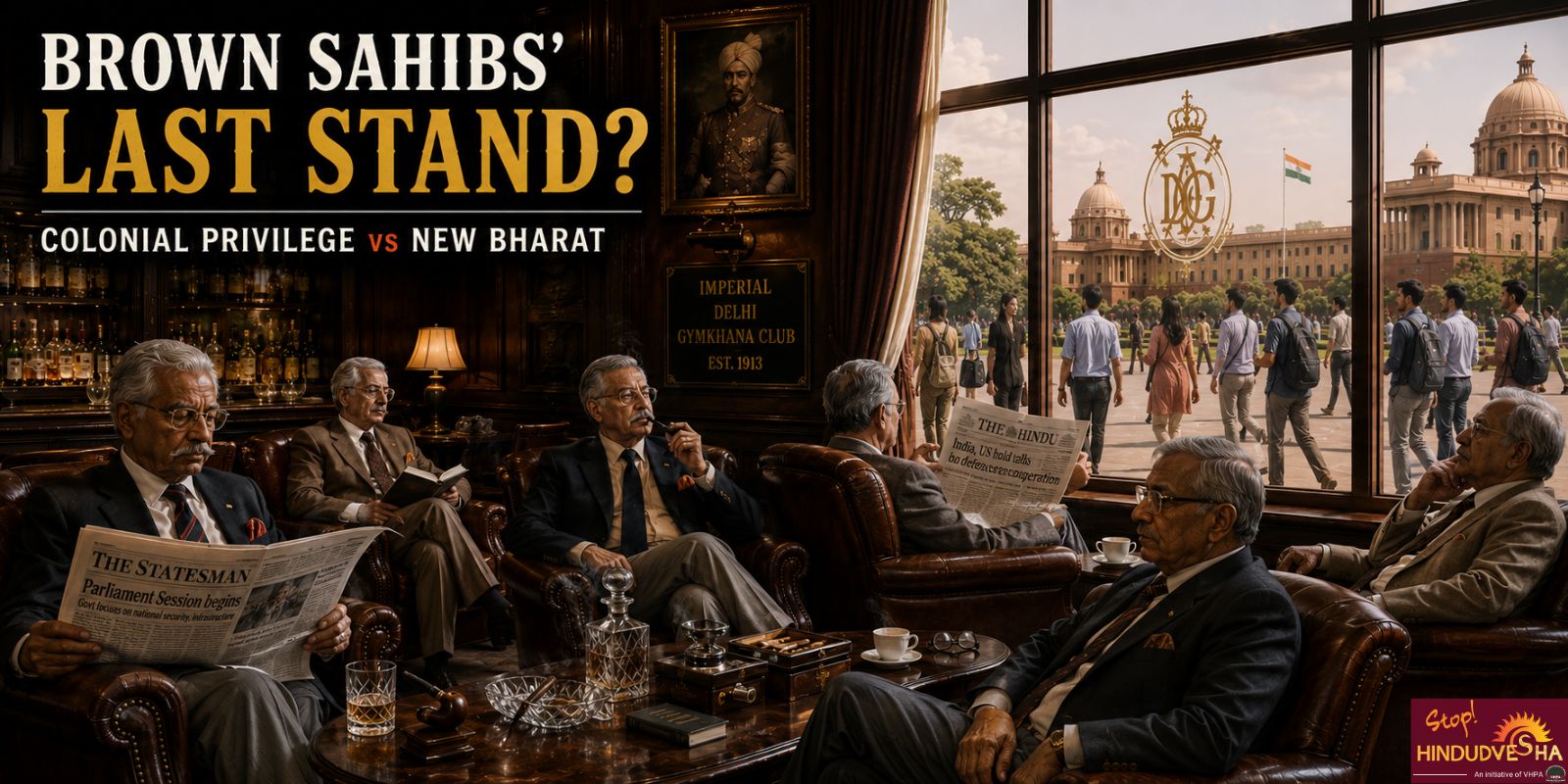
Summary
As India experiences a powerful civilizational reawakening, the government’s directive to vacate the Delhi Gymkhana Club’s prime Lutyens Delhi premises has ignited a sharp debate. The 113-year-old colonial-era club, originally the Imperial Delhi Gymkhana Club, symbolizes the persistence of hereditary privilege, opaque membership, and minimal rent paid to the government despite its elite status.
Critics argue that the club represents an outdated colonial relic that has no place in a merit-driven New India. While the Lutyens elite defends it as “heritage,” the controversy highlights the deeper conflict between colonial hangover and Bharat’s indigenous resurgence. The episode raises fundamental questions: should colonial-era institutions continue enjoying prime public land and special privileges, or is it time to retire the last bastions of such exclusivity in a decolonizing nation?
As India undergoes a profound civilizational and cultural reawakening, it also battles the classic Dr. Jekyll and Mr. Hyde syndrome. The archetypal civilizational tussle between old India and new India is becoming more pronounced. The old India of the colonial elite and the Lutyens ecosystem — where the brown sahibs zealously carry on the legacy of the former colonial masters through dated customs, archaic mannerisms, hierarchical patterns, coded rituals, and elite gatekeeping apparatuses — sits increasingly at odds with the new India, represented by the revival of Bharat’s ancient civilizational and cultural identity.
In old India, colonial hangover passes off as heritage and culture remains a mythical construct of the Lutyens elite. In new India, the beliefs, practices, and value system of the common people constitute culture, while heritage is firmly rooted in indigenous traditions and thought paradigms.
This growing divide finds sharp expression in the current row over the Union government’s directive asking the Delhi Gymkhana Club to vacate its premises in Lutyens Delhi on national security grounds.
The Lutyens elite’s fierce defense of the privilege enjoyed by this colonial relic shows how strongly the old guard continues to insist that India’s civilizational identity must remain shaped by its colonial past. On the other side stands the public sphere of new India, where ordinary citizens increasingly believe that modern India has no place for such colonial relics.
Eviction Order Rocks Lutyens Elite
The Government of India recently ordered the elite Delhi Gymkhana Club to vacate its sprawling 27.3-acre premises in the heart of posh Lutyens’ Delhi by June 5. The government justified the eviction on the grounds that the club is situated in a “highly sensitive and strategic area” and that the land is urgently required to strengthen defense infrastructure, governance facilities, and public-interest projects. The directive triggered widespread outrage among club members, leading to a legal battle in the Delhi High Court. The court refused interim relief to the club but recorded the government’s assurance that no coercive eviction would occur without due legal process and prior notice. [1] [2]
The Delhi Gymkhana is no ordinary elite club. It is a colonial-era relic built on exclusivity rooted in hereditary privilege. The 113-year-old institution has a waiting list of at least 30 years. Its membership criteria remain opaque and often whimsical. According to media reports, even substantial wealth or impressive credentials cannot guarantee entry into this heavily insulated citadel of colonial-era privilege. Marketed as a symbol of India’s heritage, the club is actually a fading relic of hereditary privilege, where membership is often determined by the “right bloodline” or the “right connections”. This colonial edifice, located at the center of independent India’s elite power corridors, has long hosted Cabinet ministers, retired Generals, judges, corporate heavyweights, and diplomats. [3] [4]
This episode brings into focus deeper questions about privilege and power that extend far beyond the club’s walls.
The Gymkhana Club’s Colonial Roots
In the backdrop of an India that is becoming increasingly comfortable with its indigenous cultural identity and civilizational heritage, where elite structures of social capital and cultural hegemony are fast crumbling to make way for a people’s culture marked by meritocracy and hard work, structures like the Delhi Gymkhana Club stand out as a civilizational anomaly. They symbolize an era of brute privilege that mirrors the colonial dystopia of “Dogs and Indians Not Allowed” in implicit ways. The elite markers — evaluating how perfectly the brown sahibs have internalized colonial codes of sophistication and elite behavior, along with their “pedigree” — continue to guard the entry points to this citadel. Celebrating its exclusionary privilege as heritage, the Lutyens elite’s strong opposition to the government’s decision to reclaim the site only recreates a colonial-era social and cultural hierarchy that remains inaccessible to most Indians, precisely because of their Indianness.
The Delhi Gymkhana Club was founded in 1913 during British colonial rule. It was originally called the “Imperial Delhi Gymkhana Club”. British colonial administrator Spencer Harcourt Butler served as its first President. After India gained independence in 1947, the word “Imperial” was removed from its title. The colonial government had leased the land to the club in February 1928. Even today, the club pays a ridiculously meager Rs 1,000 per year in rent to the government, while its membership fees typically exceed 2 million rupees annually. [5] [6] [7]
These facts highlight the deeper contradictions that this episode has brought to the surface.
The Brown Sahibs’ Fortress
The Lutyens elite’s reaction to the Delhi Gymkhana Club row reflects the typical patterns of an old aristocracy’s superiority complex. Those who have risen through hard work and merit are often contemptuously dismissed as “nouveau riche”, seen as a stain on the refined worldview of the brown sahibs.
Even more concerning is that colonial-era structures like the Delhi Gymkhana Club have evolved into parallel power centers. While serving as exclusive networking spaces for the Lutyens elite — which includes members of the administrative and political establishment — these clubs function as echo chambers of a Nehruvian-era colonial worldview that is increasingly at odds with India’s changing civilizational narrative and its ongoing cultural reawakening. [8]
Many observers argue that the Delhi Gymkhana Club came to symbolize the seamless transfer of colonial structures of power and governance to independent India. It represented a tacit understanding between the British sahibs and the brown sahibs, with the latter reproducing the same exclusions, hierarchies, and rituals of belonging that defined the colonial era:
“Hidden behind manicured lawns and colonial architecture, the club became a symbol of power, privilege, and old-world influence — a place where bureaucrats, generals, diplomats, politicians, and industrialists quietly shaped networks over drinks, bridge games, and tennis matches.” [9]
In his book Modi Vs. Khan Market Gang, veteran journalist Ashok Shrivastav describes the Lutyens ecosystem as a powerful network comprising dynasty politicians, influential bureaucrats, English media elite, leftist historians, select industrialists, and self-proclaimed intellectuals. He argues that this group operates on the understanding that, regardless of who holds formal power in government, the system ultimately remains under its influence. [10]
This entrenched network and its resistance bring us to the intense public reaction that followed the government’s directive.
Left’s Epic Meltdown
The government’s directive to vacate the Delhi Gymkhana Club land has triggered a sharp reaction among left-liberal circles, many of whom allege that the administrative decision constitutes a frontal attack on India’s heritage.
From over-the-top dramatic descriptions of elderly members playing tennis on the lush lawns and socializing to their heart’s content to clumsy attempts at portraying the Delhi Gymkhana Club as a valued public institution, sections of the Lutyens elite appear to be defending their right to enjoy prime land located right next to the Prime Minister’s residence — virtually rent-free — with considerable melodramatic flair.
Author Tavleen Singh asked rhetorically in an interview how the club’s location had suddenly become a matter of national security. She claimed that such clubs were not frequented only by the rich and suggested that any move against the building would amount to vandalism. She even advised the Prime Minister to move into a permanent residence. [11]
Indian-origin tech entrepreneur Sabeer Bhatia described the Delhi Gymkhana Club as “part of India’s living heritage”. Romanticizing the colonial-era exclusive club, he argued that such spaces foster intellectual conversations and the exchange of ideas, and that dismantling them in the name of national security seemed short-sighted. [12] [13] [14]
The defense of such colonial edifices is typically rooted in a contrived nostalgia — an implicit longing for a rose-tinted colonial past that, in reality, never existed in the form being celebrated. “The Last Supper at Delhi Gymkhana?”, reads the title of an article by The New Indian Express. [15]
“Modi govt vs Delhi Gymkhana Club is not class war: It’s a distraction from Billionaire Raj”, reads the headline of an article published by The Print. The writer alleges that the government is hand in glove with crony capitalists and is taking on the Lutyens elite to cover it up. “Like right-wing populists around the world, the Modi dispensation pretends to take on the elite, yet it has facilitated the greatest concentration of political and economic power in Indian history,” says the writer. [16]
This intense backlash and the arguments used to defend the club raise fundamental questions about how India should define its heritage in the present age.
What Is India’s True Heritage?
The irony is hard to miss. As India undergoes decolonization and works to rid itself of the Macaulay mindset, left-liberal circles resist almost every move towards civilizational reclamation and decolonization — whether it involves changing colonial-era names of roads and cities, removing Lutyens-era symbols from Rashtrapati Bhavan, or renaming structures associated with the old order.
The Delhi Gymkhana Club controversy has rekindled a fundamental debate: what truly constitutes a nation’s heritage? Can an independent country’s heritage continue to be defined primarily through the lens of its colonial past? Can colonial structures be allowed to serve as de facto cultural ambassadors while the real heritage — systematically damaged or destroyed during colonial rule — remains on the margins?
Many within the Lutyens elite who argue passionately to preserve this colonial-era club are often the same voices that look down upon the revival of India’s ancient civilizational heritage and its Hindu ethos. The colonial-era world of sahibs and memsahibs, of exclusive clubs and imported sophistication, is fading rapidly — a change this establishment finds difficult to accept.
India’s heritage is defined by its proud indigenous values and traditions, not by colonial leftovers. Its living civilizational reawakening — marked by the construction of the Ayodhya Ram Mandir, the installation of the Sengol in Parliament, the surge in temple tourism, the revival of ancient Hindu sites, greater prominence of Indian languages in education, and renewed focus on Indian knowledge systems — represents the true essence of Bharat’s heritage.
India’s living civilizational heritage does not require validation from a deeply scarred colonial past. The dynamic synthesis of tradition and modernity — combining the country’s rich civilizational roots with scientific progress, technological innovation, and sustainable growth — offers the right path forward. [17]
Wrapping Up – Time to Dismantle Colonial Relics
The Indian Prime Minister’s pointed criticism of Macaulay’s colonial legacy and his call for decolonization of the Indian psyche have consistently provoked strong reactions from left-liberal circles. Many in these circles have framed Macaulay as a supposed savior of the downtrodden, while portraying any critique of his legacy through the familiar lens of “Hindutva”.
The phenomenon of the intellectual elite championing colonial legacies is perhaps unique in its persistence in India. The Lutyens establishment has long normalized the glorification of colonialism. Dismantling such colonial leftovers is therefore a much-needed symbolic act of civilizational reclamation. When a country’s culture continues to be defined by the markers of colonial rule, the national psyche remains permanently scarred. When colonial culture is celebrated for centuries by a small elite and projected as the nation’s original culture, it becomes extremely difficult for ordinary citizens to truly decolonize.
Private citizens joining clubs in their personal capacity is unremarkable. The issue arises when a colonial-era institution is tirelessly marketed as a great public and cultural asset that all Indians should admire and respect.
Congress leader Shashi Tharoor recently recalled being denied entry to Mumbai’s ultra-exclusive Breach Candy Club in the 1960s, once again highlighting how such clubs maintained racist policies that restricted membership to European passport holders.[18]
The continued existence of exclusive bastions of colonial privilege in 21st-century India — which discriminate against most Indians either openly or subtly — is concerning enough. What is more striking is the insistence by many intellectuals on defending these relics as India’s “culture” and “heritage”.
As India steadily decolonizes and wholeheartedly embraces its Hindu civilizational heritage, the last bastions of the old sahibs and memsahibs must finally be shown the exit door.
Citations
[1] Delhi Gymkhana Club vs. Centre: The legal fight over one of India’s most elite social addresses – The Economic Times; https://economictimes.indiatimes.com/news/india/delhi-gymkhana-club-vs-centre-the-legal-fight-over-one-of-indias-most-elite-social-addresses/articleshow/131323563.cms?from=mdr
[2] Delhi High Court Refuses Interim Relief To Gymkhana club: Daily Pioneer; https://dailypioneer.com/news/slug-lite/delhi-hc-denies-interim-relief-to-gymkhana-club-in-eviction-dispute?year=2026
[3] Delhi Gymkhana Club vs. Centre: The legal fight over one of India’s most elite social addresses – The Economic Times; https://economictimes.indiatimes.com/news/india/delhi-gymkhana-club-vs-centre-the-legal-fight-over-one-of-indias-most-elite-social-addresses/articleshow/131323563.cms?from=mdr
[4] Delhi Gymkhana Club Membership Fees: Even babus can’t save Delhi Gymkhana from its old boys’ club image – India Today; https://www.indiatoday.in/india/story/delhi-gymkhana-eviction-lutyens-club-land-row-elitism-prime-minister-residence-7-lok-kalyan-marg-2916677-2026-05-25
[5] Gymkhana: Delhi’s most exclusive former ‘imperial’ club has survived over 100 years – but now faces closer order | The Independent; https://www.independent.co.uk/asia/india/delhi-gymkhana-club-modi-government-b2983518.html
[6] About Club – Delhi Gymkhana Club; https://delhigymkhana.org.in/about-club/
[7] Explained: The Delhi Gymkhana Club eviction row, and the rules governing land in the capital | Explained News – The Indian Express; https://indianexpress.com/article/explained/delhi-gymkhana-club-controversy-land-law-10708478/
[8] Delhi Gymkhana Row: Heritage or Reordering Power Map? – The Raisina Hills; https://theraisinahills.com/delhi-gymkhana-club-notice-heritage-elite-spaces-modi-narrative/
[9] Delhi Gymkhana Club faces fresh scrutiny; https://organiser.org/2026/05/28/355480/bharat/the-last-sahib-standing-why-the-delhi-gymkhana-club-must-finally-go/
[10] Modi Vs. Khan Market Gang by Ashok Shrivastav, p.. 3
[11] News18 on X; https://x.com/CNNnews18/status/2059231574176981417
[12] Sabeer Bhatia on X; https://x.com/sabeer/status/2058573795976466932
[13] Sabeer Bhatia on X; https://x.com/sabeer/status/2058928277717451212
[14] Row over Sabeer Bhatia saying India should ‘appreciate every chapter of its history’, Sridhar Vembu responds- The Times of India; https://timesofindia.indiatimes.com/world/us/row-over-sabeer-bhatia-saying-india-should-appreciate-every-chapter-of-its-history-sridhar-vembu-responds/articleshow/131350609.cms
[15] The last supper at Delhi Gymkhana?: https://www.newindianexpress.com/states/delhi/2026/May/28/the-last-supper-at-delhi-gymkhana
[16] Delhi Gymkhana Club row is a distraction from Modi’s billionaire raj; https://theprint.in/opinion/delhi-gymkhana-club-row-modi-billionaire-raj/2942465/
[17] Gen Z : Reclaiming Faith and Identity; https://stophindudvesha.org/gen-z-as-a-civilizational-vanguard-reclaiming-culture-faith-and-identity/
[18] I Was Thrown Out’: Shashi Tharoor Exposes Breach Candy Club’s ‘Racist’ Europeans-Only Provision; https://www.ndtv.com/india-news/i-was-thrown-out-shashi-tharoor-exposes-breach-candy-clubs-racist-europeans-only-provision-11553439

Donate to HINDUDVESHA
Our Mission is to explore and expose Hindudvesha through research analysis, education and response.
SUPPORT US