

USCIRF’s India Credibility Crisis Deepens with Gunisha Kaur Appointment
 Som Misha · 06/30/2026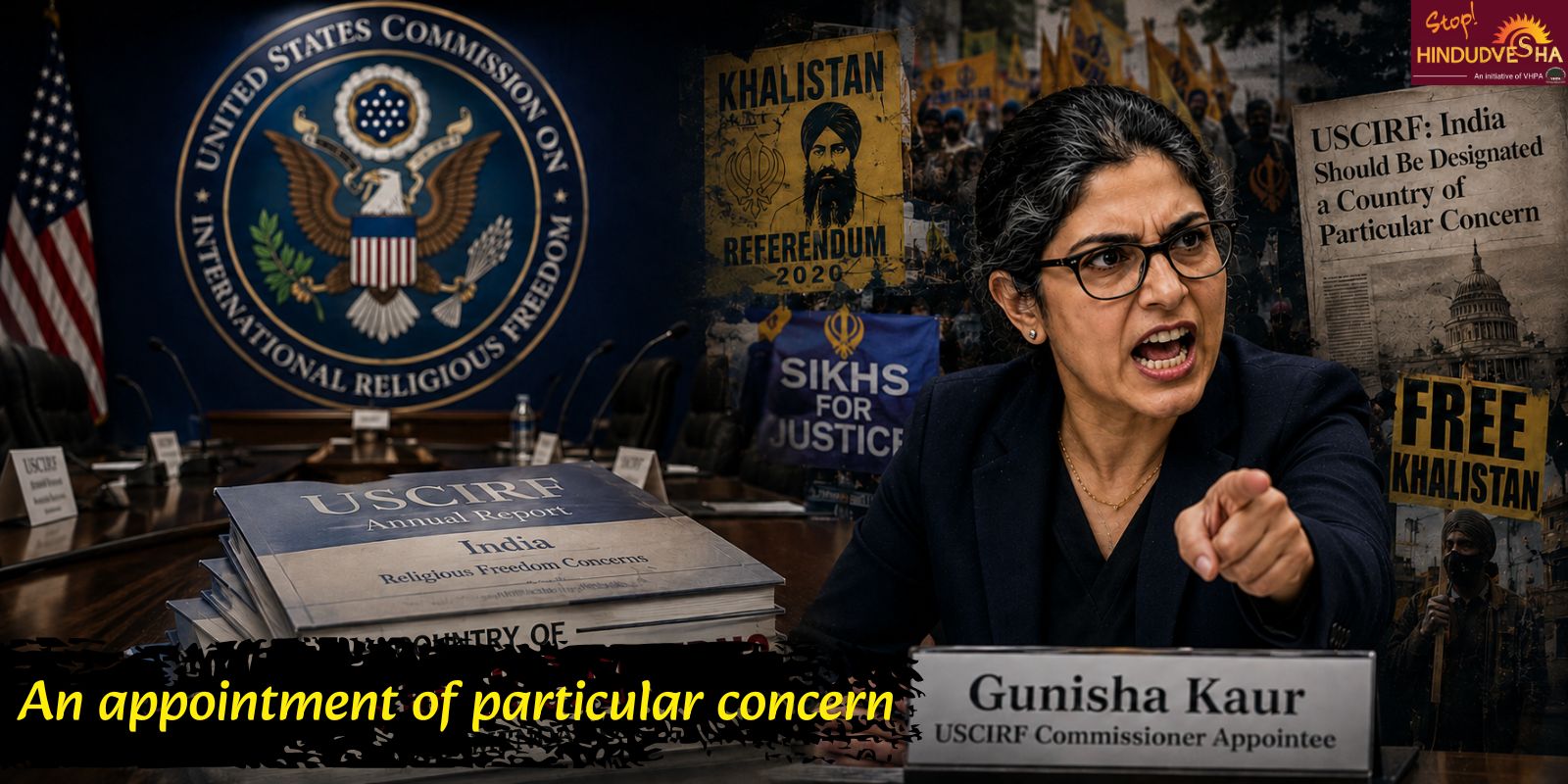
Summary
Gunisha Kaur’s appointment to USCIRF has intensified concerns in India about the commission’s credibility and perceived ideological orientation on India-related issues. Kaur’s published record — including her treatment of Jarnail Singh Bhindranwale, writings on Khalistani activism, and descriptions of individuals designated under Indian law for separatist or extremist activities — has raised questions about impartiality in evaluating India’s religious-freedom record. The appointment also arrives amid a long and contentious relationship between USCIRF and India, marked by repeated recommendations to designate India a Country of Particular Concern. Rather than easing tensions, the appointment is likely to deepen skepticism in India, where USCIRF increasingly faces questions about consistency, credibility, and institutional neutrality.
The United States Commission on International Religious Freedom has never enjoyed a warm relationship with India. For years, New Delhi has dismissed its findings as politically motivated, its methodology as selective, and its recommendations as blatant interference in the internal affairs of a sovereign democracy whose elections are widely regarded as more transparent, smoother, and less contentious than America’s own. The appointment of Gunisha Kaur [1] — an academic and activist with a documented public record of softening Khalistani separatist narratives — will do little to change that assessment. If anything, it reinforces what many Indian observers have long suspected: that USCIRF is not a neutral monitor of global religious freedom, but an ideologically loaded institution with a particular fixation on India.
The pick appears driven by frustration. After appointing Pakistani Muslims and secular Hindus as commissioners in the past and failing to gain traction in efforts to get India sanctioned, USCIRF has now turned to a pro-Khalistani propagandist Sikh to throw more mud at India, hoping some of it will stick.
This is not a communal argument. The concern is not that Kaur is Sikh. India is home to the world’s largest Sikh population; Sikhs have served as the country’s President, Prime Minister, Chief of Army Staff, and in countless positions of national eminence. The concern is who Kaur is on the public record — what she has written, whom she has defended, and how she has consistently framed India’s counter-extremism efforts as persecution rather than governance. These are institutional questions, not religious ones.
The Missing Context Behind Kaur’s Appointment
Senator Chuck Schumer announced Kaur’s appointment on May 21, 2026, describing her as a physician, anthropologist, international human rights advocate, and Sikh community leader. [2] Schumer praised her as the first Sikh to serve on USCIRF, while the Sikh Coalition — which actively lobbied for her selection — celebrated the moment as historic. [3]
What was conspicuously absent from these announcements was any mention of Kaur’s documented body of work: a book that rehabilitates the image of the Khalistani terrorist Jarnail Singh Bhindranwale [4], opinion pieces in major Western publications that insert Khalistan-linked grievances into unrelated policy debates, and a recurring pattern of describing individuals designated as terrorists by the Indian state as merely “activists” or “citizens.” The official framing offered a partial and carefully curated portrait — one that would likely look very different to the millions of Indians, both Hindus and Sikhs, who lived through the Punjab insurgency or have family members among its victims.
Sanitizing Bhindranwale’s Violent Legacy
Any serious assessment of Gunisha Kaur’s suitability for this role must begin with her book Lost in History: 1984 Reconstructed [5], particularly her treatment of Jarnail Singh Bhindranwale.
In the book, Kaur describes Bhindranwale as “a charismatic and influential leader of the Sikhs in the 1970s and early 1980s” [6] and frames him primarily as a religious figure victimized by state narratives — a characterization echoed by a reviewer on a Sikh heritage website [7], who described the book as presenting Bhindranwale as having “launched a campaign founded on the Anandpur Sahib Resolution, demanding minority rights and decentralization.” More troublingly, Kaur’s writing questions the attribution of anti-Hindu attacks to Bhindranwale’s movement and suggests that such accounts may have been politically manipulated by the Indian state.
To the families of thousands killed during the Punjab insurgency [8] of the 1980s — Hindus, Sikhs, and others who bore the brunt of targeted assassinations, bombings, and communal violence [9] — Bhindranwale is not a complex or misunderstood religious figure. He is the ideological force behind one of the most destructive domestic terrorist movements in post-independence India, a man whose presence in the Golden Temple complex at Amritsar precipitated Operation Bluestar [10] and whose followers carried out a campaign of sectarian bloodshed that scarred a generation of Punjabis.
This is not a matter of competing historical interpretations between equally credible viewpoints. It is the literary equivalent of a political rehabilitation project — one that sanitizes the record of a central figure in a separatist insurgency that claimed thousands of lives. Asking whether someone who holds and publishes such views can impartially evaluate India’s record on religious extremism is not a communal question. It is a basic question of institutional integrity.
Reframing Extremism Through Civil Liberties
The pattern does not end with the book. Kaur’s subsequent writing in prominent Western publications reveals a consistent rhetorical strategy: embedding the language of Sikh separatism within the more palatable vocabulary of human rights, civil liberties, and self-determination.
During the farm law protests of 2020–21, she co-authored a piece for CNN that inserted references to Sikh separatist grievances into an article ostensibly about agricultural policy — a connection that seemed strained at best and unmistakably deliberate at worst. [11]
More revealing was her writing on tensions between India and Khalistani networks abroad. In this context, she referred to Hardeep Singh Nijjar — who had been designated a terrorist by the Indian government [12] under the Unlawful Activities Prevention Act for his involvement in pro-Khalistan activities, and who headed the banned Khalistan Tiger Force — primarily as “a Canadian citizen.” Gurpatwant Singh Pannun, who heads the banned organization Sikhs for Justice [13] and was designated an individual terrorist by India’s Ministry of Home Affairs in 2020 [14] — and who has made explicit threats against Indian aviation, diplomatic missions, and Indian Canadian civilians — was described by Kaur merely as “a Sikh activist and American citizen.” In the same context, she raised the rhetorical question of why India felt “threatened” by calls for Sikh self-determination.
This rhetorical move defines a certain strand of Western activism on Khalistan: not openly defending violence but systematically stripping away its context — erasing terror designations, omitting track records, reframing architects of separatist campaigns as civil society voices, and portraying the state’s security response as the real aggression. In Kaur’s public writing, this approach has been deployed with notable consistency across multiple platforms over many years.
USCIRF’s Long Record of Targeting India
The Kaur appointment cannot be understood in isolation. It must be viewed against the backdrop of USCIRF’s long and adversarial engagement with India — one that Indian officials across party lines have repeatedly described as neither fair nor credible.
India has appeared on USCIRF’s watch lists since 2009 [15], first on Tier 2 and then through a dramatic escalation in 2020, when USCIRF first recommended that India be designated a Country of Particular Concern (CPC) [16] — a designation otherwise reserved for some of the world’s most repressive theocracies and authoritarian states, including North Korea, China, and Eritrea. It has repeated that recommendation in every annual report since, including its 2026 report [17] — making this the seventh consecutive year that India has been recommended for CPC designation. [18]
The 2026 report went further, recommending that the United States impose targeted sanctions on the RSS and India’s external intelligence agency, RAW [19] — an extraordinary recommendation that India’s Ministry of External Affairs immediately rejected. MEA spokesperson Randhir Jaiswal described the report as presenting “a distorted and selective picture of India, relying on questionable sources and ideological narratives rather than objective facts,” adding that “such repeated misrepresentations only undermine the credibility of the Commission itself.” [20]
Critically, successive US administrations — both Democratic and Republican — have declined to follow USCIRF’s recommendation and designate India as a Country of Particular Concern. This gap between USCIRF’s recommendations and actual US foreign policy is itself revealing: it suggests that the commission’s assessments of India have diverged so sharply from mainstream analytical judgment that even those in executive authority have consistently chosen to disregard them.
Questions About USCIRF’s Direction
The controversy surrounding Kaur’s appointment cannot be separated from broader questions about USCIRF’s composition and the ideological direction it has increasingly taken on India-related matters.
USCIRF’s previous vice-chair, Asif Mahmood [21] — a Pakistani American physician appointed by House Minority Leader Hakeem Jeffries — was also deeply focused on India and repeatedly sought to link India to violence against Khalistanis in the US and Canada. He drew sustained criticism from Indian commentators for his role in shaping reports that called for sanctions on Indian institutions. Mahmood was described as holding advocacy positions that frequently aligned with anti-India narratives [22] and had previously been associated with the Association of Physicians of Pakistani Descent of North America [23], which Indian analysts described as a lobbying front for Islamabad. The commission also includes commissioner Mohamed Elsanousi and has historically drawn on diaspora advocacy networks that have long pursued an adversarial posture toward India.
The concern here is not the religion or ethnicity of individual commissioners — such an argument would be both unfair and analytically weak. The concern is ideological homogeneity on a specific set of issues: whether the commission has come to include, in disproportionate measure, voices with pre-formed hostile views on India, drawn from advocacy ecosystems that treat Indian counter-extremism measures as persecution, frame separatist activists as civil-rights heroes, and approach nearly every development in Indian domestic policy through a lens of majoritarian threat.
When a commission’s composition consistently leans in one ideological direction on a single country, it does not represent analytical diversity. It reflects a convergence of priors — and in Kaur’s case, those priors are well documented in print.
What This Appointment Means in India
This appointment is also likely to shape perceptions in New Delhi and across Indian civil society. For many observers in India, it may do little to narrow the trust deficit that has been building around certain aspects of American institutional engagement with India. If anything, it may reinforce concerns that questions of separatism and extremism are not always approached through a consistent security lens in some American institutional settings.
Those concerns are especially pronounced in relation to Khalistani networks — a movement associated with the assassination of a serving prime minister [24], the bombing of a civilian aircraft that killed 329 people [25], targeted communal killings, and terror networks operating from foreign soil. [26] For many Indian observers, the tendency to describe individuals designated under Indian law for separatist or extremist activities primarily as activists or community leaders risks deepening perceptions of inconsistency in how “threatening extremism” is understood and discussed.
More broadly, the appointment is unlikely to ease the longstanding trust deficit between India and USCIRF, which has grown steadily since 2009 and accelerated sharply after the 2020 CPC recommendation. In sections of Indian public opinion, such appointments are increasingly interpreted less as neutral institutional decisions and more as reflecting a particular ideological orientation toward India.
India has already begun publicly pushing back against USCIRF, urging the body to examine vandalism targeting Hindu temples and intimidation of the Indian diaspora in the United States [27] rather than lecturing a democracy of 1.4 billion people. That inversion — the world’s largest democracy pointing to blind spots in an American commission’s own backyard — is itself a measure of how significantly USCIRF’s credibility has eroded in India.
Conclusion: The Cost of Lost Credibility
None of this is an argument that India — or, for that matter, any country — should be exempt from scrutiny. Democracies must accept criticism, and aspects of India’s past record, including the Emergency-era excesses of the Indira Gandhi government [28], merit serious engagement. There is a legitimate conversation to be had — one that a genuinely independent and genuinely impartial body could conduct with credibility and effect.
USCIRF, in its current form, cannot conduct that conversation. A commission whose recent reports have called for sanctions on India’s intelligence services and a major cultural organization; whose vice-chair was a Pakistani-American activist with documented advocacy positions hostile to India; and which now includes a commissioner whose published body of work involves the rehabilitation of Khalistani separatist figures and the reframing of designated terrorists as community leaders — such a commission increasingly lacks both credibility in New Delhi and the analytical integrity required to perform the role it was created to serve.
Gunisha Kaur’s appointment is not the cause of USCIRF’s India problem. It is its latest symptom. And the question worth asking — one USCIRF’s leadership appears entirely uninterested in confronting — is what purpose a commission on religious freedom ultimately serves when its primary target has concluded, based on substantial evidence and across successive governments of different political persuasions, that the commission is no longer worth engaging with at all.
That is not India’s failure. It is USCIRF’s.
Citations
[1] United States Commission on International Religious Freedom. “Gunisha Kaur.” USCIRF. https://www.uscirf.gov/about-uscirf/commissioners/gunisha-kaur
[2] “NY Senator Chuck Schumer Appoints Dr. Gunisha Kaur to US Commission on International Religious Freedom.” News India Times. https://newsindiatimes.com/ny-senator-chuck-schumer-appoints-dr-gunisha-kaur-to-us-commission-on-international-religious-freedom/
[3] Sikh Coalition. “Dr. Gunisha Kaur Appointed to USCIRF by Senator Schumer.” Sikh Coalition, 2026. https://www.sikhcoalition.org/blog/2026/dr-gunisha-kaur-appointed-to-uscirf-by-senator-schumer/
[4] “Khalistan Movement: Sikh Militancy on Rise Again.” Boloji. https://www.boloji.com/articles/53677/khalistan-movement-sikh-militancy-on-rise-again
[5] Gunisha Kaur. Lost in History: 1984 Reconstructed. PDF. https://www.vidhia.com/Historical%2C%20Political%2C%20Philosophical%20and%20Informational/Lost_in_History_Second_Edition-_Gunisha_Kaur.pdf
[6] “Who Is Gunisha Kaur, New USCIRF Commissioner? Anti-India, Pro-Khalistani Exposed Details.” OpIndia, May 2026. https://www.opindia.com/2026/05/who-is-gunisha-kaur-new-uscirf-commissioner-anti-india-pro-khalistani-exposed-details/
[7] “Lost in History: 1984 Reconstructed.” SikhChic. https://www.sikhchic.com/article-detail.php?cat=12&id=907
[8] James Sterba, “The Punjab Torn by Terror.” New York Times Magazine, September 8, 1985. https://www.nytimes.com/1985/09/08/magazine/the-punjab-torn-by-terror.html
[9] “Punjab Insurgency / Khalistan Violence.” YouTube Video. https://www.youtube.com/watch?v=9pcV0cYmsbk
[10] Brut India. “What Led to Operation Bluestar and Who Were the Men Behind It?” Facebook Video. https://www.facebook.com/brutindia/videos/what-led-to-operation-bluestar-and-who-were-the-men-behind-it/26300906336238767/
[11] Simran Jeet Singh and Gunisha Kaur, “Indian Farmer Protests Are About More Than Agriculture.” CNN Opinion, December 11, 2020. https://edition.cnn.com/2020/12/11/opinions/indian-farmer-protests-simran-singh-gunisha-kaur
[12] “Hardeep Nijjar Death: Canada’s Shocking Report Contradicts Trudeau’s Claims.” NDTV Video. https://www.ndtv.com/video/hardeep-nijjar-death-canada-s-shocking-report-contradicts-trudeau-s-claims-on-hardeep-s-death-895547
[13] “Centre Extends Ban on Pro-Khalistani Fringe Group Sikhs for Justice by Another 5 Years.” News on Air. https://newsonair.gov.in/centre-extends-ban-on-pro-khalistani-fringe-group-sikhs-for-justice-by-another-5-years/
[14] “Gurpatwant Singh Pannun among Nine Designated as Terrorists under UAPA.” The Tribune. https://www.tribuneindia.com/news/nation/gurpatwant-singh-pannun-among-nine-designated-as-terrorists-under-uapa-107197
[15] “USCIRF’s Anti-India Obsession: Freedom Crusade or a Political Smear?” Stop Hindu Dvesha. https://stophindudvesha.org/uscirfs-anti-india-obsession-freedom-crusade-or-a-political-smear/
[16] “US Panel on Religious Freedom Wants Donald Trump Administration to Designate India as Country of Particular Concern.” Deccan Herald. https://www.deccanherald.com/world/us-panel-on-religious-freedom-wants-donald-trump-administration-to-designate-india-as-country-of-particular-concern-831232.html
[17] United States Commission on International Religious Freedom. “Religious Minorities in India Suffer Escalating Attacks.” USCIRF. https://www.uscirf.gov/news-room/releases-statements/religious-minorities-india-suffer-escalating-attacks
[18] “Assault on India’s Sovereignty: The Misleading and False Narrative of USCIRF.” Organiser, March 17, 2026. https://organiser.org/2026/03/17/344455/bharat/assault-on-indias-sovereignty-the-misleading-and-false-narrative-of-uscirf/
[19] “USCIRF’s India Report ‘Distorted’: MEA Calls Out US Panel’s Recommendation to Sanction RAW, RSS.” Republic World. https://www.republicworld.com/india/uscirf-s-india-report-distorted-mea-calls-out-us-panel-s-motivated-and-biased-recommendation-to-sanction-raw-rss
[20] “USCIRF’s India Report: India Rejects Findings, Calls Report Biased and Motivated.” Organiser, May 11, 2026. https://organiser.org/2026/05/11/352670/bharat/uscirfs-india-report-india-rejects-findings-calls-report-biased-and-motivated/
[21] “Who Is Asif Mahmood? USCIRF Commissioner, Pakistani-American, Anti-India Conspiracies, Propaganda, Unverified Claims.” News18. https://www.news18.com/world/who-is-asif-mahmood-uscirf-commissioner-pakistani-american-anti-india-conspiracies-propaganda-unverified-claims-9276723.html
[22] “USCIRF’s Bharat Narrative: A Politicised Assault on Bharat’s Sovereignty and Civilisational Identity.” HinduPost. https://hindupost.in/world/uscirfs-bharat-narrative-a-politicised-assault-on-bharats-sovereignty-and-civilisational-identity/
[23] “India Questions USCIRF’s Credibility amid Diplomatic Concerns.” Organiser, March 29, 2026. https://organiser.org/2026/03/29/346138/bharat/india-questions-uscirfs-credibility-amid-diplomatic-concerns/
[24] Encyclopaedia Britannica. “Why Was Indira Gandhi Assassinated?” https://www.britannica.com/question/Why-was-Indira-Gandhi-assassinated
[25] “Air India Flight 182: The Bombing That Killed 329 People.” BBC News. https://www.bbc.com/news/world-asia-india-66909820
[26] “Blood for Blood: Book Review.” CoHNA. https://cohna.org/blood-for-blood-book-review/
[27] “Distorted, Selective Picture: India on USCIRF Recommendation to Sanction.” NewKerala. https://www.newkerala.com/news/a/distorted-selective-picture-india-mea-uscirfs-recommendation-sanction-385.htm
[28] “48 Years of Emergency: Atrocities Suffered, Unwavering Resistance Have Profoundly Influenced Nation’s Collective Memory.” Firstpost. https://www.firstpost.com/opinion/48-years-of-emergency-atrocities-suffered-unwavering-resistance-have-profoundly-influenced-nations-collective-memory-12786642.html

Donate to HINDUDVESHA
Our Mission is to explore and expose Hindudvesha through research analysis, education and response.
SUPPORT US