

Vanished Temples of Sindh: Echoes of a Silenced Civilization
 Aditi Joshi · 08/18/2025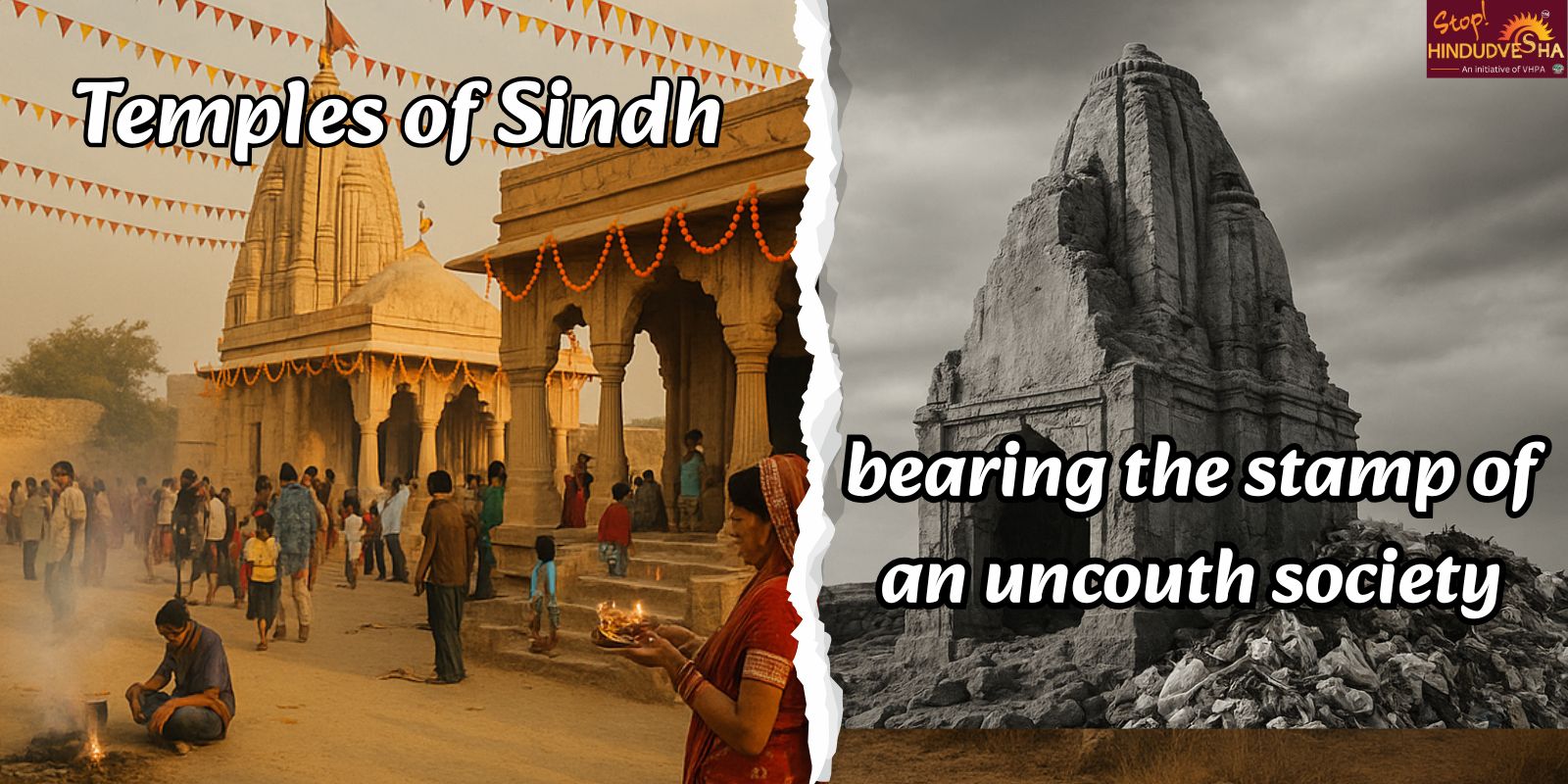
- The trajectory from Sindh’s position as a vital center of Indic civilization to its present state of religious and cultural amnesia.
- The silence, both global and national, that has surrounded the systematic desecration of sacred sites, contrasting it with international responses to similar heritage losses elsewhere.
- Temples are not merely places of worship, but civilizational anchors that embody language, art, tradition, and communal memory.
- The erasure of Sindh’s temples is not simply a Pakistani phenomenon but also an Indian failure of memory and heritage preservation.
- Shatrubodh is necessary to resist ongoing forms of cultural attrition, as it reclaims and frames memory as both a moral imperative and a civilizational survival.
Long before modern borders were etched by colonial cartographers, a sacred geography existed, known as Sapta Sindhu, the land of the seven rivers, where the Vedas were first sung, and Dharma breathed through temples, rituals, and community life.[1] Among these rivers, the Sindhu (Indus) stood supreme, not merely as a physical artery sustaining agriculture and trade, but as a metaphysical axis around which the spiritual imagination of Bharat revolved.
Sindh, named after the Sindhu itself, was never a remote frontier, nor a marginal appendage to the subcontinent. It was a luminous node in the civilizational web of Indic culture. From the hymns of the Rigveda that praise the might of the Sindhu to the philosophical ferment of Buddhist and Jain orders, the region was a crucible of intellectual and spiritual significance. Cities like Alor and Debal were thriving centers of commerce and learning, where Sanskritic traditions coexisted with vibrant mercantile networks extending to West and Central Asia.
Yet, in the contemporary imagination, the name “Sindh” rarely conjures visions of its once-glorious temples, intricately carved murtis, or the melodic cadence of bhajans that once floated along its riverbanks.[2] Instead, it is too often remembered through the lens of rupture, its image refracted through the violence of invasions, forced conversions, and the systematic erosion of its Indic heritage.
This silence is not benign; it is the residue of centuries of conquest, theological displacement, and cultural effacement. The temples that once stood as custodians of Dharma are largely absent from collective memory, their absence a testament to the deliberate reconfiguring of the region’s heritage. To speak of Sindh today is therefore to confront this silence, recovering what has been muted, to illuminate what has been obscured. It is an act not of nostalgia alone, but of historical reclamation: a reassertion of the civilizational heartbeat that once pulsed along the banks of the Sindhu.
Sindh Before 1947: A Tapestry of Temples
Before Partition carved the subcontinent into two bleeding halves, Sindh was home to a thriving Hindu community that formed nearly a quarter of its population. Sanātana Dharma was not a marginal faith in this land; it was a living, breathing force that animated daily life, festivals, and public culture. The cities of Shikarpur, Sukkur, Hyderabad, and Karachi bore witness to this vibrancy, their skylines marked by temple spires that were at once places of worship and emblems of civilizational continuity.
Among these sacred sites was the famed Ramapir Temple at Tando Allahyar, where annual melās drew thousands of devotees in a celebration that blended spiritual devotion with communal solidarity. The Hinglaj Mata Temple, nestled deep in the Makran Mountains (in present-day Balochistan), was a pilgrimage destination of such magnetism that it attracted worshippers from across regions and, remarkably, from diverse religious traditions.[3] The shrines of Jhulelal, a water deity and cultural icon of Sindhi Hindus, resonated with devotional songs, their sanctity acknowledged even by sections of the Muslim populace.
These temples were far more than religious structures. They functioned as civilizational anchor points. Within their courtyards, schools imparted learning, kitchens sustained the poor, and dramatic performances kept the epics alive in public memory. They safeguarded artistic traditions, oral narratives, and moral instruction, ensuring the transmission of culture across generations.
To dismantle such spaces was not an act of mere iconoclasm. It was the systematic targeting of a civilizational ecosystem. Each demolished temple represented the erasure of an educational center, a cultural archive, and a moral compass. In effect, the destruction of these sacred sites was an assault upon the very identity and memory of the community, a form of civilizational assassination.[4]
1947: When Devotees Became Refugees
The Partition of India, often narrated through the searing violence of Punjab, unfolded in Sindh with a quieter, more insidious cruelty. Unlike Punjab or Bengal, Sindh did not witness massacres on the same scale. Yet what it lacked in bloodshed, it compensated for through systemic intimidation, economic marginalization, and targeted acts of religious cleansing.[5]
The exodus was not precipitated by chaotic violence, but by a deliberate dismantling of the conditions that made Hindu life sustainable. Temples, those age-old sanctuaries of worship and community, were defiled. Sacred spaces that had anchored the identity of the Sindhi Hindus were desecrated, sending a clear and unambiguous message: the custodians of these traditions had no place in the new order.
Faced with fear, grief, and the erosion of security, the Hindu populace departed, not as migrants seeking opportunity, but as refugees fleeing dispossession. They carried little but memory: fragments of festivals, snatches of songs, and the invisible thread of cultural continuity.[6]
In their flight, the most painful abandonment was not material wealth, but the divine. Mūrtis, embodiments of their deities, were left behind in desecrated sanctuaries. Priests, long the custodians of ritual and oral tradition, were scattered. The bells of temples fell silent, their echoes fading into the emptiness of structures left to decay or repurposed beyond recognition.
In India, the displaced Sindhi Hindus rebuilt their lives with resilience and enterprise, establishing communities, markets, and temples anew. Yet the sacred geography of Sindh, the spaces consecrated by centuries of worship, did not survive. The temples remained behind, stripped of their custodians, their voices extinguished from the living landscape of the region.
Aftermath: From Sanctuaries to Silence
In the decades following Partition, the fate of Sindh’s temples unfolded along a trajectory of sustained neglect and deliberate appropriation. What survived the initial wave of desecration did not remain untouched by time or policy. Many temples were repurposed, some transformed into mosques or madrasas, others converted into government offices, their sacred precincts stripped of ritual function and rebranded for administrative or religious utility alien to their original purpose.[7]
Others met a more violent end. Mūrtis were shattered; Sanskrit inscriptions were chiseled out, severing the textual and iconographic link to the temple’s heritage.[8] Where physical structures endured, they were often taken over by squatters, their sanctums adapted into living quarters.[9] In an irony both tragic and symbolic, some temple spaces were relegated to the status of public latrines—sites of reverence reduced to places of defilement.[10]
The examples are numerous and telling. The Shiv Mandir in Shikarpur, once the beating heart of local religious festivities, now stands crumbling, unmarked, and inaccessible to the public. The Rama Pir Temple in Mirpurkhas lies desecrated, its structure scarred by vandalism. The Kali Mandir in Karachi, still physically extant, survives in a state of indignity, its walls hemmed in by garbage, its sanctity eroded by official indifference and public neglect.
This degradation was not a random consequence of time. It was neither accidental nor incidental. It was the product of a systemic, sustained process, a slow erasure designed not only to dismantle bricks and mortar, but to extinguish the cultural memory these temples once embodied. Through the loss of these structures, a civilizational inheritance was not simply forgotten; it was actively effaced.
Emotional Fallout: A People Without Anchors
For Sindhi Hindus in India and across the diaspora, the pain is neither episodic nor confined to memory; it is generational. Grandparents speak of temples to which they can never return, their recollections threaded with longing and resignation. Parents recall festivals once celebrated in absentia; rituals adapted to new geographies but emptied of their original setting. Children born far from the Sindhu’s banks inherit only fragments: stories passed down like heirlooms, imbued with both pride and a gnawing sense of cultural orphanhood.
In other diasporic histories, exile is anchored to a recognized cultural geography. Jewish memory continues to circle back to Jerusalem; Armenian longing finds symbolic focus in Mount Ararat. But for the Sindhi Hindu community, displacement carried with it a double loss: the physical homeland and the right to remember it in the national consciousness.
In post‑Partition India, their arrival was marked not by national commemoration but by bureaucratic indifference. As refugees, their survival was prioritized over the preservation of heritage. The temples they left behind were not integrated into the idea of “national heritage” in India. They were not the subject of restoration projects, state memorials, or cultural reclamation. Consequently, the trauma of Sindhi Hindus was confined to the private realm. It remained personal but never allowed to be civilizational.
What Remains: Fragments of a Forgotten Dharma
A handful of sacred structures in Sindh endure, though they stand as rare survivors in a landscape of absence. The Kalka Devi Cave Temple near Arore remains one of the few functioning Hindu temples still in operation. Its survival is remarkable not only for its continuity of worship but for the occasional offerings made even by local Muslim communities, a faint echo of the syncretic reverence that once shaped the cultural fabric of Sindh.
Similarly, the Umarkot Shiv Mandir, sustained by the devotion of a small Hindu community, continues to mark the annual Mahāśivarātri with processions and rituals. These observances, however, are no longer the vibrant, region‑wide festivals they once were; instead, they are acts of quiet perseverance, carried out in isolation from the larger civilizational network that once sustained them.
Beyond these exceptional sites, the more common reality is one of ruin. Temples lie broken, stripped of mūrti, purpose, and even name. Their walls and courtyards remain as architectural testimony, but the animating presence that once sanctified them has long departed. What survives is not living worship, but the skeletal remains of a heritage that endures in stone even as its soul has been silenced.
Why the Silence?
When the Islamic State reduced the ancient city of Palmyra to rubble, the global response was swift and unequivocal. The act was condemned as “heritage genocide,” a crime against humanity’s shared past. When the Bamiyan Buddhas were obliterated by the Taliban, UNESCO and world leaders mourned the loss as a cultural catastrophe.[11] These sites, once symbols of civilizational grandeur, were granted the dignity of remembrance.
Yet, the slow and systemic destruction of Sindh’s Hindu temples has elicited no comparable outrage. No international resolutions were passed. No documentaries chronicled the disappearance. No commemorative campaigns were launched. The erasure of a millennia-old sacred geography proceeded in silence, unacknowledged by the world, and unremembered even in the land to which the displaced belonged.
India, often seen as the civilizational homeland of Hindus, has itself remained largely reticent. The narrative of Partition, as constructed in official discourse, revolves around themes of nationhood, political division, and the rehabilitation of refugees. The loss of sacred sites, the temples, shrines, and cultural ecosystems left behind, has rarely entered the national conversation. These remnants of Sanātana Dharma, situated outside India’s political borders, do not comfortably align with the secular framework of curated memory that dominates post-Independence historiography.
Thus, the silence endures. But it is not the silence of reconciliation or closure. It is a silence born of suppression—a suppression of history, of trauma, and of the civilizational wound that refuses to heal because it has never been fully acknowledged.
Lessons from the Ruins
The story of Sindh’s temples is, above all, a lesson in the fragility of civilizations. Civilizations do not perish only when cities fall or empires collapse; they die when their memory is extinguished. A temple is more than a structure for ritual worship; it is a repository of language, art, tradition, and collective spirit. Its destruction is not merely an architectural loss, but an act of cultural amputation. The erasure of Sindh’s temples, therefore, is not solely a Pakistani episode; it is also an Indian failure: a failure to remember, to preserve, and to honor.
It is equally a warning. The forces that dismantled Sindh’s Dharma have not vanished; they persist in altered forms. They shift, mutate, and reappear in courtrooms where heritage is litigated, in classrooms where history is rewritten, in media that reframes cultural narratives, and in political or religious spaces that continue to shape public memory. This is why the lesson of Sindh is inseparable from Shatrubodh—civilizational alertness to threats, whether overt or insidious.[12]
To Remember is to Reclaim
To narrate the story of Sindh’s vanished temples is not an exercise in nostalgia, but an act of moral necessity. Temples may be demolished, but a civilization only dies when it forgets why they matter. To remember them is to affirm their significance, to restore them as part of the living cultural inheritance of Bharat.
We must remember them not as mere ruins, but as reminders. We must teach future generations not only about Akbar and Gandhi, but also about Jhulelal and Hinglaj Mata, names that anchor the civilizational geography of Sindh. We must document, archive, and narrate until silence gives way to memory, and memory gives way to justice.
Sindh’s temples may be gone from their physical landscapes, but if they live in our historical consciousness, truthfully, vividly, and insistently, they are not lost. In remembrance lies reclamation. In memory lies the survival of civilization.
Citations
[1] Punjab: A look into history of Sapta Sindhu; https://organiser.org/2024/02/14/221786/bharat/punjab-a-look-into-history-of-sapta-sindhu/
[2] Sindhu River is related to Hindu religion and its glory in Rigveda – Navbharat Times; https://navbharattimes.indiatimes.com/astro/others/sindhu-river-is-related-to-hindu-religion-and-its-glory-in-rigveda/articleshow/120931981.cms?story=1
[3] Hingol Cultural Landscape – UNESCO World Heritage Centre; https://whc.unesco.org/en/tentativelists/6109/
[4] Hinglaj Mata: All about the ancient Hindu temple in Pakistan that’s making waves on internet – The Economic Times; https://economictimes.indiatimes.com/news/india/hinglaj-mata-all-about-the-ancient-hindu-temple-in-pakistan-thats-making-waves-on-internet/articleshow/109695856.cms?from=mdr
[5] Sindh: A Homeland Lost In Silence; https://indiacurrents.com/sindh-a-homeland-lost-in-silence/
[6] Hindus in Pakistan – Minority Rights Group; https://minorityrights.org/communities/hindus-2/
[7] These temples in Pakistan are now madrasas; https://scroll.in/article/754708/these-temples-in-pakistan-are-now-madrasas
[8] Silenced histories, razed shrines: The difficult task of rediscovering India and Pakistan’s shared heritage; https://www.orfonline.org/research/silenced-histories-razed-shrines-the-difficult-task-of-rediscovering-india-and-pakistan-s-shared-heritage
[9] Vanishing Hindu Temples, Shrines and Heritage Sites in Islamic Pakistan; https://hinduexistence.org/2022/01/19/vanishing-hindu-temples-shrines-and-heritage-sites-of-islamic-pakistan/
[10] Hindu Temples in Pakistan: During Partition and Aftermath; https://pm.sdcollegeambala.ac.in/wp-content/uploads/2021/07/Vol10-3.pdf
[11] Bamiyan Buddhas | Whose Culture?; https://whoseculture.hsites.harvard.edu/bamiyan-buddhas
[12] Hindus Preach Secularism, Others Jihad; https://stophindudvesha.org/while-they-preach-jihad-hindus-preach-secularism-the-ostrich-syndrome-of-a-civilization-in-peril/

Donate to HINDUDVESHA
Our Mission is to explore and expose Hindudvesha through research analysis, education and response.
SUPPORT US