

While They Preach Jihad, Hindus Preach Secularism: The Ostrich Syndrome of a Civilization in Peril
 Aditi Joshi · 06/08/2025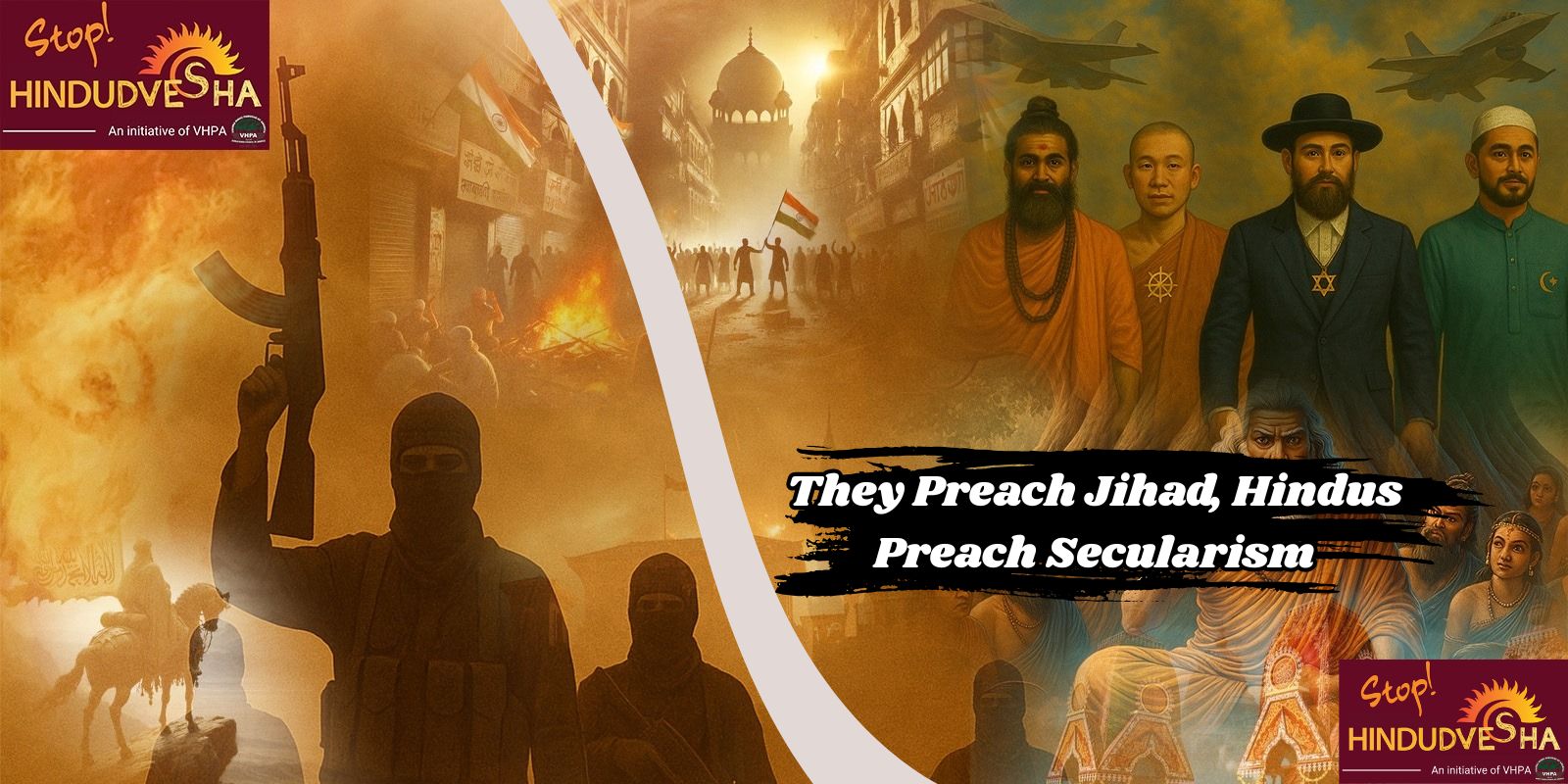
- AQIS issued a manifesto reframing India’s counter-terror strikes as a religious war by the “Bhagwa regime,” calling explicitly for Jihad fi Sabilillah (a holy war).
- AQIS weaponized language and fabricated persecution narratives to portray India as a Hindu oppressor, thus inciting global Muslim sentiment.
- Despite the open call for jihad, Hindu society responded with apathy, distraction, and fear of being labeled intolerant, reflecting a deep psychological and cultural erosion rather than a healthy instinct of self-preservation.
- The widespread failure to recognize and confront ideological threats stems from decades of civilizational disarmament through Nehruvian secularism, Marxist historiography, and Bollywood’s distortion of history, leading to a loss of Shatrubodh, or enemy awareness.
- Hindus need to revive Shatrubodh—not as hatred, but as vigilant clarity and courage—to defend Dharma with discernment, ideological strength, and cultural unity before the threat of annihilation becomes irreversible.
On May 7, 2025, Al-Qaeda in the Indian Subcontinent (AQIS) issued a chilling and unambiguous declaration following India’s precision airstrikes on nine known terror launchpads in Pakistan the previous day[1]. This statement, disseminated via the group’s official media arm, Al-Sahab Media, was no routine communiqué—it was a calculated ideological proclamation, a call to arms steeped in militant theology and civilizational animosity[2].
In this manifesto, AQIS made no attempt to temper its language with diplomatic caution[3]. Instead, it openly framed the Indian strikes as an assault by the “Bhagwa regime”—a deliberate pejorative targeting any political assertion of Hindu identity. The term “Bhagwa” refers to the saffron flag symbolic of Sanatana Dharma, and its usage here was no accident: it sought to recast the Indian state not as a pluralistic polity but as a religious oppressor. This linguistic framing transformed a counter-terror operation into a flashpoint of religious conflict, evoking historical grievances and invoking divine injunctions.
The most dangerous aspect of their message, however, was not the political rhetoric but the explicit theological call to Jihad fi Sabilillah—a holy war “in the path of Allah.” This was no vague appeal; it was a clear directive for all Muslims of the Indian subcontinent to rise against India and wage war until the supremacy of Islam was established. This is not fringe ideology; it is mainstream Jihadist doctrine, now explicitly aimed at Bharat.
Yet, in the face of this unmasked declaration of civilizational war, Hindu society responded with a deafening silence. There was no surge of national urgency, no mobilization of thought leaders, no public debate, and certainly no intellectual or cultural counter-offensive. Instead, the response was a dull drone of daily distractions—celebrity gossip, cricket controversies, social media spats. Where outrage should have reigned, there was indifference. Where clarity was imperative, confusion prevailed. Where unity was vital, inertia held sway.
This pattern is neither new nor coincidental. It is a symptom of a much deeper malaise—civilizational, psychological, and spiritual.
The Hindu response, or more accurately, the lack thereof, reveals a grave illness eroding the core of our collective being: the near-total absence of Shatrubodh.
The AQIS Statement: A Call for War of Civilizations
The Indian airstrikes on May 6, 2025, were a measured military response to a series of deadly cross-border terrorist attacks that claimed several Indian soldiers’ lives. These strikes targeted terror launchpads in Pakistan-occupied territory, locations long known as incubators of jihadist violence against India. The operation was tactical, grounded in the sovereign right of a nation to defend its citizens from terror emanating beyond its borders.
AQIS, however, swiftly reinterpreted the narrative, transforming India’s defensive action into an existential religious war. Through Al-Sahab Media, AQIS portrayed the Indian strikes not as legitimate counterterrorism but as a sectarian assault on Muslims by the so-called “Bhagwa regime.”
The deliberate use of “Bhagwa regime” served as a rhetorical device aimed at delegitimizing Hindu political identity. It sought to portray Hindu resurgence as tyrannical oppression, framing the Indian state as a communal and religiously motivated aggressor. This was not mere propaganda; it was an ideological maneuver intended to justify jihad by casting the conflict in religious terms.
AQIS went further, alleging without evidence that the Indian Air Force had bombed mosques and Muslim neighborhoods—fabrications crafted to inflame Muslim sentiment globally. Such accusations are classic Jihadist tactics: constructing a narrative of persecution to ignite religious fervor.
The AQIS statement ended with an explicit call for Jihad fi Sabilillah—Holy War in the path of Allah—obligating Muslims across the subcontinent to take up arms until “Islamic supremacy is established.” This call is not about territorial disputes or mere retaliation; it is a civilizational agenda aiming at the eradication of Hindu spiritual and cultural foundations[4].
This declaration was deliberate and strategic, not an impromptu outburst. It embodied the cold logic of jihadist doctrine, designed to radicalize, recruit, and mobilize believers by fusing theological grievance, historical narrative, and political tension[5].
AQIS is no fringe actor; it operates as part of a transnational jihadist network, thoroughly steeped in Islamic theology, historical grievance narratives, and media warfare. Its statements are meant to resonate across borders and incite unrest within the Muslim communities of India itself.[6]
While the Indian state may categorize such statements under counterterrorism frameworks, Hindu society must recognize them for what they truly are: explicit declarations of ideological war and religious supremacism—blueprints for civilizational conquest. To ignore them is not merely naïve; it is existentially perilous.
The Deafening Silence: Hindu Society’s Reaction
Despite this direct threat, Hindu society was eerily silent. As AQIS declared war not just on India’s political structure but on Hindu civilization, there was no collective surge of protective instinct.
There was no serious intellectual discourse, no mainstream media analysis unpacking the ideological threat, no coordinated civil society response, and no religious institution mobilization. Our “thought leaders” were engrossed in trivialities—tweeting about web series, debating “toxic masculinity,” or reiterating worn secular platitudes. Cultural commentators were absorbed in cricket scandals and celebrity gossip, oblivious—or perhaps willfully blind—to the ideological war brewing at their doorstep.
For the general public, the Jihadist call to arms was just another headline, quickly consumed and quickly forgotten amidst the endless scroll of memes and cricket highlights. An existential threat was dismissed as ephemeral clickbait[7].
More alarming was the policing of those who dared to raise alarms. Voices calling for awareness and preparedness were shut down with scripted responses born of decades of ideological subversion:
- “Not all Muslims are like that.”
- “Let’s not be communal.”
- “This will blow over.”
- “You’re spreading hate.”
- “Don’t generalize.”
- “India is a secular country.”
These are not signs of balanced discourse; they are reflexive attempts to suppress survival instincts. A civilization that once produced warriors like Maharana Pratap and Shivaji now chokes on its fear of being labeled “intolerant.” This psychological colonization means that even the assertion of self-preservation is branded extremism.
This is learned helplessness—where a people historically known for martial spirit and resilience become mere spectators to their own erosion. Hindus see the threats but are conditioned not to respond.
Thus, while jihadists prepare for war, Hindus prepare for IPL finals. While enemies strategize ideological conquest, we debate box office numbers. While civilizational war looms, we lull ourselves with mantras of neutrality.
This is not tolerance; it is civilizational surrender. It must end.
Understanding Shatrubodh: The Lost Civilizational Instinct
Shatrubodh—a profound Dharmic concept derived from shatru (enemy) and bodh (awareness)—signifies the clarity and vigilance required to identify and counter existential threats. In the Dharmic worldview, Shatrubodh is not optional but essential for survival and flourishing. It is the intuitive alertness that underpins the defense of not only physical territory but cultural, ideological, and spiritual integrity[8].
Our ancestors knew this deeply. The Mahabharata is not a mere family drama but a civilizational conflict where discernment and decisive action against adharma are paramount. Krishna instructs Arjuna to recognize evil clearly and confront it resolutely.
Today, however, this instinct lies dormant, systematically suppressed over decades by ideological disarmament—through Nehruvian secularism, Marxist historical revisionism, and Bollywood’s romanticization of invaders.
Under Nehruvian secularism, Hindus were taught to disown their civilizational identity and to view themselves as relics of a superstitious past. Secularism subtly imposed false equivalence between victim and aggressor, criminalizing historical memory.
Marxist historians compounded this erasure, sanitizing the brutal realities of invasions, temple destructions, forced conversions, and massacres. They portrayed invaders as cultural benefactors and indigenous defenders as inept or culpable.
Bollywood finalized the assault by projecting Hindus as villains or buffoons while glorifying Islamist figures and romanticizing conquest. This cultural conditioning weaponized art to disarm Hindu identity psychologically. The consequences are devastating:
- Real threats are ignored or dismissed.
- Enemies are romanticized; defenders demonized.
- Ideological warfare is met with secular platitudes.
- Conversion rackets are normalized as “free choice.”
- Calls for Shatrubodh are smeared as extremism.
Losing Shatrubodh is a fatal vulnerability. A society unable to distinguish friend from foe, Dharma from adharma, threat from noise, is crippled—not enlightened. Reclaiming this instinct is imperative. Without Shatrubodh, Dharma stands undefended.
The Civilizational Nature of the Conflict
This conflict transcends national security; it is existential. It is not isolated terrorism but a long-standing civilizational war. AQIS and allied jihadist groups represent a continuum of ideological hostility spanning over a millennium, aimed at eradicating Dharma and establishing theological absolutism. To reduce this to a “law and order” issue is a profound misunderstanding. This is a religio-political doctrine that deems the non-Muslim (kafir) existence a cosmic affront. Its actors operate openly, issuing fatwas and manifestos declaring their intent with unambiguous clarity.
In contrast, Hindu society’s mainstream response is muted. There is no acceptance of the existential stakes. The public square is flooded with calls for “communal harmony,” “interfaith dialogue,” and “love jihad” denials while ignoring the preparatory steps for the actual war. The battle lines are not invisible; they are drawn in speeches, social media, mosques, madrassas, and jihadist literature. The silence is willful or born of ignorance.
Call to Action: Awakening Shatrubodh
Despite the avalanche of evidence, despite the centuries of blood-soaked testimony, and despite open, public declarations of intent by jihadist forces, Hindus continue to bury their heads in the sand—like ostriches in a storm. The wind howls, the ground trembles, yet the instinct is not to rise and confront but to hide and hope it passes.
Faced with open calls for their annihilation, too many Hindus retreat not into resolve but into rationalizations and cowardly comfort phrases—the linguistic equivalent of a white flag: “It’s just fringe groups,” “If we react, we’re no better than them,” “Every religion has extremists” etc.
These are not arguments. They are coping mechanisms—designed not to engage with reality but to escape from it. This psychological denial is not a moral virtue. It is not secularism, nor is it tolerance. It is civilizational suicide disguised as humility. What begins as a reluctance to appear “intolerant” ends as a refusal to survive. Because make no mistake: the people issuing calls for jihad are not vague, nameless phantoms. They have names, organizations, doctrines, networks, goals, and histories. They do not hide their intentions. They announce them with conviction. The only ones pretending otherwise are the very people being targeted.
This state of denial is not harmless—it is lethal. Civilizations that lose the will to defend themselves do not get the luxury of prolonged survival. History does not spare the timid. It crushes them. By constantly downplaying threats, Hindus have become perpetually reactive: always caught off guard, always scrambling after the damage is done, always surprised that ideological hatred exists—even after centuries of being its target.
This is more than irresponsibility. It is a betrayal of Dharma. Dharma is not passivity. Dharma is not appeasement or cowardice dressed up as compassion. It demands clarity, courage, and Shatrubodh. To recognize a threat is not hatred. Preparing for conflict is not warmongering. Speaking the truth is not “communal.” It is time to abandon the illusion that hiding will keep us safe. Ostriches don’t survive storms; they get buried in them.
If Hindu society continues to rationalize away its own destruction, it will soon find itself in a world where nothing remains to be defended. And history will not mourn the fall of a people who chose delusion over Dharma.
Conclusion
It is time to reclaim our civilization’s instincts. The ancient Dharmic concept of Shatrubodh—the awareness of enemies and existential threats—is not an invitation to hatred or bigotry. Rather, it is a call to vigilance, clarity, and courage. It demands nothing less than a steadfast commitment to protecting Dharma and all that it embodies.
To defend Dharma, we must first clearly see what threatens it. This means breaking free from decades of apathy, distraction, and denial. It means reviving Dharmic education in its full depth and breadth—not just rituals and stories but the ideological framework that empowers discernment and resilience.
It means countering false narratives that permeate our schools, universities, and media—narratives that either ignore threats or paint defenders as villains. We must challenge Marxist distortions, Nehruvian amnesia, and Bollywood’s sanitized versions of history that have dulled our civilizational edge.
It means supporting institutions, thinkers, and voices that stand unapologetically for Hindu civilization. Whether they are educators, activists, artists, or leaders, they form the frontline of our ideological defense.
AQIS’s war cry is not an idle threat. Nor is it isolated. Around us, a constellation of ideological adversaries operates with clarity of purpose, conviction, and ruthless cruelty—their objective unmistakable: the dismantling of the Hindu civilizational project.
If Hindu society continues its dangerous sleepwalk through this crisis, no amount of military hardware and no number of brave soldiers will be enough to secure our future. Weapons can fight battles, but only a vigilant and united culture can win the war for survival.
So let this be a warning and a clarion call: It is time to pull our heads out of the sand. It is time to stop being ostriches hiding from the storm and become lions—proud, aware, and unyielding.
Shatrubodh is not merely an ancient concept but your birthright and duty. Reclaim it before it is too late.
Citations
[1] Al-Qaeda In The Indian Subcontinent (AQIS) Declares Jihad Against India Is A Must Following Airstrikes in Pakistan; https://www.memri.org/jttm/al-qaeda-indian-subcontinent-aqis-declares-jihad-against-india-must-following-airstrikes
[2] Rohan Gunaratna; Inside Al Qaeda: Global Network of Terror; Columbia University Press, 2002; https://cup.columbia.edu/book/inside-al-qaeda/9780231126922/
[3] Peter L. Bergen; The Osama bin Laden I Know: An Oral History of al Qaeda’s Leader; Free Press; 2006; https://www.foreignaffairs.com/reviews/capsule-review/2006-03-01/osama-bin-laden-i-know-oral-history-al-qaedas-leader
[4] Rudolph Peters; Jihad in Classical and Modern Islam; Markus Wiener Publishers; 1996.
[5] Gilles Kepel; The War for Muslim Minds: Islam and the West; Belknap Press; 2004.
[6] Arun Shourie; The World of Fatwas: Or the Shariah in Action; ASA Publications; 1995.
[7] Sita Ram Goel; Hindu Society under Siege; Voice of India; 1981.
[8] Ram Swarup; Understanding Islam through Hadis; Voice of India; 1982.

Donate to HINDUDVESHA
Our Mission is to explore and expose Hindudvesha through research analysis, education and response.
SUPPORT US