

The United Nations and the Whitewashing of Terror: From Gaza to Kashmir
 Rati Agnihotri · 10/26/2025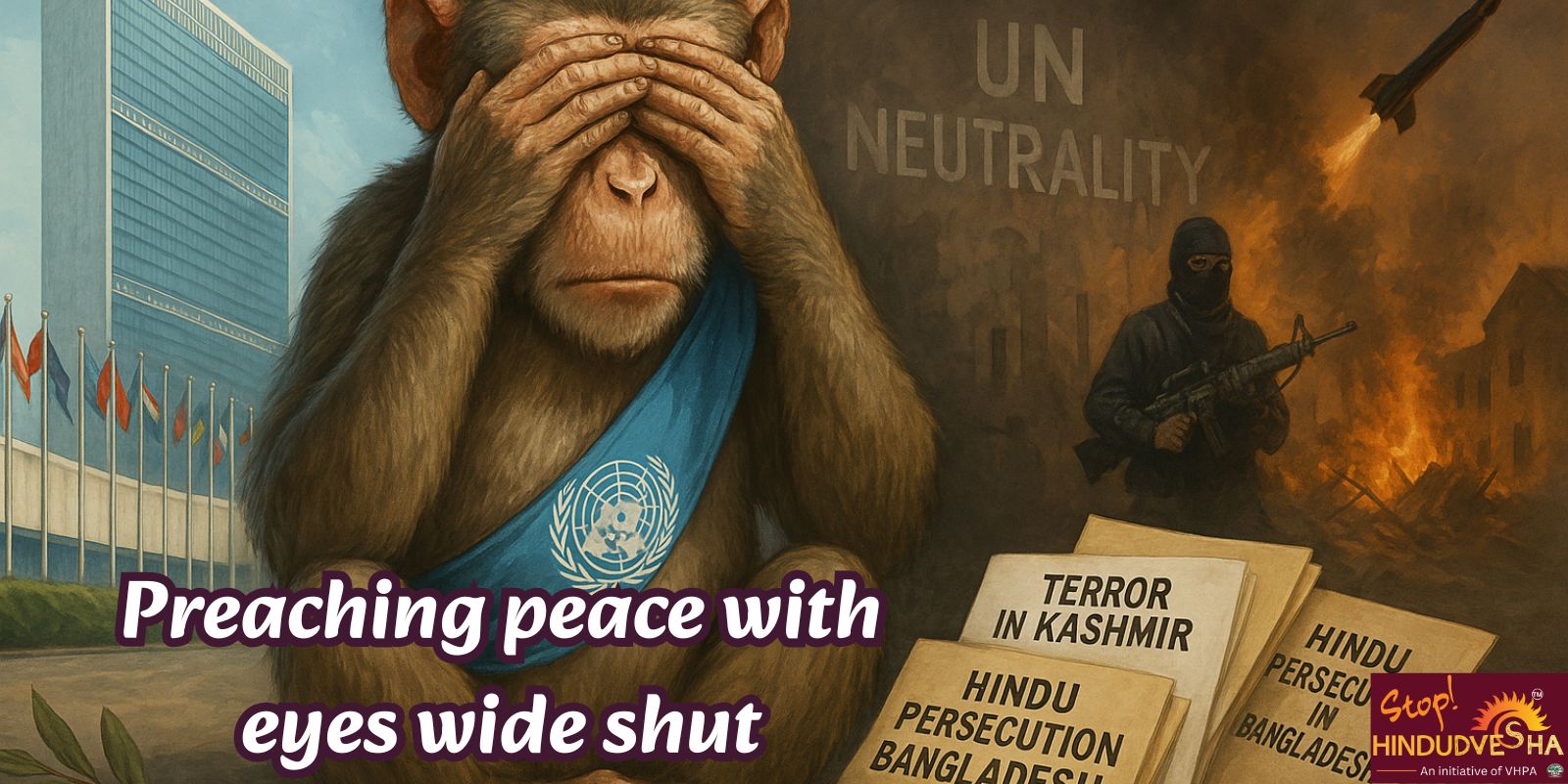
- From Pahalgam to Gaza, the UN seems to be following the left-liberal, woke, and radical Islamist template of terror sympathizing and glorification.
- The UN’s ambivalent posturing on terror and its selective neutrality have provided a huge window to Pakistan for playing the archetypal victim card.
- Pakistan is trying to create a new narrative on terrorism by turning the tables on India and portraying itself as a victim of terror.
- In his recent UNGA speech, Pakistan PM Shahbaz Sharif claimed that “India’s Hindutva-driven extremism” posed a threat to the entire world.
- The UN’s one-sided virtue signaling and its ambivalence on Hamas terrorism have enabled the creation and flourishing of a whole industry around whitewashing terror and twisting narratives.
George Orwell’s line from Animal Farm—“All animals are equal, but some animals are more equal than others”—captures the hypocrisy that defines today’s global order. At the center of this moral decay stands the United Nations, an institution that projects moral authority while practicing selective outrage. It swiftly condemns Israel for the Gaza crisis but hesitates to hold Hamas accountable for terrorism. Similarly, it lectures India to show “restraint” after cross-border attacks without acknowledging Pakistan’s decades-long sponsorship of terror.
In June 2025, Pakistan—a country with an entrenched record of nurturing militant networks—was appointed Chair of the UN Security Council’s Taliban Sanctions Committee and Vice-Chair of its Counter-Terrorism Committee. This decision, made under the guise of rotational procedure, exposes the UN’s disconnection from reality. A nation long known for sheltering terrorists now presumes to advise the world on counter-terrorism. The irony could not be starker.
Such appointments reveal how the UN’s functioning has devolved into hollow ritualism. What was once envisioned as a guardian of peace now operates through bureaucracy rather than moral clarity. For an organization expected to lead global efforts against terrorism, to entrust a terror-sponsoring state with such responsibility is nothing short of institutional self-sabotage.
The timing made the decision even more appalling. As India launched Operation Sindoor in retaliation for the Pahalgam terror attacks, the UN effectively rewarded Pakistan with prestige and legitimacy. This pattern of duplicity—whether in Gaza, Kashmir, or Bangladesh—suggests more than negligence. It points to a deeper ideological bias that aligns with left-liberal and Islamist narratives that rationalize or romanticize terrorism.
From Pahalgam to Gaza, the UN has become a stage for selective morality, enabling the distortion of truth and shielding the real perpetrators behind the façade of “human rights” and “neutrality.”
Pakistan Using the UN as a Cover to Change the Narrative on Terror
The UN’s lax attitude on terrorism and its in-built biases enabling terrorism create space for a terror-enabler like Pakistan to play the victim card and whitewash terrorism. India has provided substantial evidence to the UN[1] regarding the involvement of TRF ( The Resistance Front),[2] an offshoot of the Lashkar-e-Taiba, in carrying out the Pahalgam terror attacks. However, the UN continues to put India and Pakistan on similar footing, vaguely condemning terrorism but portraying Operation Sindoor through the prism of the “India-Pakistan” conflict, rather than rightfully recognizing India’s status as a victim of Pakistan-sponsored terror, to which it has a right to respond.
The UN’s ambivalent posturing on terror and its selective neutrality have provided a big platform to Pakistan for playing the archetypal victim card by flatly denying its role in the Pahalgam terror attacks[3]and claiming that India targeted its civilian population during Operation Sindoor.[4] A section of the Western media, peddling Pakistan’s disinformation narratives, has given further ammunition to the terror state to peddle its falsehoods.[5]
Pakistan took recourse to backdoor lobbying at the UN to drop the mention of The Resistance Front (TRF) in the UNSC statement condemning Pahalgam terror attacks.[6] The UNSC issued a press statement condemning the attacks “in the strongest terms” and reaffirming that “terrorism in all its forms and manifestations constitutes one of the most serious threats to international peace and security. But the statement didn’t name TRF or make even a cursory mention of the menace of cross-border terrorism impacting India for decades. [7]
The watered-down UNSC Press Statement on Pahalgam terror attacks is symptomatic of a rather disturbing trend – complete silence on the roots of global terrorism and the role played by specific state actors and radical ideologies in perpetuating terror. By using fuzzy language to pay lip service to condemning terrorism, the UN has turned the narrative on terrorism into a postmodern document of sorts, granting perpetrators near-complete immunity and providing a safe space for whitewashing terror.
Pakistan also uses international forums like the UN to relentlessly parrot its false narrative on Baloch insurgency, accusing India of provoking terrorism and insurgency in Balochistan. In the Jaffar Express hijack incident in March 2025, the Pakistan army claimed that 33 Baluch Liberation Army (BLA) militants, who had claimed responsibility for the attacks, had been killed.[8] Even as the UNSC issued a statement condemning “the heinous and cowardly terrorist attack”, Pakistan accused India of sponsoring militant groups in its southwest region. [9]
Pakistan is trying to create a new narrative on terrorism by portraying itself as a victim of terror. In September 2025, the US, UK, and France collectively put a “technical hold” on Pakistan’s bid to list the Balochistan Liberation Army ( BLA) and the Majeed Brigade as terrorist groups at the UNSC’s 1267 sanctions committee. [10]
Pakistan has also accused India of backing terror groups based in Afghanistan to undermine its sovereignty and national integrity. In August 2025, its Ministry of Foreign Affairs spokesperson Shafqat Ali Khan made a sensational statement claiming that groups like the BLA and Tehrik-i-Taliban Pakistan (TTP) have been acting as Indian proxies.[11]
Pakistan is aggressively manoeuvring to change the narrative of terrorism by attempting to shift the focus from the Pakistan-sponsored terrorism rooted in radical Islamic extremism targeting India to a fabricated narrative on the “Afghanistan-India terror nexus” targeting Pakistan.
Although Pakistan’s falsehoods have already been exposed, as it’s unable to present any evidence regarding these claims, that’s not the point. In classic propaganda tactics, reinforcing narratives is a proven and effective method for influencing public perception. By creating a false narrative portraying itself as the victim of terrorism, Pakistan is creating a long-term framework for enabling the further perpetuation of anti-Hindu violence facilitated by the radical Islamist ecosystem. The UN, in its sheer inability to categorically condemn Pakistan-sponsored terrorism, is effectively enabling the whitewashing of terror.
Pakistan’s Prime Minister Shahbaz Sharif’s recent UNGA address was a textbook display of irony. Playing the victim and moral crusader, Sharif accused India of exploiting “a human tragedy” for political gain and of attacking Pakistani cities. The speech descended into absurdity when he claimed Pakistan had been “on the frontline of global counter-terrorism” for two decades—this, from a nation long known for harboring and exporting terror. Shifting blame, Sharif accused groups operating from Afghan soil of carrying out attacks inside Pakistan, calling them “foreign-funded” in a veiled jab at India. He even went on to lecture Afghanistan’s interim government about peace, harmony, and women’s rights—an astonishing act of hypocrisy from the head of a state that shelters extremist ideologies.[12]
Never mind that a lecture on peace, human rights, and women’s rights from Pakistan is almost comical, given its state policy of nurturing terrorism and perfecting the art of outsourcing it.[13] Shahbaz Sharif’s UNGA speech could be dismissed as hollow posturing, but doing so would be shortsighted. A nation built on terror now attempting to rebrand itself as an anti-terror crusader poses an even greater threat. Pakistan’s duplicity is sustained by the West’s selective silence and the UN’s indifference, both of which embolden its deceit. When global institutions fail to hold Islamabad accountable, they allow a terror sponsor to masquerade as a victim, corroding the credibility of the so-called rules-based world order and further endangering regional and international stability.
Distorted Narrative on Kashmir
The United Nations has repeatedly allowed Pakistan to misuse its platforms to spread falsehoods about Kashmir, often with China’s backing. Since the abrogation of Article 370 in 2019, Pakistan’s propaganda at the UN has grown increasingly shrill and relentless. In 2022, Pakistan’s then Ambassador to the UN, Munir Akram, raised the Kashmir issue even during an emergency UNGA session convened to discuss the Russia–Ukraine war—an act that revealed Islamabad’s obsession with the topic.[14] The following year, Prime Minister Shahbaz Sharif used his 2024 UNGA address to demand the reversal of Article 370[15] and in 2025 he repeated the charade, accusing India of human rights abuses and urging the UN to conduct an “impartial plebiscite.” These staged performances expose how Pakistan exploits global forums to deflect attention from its own failures and its long-standing sponsorship of terrorism in the region.[16]
The Western world today is preoccupied with its own troubles—the Russia–Ukraine war, economic instability, and rising anti-immigrant sentiment. These issues have left little appetite for external conflicts such as Kashmir. While Western powers are unlikely to openly support India’s position, they are equally reluctant to align with Pakistan. India’s growing global stature and strategic importance have made most Western nations cautious not to alienate New Delhi unnecessarily. As a result, Pakistan’s periodic theatrics on Kashmir at the UN rarely translate into tangible outcomes.
Yet the UN’s continued indulgence of Pakistan’s falsehoods is troubling. Islamabad routinely frames Kashmir in terms of “self-determination,” language that mirrors the rhetoric of India’s left-liberal and Islamist circles. Its attempts to equate Kashmir with Gaza dangerously blur the line between genuine human rights issues and the deliberate export of jihadist extremism. By recasting terrorism as resistance, Pakistan seeks to justify its proxy war under moral disguise.
This persistent propaganda is not aimed at governing Kashmir but at keeping extremism alive and legitimized on international platforms. The UN’s silence on Pakistan’s long record of nurturing terrorism only reinforces this deception, further amplified by sympathetic Western media and academic networks.
Without decisive UN action against Pakistan’s terror infrastructure—responsible for countless attacks across India, including the 26/11 Mumbai massacre—Islamabad’s rhetoric at the UN becomes more than propaganda; it becomes a form of moral subversion. When the world’s premier body on peace and security allows a state sponsor of terrorism to masquerade as a victim, it effectively lends legitimacy to terror itself. In doing so, the UN risks losing its credibility and unwittingly playing the role of a global apologist for those who exploit religion and victimhood to sustain violence.
Pakistan continues to seek allies to echo its false Kashmir narrative. Recently, Turkish President Recep Tayyip Erdogan, addressing the UNGA, referred to Kashmiris as his “brothers and sisters” and called for a UN-mediated resolution. India’s Ministry of External Affairs swiftly rejected his remarks, stating that Turkey had no locus standi on India’s internal matters. The MEA emphasized that instead of commenting on another nation’s affairs, Erdogan should have condemned Pakistan’s continued use of cross-border terrorism as a tool of state policy against India.[17]
Pakistan has repeatedly sought to involve the UN and the US President in mediating the so-called Kashmir “conflict.” India must remain vigilant about such maneuvers. Given its independent stance on the Russia–Ukraine war and its refusal to yield to Western pressure over Russian oil imports, New Delhi should anticipate that the Kashmir issue could be revived or weaponized at the UN as a geopolitical lever to pressure India or to balance broader strategic interests in global diplomacy.
Hindutva Terror Bogey
In his recent UNGA speech, Pakistan PM Shahbaz Sharif claimed that “India’s Hindutva-driven extremism” posed a threat to the entire world. [18]
StopHinduvesha has already done a detailed coverage of the false bogey of the “Saffron terror” narrative. Our previous stories highlight how the “Hindutva terrorism” narrative developed in the context of the 26/11 Mumbai attacks and a spate of other bombings and terror attacks that occurred between 2006 and 2010. The fabricated discourse of “saffron terror” that first gained ground in the aftermath of the 2002 Gujarat riots eventually became a full-fledged conspiracy to whitewash Islamic terror and malign Hindu Dharma in the process. [19]
Even as the saffron terror narrative stands shattered in the wake of the July 2025 verdict of the Special NIA Court in Mumbai, acquitting all seven accused in the Malegaon blasts case of all charges,[20] Pakistan continues to desperately clutch on to the last straws of this sensational conspiracy by shouting hoarse about “Hindu extremism”.
The Hindutva-bashing narrative echoed by Pakistan and the left-liberal ecosystem is uncannily similar. The elite Western academia creates conspiracy theories of Hindu extremism using stock phrases like “Hindu majoritarianism “, “Brahmanical patriarchy”, “Hindutva supremacy”, etc., and the global left-liberal media further amplifies these vicious stereotypes by undertaking highly biased and distorted coverage of issues related to Hinduism and India.
The UN covertly enables such narratives by displaying blatant double standards in its approach towards Islamophobia vs Hinduphobia. While Islamophobia has explicitly been recognized by the UN, with even a day dedicated to combating the same,[21] Hinduphobia continues to be ignored by the UN despite the presence of an overwhelming amount of evidence regarding the extent of anti-Hindu violence and genocide, and repeated requests by India to facilitate the recognition of phobias against non-Abrahamic faiths. [22]
The UN’s silence on the persecution of Hindu minorities in Bangladesh and the growing hate crimes against Hindus in Western nations is deeply telling. While it frequently issues statements on Islamophobia, it has never officially acknowledged anti-Hindu pogroms such as the Kashmiri Pandit genocide of 1989–1991. This selective outrage, coupled with the dismissal of Islamist violence against Hindus, has emboldened extremist networks. The overemphasis on Islamophobia serves as a convenient smokescreen, erasing Hindu suffering and branding any discussion of Islamist terrorism against Hindus as “Islamophobic.”
UN’s Double Standards in the Israel-Gaza Conflict
In the aftermath of the October 7, 2023, Hamas attacks on Israel, UN Secretary General Antonio Guterres made a somewhat controversial statement, emphasizing that ” It is important also to recognize the attacks by Hamas did not happen in a vacuum”. [23] Although, in all fairness, the UN Secretary General unequivocally condemned the Hamas terror attack before issuing this disclaimer, nevertheless, the provocative rhetoric supposedly highlighting the historical context of the attacks does come across as a terror apology, and perhaps even echoes the narrative of the pro-Hamas lobby.
The UN’s double standards in the Israel–Gaza conflict are starkly visible. Its tone and statements reveal a clear imbalance: the organization shows little moral outrage over Hamas’s brutal attacks on Israeli civilians or its continued hostage-taking, yet it condemns Israel with unrelenting fervor for its military response. Israel has repeatedly called out this hypocrisy. In July 2025, Ambassador Danny Danon accused the UN of blaming Israel for a crisis instigated by Hamas. Earlier, in March, he criticized the Security Council for its failure to demand the immediate release of hostages held by Hamas, exposing the UN’s selective empathy and moral inconsistency. [24]
Even though Hamas has been designated a terrorist organization by individual countries like the US and the UK, the UN hasn’t officially designated the group as a terrorist organization yet. Despite repeated demands by Israel that the UNSC designate Hamas as a terror group,[25] the lack of consensus amongst its permanent and non-permanent members on this issue continues to block any such move.
In a nutshell, the UN’s one-sided virtue signaling and its ambivalence on Hamas terrorism have enabled the creation and flourishing of a whole industry around whitewashing terror and twisting narratives.
Wrapping Up
Despite its declining global influence, the UN remains the only international institution with mechanisms to uphold a rules-based world order and address challenges such as terrorism, wars, conflicts, and climate change.
As the Global South increasingly demands reforms to make the UN more equitable and transparent—and to curb Western dominance—these reforms must also prioritize counterterrorism. The world cannot afford to treat terrorism in abstract terms when UN-listed groups like Jaish-e-Mohammed and Lashkar-e-Taiba still operate with impunity, and figures like Osama bin Laden once found sanctuary in UN member states. Any credible reform must confront the ideological roots and state sponsors of terror.
For the UN to retain legitimacy, it must not allow itself to become a platform that sanitizes or legitimizes terrorism under the guise of neutrality or selective moral outrage.
Citations
[1] Indian team to present in UN evidence on Pahalgam terror attack – The Hindu; https://www.thehindu.com/news/national/indian-team-to-present-in-un-evidence-on-pahalgam-terror-attack/article69576655.ece
[2] (22) India Takes Diplomatic Offensive Against Pakistan at UN Over Pahalgam Terror Attack| News18 – YouTube; https://www.youtube.com/watch?v=NrNbnkbdGKA
[3] Pakistan claims terror network ‘dismantled’, denies LeT link to Pahalgam attack – The Hindu; https://www.thehindu.com/news/international/pakistan-claims-terror-network-dismantled-denies-let-link-to-pahalgam-attack/article69830447.ece
[4] Operation Sindoor: What’s the significance of India’s Pakistan targets? | India-Pakistan Tensions News | Al Jazeera; https://www.aljazeera.com/news/2025/5/7/operation-sindoor-whats-the-significance-of-indias-pakistan-targets
[5] ‘Western media pro Pakistan, cannot be trusted’: British expert blasts anti-India narrative on Op Sindoor – BusinessToday; https://www.businesstoday.in/india/story/western-media-pro-pakistan-cannot-be-trusted-british-expert-blasts-anti-india-narrative-on-op-sindoor-476380-2025-05-15
[6] Pakistan got UNSC to drop mention of LeT offshoot TRF- The Economic Times; https://economictimes.indiatimes.com/news/defence/pakistan-got-unsc-to-drop-mention-of-let-offshoot-trf/articleshow/120674769.cms?from=mdr
[7] Security Council Press Statement on Terrorist Attack in Jammu and Kashmir | Meetings Coverage and Press Releases; https://press.un.org/en/2025/sc16050.doc.htm
[8] Pakistan train hijack: All hostages freed, 33 BLA militants killed, claims army – The Times of India; https://timesofindia.indiatimes.com/world/pakistan/pakistan-train-hijack-all-hostages-freed-33-bla-militants-killed-claims-army-jaffar-express/articleshow/118943997.cms
[9] Pakistan accuses India of sponsoring militant terror group after train hijacking | Pakistan | The Guardian; https://www.theguardian.com/world/2025/mar/14/pakistan-accuses-india-of-sponsoring-militant-terror-group-after-train-hijacking
[10] US, UK, France put on hold Pakistan bid to designate Baloch group as terrorists | India News – The Indian Express; https://indianexpress.com/article/india/us-uk-france-put-on-hold-pakistan-bid-to-designate-baloch-group-as-terrorists-10260372/
[11] Islamabad Accuses India of Using Afghan-Based Terror Groups to Destabilize Pakistan; https://kabulnow.com/2025/08/islamabad-accuses-india-of-using-afghan-based-terror-groups-to-destabilize-pakistan/
[12] Pakistan PM UNGA Address, September 26, 2025; https://gadebate.un.org/sites/default/files/gastatements/80/pk_en.pdf
[13] Pakistan Joins UN Anti-Terror Panel Farce; https://stophindudvesha.org/pakistan-joins-un-counter-terrorism-committee-a-diplomatic-farce-drenched-in-blood/
[14] ‘Frivolous and pointless’: India tears into Pakistan for raising Kashmir issue at UN – India Today; https://www.indiatoday.in/india/story/india-slams-pakistan-frivolous-pointless-unga-special-session-ukraine-russia-2284708-2022-10-13
[15] Pakistan PM Shehbaz Sharif raises Kashmir issue in UNGA address; https://thefederal.com/category/international/pakistan-pm-shehbaz-shariff-raises-kashmir-issue-in-unga-address-147163
[16] Pakistan PM UNGA Address, September 26, 2025; https://gadebate.un.org/sites/default/files/gastatements/80/pk_en.pdf
[17] Turkey President Erdogan rakes up Kashmir Issue at the UN General Assembly; ‘We hope…’ | World News; https://www.hindustantimes.com/world-news/turkey-president-recep-tayyip-erdogan-rakes-up-kashmir-issue-at-un-general-assembly-we-hope-101758665566693.html
[18] Pakistan PM UNGA Address, September 26, 2025; https://gadebate.un.org/sites/default/files/gastatements/80/pk_en.pdf
[19] Saffron Terror Myth: A Manufactured Narrative; https://stophindudvesha.org/the-saffron-terror-myth-how-a-dangerous-narrative-was-manufactured/
[20] Malegaon Verdict: Truth Shatters the politics of ‘Saffron Terror’; https://stophindudvesha.org/malegaon-verdict-truth-shatters-the-politics-of-saffron-terror/
[21] International Day to Combat Islamophobia | United Nations; https://www.un.org/en/observances/anti-islamophobia-day
[22] Acknowledge ‘Hinduphobia’, India urges UN | India News – Times of India; https://timesofindia.indiatimes.com/india/acknowledge-hinduphobia-india-urges-un/articleshow/89028174.cms
[23] Secretary-General’s remarks to the Security Council – on the Middle East | United Nations Secretary-General; https://www.un.org/sg/en/content/sg/speeches/2023-10-24/secretary-generals-remarks-the-security-council-the-middle-east%C2%A0
[24] Danny Danon criticizes UN’s hypocrisy regarding Israel | The Jerusalem Post; https://www.jpost.com/israel-news/article-861917
[25] Israel Foreign Minister Demands UN Designate Hamas a Terror Organization; https://www.voanews.com/a/israel-s-foreign-minister-demands-un-designate-hamas-a-terror-organization/7523722.html

Donate to HINDUDVESHA
Our Mission is to explore and expose Hindudvesha through research analysis, education and response.
SUPPORT US