

Malegaon Verdict: Truth Shatters the Politics of ‘Saffron Terror’
 K. Sindhu · 08/30/2025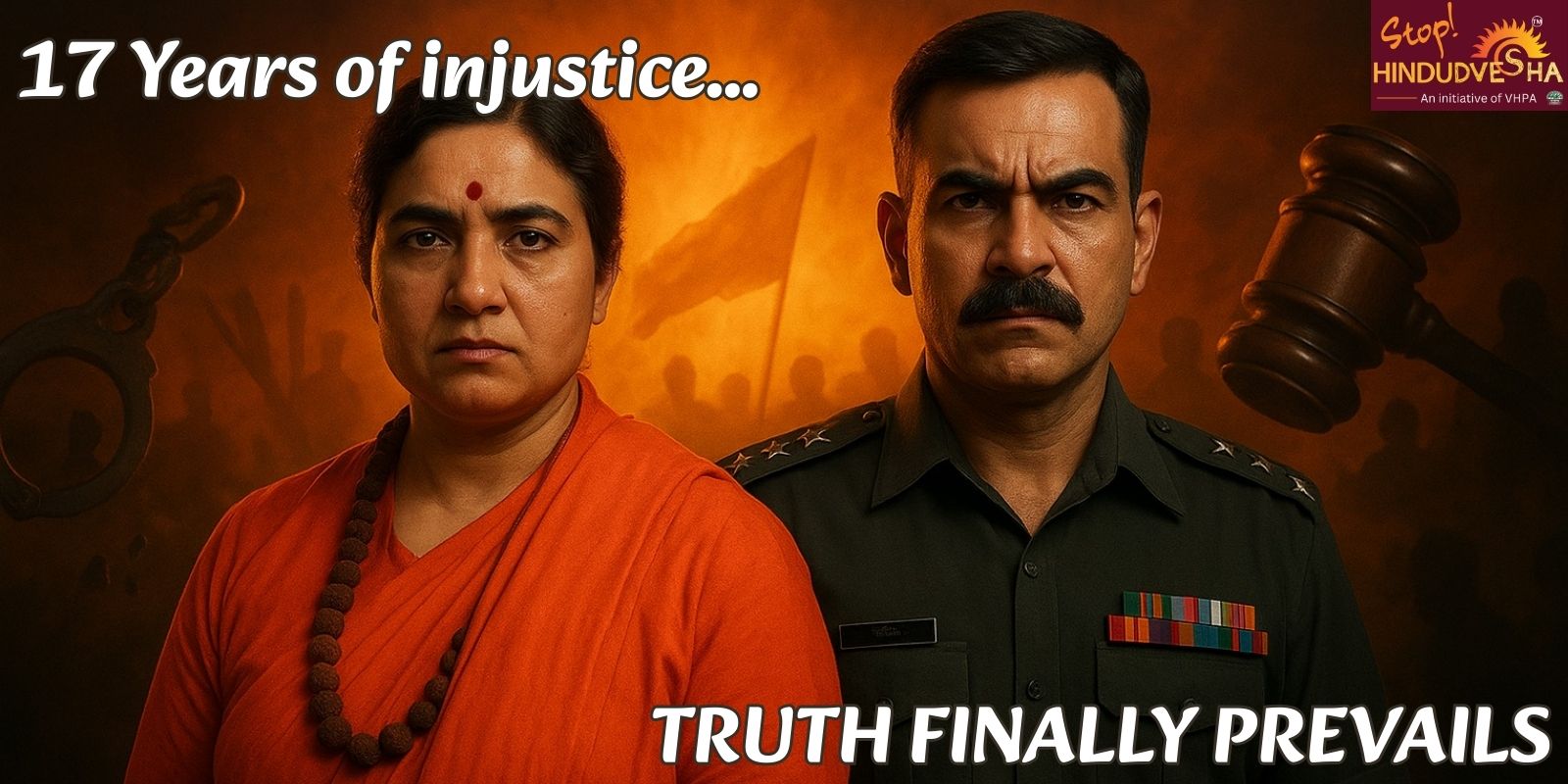
- The NIA Court’s verdict in the Malegaon case exposes the fabricated “saffron terror” narrative, revealing how false charges were used to malign the entire Hindu community.
- Acquittal alone is insufficient; measures such as a public apology, fair compensation, and strict action against erring officials are essential. Without these, the scars of injustice will remain, and state accountability will never be established.
- The ruling regime at the time misused investigating agencies and national resources, while the actual perpetrators remain untraced, showing that political narratives were prioritized over national security and justice for the deceased and injured victims of the bomb blast.
- Selective secularism has targeted Hindus while shielding others from similar scrutiny. Such bias corrodes the very spirit of equality promised by the Constitution.
- The fundamental right to freedom of speech and expression does not extend to vilifying the entire Hindu community or branding the accused as “terrorists” through media trials.
- Hindu Dharma, the antithesis of terrorism, is rooted in ahimsa, righteous conduct, and the pursuit of cosmic order, not in spreading terror or hatred.
On July 31, 2025, the Special NIA Court in Mumbai delivered a landmark verdict that ought to have served as a moment of national reckoning. After 17 years of political circus, marked by media trials and blatant institutional misuse, all seven accused in the 2008 Malegaon blast case have been acquitted of all charges. The court found no credible evidence to substantiate the allegations.
The judgment did more than clear the names of the individuals involved; it dismantled the entire “Saffron Terror” narrative, a construct deliberately fashioned by vested interests to malign Hindu Dharma and equate it with violence.
However, rather than engaging in introspection, the same political voices that orchestrated this episode have chosen to double down, resorting to tired platitudes such as “terrorism has no religion.” If that sentiment were truly held, why was an entire faith — Sanatan Dharma — singled out and vilified through the language of religious profiling? Why were monks and decorated military officers subjected to torture, prolonged imprisonment, and global defamation without credible evidence?
A previous article by Stop Hindudvesha has already exposed the manufactured nature of the “Saffron Terror” narrative, designed to demonize Hindus, suppress saffron voices, and shield the actual perpetrators of terrorism.[1] Accordingly, this article does not revisit that historical account. Instead, it focuses on the Malegaon case’s final legal closure and the broader civilizational issues it highlights — examining how state institutions were co-opted to propagate this false narrative, the roles of political actors and the media, the infringement of fundamental rights, and, most importantly, the measures Hindus must adopt to ensure such targeted persecution is never repeated.
Malegaon 2008: Facts Buried, Agenda Advanced
On 29 September 2008, a bomb exploded near Bhikku Chowk in Malegaon, Maharashtra, killing six people and injuring over a hundred. Based on intelligence inputs, modus operandi, and past incidents, initial suspicion fell on SIMI and other Islamic terror outfits. However, the investigation abruptly shifted its focus to an alleged “Hindu terror module.” Prominent figures, including Sadhvi Pragya Singh Thakur and Lt. Col. Prasad Purohit, were arrested. Over the next 17 years, they were defamed, imprisoned (later released on bail), and vilified.
The irony is that the perpetrators of this mischief never had any real evidence against the accused. Seventeen years later, the court confirmed the same — there was no credible basis for the prosecution’s claims. The so-called “revolutionary Hindu terror module” turned out to be nothing more than an ideological invention.
However, during the course of the case, a strategic shift took place in public discourse: Hindus were recast from victims to alleged perpetrators, even as Islamic terror groups like Lashkar-e-Taiba, Indian Mujahideen, and SIMI were conclusively linked to numerous attacks — including Mumbai 2008, Delhi 2005, and Hyderabad 2007.
Why? Because such narratives are rarely driven by facts, they are driven by politics. From the very dawn of independence, a deep-rooted bias against Hindu identity had been cultivated in India’s political and intellectual circles. As Sushma Swaraj famously observed in Parliament during the 1996 trust vote debate, in Lutyens’ Delhi, one could not be considered an “enlightened intellectual” unless one felt ashamed of being Indian and ashamed of being Hindu.[2] Jawaharlal Nehru himself once remarked that he was “Christian by education, Muslim by culture and tradition, and Hindu only by accident of birth.”[3] This contempt for Hindu identity created fertile ground for Left-Liberal elites and pseudo-secular forces to plant and cultivate the pernicious notion of “Hindu terror.” It was not an accidental mischaracterization but a calculated political strategy — framing Hindus as terrorists to advance partisan and ideological objectives.
‘Saffron Terror’ Story Collapses in Court
Delivering the verdict, the court noted that while it was proven that a bomb blast had taken place, the prosecution failed to provide reliable evidence to prove that the seven accused were behind it.[4]
While rejecting the evidence presented by ATS (Anti-Terrorism Squad) and NIA (National Investigation Agency), the court opined: “Upon a comprehensive evaluation of the entire evidence available on record, I am of the considered view that the prosecution has failed to adduce cogent, reliable, and legally acceptable evidence. The testimony of prosecution witnesses is riddled with material inconsistencies and contradictions. Such discrepancies undermine the credibility of the prosecution’s case and fall short of establishing the guilt of the accused beyond a reasonable doubt.”[5]
The court’s observations underscored the fact that the prosecution had relied on coerced confessions and had disregarded procedural safeguards. For example, the motorcycle allegedly used in the blast was registered to Sadhvi Pragya Thakur, one of the accused, but had been with someone else for years. The prosecution failed to prove any direct link. Witnesses turned hostile, and documentary evidence was found to have been tampered with. Most significantly, the court noted that the ATS had extracted statements through custodial torture, thereby violating the fundamental constitutional and human rights of the accused. Under judicial scrutiny, the case collapsed entirely, and the fabricated narrative of “saffron terror” was decisively discredited.
Manufacturing a Bald-Faced Lie
In his thought-provoking work Safed-Aatank: Hume Se Maino Tak[6], author M.K. Pandeya aptly characterizes the fabricated notion of “saffron terror” as Safed Aatank — a whitewashed form of terrorism rooted in Safed Jhooth (pure falsehoods) propagated by the safedposh, or “white-collared” elite. This group comprised influential politicians, bureaucrats, and their collaborators in the media and academia. Pandeya explains how this falsehood was crafted with precision, deliberately targeting Hindu symbols, traditions, and nationalistic sentiments, and then systematically injected into public discourse. He traces the process by which this fabrication was conceived, nurtured, and amplified until it permeated every corner of the nation and even reached the international stage.
Pandeya draws on the saying, “a lie told often enough becomes the truth,” to show how the then-ruling Congress Party and its allies pushed the “Saffron Terror” narrative. By repeating it across politics, speeches, and media, they turned a falsehood into an accepted “fact.” He argues that those who spread such lies, shield real terrorists, or vilify an entire community are as culpable as the perpetrators. Without the judiciary’s intervention, this fabrication would have permanently tainted Hindu Dharma. The NIA Court’s dismissal not only cleared the innocent but also freed Hindu civilization from a politically driven and undeserved mark of shame.
The Human Cost of the ‘Saffron Terror’ Myth
While the NIA Court’s judgment ultimately acquitted the accused on account of insufficient evidence and procedural improprieties, no judicial verdict can erase the personal, psychological, professional, and reputational damage they endured over nearly two decades. These were not ordinary defendants; they were individuals who had devoted their lives to serving the nation and society, among them a decorated Army officer, saints, and a Sadhvi committed to a life of spiritual discipline. Yet they were branded as “terrorists,” subjected to public vilification, and dehumanized by a partisan media and a hostile political establishment.
Sadhvi Pragya, one of the seven accused, has repeatedly described in multiple interviews the brutal torture she endured in police custody. She recounts being stripped, beaten, and subjected to inhumane treatment in a sustained effort to force a false confession and implicate other prominent figures, including Prime Minister Narendra Modi and RSS chief Shri Mohan Bhagwat. The abuse was not only physical but also a calculated attempt to break her spirit and tarnish Hindu Dharma.
Lt. Col. Prasad Purohit, an officer of the Indian Army’s Military Intelligence who had risked his life to infiltrate terrorist networks and gather actionable intelligence for the protection of national security, was incarcerated for nine years under draconian legal provisions before being granted bail. He was denied due process and suspended from duty despite acting under official orders in the national interest. His career, honor, and family life were irreparably damaged, and his reputation was dragged through the mud — all without a single piece of credible evidence to substantiate the charges. Several of the other accused were subjected to similarly inhumane treatment.
The repercussions extended far beyond the immediate accused. Their families became social outcasts, their livelihoods were destroyed, and their faith in justice deeply shaken. For nearly 17 years, these individuals and their loved ones were branded “Hindu terrorists” by the media and derided by political commentators. No compensation has been granted, and no formal apology has been issued. The mental anguish, public humiliation, financial devastation, and social alienation they endured cannot be measured in purely legal terms. Even though the judiciary has now cleared their names, the psychological scars and entrenched social stigma resulting from this orchestrated narrative will take years — perhaps generations — to heal.
Justice delayed is not merely justice denied; it also becomes a tool of persecution. In this case, the legal system was weaponized to break the spirit of those viewed as ideological threats to the government. The state-enabled witch hunt caused lasting psychological, financial, and social damage to the accused, their families, disciples, and associated institutions. It eroded public trust in state machinery, strained inter-community relations, and damaged Bharat’s reputation as a pluralistic society on the global stage.
The greater concern lies in the long-term consequences. After such prolonged suffering, can it reasonably be expected that Lt. Col. Purohit — or any officer who witnessed this injustice — will again serve with the same passion and fearlessness when gathering intelligence? Will any soldier or officer risk infiltrating terrorist organizations if they know that “knowing too much” or being ideologically inconvenient could make them the next scapegoat? This is not merely a personal tragedy; it is a matter of national security. The message conveyed by this ordeal is chilling: defending the country can cost one’s freedom, dignity, and life if the ruling regime or dominant narrative turns against them.
Justice Demands More Than Vindication
The collapse of the “saffron terror” narrative should not be seen merely as vindication for the accused; it must serve as the basis for systemic reform. Investigative agencies must be insulated from political interference, with robust accountability mechanisms to ensure that no citizen is victimized in the service of an ideological agenda. Those who were wrongfully implicated, imprisoned, and vilified in the public eye for years deserve more than quiet acquittals. At the very least, there must be a public apology from the then-ruling regime and the political leaders who fabricated the “saffron terror” narrative, maliciously implicated the accused, and weaponized the investigative process for vote-bank politics, minority appeasement, and ideological objectives.
Adequate compensation for the years of liberty lost, careers destroyed, and reputations tarnished is not an act of charity — it is the bare minimum required under the principles of justice. Victims of malicious prosecution should also pursue defamation suits against individuals and media organizations that deliberately branded them as “terrorists” before any court had pronounced judgment. In addition to a fresh investigation, strict legal action must be taken against the erring officials.
Such measures would not only restore the dignity of the wrongfully accused but also send an unequivocal message that no government, agency, or media entity can manipulate national security cases for partisan or sectarian purposes without facing serious consequences. Justice is not truly served until the scars of injustice are addressed and the machinery that caused it is held fully accountable.
When Free Speech Becomes a Weapon Against Dharma
The Constitution of India under Article 19(1)(a) guarantees freedom of speech and expression to the citizens of India. However, this right is not absolute. It comes with reasonable restrictions—such as those relating to security of the nation, public order, incitement to an offence, and defamation:
“Nothing in sub-clause (a) of clause (1) shall affect the operation of any existing law, or prevent the State from making any law, in so far as such law imposes reasonable restrictions on the exercise of the right conferred by the said sub-clause in the interests of the sovereignty and integrity of India, the security of the State, friendly relations with Foreign States, public order, decency or morality or in relation to contempt of court, defamation or incitement to an offence.” (Article 19(2) of the Constitution of India)
When all other organs of the State, including the media, themselves become violators of fundamental rights by crafting and promoting the false narrative of “Hindu terror” or “saffron terror,” the constitutional fabric is placed in grave jeopardy. In the Malegaon case and other related incidents, the entire Hindu community was maligned, while individuals such as Sadhvi Pragya were subjected to targeted attacks, public humiliation, and even hate speech.
In such circumstances, the judiciary should have acted as the ultimate guardian of fundamental rights. The Hon’ble Supreme Court, through judicial activism or suo motu action, could and should have restrained the government and its officials from making derogatory remarks about Hindu Dharma or alleging the existence of a so-called “Hindu terror” behind the blasts, especially when the case was still under judicial consideration. It could have ensured that no state authority linked religion to acts of terror and that the religious sentiments of the Hindu community were respected, especially when no doctrinal basis existed for the alleged crime and the matter was sub judice.
Similarly, investigative agencies should have been prohibited from making public statements on ongoing cases in a manner that could prejudice trial proceedings, and the media should have been barred from conducting parallel “media trials” that undermined the presumption of innocence — one of the cardinal principles of the criminal justice system.
Had such judicial intervention taken place, the damage caused by this fabricated narrative might have been contained. Instead, the absence of timely restraint allowed the falsehood to spread both nationally and internationally. Today, even after a court judgment exposing the baselessness of these allegations and acquitting the accused, the narrative persists — readily accessible through a simple online search. The harm is not merely reputational; it has defamed Hindu Dharma itself, entrenched social stigma against the acquitted, and cemented public opinion on a foundation of deliberate falsehoods.
Selective Secularism: A Tool Against Hindus
India’s constitutional promise of secularism is intended to ensure equal treatment for all religions (“Sarv Dharma Sambhava”). In practice, however, it often degenerates into a selectively applied political tool — most frequently against Hindus. The “saffron terror” narrative stands as one of the most glaring and recent examples of this bias. Its collapse in the wake of the Malegaon verdict has laid bare the double standards of those who crafted and promoted this myth. For years, certain politicians, self-proclaimed secular activists, and sections of the media had no hesitation in branding an entire community with labels such as “Hindu terror” and “saffron terror,” despite the absence of conclusive evidence and while cases were still sub judice. Yet, after the court’s acquittals, these same voices shifted their tone — now asserting that “terrorism has no religion” when speaking of jihadist groups like Lashkar-e-Taiba or other radical Islamist outfits.
If terrorism truly has no religion, they must answer why incidents like Malegaon were so readily branded as “Hindu terror” and why an entire Dharma was vilified. This is not secularism in its true sense; it is the politicization of secularism for minority appeasement, vote-bank politics, and the undermining of Hindu Dharma and the civilizational interests of Hindus.
When acts of terror are committed in the name of other faiths — particularly jihadist terror — political leaders and media figures are quick to caution against linking any religion to terrorism, urging restraint to prevent communal tension. Yet the moment an incident can be even tenuously connected, rightly or wrongly, to a Hindu individual, that caution evaporates. The indictment extends not only to the accused but to the entire Hindu community, its organizations, and even its sacred symbols.
The NIA court’s verdict has once again exposed this double standard. The deafening silence following the judgment stands in stark contrast to the loud accusations that preceded it, making clear that this brand of “selective secularism” is not about preserving harmony. It is about selectively vilifying the Hindu community while shielding others from collective blame.
Hindus and Terrorism: A Civilizational Oxymoron
Let us be clear — Hindus and terrorism are fundamentally incompatible. In Sanatan Dharma, there is no concept akin to kafir, nor any prescribed punishment for disbelief. Conversion is neither commanded nor considered a religious duty. The path to salvation is open to all, regardless of faith. Unlike the Abrahamic faiths, Hinduism:
- does not claim exclusivity over truth,
- embraces diverse philosophical traditions (dvaita, advaita, nastika), and
- even regards atheism as a valid intellectual pursuit.
How can a civilization that honors all spiritual paths be credibly associated with terrorism? Hindus do not impose their beliefs; they do not stone blasphemers, behead apostates, or issue fatwas. The core principles of Ahimsa, Vasudhaiva Kutumbakam, and Dharma stand in direct opposition to violence in the name of religious supremacy.
The “saffron terror” narrative was therefore not merely a falsehood — it was a calculated act of civilizational defamation.
Dharmic Mandate to Defend
It is important to understand that the nature of Hindu Dharma is the complete opposite of terrorism. Terrorism thrives on indiscriminate violence to instill fear among innocents, whereas dharma aims at maintaining moral balance, justice, and the fulfillment of duty in creation. The ultimate goal of Hindu philosophy is peace, compassion, and non-violence. Yet, the scriptures—especially the Bhagavad Gita—clearly state that when dharma is attacked and innocents are subjected to injustice, struggle for the defense of dharma becomes not only necessary but mandatory.
Our scriptures declare: “Dharmo rakshati rakshitah”[7]—he who protects dharma, is himself protected by dharma. This principle is repeatedly seen in Indian history. Whether it is the struggle between Rama and Ravana in the Ramayana, or the great war between the Pandavas and Kauravas in the Mahabharata, the true battle has always been between dharma and adharma. These episodes teach us that protecting dharma is the foremost duty of every Hindu.
Today, false narratives such as “Saffron Terror” attempt to malign the very soul of Hindu Dharma. Merely denying such lies privately is not enough; silence itself amounts to supporting adharma. That is why organized, lawful resistance against such attacks is necessary. The primary duty of a Kshatriya is the protection of dharma, and this spirit must awaken within every Hindu.
Our texts also emphasize that violence is never the first option. Lord Rama sought peace with Ravana before war, and Lord Krishna himself went as an envoy to the Kauravas to prevent conflict. But when all peaceful means failed, dharma-yuddha (a righteous war) became the last and inevitable option. This is the essence of the Gita: cowardice before adharma is not non-violence, but weakness.
Thus, the distinction must be clear: terrorism targets the innocent, while dharma-yuddha rests on justice, restraint, and morality. In Hindu tradition, non-violence never means tolerating injustice or surrendering to adharma; it means never initiating aggression but never retreating when dharma itself is in danger. This is the eternal truth, the timeless foundation of our civilization’s protection.
Guarding Dharma Against Manufactured Narratives
When the state apparatus is used not to uncover the truth but to manufacture narratives, the consequences are catastrophic. Institutions such as the ATS, CBI, and NIA are meant to function as apolitical bodies. Yet, too often, they have been reduced to tools of political vendetta. In Vineet Narain vs. Union of India (1997), the Supreme Court famously described the CBI as a “caged parrot,” [8] lamenting its vulnerability to political pressure. Decades later, no meaningful institutional reforms have been implemented to ensure that the investigative agencies operate independently, free from political interference. This absence of reform leaves the door wide open for the fabrication of false narratives in the future — much like the “saffron terror” myth — enabling the targeting of innocent citizens.
To prevent the repeat of such injustices, Hindus must unite and act proactively, but within lawful boundaries, against the attacks on their Dharma. Advocate J. Sai Deepak rightly said, “Do not use the Gita to teach pacifism…, teach the Gita to teach Kshatriya Dharma…”[9] Only when the Hindu community demonstrates the collective determination for protecting their Dharma and Dharmic awareness-alertness, any government that come to power regardless of its ideology, or any biased investigation agency or media outlet, think twice before attempting to malign Hinduism or fabricate such narratives.
Some measure of lawful deterrence is essential.[10] Those who seek to malign Hindu Dharma — whether individuals, governments, or national and international media — must understand that the Hindu community will respond in unity, lawfully, and resolutely. This is particularly important because Hinduism, at its core, upholds universal and benevolent principles such as Vasudhaiva Kutumbakam (“The entire world is one family”); Sarve Bhavantu Sukhinah (“May all be happy”); Sarve Santu Niramayah (“May all be healthy”); Sarve Bhadrani Pashyantu (“May all see what is auspicious”); and Ma Kashchit Duhkha-Bhaag-Bhavet (“May none suffer”).[11]
These inherent values are fundamentally incompatible with the very idea of terrorism. However, they do not demand passivity in case of malicious attacks on the Hindu Dharma itself.
Wrapping Up
The collapse of the so-called “saffron terror” narrative is not just a courtroom event — it is a reckoning for the nation. For years, the Hindu community was vilified, its symbols defamed, and its saints and soldiers humiliated — all without conclusive proof. The acquittals are not only legal vindications; they are reminders that truth, though delayed, ultimately prevails.
This episode also exposes a deeper problem — how easily political bias, selective secularism, and a compliant media can create a false national script. When such forces succeed, the damage extends beyond the accused; it strikes at the very soul of the nation, distorting how the world perceives Sanatan civilization.
It must be stated clearly that Hindu Dharma is the opposite of terrorism. At the same time, our Dharmashastras — from the Ramayana to the Mahabharata to the Bhagavad Gita — affirm that hinsa undertaken to protect Dharma is not violence but righteous duty. Arjuna was not told to lay down his arms; he was urged to fight when Adharma threatened to engulf the land. This is not a call to blind aggression — it is a call to moral courage.
In today’s world, narratives are as powerful as armies. We cannot remain silent when falsehood is weaponized against us. Unity, vigilance, and an unapologetic defense of our civilizational truth are essential for survival. The lesson of the “saffron terror” episode is clear: when we stand firm for our Dharma, no slander can withstand the force of truth. And when truth shines, no darkness — however long it lasts — can endure.
Citations
[1] The “Saffron Terror” Myth: How a Dangerous Narrative was Manufactured (StopHinduDvesha.Org, 2025); https://stophindudvesha.org/the-saffron-terror-myth-how-a-dangerous-narrative-was-manufactured/
[2] Malegaon blast verdict shatters ‘Saffron Terror’ lie of UPA government; Hindu terror theory falls apart; https://organiser.org/2025/08/02/305858/bharat/malegaon-blast-verdict-shatters-saffron-terror-lie-of-upa-government-hindu-terror-theory-falls-apart/
[3] ibid
[4] State of Maharashtra vs. Pragyasingh Chandrapalsingh Thakur; https://images.assettype.com/barandbench/2025-08-02/d5itwyxj/State_of_Maharashtra_vs__Pragyasingh_Chandrapalsingh_Thakur.pdf
[5] Testimony of witnesses riddled with inconsistencies: NIA Court junks evidence in Malegaon case; https://www.deccanherald.com/india/maharashtra/testimony-of-witnesses-riddled-with-inconsistencies-nia-court-junks-evidence-in-malegaon-case-3661803
[6] “Safed-Aatank: Hume Se Maino Tak”- by M.K. Pandeya (Manoj Jwala); ISBN: 978-81-923388-1-1
[7] Dharmo Rakshati Rakshit – धर्मो रक्षति रक्षितः; https://gurukul.org/blog/spirituality/dharmo-rakshati-rakshit/
[8] “Be you ever so high”: A brief history of the Supreme Court’s call for impartial agencies; https://www.scobserver.in/journal/be-you-ever-so-high-a-brief-history-of-the-supreme-courts-call-for-impartial-agencies/
[9] Teach Kshatra dharma to your kids with Bhagavat Gita – J. Sai Deepak; https://www.youtube.com/shorts/N5rOX9FzBlk
[10] Saffron Terror: A Congress Manufactured Conspiracy;
[11] Om Sarve Bhavantu Sukhinah – In Sanskrit with meaning; https://greenmesg.org/stotras/vedas/om_sarve_bhavantu_sukhinah.php

Donate to HINDUDVESHA
Our Mission is to explore and expose Hindudvesha through research analysis, education and response.
SUPPORT US