
Strange Bedfellows: The Christian-Muslim Alliance Targeting Hindus in California
 Rakesh Krishnan Simha · 12/08/2025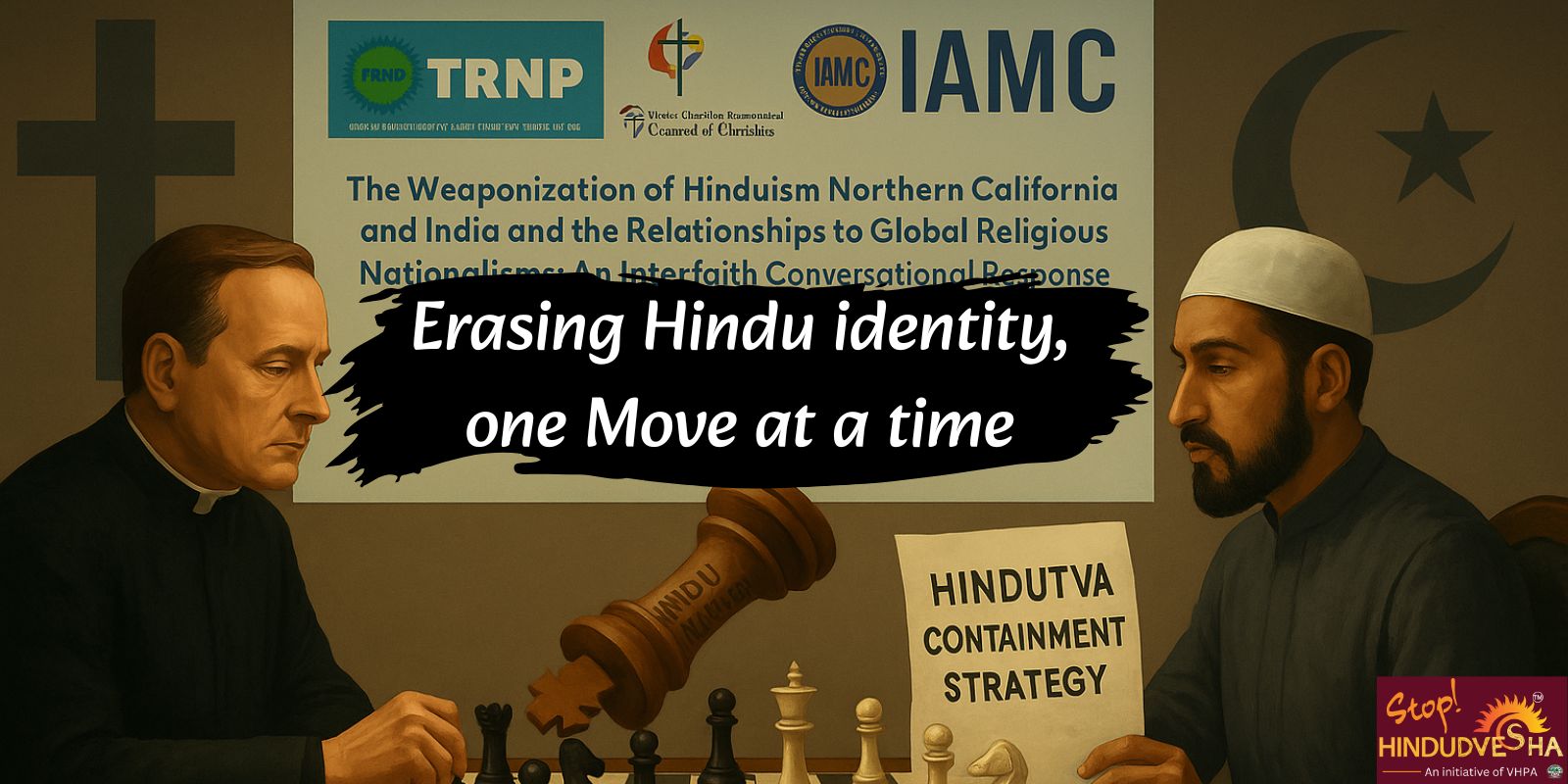
- A coordinated Christian–Muslim alliance in California is conducting a seminar tour that frames Hindutva as a dangerous form of religious nationalism, drawing sharp criticism for targeting Hindu communities.
- NYSCOC provides institutional authority while IAMC supplies ideological narratives, forming a strategic partnership influenced by missionary interests and radical Islamist networks.
- Critics argue the initiative marginalizes Hindu voices, spreads disinformation, and echoes past colonial alliances that sought to undermine Hindu reform and identity.
- Northern California is a deliberate target because of its large, influential Hindu professional population, allowing organizers to shape public discourse and blur lines between Hindu identity and political ideology.
- The effort risks delegitimizing an apolitical community, creating workplace and civic bias, and reinforcing asymmetrical power dynamics in interfaith spaces, prompting calls for balanced representation and accountability.
In California, a troubling convergence has emerged between a Christian church organization and Islamist advocacy groups, united not by shared spiritual values but by a mutual opposition to Hinduism. From November 20 to 23, the Religious Nationalisms Project (TRNP) — an initiative of the New York State Council of Churches (NYSCOC) — in partnership with the Indian American Muslim Council (IAMC), is hosting a tour of seminars in the state under the theme “The Weaponization of Hinduism in Northern California and the Relationships to Global Religious Nationalisms.”[1]
The tour, billed as an “interfaith conversation and response,” frames Hindutva — Hindu nationalist ideology — as a case study of religious nationalism, alongside Christian nationalism.[2] According to promotional materials, the seminars will explore how religious nationalism distorts faith traditions to serve exclusionary political agendas, and will offer concrete action steps for congregations to respond.
However, the initiative has drawn sharp criticism. Organizations like the Hindu American Foundation (HAF) have strongly pushed back, demanding accountability and transparency from public officials, such as New York Governor Kathy Hochul. They view the seminars as part of a broader trend of rising anti-Hindu hate incidents in the US.
Suhag Shukla, co-founder of HAF, accused NYSCOC of “joining a Muslim group … not to promote solidarity & peace — but to target peaceful Hindu Californians.” She called the event “an ambush.” HAF characterized the seminars as a “platform for spewing provocative lies against Hindus when anti-Hindu hate is at its zenith.”[3]
Ideological Nexus: Christian–Muslim Convergence
At first glance, the collaboration between a Christian ecumenical organization (NYSCOC) and a Muslim advocacy group (IAMC) may appear entirely benign — a genuine interfaith effort to safeguard democracy and pluralism. Yet a deeper examination indicates that this convergence reflects a more complex alliance, one that aligns theological, political, and identity-based motivations to critique, and potentially delegitimize, Hindu nationalism — and by extension, Hindu identity itself in the US, especially in California, where Hindu-Americans are highly visible in high-tech and immigrant communities.
At the heart of the controversy lies a strategic convergence between Christian fundamentalist elements and Islamist groups, forged in opposition to perceived Hindu supremacy. Christian critiques of Hindutva trace to missionary histories in India, where Hindu nationalism is viewed as a barrier to evangelism. US mainline denominations, including Methodists and United Church of Christ affiliates sponsoring the seminars, have long condemned Hindutva as a roadblock to their conversion activities in India. In America, this manifests in coalitions like the 2025 joint statement by over 30 US and Indian church leaders denouncing Hindutva events as “supremacist.“[4]
TRNP’s ostensible aim is to “convene, educate, train, and mobilize faith communities in response to the rising threat of religious nationalisms in the United States.” However, its parent body’s evangelical agenda is evident in its interest in its “relationship with the Church of South India.”[5] Clearly, they have conversion plans which are hidden behind the fig leaf of interfaith.
The IAMC is a US-based advocacy organization representing Indian diaspora Muslims. It is a radical Islamist group that has both direct and indirect linkages with terror organisations and radical Islamist outfits such as the banned Students Islamic Movement of India (SIMI).[6] IAMC founder Shaik Ubaid and member Abdul Malik Mujahid have headed the Islamic Circle of North America (ICNA), the US front for Jamaat-e-Islami, Pakistan. Both the IAMC and the ICNA are well-known arms of the Pakistan military establishment. “Both these organisations, apart from being used by Islamabad, are also put into effect by other Western agencies to corner and damage India’s soft power by raising fictitious issues, including that of minorities being unsafe in India.”[7]
This shared anti-Hindutva stance fosters unlikely alliances, as seen in the 2021 “Dismantling Global Hindutva” conference, where Christian, Muslim, and secular groups united against Hindus.[8] Historically, this nexus echoes colonial-era dynamics: British missionaries and Muslim elites collaborated against Hindu reform movements. In contemporary US contexts, it aligns with progressive coalitions like “100+ Organizations Stand Against Hindu Supremacy,” blending Christian anti-nationalism with Muslim civil rights advocacy.[9] The seminars exemplify this: NYSCOC’s TRNP provides ecumenical legitimacy, while IAMC supplies Hindutva-specific narratives, creating a pincer effect that marginalizes Hindu voices.
Such partnerships are not benign. A 2024 report by the California Civil Rights Department and documents provided by the Coalition of Hindus of North America show how these groups amplify disinformation, linking routine Hindu cultural expressions — temple fundraisers, yoga classes — to extremism.[10] In California, this rhetoric intersects with local politics, as seen in the failed 2023 caste discrimination bill (SB 403) pushed by anti-Hindu coalitions, which Hindu groups argued stereotyped South Asians.[11]
Both NYSCOC and IAMC frame their joint seminar series as a moral and ethical response to religious nationalism in its many guises. TRNP describes religious nationalism as “inherently antidemocratic” and “a distortion of faith” when used to marginalize religious minorities. The upcoming California tour explicitly names Hindutva (Hinduness) as a central case study while also examining white Christian nationalism.[12]
This framing performs two functions. It universalizes the threat by presenting religious nationalism as a problem across Christian, Hindu, and Muslim contexts, allowing TRNP to place itself at the moral center as a watchdog against all forms of religious supremacy. At the same time, it delegitimizes Hindutva by grouping it with Christian nationalism and similar movements, implying that it is not merely a political position but an inherently authoritarian and exclusionary force comparable to Zionism and Christian supremacism. NYSCOC has reinforced this view through webinars titled “Christian Nationalism, Zionism, Hindutva – the Dangers and Similarities of Religious Nationalism Around the World.”[13]
This convergent framing amplifies the portrayal of Hindutva as morally and politically suspect, and can shape perceptions in secular and religious communities and policy groups.
Power Dynamics and Strategic Alliance
The Christian partnership reflects a deliberate alignment of influence and resources. NYSCOC contributes institutional weight through its extensive network of US Christian denominations, encompassing tens of thousands of churches and more than 141 million followers, providing access to congregations, policymakers, and the media. IAMC extends the coalition’s advocacy reach by engaging Muslim communities from the Indian subcontinent, including Indian, Pakistani, and Bangladeshi immigrants, as well as broader South Asian American and civil rights networks.[14] Their agendas also intersect: IAMC is concerned about the impact of Hindu nationalism on Muslims, while NYSCOC remains committed to evangelizing India and other non-Christian regions. This convergence creates a symbiotic partnership that magnifies their influence.
This confluence allows joint initiatives like the California tour to carry both religious authority and political activism, targeting Hindutva as a case study — but not, crucially, examining Hindu identity with empathy.
Why California?
The decision to hold these seminars in Northern California, especially in the Bay Area, is not coincidental. Several factors make the region strategically significant in the context of religious, political, and social power dynamics.
Northern California, particularly Silicon Valley, is home to a large concentration of Hindu-American professionals, including engineers, tech entrepreneurs, and executives. Many of the most visible Indian American tech CEOs and innovators have Hindu backgrounds – Sundar Pichai of Google, Satya Nadella of Microsoft being the most marquee names.[15] Targeting this region serves several purposes for the organizers. It offers symbolic leverage by centering its message on a community that is both economically successful and emblematic of immigrant achievement in the United States. In this setting, critiques of Hindutva take on a broader meaning, touching on questions of power, representation, and social legitimacy rather than ideology alone.
The choice of audience also matters. Participants may include church members, interfaith activists, policy thinkers, and local leaders in an area where Hindu Americans are active in civic life. Discussions in such spaces can shape how religious nationalism is framed in public conversation, with possible effects on community perceptions, outreach efforts, and even workplace attitudes.
Identity politics adds another dimension. Challenging Hindu nationalism in a region with a sizeable Hindu population allows these groups to blur the line between Hindu identity and political ideology, creating disadvantages for ordinary Hindu Americans who do not identify with Hindutva. For organizations like NYSCOC and IAMC, which view opposition to Hindu influence as central to their mission, this setting offers an attractive stage. Each high-profile event becomes part of a broader strategy aimed at weakening Hindu representation and confidence.
Demographic and Electoral Significance
California is politically influential, with a large and diverse immigrant population. The seminars — scheduled at United Methodist and UCC (United Church of Christ) congregations, as well as a Sikh Gurdwara, across multiple Northern California venues — engage both religious congregants and civic actors. The potential outcomes of shaping interfaith discourse in this region include:
- Building alliances between Christian and Muslim communities on issues of religious nationalism.
- Influencing local policy debates around immigration, pluralism, religious freedom, and community relations.
- Framing Hindu Americans as a community of interest in need of critical self-reflection, particularly on “supremacist ideologies,” which may feed into broader narratives around social cohesion and minority rights.
The implicit agenda is to discredit Hindu identity and marginalize Hindu Americans.
Delegitimization of Hindu-American Communities
It is a fact that Hindus are the least politicized immigrant group in America. They are happy to donate large sums to political parties, and all they want in return is a photo-op.[16] Plus, unlike Christian churches and Muslim mosques, Hindu temples in America (and around the world) do not preach politics from the pulpit. By positioning Hindu nationalism as inherently authoritarian and worldview-threatening, the seminars potentially cast apolitical Hindu-American communities in a negative light. There are concerns that:
- Employers, especially in liberal and faith-based institutions, might view Hindu Americans through the lens of political ideology, rather than as individuals of faith or culture.
- Interfaith coalitions may increasingly exclude or marginalize Hindu perspectives, especially those that do not align with the so-called progressive framing of TRNP.
- Immigration narratives could be shaped in ways that paint Hindus as ideological risks, especially in communities where religious nationalism is framed as a challenge to pluralism.
- Given that many Hindu Americans in Northern California are high-achieving, high-status professionals, the impact could extend into social capital, community trust, and even immigration or employment discrimination.
Power Asymmetries and Epistemic Authority
Despite the interfaith framing, the power dynamic in this partnership is asymmetrical. Notably, HAF has criticized the initiative as one-sided. Because they are excluded, Hindus lack equal influence in shaping the narrative or program content of these seminars.
This asymmetry raises concerns about who defines the discourse on religious nationalism. If Christian and Muslim groups frame Hindutva without meaningful inclusion of Hindu voices, there is a risk of epistemic marginalization — the silencing or devaluation of Hindu voices, knowledge, and experiences, leading to them being considered less valid, credible, or important. In this situation, Hindu perspectives are insufficiently represented in defining what constitutes religious nationalism and how to respond to it.
Global Comparisons: Zionism, Christian Nationalism, and Hindutva
To understand the deeper significance of this alliance, it’s helpful to situate it in the broader context of global religious nationalisms and historical inter-religious dynamics.
NYSCOC has drawn parallels between Hindutva and Christian nationalism in the US and Zionism. In its webinar titled “Christian Nationalism, Zionism, Hindutva,” the church group highlighted how religious traditions can be co-opted into political ideologies that privilege one group over others.[17]
This comparison is not accidental. By placing Hindutva alongside other well-known forms of religious nationalism, the narrative becomes part of a global critique of supremacist ideologies. While intellectually and morally sound in many respects, this frame also risks reducing Hindutva — and by extension Hindus — as illiberal.
Historical Resonances and Transnational Advocacy
The partnership also reflects a long history of transnational religious advocacy among Christian and Muslim organizations. Such convergence is not new — religious and civil-society actors often band together across faith lines to address perceived majoritarian nationalism, authoritarian regimes, or human rights abuses. What is novel is the strategic targeting of Hindutva within a US domestic interfaith framework — linking it to American Christian concerns about nationalism and freedom. You could describe it as the pot calling the kettle black.
Critical Risks and Strategic Recommendations
Even if the NYSCOC positions its program as earnest, the concerns emerging from the broader community cannot be ignored.
First, the absence of balanced Hindu representation risks producing a skewed narrative, making it important for organizers to include practitioners, scholars, and community figures who can present a broad and accurate range of perspectives. Second, the possibility of casting this community as an ideological outlier can be reduced by emphasizing shared vulnerabilities among minority groups and recognizing internal diversity rather than presenting the tradition as a single, uniform bloc. A further concern is the potential development of an echo chamber among Christian and Muslim participants; this can be mitigated by promoting sustained interfaith cooperation through service initiatives, policy engagement, and joint advocacy that foster trust. Finally, discussions of religious nationalism may be misapplied in civic or professional contexts, which underscores the need for clear guidelines for workplaces, congregations, and community institutions that discourage ideological profiling, strengthen religious literacy, and incorporate anti-bias training.
Conclusion: Toward Authentic Pluralism
The Christian–Muslim nexus poses a challenge to American pluralism by using interfaith platforms to target a community that represents only 1 percent of the population yet contributes disproportionately to the nation’s scientific and technological innovation. While Christian and Muslim groups rightly decry extremism, selective focus on Hindutva — ignoring Islamist or Christian variants — breeds hypocrisy. California’s ACR 91 (2023) recognized Hindu contributions to Silicon Valley, yet events like these undermine such affirmations.[18]
To counter, Hindu groups advocate inclusive dialogue [19] that critiques biased events. Policymakers must scrutinize funding: Hochul’s office, for instance, should audit NYSCOC grants. Broader reforms — FBI tracking of anti-Hindu hate, academic guidelines against essentialism — could mitigate hate crimes and violence.
Ultimately, true interfaith work demands reciprocity: addressing Hindutva without demonizing Hindus, just as Christian nationalism merits critique without indicting all Christians. In Silicon Valley’s smorgasbord, Hindus embody the American dream; targeting them erodes it for all.
Citations
[1] “Bay Area Religious Nationalism Tour.” California-Nevada Annual Conference of The United Methodist Church. https://www.cnumc.org/newsdetails/bay-area-religious-nationalism-tour-19490040.
[2] “Religious Nationalisms Focus of California Seminars.” UM Insight. https://um-insight.net/in-the-world/advocating-justice/religious-nationalisms-focus-of-california-seminars.
[3] Shukla, Suhag (@SuhagAShukla). “Post regarding religious nationalism events.” X (Twitter). https://x.com/SuhagAShukla/status/1989097493368275110.
[4] “US and Indian Church Leaders Jointly Condemn Hindu Supremacist Event in Texas.” Ecumenical News. https://www.ecumenicalnews.com/article/us-and-indian-church-leaders-jointly-condemn-hindu-supremacist-event-in-texas/61272.htm.
[5] “Ecumenical Relationships.” New York State Council of Churches. https://www.nyscoc.org/programs/ecumenical-relationships.
[6] “Rahul Gandhi’s US Contacts Raise Concern Within Security Agencies.” The Sunday Guardian. https://latest.sundayguardianlive.com/top-five/rahul-gandhis-us-contacts-raise-concern-within-security-agencies.
[7] ibid
[8] “Dismantling Global Hindutva: A Thinly Veiled Attempt to Dismantle Hinduism.” Firstpost. https://www.firstpost.com/india/dismantling-global-hindutva-a-thinly-veiled-attempt-to-dismantle-hinduism-9911351.html.
[9] “100 Organizations Sign a Declaration Claiming to Denounce the ‘Alarming Rise of Hindu Supremacy in the US.’” HinduPost. https://hindupost.in/dharma-religion/100-organizations-sign-a-declaration-claiming-to-denounce-the-alarming-rise-of-hindu-supremacy-in-the-us/.
[10] “New Report from California Civil Rights Highlights Growing Hinduphobia in the State.” CoHNA. https://cohna.org/new-report-from-california-civil-rights-highlights-growing-hinduphobia-in-the-state/.
[11] “Hindu Parents, Dalit Group Celebrate Veto of California’s Anti-Caste Discrimination Bill.” The Economic Times. https://economictimes.indiatimes.com/nri/latest-updates/hindu-parents-dalit-group-celebrate-veto-of-californias-anti-caste-discrimination-bill/articleshow/104255004.cms.
[12] “Bay Area Religious Nationalism Tour.” California-Nevada Annual Conference of The United Methodist Church. https://www.cnumc.org/newsdetails/bay-area-religious-nationalism-tour-19490040.
[13] “Christian Nationalism, Zionism, Hindutva: The Dangers and Similarities of Religious Nationalism Around the World.” New York State Council of Churches. https://www.nyscoc.org/event/christian-nationalism-zionism-hindutva-the-dangers-and-similarities-of-religious-nationalism-around-the-world.
[14] “Religious Landscape Study: Executive Summary.” Pew Research Center, February 26, 2025. https://www.pewresearch.org/religion/2025/02/26/religious-landscape-study-executive-summary/.
[15] “Indian CEOs in America Are More Common Than Ever—What Sets Them Apart?” Newsweek, August 8, 2025. https://www.newsweek.com/2025/08/08/indian-ceos-america-are-more-common-everwhat-sets-them-apart-2101964.html.
[16] “Caught in the Crossfire: How America’s Political Battlefield Is Impacting Hindu Americans.” Stop Hindu Dvesha. https://stophindudvesha.org/caught-in-the-crossfire-how-americas-political-battlefield-is-impacting-hindu-americans/.
[17] “Christian Nationalism, Zionism, Hindutva: The Dangers and Similarities of Religious Nationalism Around the World.” New York State Council of Churches. https://www.nyscoc.org/event/christian-nationalism-zionism-hindutva-the-dangers-and-similarities-of-religious-nationalism-around-the-world.
[18] California Legislature. Assembly Concurrent Resolution 91 (ACR 91). https://legiscan.com/CA/text/ACR91/id/2839146.
[19] Hindu American Foundation YouTube Channel. https://www.youtube.com/@HinduAmerican/videos.

Donate to HINDUDVESHA
Our Mission is to explore and expose Hindudvesha through research analysis, education and response.
SUPPORT US