

Sambhal’s Demographic Shift: A Civilizational Time Bomb for Bharat
 Rati Agnihotri · 09/24/2025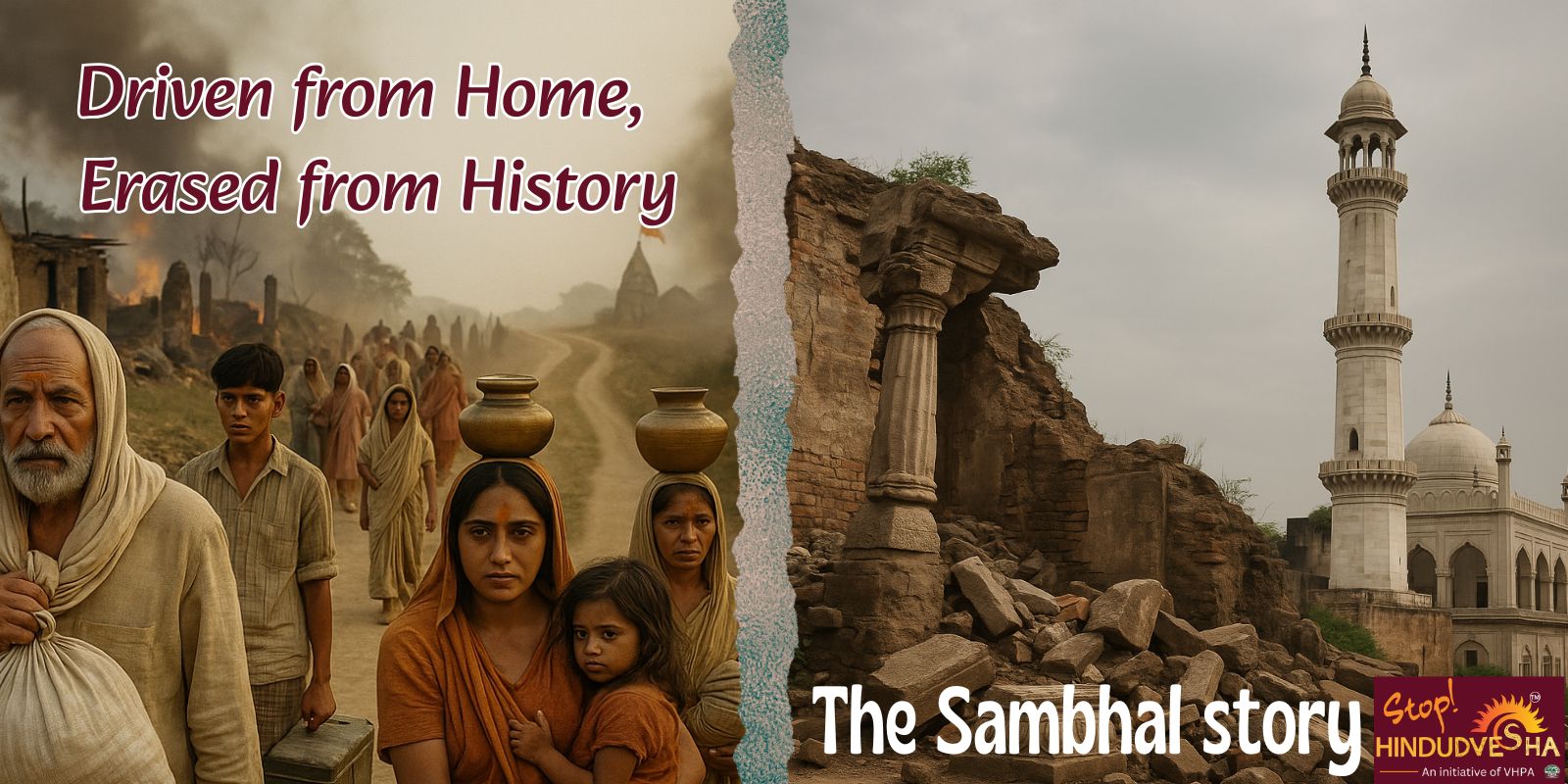
- Sambhal’s Hindu population has fallen drastically since Independence, reflecting deliberate demographic engineering through riots, intimidation, and targeted exoduses.
- Judicial reports and victim testimonies reveal systematic attempts to erase Hindu presence and heritage in the city.
- Terror networks, radicalization, and “love jihad” tactics have deepened Sambhal’s role as a hub for extremism and demographic change.
- Similar patterns of demographic imbalance and illegal immigration are visible in Assam, West Bengal, Uttarakhand, and Himachal Pradesh.
- The case of Sambhal serves as a stark warning that Bharat’s civilizational identity and Hindu majority status are under long-term threat.
Over the past decade, India has been experiencing a steady civilizational and cultural renewal. More and more Bhartiyas are reconnecting with their Dharmic roots, ancient Hindu pilgrimage sites are being revived, and India’s timeless narrative is gradually shaping both its self-understanding and its place in the world.
This renewal, however, is not only about rediscovering cultural pride. It also carries deeper significance for Bharat’s future. Years of policies focused on minority appeasement have left the Hindu majority community exposed and often insecure. In several parts of the country, the question is no longer just about freely expressing one’s faith and cultural identity, but about ensuring the continued vitality and security of Hindu society itself.
The demographic shifts taking place in certain parts of India, particularly in Assam and other regions of the North-East, have left Hindus increasingly vulnerable to the aggressive population strategies pursued by Abrahamic faiths, most notably Islam.
Sambhal, a city in Uttar Pradesh revered in Hindu scriptures as the prophesied birthplace of Bhagwan Kalki, illustrates the gravity of this trend. While its ongoing resurgence is reflected in the rediscovery of ancient temples, wells, and artifacts, Sambhal’s importance goes far beyond archaeology.[1] It is also a reminder of the deeper historical and cultural wounds that continue to shape the city’s present.
This city has long been a site where Hindu identity was systematically eroded, first under centuries of Islamic rule and later through decades of post-independence neglect. Although the three-member panel’s report on the November 2024 Sambhal violence has yet to be officially released, its reported findings are generating broad discussion and point to a sobering reality. They suggest a steep post-independence decline in Sambhal’s Hindu population, underscoring a larger demographic imbalance with serious civilizational implications.
Sambhal, however, is not an isolated case. It serves as a microcosm of a wider reality: across India, rapid demographic changes threaten to reshape entire regions. Left unchecked, these shifts could create a dystopian scenario in which the survival of Hindus as a majority community becomes increasingly uncertain within a few decades.
Forgotten Genocide: How Hindus Were Driven Out of Sambhal
As reported in the media, the judicial panel found that the Hindu population in Sambhal has fallen from about 45 percent in 1947 to just 15 percent today, while the Muslim population has grown from 55 percent in 1947 to 85 percent now. The report links this drastic demographic shift to repeated, deliberately provoked riots and a long history of minority appeasement in Sambhal’s local politics. [2] [3] [4]
The report notes that Sambhal has witnessed at least 15 riots since Independence. According to OpIndia, it also establishes that Hindus, who once lived in large numbers across several localities, are now confined to isolated pockets—a trend that has “transformed the social texture of Sambhal and intensified tensions.” [5] The findings of the judicial panel have sparked a political slugfest, with the ruling BJP government in Uttar Pradesh accusing the opposition of targeting Hindus to alter the region’s demography. Chief Minister Yogi Adityanath, citing media reports on the panel’s conclusions, warned that “those found trying to change the demography (of the region) would have to face exodus themselves.” The opposition, meanwhile, dismissed the government’s stance as “exodus propaganda.”[6]
StopHindudvesha has previously covered the November 2024 Sambhal violence, highlighting how the left-liberal and Islamist ecosystems tried to frame the incident involving the targeting of the Sambhal Jama Masjid survey by a violent mob as state-sponsored violence. However, autopsy findings revealed that the victims succumbed to bullets from country-made pistols, thus effectively countering the allegations of state-sponsored violence.[7]
The opposition also echoed the narrative of the left-liberal and Islamist ecosystems, alleging that the Uttar Pradesh government deliberately targeted the minority community in a deliberate act orchestrated in collusion with the local police, even as evidence indicated otherwise.[8]
Victim testimonies from the 1978 Sambhal riots, documented in media reports, reveal the gruesome horrors of that period—Hindu families were deliberately targeted, their homes and shops set ablaze, and people burned alive. Survivors also recounted how many Hindu residents, fearing for their lives, were forced to sell their homes at throwaway prices before fleeing the area.[9]
Media reports also recount victim testimonies from the lesser-known 1986 riots in Sambhal. During the violence, a Hindu man, Bhagwat Sharan Rastogi—a wholesale sugar dealer—was brutally murdered. His eyes were gouged out, his ears cut off, and his body sealed in a sack. According to accounts, Bhagwat Sharan was killed by a shopkeeper who was one of his retail customers. As the riots raged, the shopkeeper lured him inside under the pretext of offering protection from the mob, only to murder him in cold blood.[10] [11]
Victim testimonies from communal riots in Sambhal—particularly those of 1978, 1986, and 1993—point to a systematic conspiracy to alter the city’s demography. The erasure of the Hindu community from Sambhal cannot be dismissed as mere Hinduphobia or anti-Hindu sentiment; rather, it bears the hallmarks of a clear-cut genocide.
Beyond the chilling accounts of cold-blooded murders, these testimonies also describe the deliberate destruction of Hindu places of worship and the illegal capture of Hindu-owned lands and property. Because information about these riots was long suppressed, reliable data on casualties remain scarce. However, with the Uttar Pradesh government reportedly ordering a fresh probe into the 1978 riots[12], many victim families have begun recounting their experiences. At the same time, renewed interest in Sambhal’s Hindu heritage amid the ongoing civilizational and cultural resurgence has encouraged sections of the Indian media to revisit and publish material on these events.
Yet, a persistent effort by the left-liberal ecosystem seeks to downplay both the anti-Hindu nature of these riots and the drastic demographic changes triggered by repeated waves of Hindu exodus that followed.
From Heartland Town to Terror Hotspot
The judicial panel report also reportedly flagged the alleged presence of terror modules in Sambhal, raising alarms over “a flourishing trade in illegal arms and narcotics.” According to Indian media coverage, the report highlights the activities of several terror networks in the city and their deep-rooted local connections. Global terrorist organizations such as Harkat-ul-Mujahideen, Tehreek-e-Taliban, and Al Qaeda are reported to have established inroads in Sambhal.
The report further points to an extensive network of local youth allegedly involved in radicalization and recruitment into these modules. This underscores Sambhal’s troubling prominence within global terror chains. At one point, the city was even regarded as a major hub of Al Qaeda in the Indian subcontinent. The link is stark: Maulana Asim Umar, the first chief of Al Qaeda in the Indian subcontinent, was himself born in Sambhal. [13] [14] [15]
The report identifies several men from Sambhal who were arrested, convicted, or killed for their links to global terrorist organizations. It also highlights the city’s association with the Students Islamic Movement of India (SIMI), a radical outfit banned by the government for its involvement in terrorist activities. Taken together, these findings raise serious concerns about the deep entrenchment of radical Islamic extremism in Sambhal. In fact, considering the scale and pattern of recruitment, it would not be an exaggeration to describe the city as once functioning like a “campus recruitment hub” for extremist groups and terror networks.[16]
The report also highlights the role of outsiders in inciting the November 2024 violence that broke out during the court-mandated survey of the Sambhal Jama Masjid, which left at least four people dead and several others injured. It underscores the premeditated nature of the unrest while commending the local police for managing a highly volatile situation with restraint and skill—preventing it from spiraling into a major riot.[17]
The report also highlights the use of a multi-pronged strategy to alter Sambhal’s demography—combining so-called “love jihad” tactics with aggressive intimidation designed to instill fear in the Hindu community, eventually pushing them to either convert or flee. One particularly tragic testimony from Sambhal is the Bharti-Hammad case, which even reached the Allahabad High Court. Bharti, daughter of Kishan Lal, was once deeply devoted to Hindu customs and traditions. Her life, however, changed after coming into contact with a Turkish youth named Hammad from Sambhal. Drawn into what has been described as a “love jihad” trap, Bharti converted to Islam and took the name Sidra. Her family challenged the conversion in court, but the case was dismissed after Bharti herself supported Hammad in her testimony.[18] [19]
The disturbing revelations about Sambhal’s global terror links and the widespread use of “love jihad” tactics aimed at demographic change come at a time when foreign funding for religious conversions in India is already under intense scrutiny. The recently exposed Chhangur Baba conversion racket laid bare the dark underbelly of sexual abuse, threats, violence, and systematic brainwashing used to facilitate large-scale conversions of Hindus to Islam.
Sambhal is not an isolated case. Across western Uttar Pradesh—including Muzaffarnagar, Meerut, Shamli, Bijnor, and Saharanpur—investigations have uncovered a fertile breeding ground for terrorist networks with links traced back to countries like Pakistan and Bangladesh. [20]
For Hindus in Sambhal, the story has long been one of repeated exoduses since Independence. In this context, cultural and civilizational resurgence alone will not be sufficient to address the deeply skewed demographic balance. The dangerous collusion between radical Islamic extremism and global terror outfits in the region must be thoroughly investigated and dismantled. Only then can a genuine Hindu resurgence take root and endure.
Wake-Up Call for Hindus
The demographic shift in Sambhal should serve as a wake-up call for the Hindu community to recognize emerging patterns of change early and respond through collective social and political activism, alongside vigilance against tactics such as “love jihad.”
Similar demographic engineering strategies are reshaping the population profile of states like Himachal Pradesh, Uttarakhand, West Bengal, and Assam. The infiltration of illegal immigrants adds another layer of concern, with their growing presence threatening to alter the social fabric of India. Vote-bank politics has only compounded the problem, creating an environment where illegal immigrants are tacitly legitimized, often at the expense of the rights of lawful citizens.
The seriousness of the issue was underscored by Prime Minister Narendra Modi, who recently used his Independence Day address to warn against illegal immigration. He cautioned that unchecked infiltration was endangering India’s demography and announced the formation of a high-powered mission dedicated to addressing these demographic threats.[21]
In August 2024, Assam Chief Minister Himanta Biswa Sarma voiced concern over what he termed a “demographic invasion” caused by illegal infiltrators. He noted that many states in India are facing similar challenges and urged the central government to strengthen the border with Bangladesh to prevent the situation from worsening further. Sarma has repeatedly highlighted the rapid demographic changes in Assam. He pointed out that the Muslim population in the state has risen from 14 percent in 1951 to about 40 percent today, a shift he attributes largely to unchecked illegal immigration.[22]
Demographic change has become a pressing concern in Assam, where the state government has repeatedly warned that if the Muslim population continues to grow at its current pace, the indigenous people could soon become a tiny minority in their own land. Chief Minister Himanta Biswa Sarma recently cautioned that by 2041, the state’s Muslim population may equal that of Hindus. Citing the 2011 Census, he noted that Muslims already constituted 34 percent of Assam’s population[23], of which an estimated 31 percent were migrants. Assam Legislative Assembly Deputy Speaker Numal Momin further revealed that 15 districts of the state have now become Muslim-majority[24], stressing that not a single district had such a profile at the time of Independence—a development he described as deeply alarming.
Elsewhere, examples show how resistance can make a difference. In Himachal Pradesh, Hindu communities protested against illegally built mosques in 2024, leading a municipal corporation court to order the demolition of unauthorized floors of at least one such structure.[25] Assam’s government itself has taken an active stance in protecting indigenous rights against illegal immigrants. By contrast, in regions where Hindus remain passive, the situation has grown increasingly dire.
When combined—love jihad and land jihad tactics, the spread of local terror modules with global links, and unchecked illegal immigration—these forces form a ticking bomb. They endanger not only the future of Hindus in India, but also the civilizational identity, sovereignty, and territorial integrity of Bharat itself. In this light, the demographic shifts in Sambhal must serve as a stark warning, urging Hindus to abandon passivity and act decisively.
Reclaiming Sambhal’s Civilizational Legacy
The controversy surrounding Sambhal’s Jama Masjid stems from claims that the mosque was constructed on the site of the Harihar Mandir, which was first destroyed and then replaced during the period of Islamic invasions. While the exact date of the temple’s demolition is uncertain, some accounts suggest it occurred between the reigns of Balban and Sikandar Lodhi. However, there is no clear scholarly consensus on this timeline. Notably, historians such as Sri Ram Sharma and Meenakshi Jain have documented evidence pointing to the destruction of an ancient temple in Sambhal during the reign of Babur (1526–1530).[26] [27]
Sambhal’s mention in early texts places it among the oldest sacred sites of Hindu tradition. Archaeological remains from the region further suggest continuous habitation and ritual activity. Experts trace the temple’s origins back at least 5,000 years. The name “Sambhal” itself appears in Alexander Carlleyle’s 1879 Archaeological Survey of India report, where it is noted that the city was known as Sambhaleshwar in the Satya Yuga, Mahadgiri in the Treta Yuga, and Pingala in the Dwapar Yuga. In essence, the report recognized Sambhal’s enduring historical and spiritual importance within Hindu tradition. It also records that a temple known as Hari Mandir was rebuilt during the reign of Prithviraj Chauhan. [28]
Although definitive evidence is lacking, it is reasonable to infer that when Islamic invaders targeted the Harihar Mandir, they may have been aware of Sambhal’s deep significance in sacred Hindu texts—an awareness that could have further motivated the attack. The destruction of this heritage was not merely the loss of a structure, but a deliberate attempt to erase the Hindu identity of Sambhal.
Yet, if the erasure of Sambhal’s Hindu past tells a painful story of decline and displacement, its current civilizational and cultural resurgence holds the potential to script a very different narrative—a tale of demographic and spiritual renewal for Hindus in Sambhal.
Wrapping Up
Sambhal offers just a glimpse of a larger reality unfolding across India—Hindus being harassed, intimidated, and even prevented from celebrating their festivals in peace. At the root of this lies the politics of minority appeasement, where Hindus are routinely denied their most basic rights in the name of “secularism.”
At the same time, the ongoing civilizational and cultural resurgence in Sambhal demonstrates that Hindu unity is beginning to assert itself. The revival of Sambhal’s Hindu heritage has been spearheaded by the state government and local administration, but it would not have been possible without the active involvement of the local Hindu community.
Hindu advocacy groups, working alongside residents, have consistently raised awareness on these issues. Yet, their efforts are quickly discredited by the left-liberal media, which dismisses such solidarity by labeling it right-wing or Islamophobic—terms intended to shame and silence.
This reveals the environment Hindus in India find themselves in: surrounded day and night by Hinduphobic narratives. In such circumstances, India’s civilizational and cultural resurgence—whether in Sambhal or elsewhere—is not merely desirable. It has become essential for safeguarding the very existence of Hindu identity, culture, and civilization.
Citations
[1] “Reclaiming India’s Heritage: Sambhal’s Key Discoveries”; https://stophindudvesha.org/reclaiming-indias-hindu-heritage-sambhal-discoveries-leading-the-way/
[2] Judicial panel submits report on Sambhal violence; highlights demographic shifts, past riots; https://www.newindianexpress.com/nation/2025/Aug/28/judicial-panel-submits-report-on-sambhal-violence-highlights-demographic-shifts-past-riots
[3] Sambhal violence judicial commission submitted its report, sensational revelation, existence of harihar temple | हरिहर मंदिर के मिले साक्ष्य, फिर निकलेगा बाबर का जिन्न, संभल हिंसा की रिपोर्ट ने सबको चौंकाया; https://zeenews.india.com/hindi/india/up-uttarakhand/sambhal/sambhal-violence-judicial-commission-submitted-its-report-sensational-revelation-existence-of-harihar-temple/2899889
[4] Hindus reduced to 15 percent in Sambhal report on 2024 riots flags demographic shift | India News – Times Now; https://www.timesnownews.com/india/hindus-reduced-to-15-percent-in-sambhal-report-on-2024-riots-flags-demographic-shift-article-152538860
[5] Sambhal judicial report: Love jihad cases and terror links exposed; https://www.opindia.com/2025/08/uttar-pradesh-judicial-report-on-sambhal-violence-reveals-changing-demography-past-communal-riots-and-targeted-attacks-on-hindus/
[6] Sambhal report shows how Hindus were targeted in order to change demography: UP CM Yogi Adityanath | Lucknow News – The Indian Express; https://indianexpress.com/article/cities/lucknow/yogi-adityanath-up-sambhal-report-hindus-targeted-10219259/
[7] Politics & international meddling obstruct India’s cultural revival; https://stophindudvesha.org/sambhal-violence-political-opportunism-and-international-interference-hinder-indias-cultural-restoration/
[8] Ibid.
[9] ‘People were burned alive, everyone was screaming’, victims of Sambhal riots tell their story – CNBC TV18; https://www.cnbctv18.com/india/sambhal-riots-lord-shiva-temple-victims-stories-people-burned-alive-19525494.htm
[10] संभल: 1986 के दंगे में जिस शख़्स के पिता को आरी से काटा गया, उसने नेजा मेला पर कही ये बात, झकझोर देगी आपबीती – Sambhal man whose father was cut with saw in 1986 riots reacts on Neja Mela his story will; https://www.aajtak.in/uttar-pradesh/story/sambhal-man-whose-father-was-cut-with-saw-in-1986-riots-react-on-neja-mela-his-story-will-shock-you-lclam-strc-2198504-2025-03-24
[11] 1986 Sambhal riots: A Hindu businessman was brutally killed, the son still awaits justice; https://www.opindia.com/2025/01/1986-sambhal-riots-bhagwat-sharan-killed-by-muslims-son-still-waiting-for-justice/
[12] Files Reopened, Probe Reordered: Yogi Adityanath Starts Sambhal ‘Surgery’ Day After Trailblazing Interview With Arnab Goswami | Republic World; https://www.republicworld.com/india/up-govt-orders-fresh-probe-into-1978-sambhal-riots-as-yogi-adityanath-says-old-wounds-need-surgery-waqf-board-india-live-news-updates
[13] Judicial panel submits report on Sambhal violence; highlights demographic shifts, past riots; https://www.newindianexpress.com/nation/2025/Aug/28/judicial-panel-submits-report-on-sambhal-violence-highlights-demographic-shifts-past-riots
[14] संभल का पाकिस्तान और अमेरिका कनेक्शन उजागर… न्यायिक आयोग की रिपोर्ट में टेरर मॉड्यूल को लेकर सामने आए ये बातें – sambhal violence judicial report reveals terror links Pakistan america IcIa – AajTak; https://www.aajtak.in/uttar-pradesh/story/sambhal-violence-judicial-report-reveals-terror-links-pakistan-america-lcla-rptc-2321074-2025-08-29
[15] Uttar Pradesh: Intelligence report reveals Sambhal’s role in Al Qaeda, ISIS recruitment in India – India Today; https://www.indiatoday.in/india/story/uttar-pradesh-intel-report-reveals-this-small-town-sambhal-role-in-al-qaeda-isis-recruitment-in-india-2778722-2025-08-29
[16] Ibid.
[17] Sambhal violence: Judicial panel submits report after 9 months | Hindustan Times; https://www.hindustantimes.com/cities/lucknow-news/sambhal-violence-judicial-panel-submits-report-after-9-months-101756408166257.html
[18] Sambhal judicial report: Love jihad cases and terror links exposed; https://www.opindia.com/2025/08/uttar-pradesh-judicial-report-on-sambhal-violence-reveals-changing-demography-past-communal-riots-and-targeted-attacks-on-hindus/
[19] The Sambhal Files: हिन्दू लड़की का तुर्क से निकाह, भव्य दावत-ए-वलीमा, पलायन की ख़ौफ़नाक कहानी – sambhal violence judicial committee investigation report about love jihad – Navbharat Times; https://navbharattimes.indiatimes.com/state/uttar-pradesh/sambhal/sambhal-violence-judicial-committee-investigation-report-about-love-jihad/articleshow/123596145.cms
[20] Western Uttar Pradesh a safe haven for terror suspects; https://www.newindianexpress.com/nation/2018/Dec/27/western-uttar-pradesh-a-safe-haven-for-terror-suspects-1917286.html
[21] PM Modi warns illegal immigration threatens India’s demography; https://www.newsonair.gov.in/pm-modi-warns-illegal-immigration-threatens-indias-demography/
[22] Many states suffering from ‘demographic invasion’ by illegal infiltrators: Assam CM | Hindustan Times; https://www.hindustantimes.com/cities/others/many-states-suffering-from-demographic-invasion-by-illegal-infiltrators-assamcm-101722481854857.html
[23] Assam’s Muslim population may equal Hindus by 2041: Himanta Biswa Sarma | Latest News India; https://www.hindustantimes.com/india-news/assams-muslim-population-may-equal-hindus-by-2041-himanta-biswa-sarma-101753284202735.html
[24] Assam’s 15 districts have become Muslim-majority: Deputy Speaker Numal Momin – The Economic Times; https://economictimes.indiatimes.com/news/politics-and-nation/assams-15-districts-have-become-muslim-majority-deputy-speaker-numal-momin/articleshow/122484251.cms?from=mdr
[25] Shimla’s Sanjauli mosque unauthorised, MC chief orders building’s demolition | Hindustan Times; https://www.hindustantimes.com/cities/chandigarh-news/shimlas-sanjauli-mosque-unauthorised-mc-chief-orders-building-s-demolition-101746270692339.html
[26] Sambhal dispute must be seen through its history; https://thesquirrels.in/governance/sambhal-dispute-must-be-seen-through-its-history-8550367
[27] Sambhal riots: Was the centuries-old Kalki temple in Sambhal razed? What 1879 ASI report, historians say – India Today; https://www.indiatoday.in/india/story/sambhal-violence-riot-up-court-plea-shahi-jama-masjid-kalki-temple-history-explained-asi-report-2639611-2024-11-25
[28] Sambhal dispute must be seen through its history; https://thesquirrels.in/governance/sambhal-dispute-must-be-seen-through-its-history-8550367

Donate to HINDUDVESHA
Our Mission is to explore and expose Hindudvesha through research analysis, education and response.
SUPPORT US