

Sambhal Violence: Political Opportunism and International Interference Hinder India’s Cultural Restoration
 Rati Agnihotri · 12/24/2024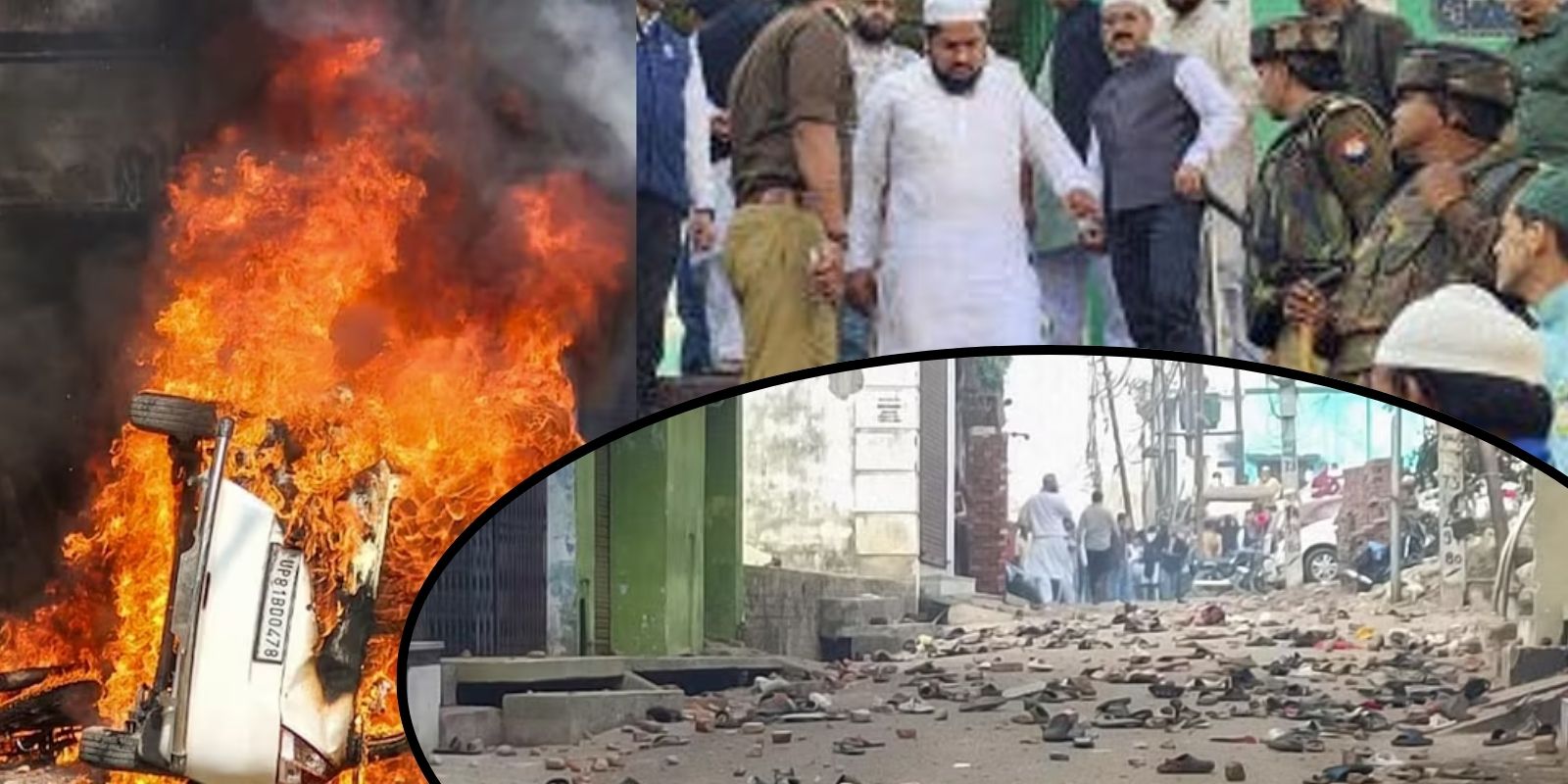
- The Sambhal violence serves as a stark example of anti-Hindu narrative construction intertwined with the politics of minority appeasement.
- The violent incident at the disputed Sambhal Shahi Jama Masjid during a court-mandated survey is being misrepresented to vilify petitioners advocating for the reclamation of ancient Hindu temples.
- The Places of Worship Act of 1991 is being leveraged by left-liberal groups and radical Islamist elements to obstruct Hindus from pursuing legal remedies to ascertain the religious character of disputed sites.
- While many nations have taken proactive measures to reclaim their cultural and religious spaces from the influence of colonizers and invaders, similar efforts in India are unfairly labeled as “unconstitutional” or “anti-minority.”
In Snakes in the Ganga: Breaking India 2.0, authors Rajiv Malhotra and Vijaya Viswanathan delve deeply into the distortion of Indian sociocultural dynamics through the lens of Western academic frameworks, particularly critical race theory (CRT). They argue that CRT, originally developed to address systemic racial inequalities in the West, is being inappropriately applied to India by equating caste with race. This intellectual imposition creates artificial binaries of “oppressor” and “oppressed,” casting so-called “high castes” as colonial-style oppressors and “low castes” as victims.[1]
The authors emphasize that postcolonial and decolonial academic frameworks, effective in empowering formerly colonized civilizations like those in Africa and Latin America, are manipulated in the Indian context to achieve the opposite effect. Instead of empowering indigenous narratives, they argue, such frameworks celebrate colonial legacies and demonize India’s attempts to reclaim its historical and cultural identity. This inversion repositions former colonizers as benign cultural influences while recasting the colonized as perpetrators of oppression within their societies, leading to distorted perceptions of India’s sociopolitical landscape.
The Western media, alongside segments of Indian media, contributes to this paradigm by portraying India’s decolonization efforts as attacks on constitutional principles and minority rights. Hindu nationalist organizations, for example, are often categorized as “extremist right-wing” entities and likened to European nationalist movements. However, experts suggest that Hindu nationalism is more accurately understood as an indigenous effort to decolonize and reconnect with India’s civilizational ethos. Yet, this perspective rarely gains traction. Instead, decolonization initiatives are framed within an oppressor/oppressed narrative, with Hindu nationalists cast as oppressors and minorities or Dalits as the oppressed.
This reductive framing often escalates tensions, particularly when contested religious sites become the subject of public and judicial scrutiny. For instance, archaeological investigations mandated by courts to resolve disputes over such sites are frequently met with backlash from the left-liberal establishment. These groups construct narratives rooted in propaganda, portraying these efforts as communal or sectarian, thereby exacerbating social divides.
The recent Sambhal violence exemplifies this phenomenon. On November 24, 2024, a court-ordered survey of the Sambhal Shahi Jama Masjid in Uttar Pradesh turned violent when a mob obstructed the authorities. Reports indicate that some protesters fired on police with locally-made guns, injuring personnel[2] and resulting in at least four deaths. Despite attempts by left-liberal and Islamist ecosystems to frame this as state-sponsored violence, autopsy findings revealed that victims succumbed to bullets from country-made pistols, contradicting the propaganda narrative.[3]
The Sambhal episode has reignited debates about India’s Places of Worship Act, as the court-mandated survey stemmed from a petition asserting that the mosque was built over a Hindu temple dedicated to Bhagwan Kalki.[4] Such incidents highlight the larger context in which India’s efforts to explore its historical and cultural claims are met with resistance and misrepresentation.
This case underscores the urgent need for balanced and fact-based discussions about India’s cultural resurgence, ensuring that genuine decolonization efforts are not stymied by ideologically motivated distortions.
Conspiracy Theories Surround Sambhal Violence
The Sambhal violence of November 24, 2024, has brought to light a series of controversies surrounding the court-mandated survey of a Mughal-era mosque in Sambhal, Uttar Pradesh. As the investigation unfolds, the local police have filed charges against more than 2,700 individuals, including Zia-ur-Rehman Barq, a Member of Parliament from the regional opposition Samajwadi Party[5]. Barq stands accused of orchestrating the unrest, reportedly visiting the mosque without prior permission and inciting the violence. While the MP has denied these allegations and sought legal intervention from the Allahabad High Court, the broader implications of the incident demand closer scrutiny.[6] [7]
Local authorities have arrested over 30 individuals and identified more than 400 suspects in connection with the violence.[8] The police, according to media reports, are also probing the potential involvement of external entities after recovering ammunition from the site that originated in Pakistan and the United States. Empty cartridges manufactured by Pakistan’s Ordnance Factory and others sourced from American-made weapons were reportedly found at the scene. Investigators are exploring whether these materials were acquired locally or are part of a larger conspiracy involving external actors.[9]
The possibility of foreign involvement cannot be discounted, especially given the documented tactics of hostile states like Pakistan. Such states have often leveraged communal tensions in India to further their geopolitical agendas, using incidents of unrest as recruitment tools for radicalizing local youth. Reports suggest that terror groups may exploit episodes like Sambhal to propagate narratives of minority persecution in India, thereby bolstering their recruitment strategies.[10]
The Sambhal violence is not an isolated incident but part of a recurring pattern seen in India over the past few years. From the anti-CAA protests at Shaheen Bagh to the widespread farmer protests, there has been increasing evidence of external influences manipulating domestic unrest. These carefully orchestrated movements, often termed the “woke toolkit,” seem designed to project India as an oppressive state that undermines its democratic and secular ethos. The Sambhal violence, too, fits into this narrative, with the predictable fallout of foreign and domestic media accusing India of targeting minorities.
In the wake of the violence, the focus of public discourse has shifted from condemning lawlessness to vilifying those who sought legal recourse for the survey. Rather than being recognized as legitimate actors exercising their rights, the petitioners behind the court-ordered investigation are painted as provocateurs responsible for communal discord. This distortion reflects a broader bias within left-liberal narratives, which often portray Hindus seeking redressal in cases involving disputed religious sites as agitators rather than rightful litigants.
The left-liberal ecosystem’s stance on incidents like Sambhal violence seems to suggest that Hindus should avoid filing petitions perceived as controversial. This narrative effectively blames the petitioners for inciting violence rather than holding accountable those who engaged in illegal acts to obstruct lawful procedures.
Emerging evidence points to the possibility of a well-orchestrated conspiracy involving multiple stakeholders. Advocate Vishnu Shankar Jain, the lead petitioner in the Sambhal Shahi Jama Masjid case, has faced numerous death threats[11] and instances of online harassment[12]. Jain, a prominent figure in cases involving contested religious sites, has been involved in significant legal battles, including the Shri Ram Janmabhoomi case in Ayodhya and the ongoing Shringar-Gauri-Gyanvapi case in Varanasi.
The threats against Jain are not isolated incidents but part of a broader narrative aimed at stifling the Hindu community’s quest for justice. Radical Islamist groups and left-liberal factions appear to use the banner of secularism as a tool to delegitimize Hindu claims over disputed sites, perpetuating a narrative of victimhood to shield illegal activities. The Sambhal violence thus becomes another chapter in this ongoing saga of suppression and distortion.
Scrutinizing India’s Places of Worship Act
Left-liberal stakeholders and certain Muslim leaders frequently invoke the Places of Worship Act of 1991 to challenge court orders for surveys of disputed religious sites, often branding these orders as unconstitutional. However, it is critical to note that ancient and historical monuments or archaeological sites governed by the Ancient Monuments and Archaeological Sites and Remains Act of 1958 fall outside the scope of the 1991 Act.[13] Sambhal is one such site.
Enacted under Prime Minister P.V. Narasimha Rao’s Congress-led government, the 1991 Act seeks to maintain the status quo of the religious character of places of worship as they existed on August 15, 1947. The only exception was the Ram Janmabhoomi-Babri Masjid dispute, already under judicial consideration.[14]
In a 2022 Supreme Court hearing, then Chief Justice of India, Justice D.Y. Chandrachud, remarked that the Act prohibited altering the character of a religious place but did not preclude courts from determining its religious nature.[15] Although he later clarified that these comments were merely observations and not binding verdicts, these remarks, made during proceedings on the Gyanvapi mosque dispute in Varanasi, have taken on added significance as several public interest litigations (PILs) challenging the Act are now under the Supreme Court’s review.[16]
The apex court has sought the government’s views on the Act while imposing a temporary moratorium on lower courts from hearing new cases involving disputed religious sites. It has also directed that no new surveys be conducted in ongoing cases until it decides on the 1991 Act.
Justice Chandrachud’s earlier comments highlight a key point: many of the contested sites lack a clear religious identity, making it necessary to ascertain their historical and religious character before applying the 1947 cut-off mandated by the Act. For instance, in the Gyanvapi mosque case, the petitioners, the Vyas family, claimed that they conducted prayers in the cellar of the mosque until 1993, when access was restricted. They argued that hereditary priests have a legitimate right to resume their rituals within the structure.[17]
The disputed site of Gyanvapi has long been a focal point of cultural and religious contention. Historically, the site appears to have functioned as a dual religious space, with Hindus reportedly performing rituals in its basement. Media reports indicate that Hindu worshippers regularly prayed in an area referred to as “Vyasjee ka Tahkhana” until access was restricted. In January 2024, a Varanasi court granted permission for puja rituals in this cellar, following findings from the Archaeological Survey of India (ASI). The ASI report suggested the presence of a large Hindu temple at the site, which was demolished in the seventeenth century.[18]
A similar narrative surrounds the Sambhal’s Shahi Jama Masjid, exhibiting a complex historical identity. Local elders recall the site as “Hari Hari Mandir,” suggesting it once served a Hindu religious function.[19] Journalist and Hindu rights activist Swati Goel Sharma conducted extensive fieldwork in Sambhal, documenting the site’s dual religious character through first-hand accounts. According to her findings, Hindus frequented the site until the communal riots of 1978, which led to significant demographic shifts. Many Hindus fled the area out of fear, leaving the site predominantly under Muslim use.[20]
In an interview with India TV, Sharma elaborated on the demographic changes following the riots. The Hindu population in the area diminished significantly, especially near the disputed site. Elderly residents recalled a well near the disputed Masjid, now covered and guarded by police, where Hindus once conducted puja rituals. Sharma recounted conversations with refugees from Pakistan who moved to Sambhal during Partition. Many of these refugees identified the site as “Hari Hari Mandir” upon their arrival. Locals from the Independence era described the structure as rudimentary, with no clear sign indicating whether it was a temple or mosque. According to her interviews, the site was shared by Hindus and Muslims, reflecting a blurred religious character that challenges contemporary narratives.[21]
The controversies surrounding such sites have renewed scrutiny of the Places of Worship Act of 1991. Petitions challenging the Act argue that it undermines the constitutional principle of secularism by denying religious communities the right to seek legal redress for reclaiming their places of worship. Petitioners contend that the Act infringes upon fundamental rights, including the freedom to practice and propagate religion and the right to manage religious affairs. They further criticize the Act for violating the principle of judicial review, a cornerstone of India’s constitutional framework, by restricting lawsuits to reclaim contested religious spaces.[22]
Opposition’s Role in Sambhal Incident
Minority appeasement has been a longstanding feature of India’s political landscape, cutting across party lines. Whether it is the ruling Bharatiya Janata Party (BJP) or opposition parties like the Congress, political strategies often center around catering to specific voter bases. Unfortunately, the Sambhal violence has been drawn into this realm, becoming a tool for political maneuvering rather than a straightforward law and order issue.
The opposition has turned the Sambhal violence into a political flashpoint, accusing the Uttar Pradesh government of targeting the minority community. The forensic evidence indicates that the victims died from bullets fired by country-made pistols—contradicting claims of state-sponsored violence. Yet, opposition leaders allege that the violence was a deliberate act orchestrated by the ruling BJP in collusion with the police. The issue has been raised repeatedly in the Uttar Pradesh State Assembly, with parties like the Samajwadi Party framing it as a communal conspiracy designed for political gains[23]. The Congress, too, has sought to exploit the incident, meeting with victims and presenting the violence as a calculated strategy by the BJP.
A striking feature of the Sambhal controversy is the alignment of opposition parties’ narratives with those propagated by the left-liberal ecosystem. Central to this discourse is the Places of Worship Act of 1991, which is portrayed as sacrosanct and untouchable, as though its primary purpose is the unassailable protection of minority rights. However, such portrayals ignore that the Act is merely a piece of legislation that can be amended or repealed per constitutional and legal provisions. Opposition leaders have argued that recent legal cases seeking to reclaim ancient temples violate the Act’s provisions, portraying the acceptance of these cases by lower courts as an attack on the Act and, by extension, on minority rights.[24]
This narrative, however, is fraught with oversimplifications. Attempts by Hindus to reclaim ancient religious sites have largely adhered to legal channels. These cases involve historical and archaeological evidence of prior Hindu worship at these contested sites, with surveys often uncovering artifacts indicating the existence of temples. Far from engaging in acts of vandalism or extrajudicial reclamation, Hindu petitioners have taken a methodical and lawful route to assert their claims.
Politicizing such issues not only skews public perception but also exacerbates communal unrest. It creates a self-perpetuating cycle where incidents like the Sambhal violence serve as fodder for political narratives, which, in turn, fuel further polarization and unrest. This vicious cycle benefits opportunistic political actors while deepening societal divides, leaving little room for genuine reconciliation or justice.
Hostility Toward India’s Cultural Restoration
Resistance against the revival of India’s civilizational and cultural ethos has become a focal point for the left-liberal ecosystem, which often frames such efforts as regressive or divisive. Yet, reclaiming historical and cultural identity from the shadow of colonial rule is widely regarded as a legitimate and necessary process. For instance, as highlighted in an OpIndia article, Greece has actively restored churches converted into mosques during Ottoman rule, with many reclaimed in the 19th and 20th centuries.[25] Similarly, in Mali, the government recently renamed 25 public spaces in its capital, Bamako, shedding colonial-era names in favor of African figures, signaling a move toward cultural independence.[26]
Around the world, such initiatives are celebrated as restoring dignity and heritage. But when it comes to India, any effort to revive its ancient cultural identity is often met with disdain and hostility. Critics frequently argue that India’s streets, parks, and landmarks should continue bearing the names of invaders and colonizers, ignoring the deep scars these figures left on the country.
This resistance is often cloaked in constitutional rhetoric, portraying cultural revival as “anti-constitutional.” However, the Indian Constitution, like any living document, is subject to interpretation and amendment. It is not an immutable text, nor should it be misused to glorify colonial legacies or defend neo-colonial cultural domination.
Wrapping up
The Muslim minorities in India have been drawn into a broader effort to resist the country’s civilizational and cultural resurgence, ostensibly in the name of protecting minority rights. However, this narrative often serves as a diversion, keeping the community anchored to an invaders’ complex rather than addressing pressing socio-economic challenges. It fosters a hyper-aggressive identity that alienates the Muslim community from India’s Hindu roots, perpetuating division rather than fostering unity.
This trajectory is counterproductive. Indian Muslims should consider reorienting themselves within a narrative that aligns with India’s ancient civilizational ethos, embracing a shared heritage rather than clinging to the contentious legacy of invaders. Forcefully identifying with the history of barbaric conquerors and looters only deepens the disconnect and hinders progress.
Arshia Malik, a writer and researcher, highlighted this issue in a compelling article for The New Indian Express. She critiques the role of Marxist historians in shaping a distorted narrative that downplays the impact of Islamic invasions and whitewashes the destruction of temples and cultural symbols. Malik urges Indian Muslims to reject the imposed identity rooted in these narratives and renegotiate their cultural and social paradigm. As Malik aptly puts it, Indian Muslims have an opportunity to redefine their place within the broader civilizational framework of India—one rooted in shared history and mutual respect for cultural heritage:
For Indian Muslims, this cultural resurgence poses both a challenge and an opportunity. The challenge lies in acknowledging the historical grievances of Hindus without falling into the trap of defensive denialism. Denying history, as painful as it may be, only reinforces the perception that Muslims are unwilling to engage with uncomfortable truths. The opportunity, however, lies in embracing a new paradigm of coincidence – one that recognizes the pluralistic ethos of India and seeks to positively contribute to the country’s cultural and political renaissance.[27]
Citations
[1] Snakes in the Ganga: Breaking India 2.0 by Rajiv Malhotra and Vijaya Viswanathan
[2] As Islamists go on a rampage against a court-ordered survey of Jama Masjid, left-liberals blame Centre, former CJI for violence; https://www.opindia.com/2024/11/as-violence-grips-sambhal-over-court-ordered-survey-of-jama-masjid-left-liberals-twist-facts-to-shield-riotous-islamists-and-blame-authorities/#google_vignette
[3] Sambhal violence: Autopsy suggests deaths caused by country-made weapons, says DM | India News – Times of India; https://timesofindia.indiatimes.com/india/sambhal-violence-autopsy-suggests-deaths-caused-by-country-made-weapons-says-dm/articleshow/115677076.cms
[4] Sambhal Violence: A pre-mediated attack with a foreign element to it; https://organiser.org/2024/12/09/268504/bharat/sambhal-violence-a-pre-mediated-attack-with-a-foreign-element-to-it/
[5] Sambhal: Fear grips Indian city after deadly weekend clashes; https://www.bbc.com/news/articles/cr7ndg52y3zo#
[6] Sambhal Riot Accused MP To Face New FIR After ‘Electricity Theft’ Charge | Times Now; https://www.timesnownews.com/india/sambhal-riot-samajwadi-mp-zia-ur-rehman-barq-to-face-new-fir-after-electricity-theft-charge-article-116460959
[7] Show cause notice issued to Sambhal violence accused Samajwadi Party MP Zia ur Rehman Barq for unauthorised construction; https://www.opindia.com/2024/12/show-cause-notice-issued-to-sambhal-violence-accused-samajwadi-party-mp-zia-ur-rehman-barq-for-unauthorised-construction/
[8] Sambhal violence: 33 sent to jail, 400 persons identified so far; https://www.opindia.com/2024/12/sambhal-violence-33-sent-to-jail-400-identified-says-dm-rajendra-pensiya/
[9] Sambhal Violence: A pre-mediated attack with a foreign element to it; https://organiser.org/2024/12/09/268504/bharat/sambhal-violence-a-pre-mediated-attack-with-a-foreign-element-to-it/
[10] Ibid.
[11] संभल मस्जिद के याचिकाकर्ता विष्णु शंकर जैन को हत्या की धमकी | Sambhal masjid ke yachikakarta vishnu shankar jain ko hatya ki dhamki; https://hindi.opindia.com/news-updates/vishnu-shankar-jain-receives-death-threats-after-sambhal-mosque-violence/
[12] Lawyer for Hindu Group Receives Online Threat Amid Mosque Dispute | Meerut News – Times of India; https://timesofindia.indiatimes.com/city/meerut/lawyer-for-hindu-group-receives-online-threat-amid-mosque-dispute/articleshow/116221999.cms
[13] Places of Worship Act, 1991- Provisions and Exemptions: Explained; https://www.opindia.com/2022/05/explained-places-of-worship-act-1991-provisions-and-exemptions-in-the-law-gyanvapi-dispute/
[14] Ibid.
[15] Remarks made in court an observation: Ex-CJI | Latest News India – Hindustan Times; https://www.hindustantimes.com/india-news/remark-made-in-court-an-observationexcji-101734116493579.html
[16] Remark made in court an observation: Ex-CJI | Latest News India – Hindustan Times; https://www.hindustantimes.com/india-news/remark-made-in-court-an-observationexcji-101734116493579.html
[17] Hindus Allowed To Worship in Sealed Basement of Varanasi’s Gyanvapi Mosque; https://www.ndtv.com/india-news/hindus-allowed-to-worship-in-sealed-basement-of-varanasis-gyanvapi-mosque-4966487
[18] Here’s All About The ‘Vyasji Ka Tehkhana’ in Gyanvapi Complex Where Varanasi Court Has Allowed Puja by Hindus; https://swarajyamag.com/news-brief/heres-all-about-the-vyasji-ka-tehkhana-in-gyanvapi-complex-where-varanasi-court-has-allowed-puja-by-hindus#:~:text=The%20Gyanvapi%20complex.,in%20the%20Gyanvapi%20mosque%20complex
[19] 16th-Century Mosque Standing On Shri Hari Har Temple Ruins In Sambhal, Residents Testify About Mosque Officials Denying Access to Ancient Well For Hindu Rituals; https://thecommunemag-com.translate.goog/16th-century-mosque-standing-on-shri-hari-har-temple-ruins-in-sambhal-residents-testify/?_x_tr_sl=en&_x_tr_tl=hi&_x_tr_hl=hi&_x_tr_pto=tc
[20] Swati Goel Sharma on x; https://x.com/swati_gs/status/1861661337958453495?ref_src=twsrc%5Etfw%7Ctwcamp%5Etweetembed%7Ctwterm%5E1861661337958453495%7Ctwgr%5E78b83be90cda83949c291297a65808838b3c3129%7Ctwcon%5Es1_&ref_url=https%3A%2F%2Fthecommunemag.com%2F16th-century-mosque-standing-on-shri-hari-har-temple-ruins-in-sambhal-residents-testify
[21] Coffee Par Kurukshetra: संभल का हिंदू सर्वे क्या कहता है? | Sambhal Masjid Survey | Sambhal News – YouTube; https://www.youtube.com/watch?v=POCcBINXJhQ
[22] CJI-led bench to hear pleas against Places of Worship Act on December 12 | India News – The Indian Express; https://indianexpress.com/article/india/sc-places-worship-act-pleas-special-bench-9711758/
[23] Sambhal violence: Uproar in UP Assembly as government, opposition take potshots at each other; https://www.newindianexpress.com/nation/2024/Dec/16/sambhal-violence-uproar-in-up-assembly-as-government-opposition-take-potshots-at-each-other
[24] Places of Worship Act must be implemented in letter and spirit: Congress; https://www.nationalheraldindia.com/politics/places-of-worship-act-must-be-implemented-in-letter-and-spirit-congress#google_vignette
[25] Western media maligns India over Ram Mandir Pran Pratishtha: How Greece reclaimed churches turned into mosques under Ottoman rule; https://www.opindia.com/2024/01/western-media-maligns-india-over-ram-mandir-how-greece-reclaimed-churches-turned-into-mosques-under-ottoman-rule/
[26] Mali: Bamako renames 25 public places to honor national history; https://www.senenews.com/en/africa/mali-bamako-renames-25-public-places-to-honor-national-history-5216.html
[27] Global backlash against Muslims: Call for reflection, modernization – THE NEW INDIAN; https://www.newindian.in/global-backlash-against-muslims-call-for-reflection-modernization/

Donate to HINDUDVESHA
Our Mission is to explore and expose Hindudvesha through research analysis, education and response.
SUPPORT US