

Hindu Festivals and Temples Under Siege: A Systemic Global Assault on Hindu Identity
 Rati Agnihotri · 12/02/2024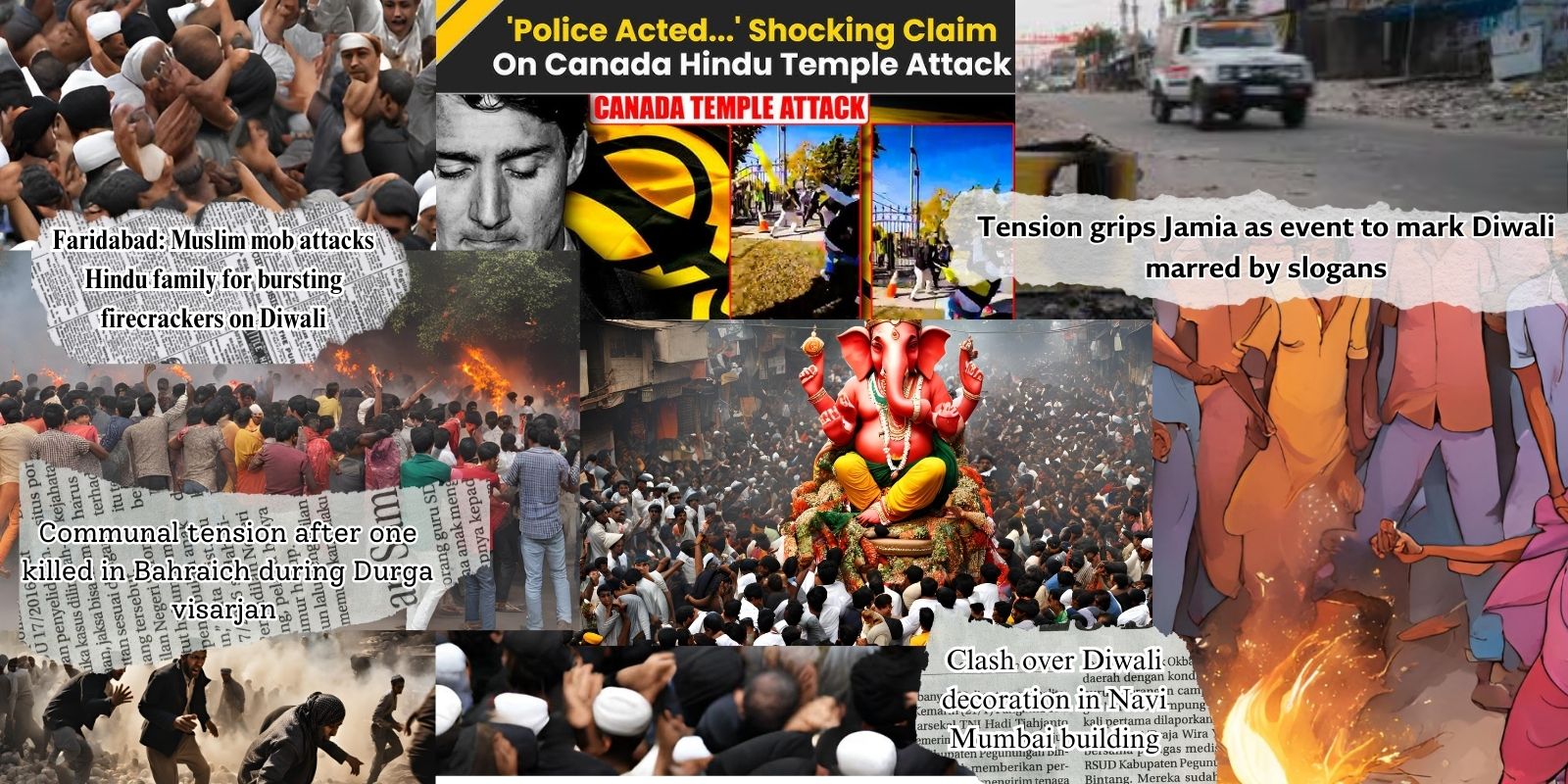
- Rising attacks on Hindus during festivals like Diwali, Dussehra, and Durga Puja stem from deep-seated Hindudvesha (anti-Hindu hatred).
- Western media often downplays or ignores the Hinduphobia driving these attacks, failing to highlight the larger narrative behind them.
- Harassment and intimidation of Hindus during festivals have become a key weapon in the woke agenda against Hindu traditions.
- Woke virtue signaling during Hindu festivals indirectly fosters a climate that legitimizes real-life attacks on Hindus and their celebrations.
- The ultimate goal is to discourage Hindus from celebrating their customs and traditions.
Attacks on Hindu temples in Western countries like the United States, United Kingdom, and Canada have increased significantly in recent years. These incidents often stem from deep-rooted anti-Hindu and anti-India sentiment. A common pattern involves temple walls being defaced with hateful graffiti targeting both Hinduism and India. For example, in September 2024, the BAPS Swaminarayan Mandir in California was vandalized with slogans like “Hindus go back.” This attack followed another similar incident just 10 days earlier when the BAPS Shri Swaminarayan Mandir in Melville, New York, was defaced with anti-Hindu messages.[1]
In the UK, another troubling event occurred in January 2024 when a masked man entered a Shiva temple in Wembley and attempted to destroy idols while reciting verses from the Quran. Devotees and volunteers managed to stop him, but the incident highlighted the growing threat to Hindu places of worship worldwide.[2]
Attacks on Hindu temples and hate crimes against Hindus tend to escalate during Hindu festivals. For instance, during Diwali, a temple in Canada was vandalized by Khalistani supporters[3], sparking protests from the Hindu community. In India, where Hindus are the majority, similar incidents have been reported during festivals, with some members of minority groups intimidating Hindus celebrating Diwali. In neighboring Bangladesh, attacks on Hindu temples and desecration of idols during festivals like Durga Puja and Diwali are distressingly common.
These patterns reveal a troubling trend: harassment and violence against Hindus during their festivals are becoming a weapon used to intimidate the community. This suggests a broader effort to undermine Hindu traditions and beliefs. Despite this, the so-called “woke” ecosystem often remains silent on the issue, failing to condemn the inherent Hinduphobia driving these attacks. Worse, it sometimes even supports narratives that further spread anti-Hindu sentiment.
What is even more troubling is that mainstream international media coverage often focuses on superficial details, framing such incidents as political issues tied to India, particularly by highlighting claims of “Hindutva majoritarianism” associated with the Modi government. This narrative downplays the Hinduphobic agenda and avoids addressing the systemic nature of rising hate crimes against Hindus globally. By portraying these attacks as isolated events and neglecting deeper analysis, Western media fails to acknowledge the broader pattern of Hinduphobia and its connection to these violent acts, overlooking their contribution to a larger narrative of targeted hate crimes against Hindus both in India and abroad.
This article aims to explore the systematic nature of attacks on Hindus and their places of worship, particularly during festivals. It will also examine how the woke ecosystem not only ignores these incidents but actively perpetuates the discourse that fuels such Hinduphobia.
Systematic and coordinated attacks
A series of incidents highlight a troubling global trend of hostility toward Hindu festivals, suggesting a broader, systemic pattern rather than isolated events. From disruption of festivities to vandalism, harassment, and physical violence, these acts share a common thread of intolerance toward Hindu cultural and religious expressions:
- Navi Mumbai, Maharashtra: A dispute in a housing society during the recent Diwali celebrations highlighted a growing trend of hostility towards Hindu festivals.[4] Members of the Muslim community objected to decorative lighting displays along the streets and common areas surrounding the building. Tensions escalated when a video of the confrontation went viral, showing a group of men threatening Hindu women who were putting up festive lights. The video captured a man verbally abusing and intimidating the women, demanding they stop their activities. Other members of his community joined in the harassment, with the same man also threatening the person recording the incident.
- Faridabad, Haryana: A Hindu family faced violence allegedly over their use of firecrackers during Diwali celebrations. According to OpIndia, members of the Muslim community in the neighborhood attacked the family, including women and children.[5] The mob, led by two men, reportedly assaulted the family and molested their daughter, attempting to sexually assault her. The conflict began when the family’s young son burst firecrackers outside their house, which led to complaints and demands to stop. When the family refused, the mob responded by pelting stones and bricks at their home, forcing the terrified family to lock themselves inside.
- Jamia Milia incident: In October 2024, Hindus at Jamia Millia Islamia University were reportedly intimidated during a campus Diwali celebration. A group of Muslim students disrupted the event, chanting slogans such as “Allahu Akbar” and “Palestine Zindabad.” According to reports, the students vandalized the decorations by kicking over the diyas and rangoli that were prepared for the occasion. Videos of the incident circulated widely on social media, showing the brazen disregard for the cultural and religious sentiments of Hindu students on campus.[6]
- Baharaich: During the Dussehra celebration in October 2024, an immersion procession in Maharajganj, Bahraich, Uttar Pradesh, turned violent when local Muslims reportedly became agitated over the DJ music. Stone pelting ensued, resulting in the Durga idol being damaged. This angered the Hindu community, and a conflict erupted. Amid the chaos, 22-year-old Ram Gopal Mishra reportedly removed a green flag from a Muslim household and replaced it with a saffron one. Tragically, this act led to Mishra being brutally murdered by an Islamist mob.[7]
- Lal Chowk, Srinagar: During Diwali 2024, a video featuring a Kashmiri child influencer went viral. The boy expressed disdain for the grand Diwali celebrations at Srinagar’s Lal Chowk, where hundreds of locals and tourists gather to light the diyas. In the video, the influencer complained about the display of Hindu idols, saying he was upset to see so many in Kashmir.[8]
The targeting of Hindu festivals is not new. A News18 article[9] from October 2024 provided a detailed history of recent attacks on Hindu celebrations. On January 22, 2024, the day of the Pran Pratishtha ceremony of the Ayodhya Ram Mandir, at least 10 Ram Mandir Shobha Yatras were attacked. Between 2015 and 2023, 27 attacks were recorded during Hanuman Jayanti processions across states like Odisha, Jharkhand, Delhi, Andhra Pradesh, Uttarakhand, Madhya Pradesh, and Rajasthan. Even Ganesh Chaturthi celebrations in 2024 were disrupted at least 15 times by Islamist groups. Lesser-known festivals like Parshuram Jayanti and Nag Panchami have also faced similar hostility.
Another OpIndia article in September 2024[10] analyzed the growing attacks on Hindus during Diwali, documenting 24 incidents between 2005 and 2024. Among these were the horrific 2005 Diwali bombings in Delhi, where explosions killed 62 people and injured over 200. In 2017, a Kashmiri Pandit family was reportedly attacked in Kashmir for lighting Diwali diyas. That same year, gunfire disrupted a Diwali celebration in East Delhi, leaving participants shaken.
These incidents paint a disturbing picture of the growing hostility and violence directed at Hindus during their festivals. Such events are not isolated but part of a broader pattern of intimidation, harassment, and attacks targeting Hindu cultural and religious expressions.
Hindu Hate is a Global Enterprise
The targeting of Hindu festivals is not confined to India. Hindus in Bangladesh have faced brutal violence since the toppling of the Sheikh Hasina government and the subsequent rise of radical Islamist groups. In October 2024, these groups issued extortion threats to Hindu temples and puja committees ahead of Durga Puja. Numerous instances of vandalism against Maa Durga idols were reported across the country, highlighting the worsening plight of Hindus in Bangladesh.[11]
Donald Trump, the recent President-elect of the United States, became the first major world leader to highlight the issue of radical Islamist violence targeting Hindus in Bangladesh. In a post on Truth Social, Trump stated, “I strongly condemn the barbaric violence against Hindus, Christians, and other minorities who are getting attacked and looted by mobs in Bangladesh, which remains in a total state of chaos.”[12]
Globally, however, such incidents are neither rare nor isolated. In November 2024, a video surfaced showing Khalistani separatist Gurpatwant Singh Pannun issuing threats against Hindus celebrating Diwali. According to reports by OpIndia, Pannun warned that Hindus should avoid bursting firecrackers, threatening multiple temple attacks if such celebrations took place.[13]
These threats were not empty rhetoric. During the 2024 Diwali weekend, Khalistani extremists attacked an Indian consular camp at the Hindu Sabha Temple in Brampton, Canada, violently disrupting the event and targeting women and children.[14]
Adding to the controversy, Canada’s Leader of Opposition, Pierre Poilievre, withdrew from a Diwali event, citing ongoing diplomatic tensions between India and Canada. However, the move drew sharp criticism from the Canadian Hindu community, which viewed it as a slight against their identity and culture. Hindu groups argued that Poilievre’s decision reflected an attitude that positioned Hindus as “outsiders” in a nation that prides itself on multiculturalism.[15] While the withdrawal was ostensibly linked to diplomatic disputes, the underlying tone seemed to resonate with Hinduphobia rather than geopolitics.
The examples provided here are a small sample of a much larger and rapidly escalating trend of violence, harassment, and intimidation directed at Hindus during their festivals. The systemic nature of these incidents reveals a broader effort to target and undermine Hindu cultural and religious practices.
Western Media’s Complicity
One glaring issue is the hypocrisy of Western media, which consistently fails to report or adequately cover incidents of violence against Hindus, often framing these events with a biased and dismissive perspective. When Hindu processions or festivals are disrupted by violence, media narratives frequently imply that Hindus themselves provoke such responses. This misdirection shifts attention from the real issue—deep-seated hatred against Hindus—to politically charged narratives like “Hindutva majoritarianism.” A notable example is the international media’s silence on the brutal murder of 22-year-old Ram Gopal Mishra in Bahraich, India, during a Durga visarjan (immersion) procession on October 13, 2024. Mishra was lynched by an Islamist mob, yet this shocking act of violence failed to make headlines in prominent Western outlets.[16]
Had Mishra belonged to a minority community, the global media response would likely have been vastly different, sparking widespread outrage and prolonged coverage. This disparity highlights a troubling bias in how communal violence is reported, often relegating Hindu victims to the margins of global attention. Such selective reporting not only denies justice to victims like Mishra but also fosters a skewed narrative that implicitly justifies or downplays violence against Hindus.
The media’s silence on these incidents becomes even more troubling when contrasted with the fervent coverage of attacks involving minority groups. In cases where Hindus are the victims, their suffering is either ignored or reduced to a footnote, while the perpetrators are rarely scrutinized. This approach sidesteps the systemic nature of anti-Hindu hate and avoids confronting the ideological roots of such violence. Instead, media outlets often divert blame by tying incidents to broader political narratives in India, such as Hindutva, thereby obscuring the real issue: targeted hatred against Hindus.
By consistently underreporting these attacks, global media perpetuates neglect and emboldens perpetrators. The lack of attention or condemnation for violence against Hindus creates an environment where such acts are normalized and dismissed. By perpetuating misdirected narratives and willfully underreporting these attacks, the media becomes complicit in this assault, creating a fertile ground for Hindu hate to grow unchecked. This silence and distortion are nothing short of a betrayal of truth and justice.
Woke Virtue Signaling: The Silent Violence
The woke virtue signaling surrounding Hindu festivals like Diwali, Holi, and Karwa Chauth has grown into a full-fledged industry. As these festivals approach, Hindus are bombarded with a constant stream of advice—don’t burn crackers during Diwali, use eco-friendly colors for Holi, conserve water, avoid sweets on Diwali, and refrain from exchanging gifts to reduce carbon footprints. While such advice is often cloaked in concern for the environment or social welfare, it starkly contrasts with the lack of similar scrutiny applied to other festivals or global practices. One cannot help but wonder: wouldn’t the world be a better place if the same vigilance were directed toward genuinely pressing issues?
A previous write-up by Hindudvesha highlighted how Western media consistently demonizes Hindu festivals, often exaggerating claims of pollution and patriarchy. Readers can access the full article for detailed insights.[17]
The problem goes beyond mere virtue signaling. The incessant targeting of Hindu festivals and the forced secularization of these traditions indirectly legitimize direct attacks on Hindus during their celebrations. The same Western media that demonizes Hindu festivals remains conspicuously silent when Hindus face violence during these events. This silence encourages anti-Hindu groups, as their actions go unchecked and uncriticized on a global scale. Demonizing festivals while ignoring attacks on Hindus reflects deep-seated Hinduphobia, creating a subtle yet insidious environment conducive to such violence.
A 2022 report by the Network Contagion Research Institute (NCRI) revealed the large-scale dissemination of anti-Hindu misinformation on social media. A follow-up study in 2023 further established a strong correlation between online hate speech and real-world violence against Hindus. Memes, jokes, and slurs targeting Hindus and their festivals fuel this cycle, much like patterns observed in antisemitic violence.[18]
Insensitive posts targeting Hindu festivals have become rampant on social media, from derogatory jokes about Navratri to slurs mocking Hindu traditions. Such content normalizes prejudice and contributes to an environment where real-life violence against Hindus feels justified. Expanding research into the correlation between social media narratives and physical attacks on Hindus is essential to addressing this growing threat.
Woke virtue signaling surrounding Hindu festivals and the stereotyping of Hindu traditions are as harmful as physical attacks on Hindus during these celebrations. Academic, media and cultural narratives often perpetuate anti-Hindu tropes, indirectly sustaining the very environments that enable violence against the community.
Both virtue signaling and direct attacks on Hindus share a common objective: to discourage Hindus from celebrating their traditions. Virtue signaling operates at the level of ideological Hinduphobia, crafting a narrative designed to alienate Hindus from their culture. When such narratives fail to achieve their goals, they often escalate into overt intimidation and violence.
Wrapping Up
UK Prime Minister Keir Starmer’s Diwali reception at 10 Downing Street sparked controversy after members of the British Hindu community expressed concerns about including alcohol and non-vegetarian snacks in the menu. Hindu groups emphasized the need for cultural sensitivity and inclusivity, pointing out that consulting community organizations and religious leaders before hosting such celebrations is crucial to avoid such lapses.[19]
INSIGHT UK, a Hindu advocacy group, highlighted the issue on its X (formerly Twitter) handle, reminding the public that Diwali is not just a festive occasion but also deeply rooted in religious significance. The organization criticized the menu, stating it reflected a lack of understanding and respect for the religious traditions associated with the festival.[20]
The incident underscores a broader issue: the lack of cultural sensitivity toward Hindu festivals and traditions. This gap in understanding highlights the urgent need to reframe the global narrative around Hindu festivals.
Challenging the global woke propaganda against Hindu festivals is essential for creating a more respectful and inclusive discourse. By fostering an enabling narrative, we can not only build a greater understanding of Hindu traditions but also discourage the increasing trend of attacks on Hindus during their festivals. Changing the narrative is necessary to ensure that Hindu cultural and religious practices are respected worldwide.
Citations
[1] Anti-Hindu graffiti appears on BAPS temple in US, 2nd incident in 10 days | World News – Business Standard; https://www.business-standard.com/world-news/anti-hindu-graffiti-appears-on-baps-temple-in-us-2nd-incident-in-10-days-124092600694_1.html
[2] UK: Masked, hooded man vandalises Eelapatheshwarar Shiva temple in Wembley while reciting Islamic verses; https://organiser.org/2024/01/11/215780/world/uk-masked-hooded-man-vandalises-eelapatheshwarar-shiva-temple-in-wembley-while-reciting-islamic-verses/
[3] Pro-Khalistani attack on Canada Hindu temple: Thousands march in solidarity in Brampton city – India Today; https://www.indiatoday.in/world/canada-news/story/pro-khalistani-attack-canada-hindu-temple-thousands-march-solidarity-brampton-2628179-2024-11-05
[4] Clash over Diwali decoration in Navi Mumbai building; Society chairman detained – Times of India; https://timesofindia.indiatimes.com/city/navi-mumbai/two-groups-clash-over-lighting-up-building-for-diwali-society-chairman-detained/articleshow/114771187.cms
[5] Faridabad: Muslim mob attacks Hindu family for bursting firecrackers on Diwali, molests young girl, victim family puts up ‘house for sale’ poster – OpIndia; https://www.opindia.com/2024/11/faridabad-muslim-mob-attacks-hindu-family-for-bursting-firecrackers-on-diwali-molests-young-girl/#:~:text=In%20Faridabad%2C%20Haryana%2C%20a%20Hindu%20family%20was%20reportedly,mob%20led%20by%20two%20men%2C%20Raj%20and%20Ashiq.
[6] Tension grips Jamia as event to mark Diwali marred by slogans; security beefed up – News 9 Live; https://www.news9live.com/india/tension-grips-jamia-as-event-to-mark-diwali-marred-by-slogans-security-beefed-up-2730471
[7] Communal tension, clashes, after one killed in Bahraich – Hindustan Times; https://www.hindustantimes.com/india-news/communal-tension-clashes-after-one-killed-in-bahraich-101728932638217.html
[8] Mood off over Hindu idol, Diwali celebration’: Young man’s rant at Srinagar’s Lal Chowk sparks outrage – Newsable Asianet News; https://www.msn.com/en-in/news/India/mood-off-over-hindu-idol-diwali-celebration-young-mans-rant-at-srinagars-lal-chowk-sparks-outrage-watch/ar-AA1tpsS8
[9] Opinion | Bahraich Violence and a Brief History of Recent Attacks on Hindu Festivals – News 18;
[10] Stone peltings, clashes and more: 17 attacks in 9 days on Hindu celebration of Ganesh Puja by Islamists across India and Bangladesh – OpIndia; https://www.opindia.com/2024/09/stone-peltings-clashes-and-more-multiple-attacks-on-hindu-celebration-of-ganesh-puja-by-islamists-across-india-and-bangladesh/
[11] The violence in Bangladesh after Hasina’s ouster stirs fear within the country’s Hindu minority – World News; https://apnews.com/article/bangladesh-violence-hindu-sheikh-hasina-85fe6619c38e1b07e407441cb054a74e
[12] Trump sends Diwali greetings, condemns attacks on Hindus in Bangladesh – The Economic Times; https://economictimes.indiatimes.com/news/international/world-news/trump-sends-diwali-greetings-condemns-attacks-on-hindus-in-bangladesh/articleshow/114830976.cms?from=mdr
[13] US-supported Khalistani terrorist Pannun threatens to attack Hindu temples for fireworks on Diwali; https://www.opindia.com/2024/11/us-supported-khalistani-terrorist-pannun-threatens-to-attack-hindu-temples-for-fireworks-on-diwali/
14] Brampton: Thousands take out solidarity rally against attacks on Hindu temples in Canada; https://ddnews.gov.in/en/brampton-thousands-take-out-solidarity-rally-against-attacks-on-hindu-temples-in-canada/
[15] Hindus in Canada feel betrayed as Opposition leader Pierre Poilievre pulls out of Diwali event – India Today; https://www.indiatoday.in/world/story/canadia-hindus-betrayed-leader-of-opposition-leader-pierre-poilievre-conservative-party-withdraw-from-diwali-event-2625532-2024-10-30
[16] Ram Gopal Mishra, who was killed by Islamist mob in Bahraich, was married just 2 months ago, belonged to a poor family; https://www.opindia.com/2024/10/ram-gopal-mishra-killed-islamist-mob-bahraich-married-2-months-belonged-poor-family/
[17] From Diwali to Holi: The Media War on Hindu Festivals; https://stophindudvesha.org/from-diwali-to-holi-the-media-war-on-hindu-festivals/
[18] Hinduvdesha and UN’s Double Standard; https://stophindudvesha.org/hindudvesha-and-uns-double-standard/
[19] ‘Non-veg, alcohol’ at UK PM Starmer’s Diwali party menu upsets British Hindus | World News – Hindustan Times; https://www.hindustantimes.com/india-news/nonvegetarian-alcohol-at-uk-pm-starmers-diwali-party-menu-upsets-british-hindus-101731237470511.html
[20] INSIGHT UK on X; https://x.com/INSIGHTUK2/status/1854996915542536360

Donate to HINDUDVESHA
Our Mission is to explore and expose Hindudvesha through research analysis, education and response.
SUPPORT US