

From Colony to Custodian: India’s Rise as the Heir to the Free World
 Rakesh Krishnan Simha · 09/18/2025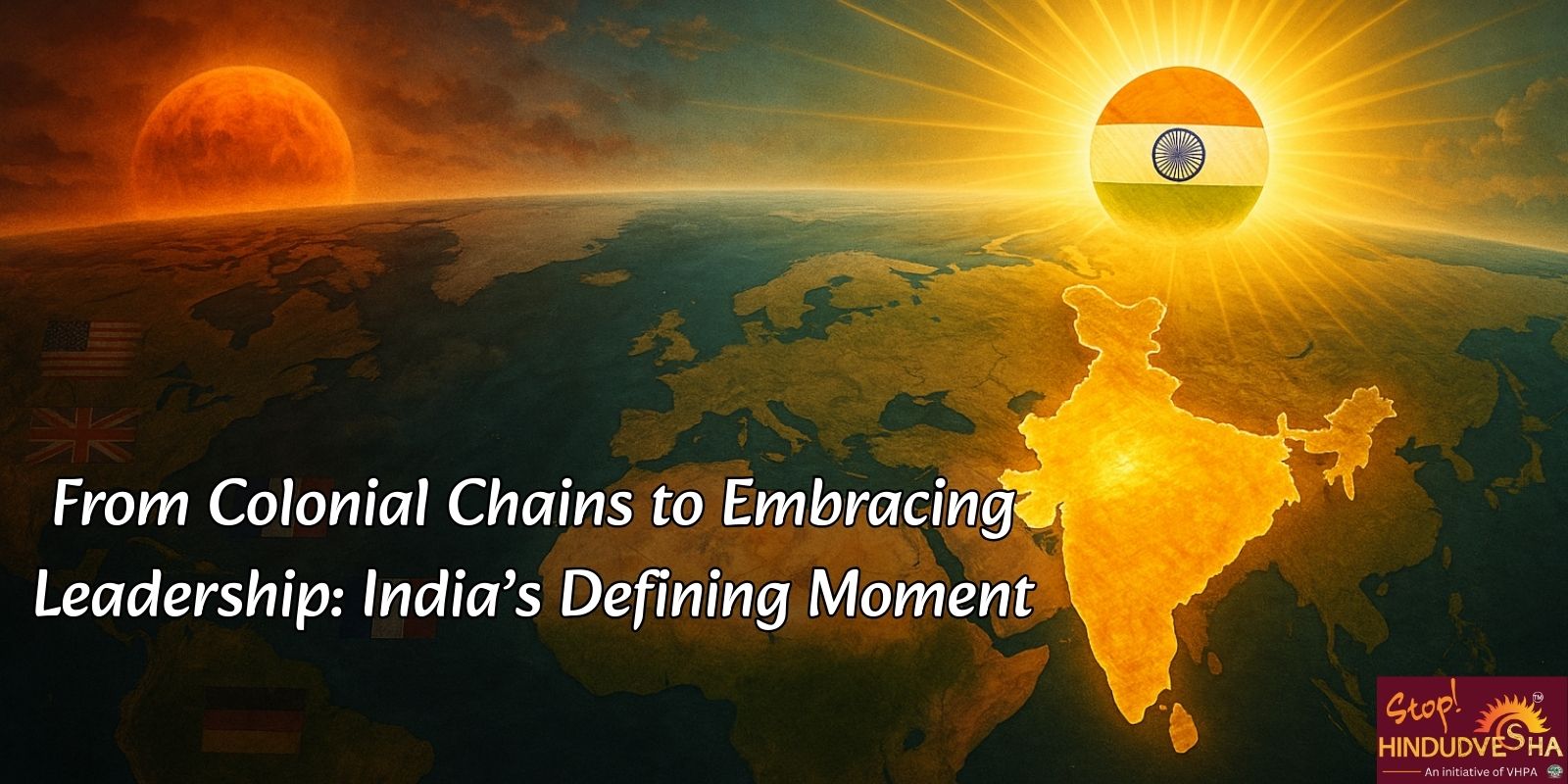
- The West’s economic and ideological decline has created a leadership vacuum in global institutions and values.
- India, historically the world’s largest economy for centuries, is regaining prominence with rapid growth and demographic strength.
- Studies project India will be the leading economy in the world in GDP by the late 21st century, restoring its pre-colonial stature.
- To lead, India must inherit and reform Western institutions, invest in liberal democracy, deepen its ties with the Global South, and build technological sovereignty.
- India’s civilizational depth positions it to offer a balanced model of prosperity, ethics, and democracy for a post-Western world.
In an era where the once-unassailable dominance of Western powers is waning, a profound shift is underway. European nations, such as Britain, France, Germany, and Italy —former architects of the global order —are retreating from the world stage.[1] The US, once the undisputed leader, is looking inwards even as many Americans fear they are headed towards internal strife.[2] Their exit is leaving a vacuum in institutions and values that have long defined the “Free World.”
Amid this transition, India — the world’s largest democracy — stands poised not merely to observe but to actively inherit and perpetuate these legacies. By upholding – rather than replacing – Western institutions like the World Bank, the International Monetary Fund, and the United Nations, advancing technological innovation, and upholding liberal values, India can ensure the continuity of a free and open international system while reclaiming its historical mantle as the planet’s leading economy. This is not just an opportunity; it is a historical imperative, as India resets to its pre-colonial stature amid a rapidly eastward-tilting global economy.
India’s Historical Economic Supremacy: A Legacy Interrupted
For millennia, India was the economic heartbeat of the world. In 1983, Belgian economist Paul Bairoch presented a study of the world economy that sparked controversy in Western academic and political circles. In ‘Economics and World History: Myths and Paradoxes’, he said that in the year 1750, China’s share of global GDP was 33 per cent, India’s 24.5 per cent, placing them far ahead of the West.[3]
Shaken and stirred by these figures, the Organization for Economic Cooperation and Development (OECD) constituted the Development Institute Studies under Professor Angus Maddison of the University of Groningen to investigate Bairoch’s claims. The data Maddison compiled affirmed – what nearly every Indian school child knew but was mysteriously unknown to the West – that India was among the wealthiest countries in the world until the British arrived and utterly ruined it.
Maddison’s figures showed India had the largest economy on the planet for 1,700 of the past 2,000 years.[4] Between 1 CE and 1000 CE, India had a 32 percent share of the global GDP. During the second millennium, Islamic invasions significantly disrupted economic activity, and India lost its position to China. Still, India’s share remained at 28-24 percent between 1000 and 1700 CE. European colonization from the mid-1700s to 1947 was the final nail in the coffin of the Indian economy, creating rampant poverty.
Centre of Gravity Shifts
Since Bairoch and Maddison presented those paradigm-shifting studies, the world has moved at warp speed. China is already the second-largest economy in the world, and India has overtaken Japan to take the No.4 spot.[5] What has surprised everyone is how rapidly India is growing (7.8 percent), even as the G7 has been languishing in sub-1 percent growth. In fact, the UK’s GDP grew by just 0.6 percent.[6]
Contrary to what some experts say, it’s not the wars in Iraq, Afghanistan, and Ukraine that have caused the West to lose traction. It’s because the East is becoming wealthier in comparison through better economic practices and systems. The current financial crisis reinforces the growing sense that the West is losing its global influence. For many, this marks not just a downturn, but a fundamental transformation in world affairs — commonly described as a decisive shift to the East in international politics.
One of the significant spinoffs of the Ukraine War is India’s decision to double down on Russian oil.[7] China’s trade with emerging markets has grown to a level that it can now offset any weakness in Western countries. Russia is building thousands of miles of pipelines from Siberia to China and Japan, allowing it to route its vast oil and gas resources directly to the Asia-Pacific.[8]
As the West stumbles through the recession, both India and China are racing each other to acquire the world’s minerals and commodities. While Indian companies are investing in Africa’s agriculture sector to grow food for a billion people, China is investing in mining.[9]
That’s not all. Western clubs, such as G7, are on life support. Russia has been sanctioned to hell because of the Ukraine War, and yet the Russian economy has not collapsed, but, on the contrary, is growing faster than Western economies. NATO, once the glue that bound the North Atlantic nations together, has lost its mojo.[10]
Erosion of the Western Order
While the loss of economic clout is overtly visible, the more damaging erosion has been ideological. Increasing political polarization, institutional decay, and the rise of the far right have fractured the West from within. As American conservative Patrick Buchanan put it, the United States and its institutions are failing to perform basic functions like defending borders or balancing budgets.
Buchanan’s book, ‘Suicide of a Superpower,’ about America’s decline, has been called racist and homophobic by critics, but it nevertheless has some grounding in reality. “America is disintegrating,” he screams. “The centrifugal forces pulling us apart are growing inexorably. What unites us is dissolving. And this is true of Western Civilization…. Meanwhile, the state is failing in its most fundamental duties. It is no longer able to defend our borders, balance our budgets, or win our wars.”[11]
That is a preview of tomorrow’s world without the West.
Routing Around
The concept of a “World Without the West” was first articulated by American academics Steven Weber, Naazneen Barma, and Ely Ratner, who said that in the new world order, the rising powers are keen to break the dominance of the current order by increasingly “routing around” the West.[12]
For years, the East vs West debate has been framed largely in terms of whether emerging powers like China, India, Russia, and Brazil will integrate into or challenge the existing international system built by the West. Weber and his associates contend that rising powers are opting for neither.
“By preferentially deepening their own ties among themselves, and in so doing loosening relatively the ties that bind them to the international system centered in the West, rising powers are building an alternative system of international politics whose endpoint is neither conflict nor assimilation with the West,” they say.
This works in two ways. One, the rising powers deepen their trade, defense, and cultural ties among themselves, creating a new parallel international system. So, in effect, by not playing by the rules set by the West, they are establishing an alternative arrangement in which they neither enter into conflict situations with the West nor enter into subservient alliances (like those offered to South Korea and Japan).
Crucially, the developing world is routing around not just the West but also the idea of the West, making it increasingly difficult for Western narratives to penetrate the developing world.
The emerging powers are preferentially deepening ties among themselves in economic, political, and even security domains. In doing so, they are loosening, in relative terms, the ties that bind them to the liberal international system centered in the West.
The Ukraine War, which started in 2014, was the catalyst that led to Russia and China routing around the West. Following their 2022 invasion, in response to American sanctions, the Russians developed alternative product delivery and payment mechanisms designed to circumvent these sanctions. As the years have gone by, these parallel systems have become formalized and permanent.
For instance, Russia has created a “shadow fleet” of over 600 crude carriers that operate in international waters without a flag, transferring Russian oil to flagged vessels.[13] In just a few hours, millions of tons of sanctioned crude oil become part of the global economy. India has joined these mechanisms in its quest for affordable energy to support its high-octane economy.
The free flow of sanctioned Russian oil is just one of the many ways the world is routing around the West. The West is slowly being squeezed out of international commerce.
India as the Future No. 1
According to a study by Sydney’s Universal Business School, by 2060, India’s economy will be double the GDP of the United States and equal to 95 percent of the GDP of China. “It moves above the GDP of China in the third forecast period and is 48 percent higher by 2080. In 2100, India’s GDP is 51 percent greater than that of China and more than three times the GDP of the United States.”[14]
India’s trajectory is not speculative; it’s backed by rigorous forecasts. Key milestones include:
- 2039: India’s GDP hits $30 trillion, surpassing the US.
- 2044: India’s labor force reaches 748 million, overtaking China’s.
- 2076: India’s GDP at $125 trillion exceeds China’s.
- 2100: India’s GDP balloons to $287 trillion — 51% larger than China’s and over three times the US’s.
These figures signal the country’s inevitable return to prominence, driven by demographics (a young, skilled workforce), digital innovation, and policy reforms such as “Make in India.” Yet, economic might by itself won’t suffice in a fragmented world. To lead sustainably, India must become the successor to the West’s intangibles.
Dual Responsibility
India finds itself in a unique position. It is simultaneously an Eastern power and a carrier of many Western liberal values, including constitutional democracy, the rule of law, freedom of the press, and pluralism. It shares cultural and trade ties with emerging powers, but it also shares institutional DNA with the Free West.
This dual identity gives India a unique responsibility and opportunity: to inherit and sustain the best of the West — its institutions, technologies, and liberal values — while leading a new global coalition that champions economic fairness, cultural respect, and political sovereignty.
What India Must Do
The projected future of Indian leadership will not unfold automatically. To seize this moment, India must shoulder immense responsibility, pursue prudent policies, and resist distractions from reckless geopolitical conflicts. It must act as a stabilizing elder, balancing ambition with restraint while carrying forward the values and institutions that sustain global order.
- Champion Institutional Continuity: India must position itself as the natural heir to Western institutions, particularly those that promote freedom, trade, and global cooperation. Whether it is in the reform of the United Nations, World Trade Organization, or Bretton Woods institutions, India should demand a larger role — not to destroy the existing order, but to revitalize and rebalance it.
- Invest in Liberal Values at Home: As India rises, it must avoid the trap of internal authoritarianism. The credibility of Indian leadership on the global stage will depend on its ability to uphold democratic values at home — free speech, judicial independence, and minority rights. These are not merely Western ideas; they are universal principles that India has practiced, however imperfectly, for 75 years.
- Lead the Global South: India must deepen its ties with Africa, Southeast Asia, and Latin America — not as a competitor to China but as a more inclusive and democratic partner. India’s trade with ASEAN and Africa is already growing rapidly; this should be accelerated through long-term investments in infrastructure, education, and green energy.
- Build Technological Sovereignty: Inheriting the West’s technology ecosystem means going beyond being a service provider. India must invest in indigenous innovation — AI, biotech, aerospace, semiconductors — and create public-private ecosystems that seamlessly integrate with Silicon Valley. The success of ISRO and the Digital India mission are strong foundations to build on.
- Export Democratic Models: As Western soft power wanes, India can fill the gap — not through coercion but through example. Its success in maintaining democratic institutions alongside rapid economic growth provides a compelling alternative model for developing countries tired of the binary choice between Western liberalism and Chinese authoritarianism.
Reclaiming the Civilizational Role
India is not just another economic power. It is a civilizational state with millennia of philosophical, scientific, and spiritual traditions. A rising India must not mimic the West’s hubris, nor China’s opacity. Instead, it should offer a third path: one that combines material prosperity with spiritual depth, technology with ethics, and growth with sustainability.
This is not nostalgia — it is a necessity. A world without a guiding center will drift into fragmentation, conflict, and cultural nihilism. The West no longer has the economic or moral capital to lead. But a rising India does — but only if it chooses to.
Wrapping up
History rarely offers second chances. For 1,700 years, India led the world in economics, culture, and innovation. Invasions and colonialism interrupted that story. But now, the pendulum is swinging back — not out of revenge or resentment, but through the sheer momentum of history.
As the Western order withdraws under the weight of its contradictions, India must step up — not to dominate, but to lead. It must inherit the West’s best values, discard its worst impulses, and chart a new course for the world — one rooted in freedom, dignity, and shared prosperity.
The 21st century will not belong to the West, nor to China. If India plays its cards right, it could belong to humanity — with India at the helm.
Citations
[1] BRICS Expansion, the G20, and the Future of World Order (Carnegie Endowment for International Peace, 2024); https://carnegieendowment.org/research/2024/10/brics-summit-emerging-middle-powers-g7-g20?lang=en
[2] The Americans Prepping for a Second Civil War (New Yorker, 2024); https://www.newyorker.com/magazine/2024/11/11/among-the-civil-war-preppers
[3] Ancient Indian Economy; https://www.cdeep.iitb.ac.in/slides/S17/MNG652/MNG652-L5.pdf
[4] From 1 AD To Today: A 2000-Year Story Of India’s Economic Rise (Swarjya Magazine, 2024); https://swarajyamag.com/newsletters/from-1-ad-to-today-a-2000-year-story-of-indias-economic-rise
[5] India overtakes Japan to become world’s 4th largest economy: NITI Aayog CEO (Door Darshan News, 2025); https://ddnews.gov.in/en/india-overtakes-japan-to-become-worlds-4th-largest-economy-niti-aayog-ceo/
[6] OECD GDP growth slows abruptly to 0.1% in the first quarter of 2025 (OECD, 2025); https://www.oecd.org/en/data/insights/statistical-releases/2025/05/gdp-growth-first-quarter-2025-oecd.html
[7] ONGC group refiners will buy every available drop of Russian oil as long as economical, says chairman AK Singh (The Indian Express, 2025); https://indianexpress.com/article/business/ongc-group-refiners-will-buy-every-available-drop-russian-oil-economical-chairman-ak-singh-10219327/
[8] The global Implications of a Russian Gas Pivot to Asia (Nature Communications, 2025); https://www.nature.com/articles/s41467-024-55697-7
[9] India-Africa partnership for agricultural development and food security (The Indian Express, 2025); https://indianexpress.com/article/upsc-current-affairs/upsc-essentials/india-africa-partnership-for-agricultural-development-and-food-security-10092618/
[10] How NATO Lost Its Way (Compact Magazine); https://www.compactmag.com/article/how-nato-lost-its-way/
[11] Suicide of a Superpower: Will America Survive to 2025? (Catholicity, 2025); https://www.catholicity.com/mccloskey/suicide.html
[12] A World Without the West (The National Interest, 2007); https://www.jstor.org/stable/42896050
[13] UPDATED: Illuminating Russia’s Shadow Fleet (Windward, 2025); https://windward.ai/knowledge-base/illuminating-russias-shadow-fleet/
[14] The world’s largest economies in 2100 – India No. 1 (The Universal Business School, Sidney); https://www.ubss.edu.au/articles/2022/september/the-world-s-largest-economies-in-2100-india-no-1/

Donate to HINDUDVESHA
Our Mission is to explore and expose Hindudvesha through research analysis, education and response.
SUPPORT US