
Church-Dravidianism Nexus: An Ideological Time Bomb Against Sanatana and Sovereignty
 Manoj Jwala · 06/20/2025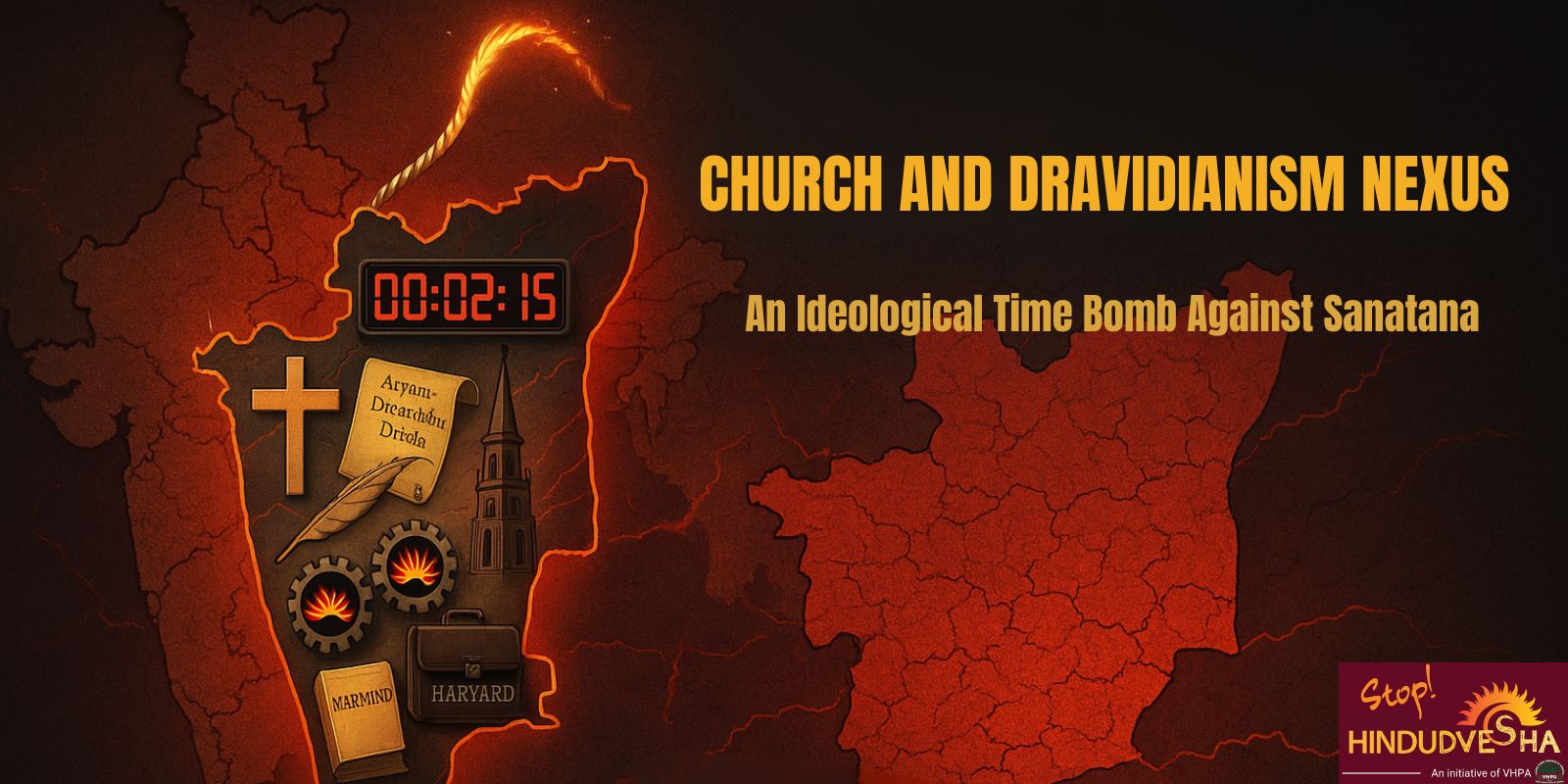
- Dravidianism is a colonial and Church-inspired ideological project, designed to break India’s cultural unity and fragment Hindu society.
• British officials and missionaries fabricated the ‘Aryan-Dravidian’ divide using linguistics and ethnography, artificially separating South Indian languages from Sanskrit and giving them a distinct identity.
• Christian missionaries linked Dravidian identity to Christianity to sever Tamil society from its Sanatana roots, with Robert Caldwell playing a central role in this campaign.
• The politics of Tamil Nadu (especially DMK and AIADMK) has long operated within this ideological construct, where opposition to Brahmins, Sanskrit, and Sanatana Dharma has been deeply intertwined with Church-linked agendas.
• This intellectual war is still ongoing today. It poses a serious challenge to India’s national consciousness, religious identity, and social harmony — confronting it must now be treated as a national priority.
For the past five centuries, European and American religious expansionist powers have continuously conspired against the Indian nation and Indian nationalism. Their aim has been to divide India’s harmonious and pluralistic religious society. Efforts have included manufacturing an artificial ideological divide, such as ‘Aryan vs. Dravidian’, inventing the fictitious ‘Aryan Invasion’ theory, and recasting Dravidian identity through a Christian lens — all executed through calculated and long-term strategies.
To implement these agendas, various intellectual constructs were introduced from time to time. Western linguistics and anthropology became key tools — used not only to dismantle the identities of various civilizations but also to gradually mold them into the framework of Christianity.
From these very tools emerged a divisive ideology—Dravidianism. In the words of Western scholars themselves, this ideology is like a “time bomb” that periodically detonates against India’s social and political unity. It has deeply impacted the roots of Indian nationalism. In fact, this ideology causes more damage than physical weapons because it directly targets society’s collective consciousness and the unity of the nation.
Colonial Roots of ‘Dravidian’ Project in India
This ideology did not arise suddenly; it was the result of well-planned efforts under colonial rule. When the East India Company came to India, its agenda was not just economic — it also had clear religious and cultural expansionist motives.
One example is Francis Whyte Ellis[1], a British collector of the Madras district. He proposed that South Indian languages constituted an independent language family. Building on this, Alexander D. Campbell[2], superintendent of Fort St. George College in Madras, composed a grammar of the Telugu language. In this grammar, he attempted to establish that although most Indian languages evolved from Sanskrit, South Indian languages — Tamil, Telugu, Kannada, and Malayalam — had no relation to Sanskrit. Ellis himself wrote the “Note to the Introduction” in Campbell’s 1816 grammar book, where he advocated for classifying South Indian languages as a separate linguistic family.
Following this, Anglican missionary Robert Caldwell coined the term “Dravidian”[3] to legitimize his religious agenda. He borrowed the word from the term “Dravida” used in the Sanskrit text Tantravartika authored by Kumarila Bhatta, and applied it to South Indian languages. Caldwell sought to entirely sever their linguistic connection to Sanskrit and link them instead to Hebrew, the language of the Bible.
His book A Comparative Grammar of the Dravidian or South Indian Family of Languages (1856)[4] put forward the claim that “Dravidian” was a distinct major language group. Through this classification, Caldwell gave the idea of Dravidian separatism a quasi-theological foundation, which gave Christian missionaries a moral pretext to disconnect Tamil society from the Sanatana spiritual tradition and convert it to Christianity.
Dravidian Movement: An Intellectual ‘Time Bomb’
It is worth asking: Why did officials of the British East India Company and Church missionaries feel the need to write grammars of South Indian languages and sever their link with Sanskrit? The answer is clear — their objective was to separate South Indians from the Arya-Vedic-Hindu tradition, recast them as a separate civilization, and gradually assimilate them into the framework of Christianity.
The works authored by Ellis and Campbell opened the first intellectual gateway for this process. They argued that Tamil and Telugu shared a common ancestor that was non-Sanskritic.[5] Through this gateway entered figures like Max Müller, a paid translator employed by the British establishment, who distorted Hinduism at its roots through arbitrary and manipulative translations of the Vedas.
Birth of the Dravidian Movement
Alongside these developments came the influence of Western racial anthropology, which laid the toxic foundation for socio-political divisions in South India — based on fabricated binaries like Aryan vs. Dravidian, North vs. South, light-skinned vs. dark-skinned, and Brahmin vs. non-Brahmin. It was as a result of these engineered narratives that the Dravidian movement was born. In the 1950s, an Archbishop in Madurai described it as a “time bomb” — a strategic tool activated by the Church with the intent to destroy Hindu Dharma in Tamil Nadu.[6]
And that description still seems relevant today. Not long ago, Tamil Nadu minister Udhayanidhi Stalin publicly stated:
“Sanatana Dharma is a disease that must be eradicated,”[7]
“The very purpose of the Dravidian movement was to abolish Sanatana Dharma.” [8]
In truth, the politics of anti-Brahminism, anti-Sanatana Dharma, and anti-Hindi sentiment in Tamil Nadu have existed for nearly a century. Its ideological roots lie in the Church-backed Aryan-Dravidian divide. This ideological legacy began with E. V. Ramasamy Periyar and was later politicized by C. N. Annadurai as the Dravidian Movement. Udhayanidhi’s statement in Chennai is a direct reflection of this mindset:
“We don’t just oppose mosquitoes, dengue, coronavirus, and malaria — we eradicate them. Similarly, we are not here to merely oppose Sanatana Dharma; our mission is its complete annihilation.”
He further asserted:
“We stand firm in our stance, we will face any legal challenge, and we will not back down an inch from our resolve to remove Sanatana Dharma from Dravidian soil.”
Dravidian Politics: An Ideological Explosion of Division
Today, the major political parties of Tamil Nadu — DMK (Dravida Munnetra Kazhagam) and AIADMK (All India Anna Dravida Munnetra Kazhagam) — are ideologically grounded in anti-Brahminism. This doctrine is part of a long-term Church-driven agenda aimed at simultaneously fragmenting India, dismantling Sanatana Dharma, and weakening Hindu society.
The political exploitation of the Aryan-Dravidian divide began during India’s freedom struggle itself, with attempts to separate Tamil Nadu from India and establish a breakaway nation called “Dravidastan.” Though that movement was defeated, its spirit survives in disguised forms. Both DMK and AIADMK are products of Church-influenced ideology. They continually promote anti-Brahmin, anti-Sanskrit, and anti-Hindi campaigns, with the underlying goal of disrupting India’s unity and erasing Sanatana Dharma from public and political life.
Udhayanidhi’s recent declarations make it evident that Church-backed religious expansionism is still very much alive. When a state minister openly calls for the extermination of Sanatana Dharma, it signals how deeply and systematically government machinery is being used against Hinduism, and will likely continue to be used.
When Vatican-Backed Church Missions Receive State Patronage
When Vatican-controlled Church missions receive open cooperation and protection from state power, their bishops and clergy in Tamil Nadu become more active, vocal, and bold. Their claim — “The Dravidian movement is a time bomb against Hindutva” — now appears entirely accurate.
This “time bomb” was engineered by a colonial quartet — Macaulay, Max Müller, Caldwell, and William Jones — who, through linguistics and racial anthropology, invented and propagated the Aryan-Dravidian divide.
Even today, the remote control of this ideological bomb remains in the hands of the Vatican’s intellectual strategists. These forces are actively working, through the Dravidian movement, to erase Vedic Hindu traditions in South India and replace them with Christian expansionism.
Whether it was Periyar and Annadurai, or later Karunanidhi and Jayalalithaa, or today’s Chief Minister M. K. Stalin and his son, Minister Udhayanidhi — all have served as instruments of the Church-backed system that has entrenched anti-Sanatana Dharma sentiment as a permanent political culture in Tamil Nadu.
Christianization Under the Veil of Dravidianism
Bishop Ezra Sargunam, who passed away recently and was responsible for establishing thousands of churches in Tamil Nadu, used to openly call the deities of Sanatana Dharma “demons” and was a vocal advocate for forced Christian conversions. In an interview with Swarajya magazine, he proudly admitted to having claimed to have overseen the construction of hundreds of thousands of churches across Tamil Nadu and converting millions of Hindus to Christianity.
Sargunam was the same man who had the audacity to distribute Christian propaganda booklets during the sacred Hindu Kumbh Mela in Prayagraj. According to Swarajya, he received his pastoral training under American evangelist Billy Graham, who did not believe in Darwin’s theory of evolution and was known for intolerance towards Jews.
Sargunam was not just an ordinary missionary but an active political player in Tamil Nadu, manipulating political outcomes to suit Church interests. Even today, Church missions operate with teams of pastors and bishops who influence politics under the guise of religion. Pastor Jagat Gospel is a particularly notable name.
These pastors maintain a direct relationship with the DMK (Dravida Munnetra Kazhagam). Whenever DMK comes to power, new strategies are adopted to undermine Sanatana Dharma through state machinery, such as taxation on Hindu temples, government grants to churches, and propagating distorted histories in school curricula, like claiming that Adam (the Biblical figure) was a Tamil speaker.
Church-run institutions receive government funding and simultaneously work to convert Hindus. Their publishing arms use language and culture as tools to pull Tamils toward Christianity while spreading false and hateful literature against Sanatana Dharma. Pastors like Jagat Gospel, who are central to these plans, are so powerful that neither DMK nor AIADMK leaders dare to defy them.
Pastor Mohan C. Lazarus and His Proximity to Power
One such pastor is Mohan C. Lazarus, a close associate of Udhayanidhi Stalin. Born into a Hindu family, he later converted under Church influence and became a Christian preacher. Today, he lures innocent Tamils into Christianity by performing so-called miracles. He has deliberately set up his office near Tiruchendur, an ancient Hindu pilgrimage site, where even political meetings with leaders like Stalin are held.
These Church “agents,” disturbed by the widespread presence of Hindu temples, often label Tamil Nadu as the “stronghold of the devil” and repeatedly proclaim that Sanatana Dharma must be wiped out, with political figures like Stalin echoing their sentiments.
South India: The Foundation of Sanatana Culture
The truth is, Tamil, Telugu, and Kannada regions are the cradle of Sanatana Dharma. The very soil of South India is where Hindu culture has flourished most deeply. In fact, the roots of Hindu civilization lie here. If these roots are dried up or uprooted, then the flowers will inevitably fall and the tree will collapse. This is why Christian expansionist forces have focused their efforts on the South — because they know that if the roots are destroyed, the entire structure of Sanatana Dharma in India will collapse.
Protecting the South from such forces is not merely a cultural necessity, but a religious and national duty — essential for preserving the integrity of Sanatana Dharma and the unity of India.
Even today, Tamil Nadu remains a guardian of rare cultural and spiritual traditions that were destroyed in North India during Islamic invasions. The traditions of temples, monasteries, and scriptural learning that were erased in the North have survived in Tamil Nadu. For instance, worship of avatars like Varaha and Narasimha — now nearly extinct in much of India — remains alive in the South.
During the recent Kumbhabhishekam (ritual consecration) of the Kashi Vishwanath Temple, the North Indian priests lacked the required ritual knowledge, and it was a scholar from Tamil Nadu who was brought in to revive the ancient procedures. Likewise, four of the five Pancha Mahabhuta (five-elemental) temples — sacred to the Sanatana tradition — are still located in Tamil Nadu, including the Chidambaram Nataraja Temple, which holds a place of exceptional reverence.
Tamil Nadu’s spiritual antiquity has deeply influenced its neighboring regions—Karnataka, Andhra-Telangana, and Kerala—forming a cultural and dharmic ecosystem that remains vital to India’s civilizational continuity.
Ending Dravidianism: Now a National Priority
Direct violence can be curbed through military force, as has been done in Kashmir. But a far more serious threat lies in ideological attacks that do not target the body, but the mind, beliefs, faith, and thinking of individuals. This ideological assault gradually creates divisions within society, increases the distance between people in the name of religion, and weakens a unified religious culture. It cannot be countered by the police or the military, because it is a battle fought on the plane of consciousness and thought.
This process erodes the roots of Indian nationalism and works to hollow out the nation from within. Confronting it is not merely a matter of security — it is about protecting the nation’s consciousness and soul.
To confront this, the Government of India must formulate a well-organized intellectual and cultural strategy, just as the British East India Company and colonial regime once did to fracture India’s unity. Just as they fabricated the Aryan-Dravidian divide using linguistics, racial anthropology, literature, and history, we must now work to dismantle and reject this entire ideological web.
Even if this may not seem like the government’s direct responsibility, it is now an unavoidable national imperative in the interest of historical justice and civilizational identity. After all, it was the foreign rulers—the British Company and their scholar-missionaries—who gave birth to this ideological bomb called ‘Dravidianism’, nurtured it systematically, and used it as a weapon to fracture Indian unity.
Citations
[1] Francis Whyte Ellis; https://en.wikipedia.org/wiki/Francis_Whyte_Ellis
[2] A.D.Campbell, Grammar of the Teloogoo Language, 1849; https://dn790006.ca.archive.org/0/items/grammarofteloogo00camprich/grammarofteloogo00camprich.pdf
[3] Dravidian languages; https://en.wikipedia.org/wiki/Dravidian_languages
[4] Robert Caldwell; https://en.wikipedia.org/wiki/Robert_Caldwell
[5] Rajiv Malhotra, Breaking India – Western Interventions in Dravidian and Dalit Faultlines, https://archive.org/details/RajivMalhotraAndAravindanNeelakandanBreaking
[6] Is Tamil Nadu Becoming A Hotbed For Evangelists? (Swarajya, 2019); https://swarajyamag.com/videos/is-tamil-nadu-becoming-a-hotbed-for-evangelists
[7] Udaynidhi’s comment on Sanatana Dharma; https://www.thehindu.com/news/national/tamil-nadu/udhayanidhis-remarks-on-sanatana-dharma-triggers-political-row/article67267184.ece
[8] स्टालिन के सनातन वाले बयान के बारे में धर्म और इतिहास के जानकारों की क्या राय है? (BBC News Hindi, 2023); https://www.bbc.com/hindi/articles/c0j350wyvjno

Donate to HINDUDVESHA
Our Mission is to explore and expose Hindudvesha through research analysis, education and response.
SUPPORT US