

USCIRF’s Hindutva Lens: Framing Hindu Identity as a Security Concern
 Rati Agnihotri · 05/07/2026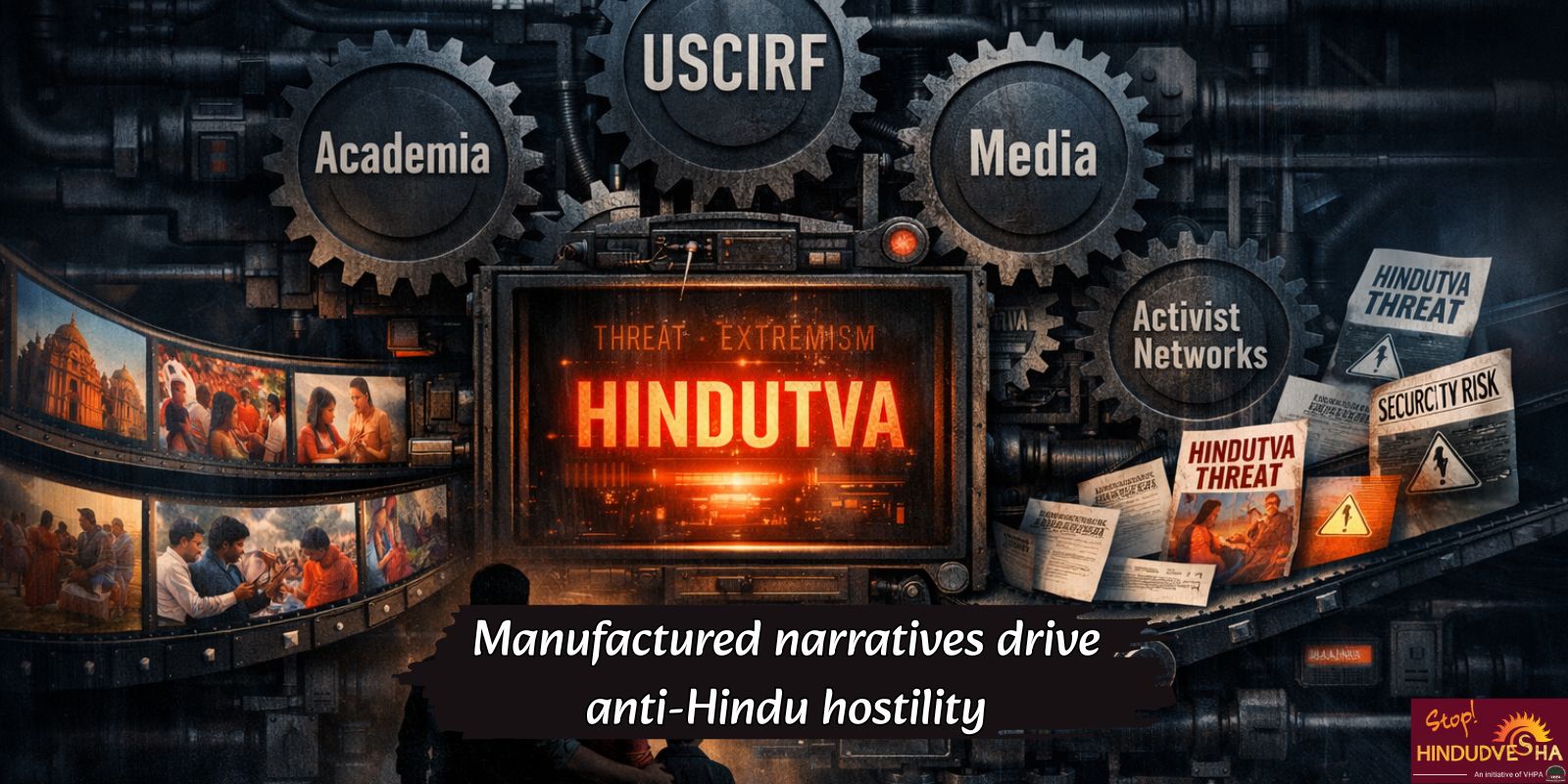
Summary
This essay examines how the USCIRF’s latest report reflects a broader pattern in Western academic, media, and policy discourse that frames “Hindutva” as a security threat, thereby delegitimizing Hindu identity and advocacy. It argues that this narrative, amplified by sections of academia and civil society, diverts attention from the rise of Hinduphobia and anti-Indian hostility in Western societies. Drawing on case studies including the Rutgers report, the SOAS inquiry into Leicester violence, and NCRI data on online hate trends, the essay highlights how such framing shapes public perception and policy outcomes. The convergence of narrative, institutional influence, and real-world incidents creates a climate in which Hindu concerns are marginalized, underscoring the need for more balanced, evidence-based discourse.
A consistent pattern now defines the Western framing of Hindu issues: delegitimize first, engage later. In recent years, a dominant narrative has taken hold—the routine invocation of a largely constructed “Hindutva” framework to discredit the articulation of Hindu concerns in Western democracies. The result is a striking inversion in which a small minority community is recast as an “oppressor,” through sweeping and often unsubstantiated claims of “Hindutva supremacy,” “Hindutva fascism,” and “saffron terrorism.”
The latest report by the U.S. Commission on International Religious Freedom (USCIRF) follows this familiar script. It advances a contested narrative of minority oppression in India, not merely as analysis, but as a device to deflect attention from the rise of Hinduphobia in Western societies and to justify increased scrutiny of Hindu identity and advocacy abroad. More notably, the report sheds even the minimal pretense of neutrality, moving into the realm of policy prescription. It calls for sanctions on the RSS and recommends that individuals or entities associated with it face asset freezes and entry bans into the United States.
This reflects a broader and increasingly entrenched pattern: the deployment of the “Hindutva” construct to delegitimize legitimate Hindu concerns. Such framing diverts attention from the lived realities of the Hindu diaspora, including temple vandalism, rising hate incidents, caste-based profiling, and persistent forms of academic bias.
The sections that follow examine how this narrative has been systematically constructed and amplified by an interconnected ecosystem spanning activist networks, sections of academia, civil society organizations, and think tanks. They further explore how this framework operates to constrain and stigmatize the public articulation of Hindu issues in the West.
Implicit Targeting of Hindu Advocacy in the US
The U.S. Commission on International Religious Freedom has consistently pursued a pronounced anti-India agenda, painting a misleading picture of minority oppression and religious intolerance. [1] Moreover, the USCIRF routinely targets anti-conversion laws in various Indian states, portraying them as part of a broader conspiracy against religious minorities. Several analysts have argued that the USCIRF operates within a wider ecosystem that includes missionary lobbying efforts focused on India.[2]
However, the Commission displays an unusual degree of hostility in its latest report, launching a direct attack on the Rashtriya Swayamsevak Sangh (RSS). The report’s key findings on India lack both rigor and factual grounding. The section on India reads less like objective analysis and more like an ideologically driven polemic. It asserts, with little substantiation, that throughout 2025 “Hindu nationalist mobs across several states harassed, incited, and instigated violence against Muslims and Christians with impunity.” [3]
It cites selective incidents of alleged targeting of minorities in India without providing adequate background or context, consistently portraying the Hindu community as the primary perpetrators and explicitly demonizing “Hindu nationalism.” The report reaches a particularly troubling point when it references the Pahalgam terror attacks to raise concerns about the alleged targeting of Muslims in their aftermath. The term bias itself seems insufficient to describe a report that does not find it necessary to explicitly condemn the brutal killing of Hindu tourists in Pahalgam on the basis of their religious identity, yet invokes the same incident to argue that it resulted in the targeting of Muslim minorities in India. [4]
The report recommends that India be designated as a “country of particular concern.” It further calls for targeted sanctions against the RSS, effectively barring its entry into the United States. In addition, it urges the U.S. Congress to reintroduce and pass the Transnational Repression Reporting Act of 2024, which would mandate annual reporting on alleged acts of transnational repression by the Indian government targeting religious minorities in the United States. [5]
The USCIRF’s support for the Transnational Repression Bill can be viewed as an implicit targeting of the Hindu American community. Many within the community, along with several Hindu advocacy organizations in the United States, have raised concerns about similar legislative efforts, including California Senate Bill SB509. They argue that, under the guise of addressing transnational repression, such measures could be misused to target community members and portray them as proxies of foreign governments, thereby endangering their safety and civil liberties. Several Hindu organizations, including the Coalition of Hindus of North America (CoHNA) and the Hindu American Foundation (HAF), have explicitly opposed the bill. Samir Kalra, Managing Director of HAF and a civil rights attorney, has cautioned that such legislation could be weaponized to suppress legitimate dissent, particularly on issues related to extremism and terrorism, as individuals raising these concerns could be labeled as foreign agents. [6]
The USCIRF report’s attack on the RSS constitutes an indirect assault on Hindu advocacy in the West. The RSS operates within India, where it has played a significant role in fostering an environment that supports the preservation of Hindu culture and identity, as well as the public articulation of Hindu concerns. While the RSS itself does not operate directly in Western countries, many independent Hindu organizations in regions such as the United States and the United Kingdom draw inspiration from similar cultural and civilizational principles and engage in activities aimed at preserving the identity and rights of the Hindu diaspora. The persistent targeting of the RSS by a left-liberal, activist, and Islamist-aligned ecosystem must therefore be understood as part of a broader, coordinated effort to weaken Hindu advocacy in the West.
By constructing a case for banning the RSS in the United States, the USCIRF report effectively lays the groundwork for curbing the rights and civil liberties of Hindu advocacy organizations across Western countries, framing their work through the constructed lens of “Hindutva supremacy.”
Since India is the civilizational homeland of Hindus, issues affecting the Hindu diaspora in the West often intersect with legitimate concerns of the broader Hindu community in India, which has at times faced policies perceived as favoring minority appeasement. The prevalence of anti-Hindu hate crimes in India, along with concerns about coercive or inducement-based religious conversion practices, remains a significant issue. With the rise of nationalist discourse, sections of the community have become more confident in articulating their concerns publicly without fear of intimidation. These shifts have unsettled certain interest groups, contributing to the increasingly negative framing of “Hindutva” in parts of the media, academia, and civil society.
The USCIRF report reflects these same patterns of “Hindutva” criticism. By advocating measures such as the Transnational Repression Bill, it implicitly extends this framing to the Hindu community in the United States.
How Academia Fuels the “Hindutva Threat”
Over the past decade, parts of Western academia have shown heightened engagement in studying and critiquing the rise of “Hindutva.” The Dismantling Global Hindutva Conference, organized in 2021 with the support of several prominent U.S. universities, is a notable example. The conference featured speakers drawn largely from the far-left ideological spectrum, including scholars with a documented record of Hinduphobic rhetoric, individuals sympathetic to extremist movements, and commentators critical of India’s civilizational resurgence. [7]
In October 2025, Rutgers University hosted a panel discussion on a report titled “Hindutva in America: An Ethnonationalist Threat to Equality and Religious Pluralism.” Presented under the guise of scholarly analysis, the report advanced sweeping allegations against Hindu American organizations, claiming they function as proxies for the RSS and serve as conduits for caste discrimination, Islamophobia, and anti-minority politics. Notably, these claims were made without substantial evidence, relying instead on speculative ideological assertions and the logically flawed premise of guilt by association. [8] [9]
In February 2026, a report on the 2022 Leicester violence led by the School of Oriental and African Studies (SOAS), a public research university in London and a member of the University of London, was released. Despite presenting itself as an independent academic institution, SOAS is often viewed by critics as advancing a markedly left-leaning perspective on geopolitical and cultural matters. The report largely attributed the unrest to “Hindutva” or “Hindu nationalism,” alleging that social media disinformation during the period was driven by “international narratives, particularly from India.” It further claimed that the events were predominantly framed online through a Hindutva lens, portraying Hindus as victims of “Pakistani” and “Islamist” gangs. The report aligns with a broader pattern of what critics describe as academic bias against Hindu perspectives in the West, implicitly linking the violence to the Modi government and to what it terms “Hindu nationalism associated with the Bharatiya Janata Party.” [10]
Interestingly, while the report does acknowledge the role of “political Islamists” in passing, it places disproportionate blame for the violence on “Hindu nationalism” or “Hindutva.” It makes serious allegations against the Modi government for covertly inciting communal tensions in the UK without presenting substantive evidence. The report also includes a dedicated section on “Hindutva,” advancing claims that portray it as inherently anti-Christian and anti-Muslim. It further targets Hindu advocacy in the UK by characterizing reported engagements between Hindu organizations and political representatives during the Leicester unrest as part of a coordinated “Hindutva” effort against Muslims. At this stage, the underlying thrust of the report becomes clear: by relying on a particular academic framing of Hindutva and Hindu nationalism, it seeks to delegitimize the concerns of the Hindu community in the UK regarding their safety, civil liberties, and the preservation of their cultural identity.
Hindu advocacy groups in the UK strongly criticized the report, raising concerns about its funding, impartiality, and the ideological orientation of its contributors. They also pointed to the role of George Soros’s Open Society Foundations as a funding source, arguing that it has taken positions they view as critical of Hindu interests and India. [11]
The findings of the SOAS inquiry into the Leicester violence stand in stark contrast to the Henry Jackson Society report published in November 2022. Drawing on interviews with Hindu and Muslim residents, as well as video evidence, police records, and social media analysis, that report concluded that the unrest was a localized community cohesion issue, later mischaracterized as the result of organized Hindutva activity. [12] It further examined how claims of Hindutva involvement were amplified and highlighted the role of certain media narratives and radical Islamist groups in promoting what it described as a “Hindutva conspiracy” framework. [13]
From the Dismantling Global Hindutva Conference to the Rutgers University report and the SOAS inquiry into the Leicester violence, the pattern is strikingly consistent. Vague, ideologically driven generalizations about Hindutva and Hindu nationalism are advanced, the Modi government is portrayed as anti-minority, and then tenuous parallels are drawn between developments in India and the public articulation of Hindu concerns in the West. By this logic, any critique of the growing influence of radical Islam in Western societies or any condemnation of rising Hinduphobia is framed as an extension of “Hindutva,” and is therefore dismissed as illegitimate by default.
A similar pattern is evident in the broader academic, media, and think-tank literature on “Hindutva.” The term is frequently defined through reductive and ideologically loaded interpretations, while the public articulation of Hindu concerns is cast with suspicion. Parallels are routinely drawn between Hindutva and Islamist extremism, creating a narrative in which a civilizational framework centered on cultural reclamation is portrayed as inherently aggressive or violent.
The Normalization of Anti-Hindu Hate
Academic hostility toward Hindu perspectives creates conditions under which growing Hinduphobia in the West is overlooked or minimized. When incidents of anti-Hindu hate crimes, including those involving radical Islamist actors, are reduced to footnotes while an exaggerated “Hindutva threat” dominates media and civil society discourse, it signals a troubling normalization of anti-Hindu prejudice.
In March 2026, a series of violent attacks by Muslim groups targeting Hindus, Sikhs, and Indian-owned businesses across parts of London raised serious concerns within the community. One establishment was targeted twice within a few days. Eyewitness accounts described 15–20 attackers approaching from the direction of a nearby mosque and vandalizing the premises. On March 3, 2026, a Holi celebration in Harrow was reportedly disrupted by a group of Muslim youth. According to eyewitness accounts, some individuals entered the premises during the celebrations, allegedly shouting abuses and throwing objects, with the situation escalating into a broader attack on attendees. [14]
British MP Bob Blackman emphasized that despite raising the Holi incident in the British Parliament, the violence had not stopped and that “the perpetrators of the original Holi attack remain at large”. He also demanded accountability from the Metropolitan Police, arguing that although a group of 20 people had disrupted the Holi celebration, only one arrest had been made so far. [15]
Even as the SOAS inquiry report on the Leicester violence, which called on the UK government to recognize “radical and militant Hindutva,” received widespread media coverage [16] [17], anti-Hindu hate incidents during the recent Holi celebrations were largely downplayed or ignored. The more troubling aspect is that hostility directed at the Hindu diaspora in the West is often reframed as generic “community tensions.” The communal dimension is either minimized or denied altogether, and when Hindu organizations raise concerns about the role of radical Islamist elements in perpetuating Hinduphobia, they are quickly labeled as “Islamophobic.”
The heightened sensitivity toward Islamophobia, coupled with the reluctance to acknowledge the existence of Hinduphobia, has placed the Hindu diaspora in the West in a vulnerable position, where even legitimate criticism of radical Islamist extremism can be construed as Islamophobia. In the absence of a comparable framework to safeguard the rights of the Hindu community, incidents of Hinduphobia often remain unaddressed.
Between Violence and Vilification: The Hindu Diaspora Under Strain
Many troubling incidents of anti-Hindu hate crimes have been reported across several Western countries in recent years. In February 2026, a Sikh student was assaulted on the campus of San Jose State University in the United States after being mistaken for a Hindu. The attackers reportedly forced him to the ground and removed his turban while using the term “Hindu” as a derogatory slur. [18]
In April 2025, Dharmesh Kathireeya, a 27-year-old Indian national in Rockland, Canada, was fatally stabbed by an 83-year-old neighbor. According to media reports, the attacker had previously directed anti-India and racist remarks at the victim and his wife. The sudden rise in deaths of Indian-origin students in the United States in 2024 has also raised concern. At least 11 Indian students died that year under unclear or suspicious circumstances, with seven deaths occurring within a span of just three weeks between January 15 and February 5. While these incidents cannot be directly attributed to Hinduphobia, the lack of clarity surrounding several of the cases makes them a cause for concern and invites closer scrutiny in the broader context of rising anti-Indian and anti-Hindu sentiment in Western societies. [19]
Amid the rise in racism targeting people of Indian origin and Hindus on social media, along with increasing attacks on temples across Western democracies such as the United States, the United Kingdom, and Canada, the Hindu diaspora finds itself at a precarious juncture. It is often expected to conform to prevailing norms of political correctness rather than openly articulate legitimate concerns about its security and identity. When attention shifts away from addressing concrete instances of anti-Hindu hatred and violence toward portraying “Hindutva” in derogatory terms and advancing unsubstantiated claims of caste-based discrimination, it creates the impression that the community is being pushed onto the defensive.
The Hindutva narrative advanced by the left-liberal and radical Islamist ecosystem reflects a familiar pattern of victim-blaming, where a catalogue of perceived threats is invoked to rationalize continued marginalization.
Closing Remarks: The Rising Cost for Hindus in the West
The convergence of academic framing, policy advocacy, and media narratives around “Hindutva” is no longer an abstract intellectual exercise; it has tangible consequences for how Hindu identity is perceived and treated in Western societies. When a civilizational framework is persistently recast as a threat, it creates the conditions for suspicion, marginalization, and, increasingly, hostility toward the communities associated with it.
The NCRI report underscores this shift, showing how digital narratives can rapidly translate into real-world targeting. The rise in anti-Indian rhetoric, its amplification through coordinated networks, and its spillover into offline incidents—including harassment at Hindu temples and protests featuring signs such as “Deport H-1B Scammers [20]”—are not isolated developments. They form part of a broader pattern in which ideological constructs shape public perception and, in turn, influence behavior on the ground.
At stake is not merely a debate over terminology, but the legitimacy of Hindu identity and advocacy in the public sphere. If the current trajectory continues—where legitimate concerns are dismissed as ideological extremism and community voices are preemptively delegitimized—the result will be a narrowing of civic space for an entire diaspora.
Addressing Hinduphobia in the West, therefore, requires more than reactive responses to individual incidents. It demands a critical re-examination of the narratives that frame Hindu identity, a commitment to evidentiary rigor in academic and policy discourse, and the creation of institutional safeguards that ensure Hindu communities can articulate their concerns without fear of stigma or reprisal.
Citations
[1] USCIRF’s Anti-India Obsession; https://stophindudvesha.org/uscirfs-anti-india-obsession-freedom-crusade-or-a-political-smear/
[2] New Faces in the White House, Same Old Policy Towards India; https://stophindudvesha.org/new-faces-in-the-white-house-same-old-policy-toward-india/
[3] United States Commission on International Religious Freedom 2026 Annual Report https://www.uscirf.gov/sites/default/files/2026-03/USCIRF_2026_AR%20(2).pdf
[4] Ibid.
[5] Ibid.
[6] Indian-Americans in California alarmed as Senate advances transnational repression bill – India Today; https://www.indiatoday.in/world/us-news/story/hindus-indian-american-express-concern-california-bill-passed-senate-vote-transnational-repression-khalistani-2742496-2025-06-18
[7] Oxford to Academia: Inquiry or Anti-Hindu? https://stophindudvesha.org/from-oxford-to-academia-at-large-free-inquiry-or-scripted-discourse-against-hindus/
[8] Hit Job: Rutgers Fuels Anti-Hindu Hate with Dubious Report; https://stophindudvesha.org/hit-job-rutgers-fuels-anti-hindu-hate-with-dubious-report/
[9] Rebuttal to Rutgers’ Hindutva Report; https://stophindudvesha.org/a-hindu-american-rebuttal-to-the-genocidal-subtext-of-rutgers-hindutva-in-america-report/
[10] Understanding the 2022 Violence in Leicester; https://static1.squarespace.com/static/6505d742fdd85426286c1396/t/699c3b9fe74d01125aaa433b/1771846559583/Executive+Summary+Leicester.pdf
[11] Hindu groups in UK slam SOAS-led report into 2022 Leicester unrest – The Times of India; https://timesofindia.indiatimes.com/world/uk/hindu-groups-in-uk-slam-soas-led-report-into-2022-leicester-unrest/articleshow/128728249.cms
[12] Is the SOAS inquiry into Leicester violence biased and rigged against Hindus?; https://hindupost.in/world/is-the-soas-inquiry-into-leicester-violence-biased-and-rigged-against-hindus/
[13] Unmasking the Rise of Hindudvesha in the West; https://stophindudvesha.org/the-conspiracy-of-silence-unmasking-the-rise-of-hindudvesha-in-the-west/
[14] UK Violence: Hindu festival disrupted & shops of Indians vandalised; https://organiser.org/2026/03/12/343770/world/uk-rising-islamist-hostility-hindu-festival-disrupted-shops-of-indians-vandalised-at-wembley/
[15] ‘Perpetrators still at large’: British MP Bob Blackman flags Harrow Holi clash after Indian shops attacked in Wembley – The Times of India; https://timesofindia.indiatimes.com/world/uk/perpetrators-still-at-large-bob-blackman-flags-harrow-holi-clash-after-indian-shops-attacked-in-wembley/articleshow/129681089.cms
[16] UK must recognise militant Hindutva as a form of extremism: Report on 2022 Leicester violence; https://www.thenewsminute.com/news/uk-must-recognise-militant-hindutva-as-a-form-of-extremism-report-on-2022-leicester-violence
[17] Hindutva Chants Led to Escalation in 2022 Leicester Violence: Report – The Wire; https://thewire.in/religion/report-links-hindutva-chants-to-escalation-in-2022-leicester-violence
[18] Sikh student assaulted after being mistaken for ‘Hindu’ at San Jose State University, Hindu groups condemn attack | World News – The Times of India; https://timesofindia.indiatimes.com/world/us/sikh-student-assaulted-after-being-mistaken-for-hindu-at-san-jose-state-university-hindu-groups-condemn-attack/articleshow/128364915.cms
[19] Unmasking the Rise of Hindudvesha in the West; https://stophindudvesha.org/the-conspiracy-of-silence-unmasking-the-rise-of-hindudvesha-in-the-west/
[20] “From Policy Drift to Purity Grift: How a Small Network Hijacked the Immigration Debate”, NCRI Report; https://networkcontagion.us/reports/from-policy-drift-to-purity-grift-how-a-small-network-hijacked-the-immigration-debate/

Donate to HINDUDVESHA
Our Mission is to explore and expose Hindudvesha through research analysis, education and response.
SUPPORT US