

Hit Job: Rutgers Fuels Anti-Hindu Hate with Dubious Report
 Rakesh Krishnan Simha · 10/09/2025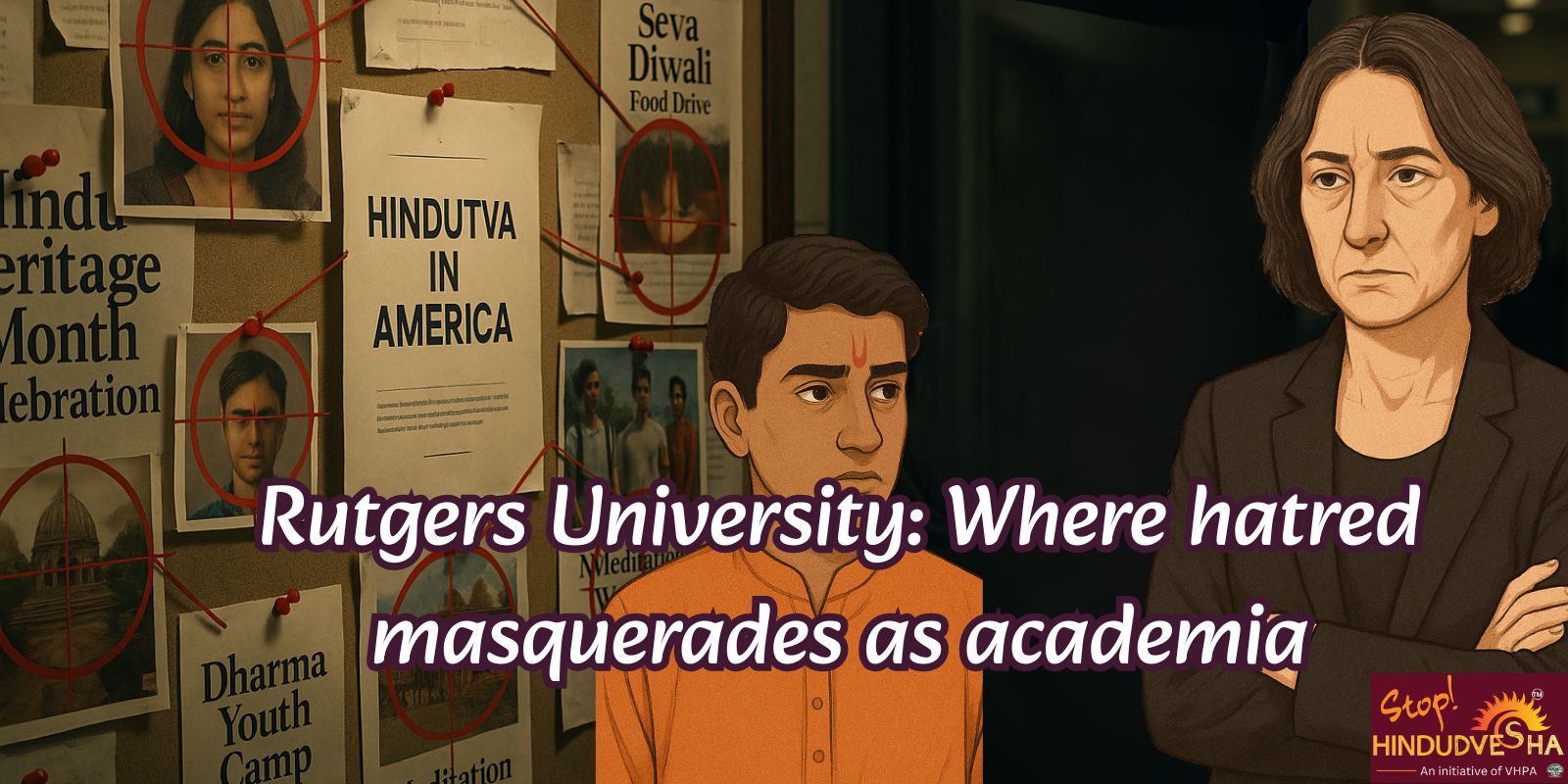
- The Rutgers University report “Hindutva in America” and its related panel are widely condemned as ideologically driven, labeling Hindu organizations as extremist and risking hostility against Hindu Americans under the guise of academic research.
- Critics point out factual errors, biased language, and a lack of community consultation, arguing that the report unfairly equates Hindu identity with nationalism while erasing the community’s civic, charitable, and interfaith contributions.
- The report’s recommendations—such as severing ties with Hindu groups and enforcing transparency mandates—are viewed as discriminatory, echoing historical patterns of exclusion against peaceful minorities.
- Hindu students already face harassment, misrepresentation, and administrative indifference on campuses; this report, featuring figures like Audrey Truschke and Sahar Aziz, may worsen such hostility amid existing antisemitic and anti-Hindu biases.
- Hindu organizations, such as AHAD and HinduPACT, have launched a counter-report using AI-based analysis to expose Rutgers’ distortions, urging federal oversight and the inclusion of Hindu scholars to uphold true pluralism and academic fairness.
On October 27, Rutgers University will host a panel discussion around its report titled “Hindutva in America: A Threat to Equality and Religious Pluralism.”[1] Far from being a neutral or academic exercise, the event and its accompanying report are drawing widespread criticism from Hindu communities across the United States, civil rights advocates, and interfaith leaders. Critics argue that this report — authored and platformed by a small but vocal group of Leftist activists — is an ideologically driven attempt to paint Hindus as a national security threat, undermining not only the rights of one of the most law-abiding immigrant groups in America, but also fracturing the very fabric of religious pluralism it claims to protect.
With baseless allegations, selective sourcing, and inflammatory rhetoric, the report, prepared by Rutgers’ Center for Security, Race and Rights (CSRR), poses a very real danger: it risks inciting religious violence, placing Hindu students on American campuses in harm’s way, and legitimizing Hinduphobia under the guise of academic freedom.
The Hindu American Foundation commented on X that, at the very moment that a city council member in Florida calls for the deportation of all Indians, a Texas senate candidate wants a Hanuman statue pulled down, and online anti-Hindu hate is ubiquitous, one would expect Rutgers to stand with Hindus in America. “Instead…more demonizing rhetoric targeting Hindus, fomenting a religious Hindu-Muslim conflict to further divide already marginalized immigrant communities.”[2]
Goebbelsian Claims and Flawed Premises
The “Hindutva in America” report tries to argue that Hindu American organizations operate as proxies of India’s Rashtriya Swayamsevak Sangh (RSS) and are working to undermine US values through Islamophobia, casteism, and anti-minority rhetoric. In words that would make the propagandist Joseph Goebbels proud, the report says: “American Hindu nationalists regularly attack religious and caste minorities within the South Asian American diaspora — including Muslims, Sikhs, Dalits, and Christians — seeking to undermine their views and influence. Hindu nationalists actively recruit among second-generation and third-generation Hindu Americans.”
It continues: “Hindu nationalists’ harmful tactics demonstrate an aversion to free speech and religious pluralism. American Hindu nationalists often use coercive strategies — including harassment and threats of violence — to insert their anti-Muslim and broader anti-pluralism viewpoints into American primary and secondary school curricula as well as higher education programming.”
But these claims are riddled with factual errors, a lack of evidence, and deep ideological bias:
- Guilt by Association: Hindu cultural groups, temples, youth camps, and interfaith outreach programs are branded as “fronts” for extremism simply because of perceived connections to Indian organizations. This is a classic example of guilt by association.
- No Community Input: Not a single major Hindu-American organization was consulted in the making of this report. The researchers never sought clarification or offered the opportunity for community input — violating basic standards of academic ethics and inclusion.
- Inflammatory Language: The repeated use of words like “fascist,” “supremacist,” and “extremist” shows a clear agenda. These terms aren’t used analytically — they’re weaponized.
- Misrepresentation of Facts: Hindu participation in conservative events or critique of radical Islamic groups is painted as Islamophobia. Criticism of Pakistan-based terror organizations is equated with anti-Muslim hate — a deeply flawed and dangerous conflation.
Erasing Hindu Civic Contributions: The report completely omits the positive contributions of Hindu organizations: disaster relief, interfaith work, education initiatives, anti-caste discrimination policies, and more. The narrative is not just biased — it is deliberately one-sided.
Manufactured Islamophobia and Khalistani Revisionism
One of the report’s central themes is that Hindutva groups have contributed to Islamophobia in the United States. It claims Hindu organizations rode the wave of post-9/11 Islamophobia to embed themselves in American conservatism. But this theory falls apart under scrutiny.
American Hindu organizations — like any other diaspora group — have legitimate concerns about radical extremism, both Islamic and otherwise. Speaking out against terrorism from Pakistan or highlighting atrocities like the Pahalgam massacre (where 26 Hindus were killed for their faith) is not Islamophobia. It’s truth-telling.
Worse, the report attempts to launder extremist ideologies like Khalistan as “victim movements.” It casts figures like Hardeep Singh Nijjar — a known Khalistani terrorist —as a “victim of transnational repression,” without addressing his past or the lack of evidence in Canada’s claims. This moral inversion is not only academically dishonest but also dangerous.[3]
Rutgers’ Agenda — Ghettoize Hindus
After labeling Hindus as intolerant and dangerous, Rutgers offers American policy makers five recommendations, which, if implemented, would turn Hindu Americans into virtual outcasts in their own country. The proposals, which sound eerily like Germany’s 1935 Nuremberg Laws that stripped Jews of their rights and demonized a law-abiding and peaceful community, are:
- Law enforcement, politicians, and civil society groups should cease partnerships with US-based Hindu nationalist groups.
- The US government should impose sanctions on or refuse entry into the United States to persons who facilitate or provide material support for anti-minority violence in India.
- US-based Hindu nationalist groups, particularly those registered as charities, must be fully transparent about their financial links abroad, including material support originating overseas, financial resources directed overseas, and ties to foreign governments.
- Federal authorities should ensure that US groups that act as proxies of India’s Rashtriya Swayamsevak Sangh and its affiliate organizations register under the Foreign Agents Registration Act.
- University administrations should educate themselves about the threats caused by Hindutva-inspired discrimination in the United States and protect professors, staff, and students within their universities from Hindu nationalist aggressions.
A Community Already Under Siege
The report lands at a time when Hinduphobia is not just theoretical — it’s happening and rising. The Hindu American Foundation, Coalition of Hindus of North America (CoHNA), and other advocacy groups have documented increasing anti-Hindu incidents in North America and Europe. These range from temple desecrations and social media harassment to physical assaults and academic discrimination.[4]
In 2023 alone, temples in New York, California, and Ontario were vandalized with anti-Hindu and pro-Khalistan graffiti. Hindu students have reported being ostracized in classrooms, told their religion is “violent,” and even asked to denounce Hindutva to participate in campus events.[5]
The Rutgers report will not help protect minority rights — it will worsen this environment by falsely implicating an entire community.
Painting a Target on Hindu Students
Through its Goebbelsian rhetoric, the report paints a target on the back of every Hindu American who engages in civic life, religious expression, or political advocacy. In an academic setting, where ideas and identity should be protected under First Amendment rights, Hindu students now find themselves labeled by association — with their heritage, with their religion, and with their values.
The risk is not theoretical. Hindu students across America have already reported threats, harassment, and bias, especially in the wake of growing anti-Hindu rhetoric on campuses.
A student‑led organization, Hindu on Campus (HOC), has launched a website to track and document over 100 incidents of anti‑Hindu or anti‑India bias at campuses across the US, UK, Canada, and Australia over the past few years. This effort aims to make data accessible for advocacy and awareness purposes.[6]
In April 2024, Congressman Shri Thanedar introduced a resolution in the US House of Representatives condemning “Hinduphobia, anti‑Hindu bigotry, hate, and intolerance.” The resolution states that Hindu Americans face stereotypes, disinformation, bullying in schools and colleges, and bias‑motivated crimes.[7]
Many Hindu students report being subject to stereotyping about their religious practices, symbols, and cultural background. This includes misrepresentations of Hinduism, being labeled “extremist” or “nationalist” simply for expressing Hindu identity, or facing jokes or disparaging remarks related to caste, gods, or religious festivals.
There are documented cases where Hindu student groups’ efforts to host cultural or religious events — or to have recognition of Hindu Heritage Month — are met with resistance or hostility. In some instances, student governance bodies or peer groups have challenged or opposed such recognition, accusing organizers of promoting a political ideology rather than religion or culture.[8]
Beyond interpersonal encounters, there have been complaints about administrative inaction or indifference when Hindu students bring up bias. Sometimes, there is a lack of cultural understanding of Hindu symbols (such as the tilak or traditional religious attire), dietary practices, or religious observances. In other cases, Hindu students feel their concerns are marginalized in diversity, equity, and inclusion (DEI) conversations.
In such a climate, Rutgers’ decision to host this panel with known anti-Hindu activists could fuel further hostility.
Who Are the Real Extremists?
One of the most troubling aspects of the Rutgers panel is the participation of Audrey Truschke, a controversial figure who has a history of incendiary remarks about Hinduism and Hindu deities. She has publicly referred to Lord Rama as “a misogynistic pig,” mischaracterized the Bhagavad Gita as endorsing “mass slaughter,” and claimed the epic Mahabharata promotes “rape culture.”[9]
Such statements would be unacceptable if said about any other religion’s prophets or texts — and rightfully so. Yet, in the case of Hinduism, these attacks are often defended under the shield of academic critique, ignoring the emotional, spiritual, and psychological impact on millions of practitioners.
Another panelist is Sahar Aziz, a professor of law at Rutgers Law School. Known for her trenchant hatred of Jews, she uses her law school position to legitimize antisemitic narratives and defend terrorist movements. On October 30, 2023, she posted on X that “the world would rather show solidarity with our corpses than honor our resistance” — a clear defense of Hamas’s October 7 massacre that claimed 1,200 lives in Israel. In the post, she shared an article featuring images of Hamas gunmen breaching Israel’s border. Earlier, in May 2021, she signed a Rutgers faculty letter defending the “Palestinian right to resistance,” implicitly endorsing Hamas rocket attacks on Israeli civilians.[10]
Moreover, CSRR — which produced this toxic report — is already under investigation by the Senate Judiciary GOP for promoting antisemitism.[11] Democratic Congressman Josh Gottheimer has also criticized the center for providing platforms to individuals connected to terrorist organizations like Al-Qaeda. The law firm of one of its sponsors has been linked to a pedophile arrested in Houston in 2024.
Shouldn’t an academic institution — particularly one in New Jersey, home to one of the largest Hindu-American populations — stand against bigotry, not platform it?
Countering the Narrative: A Hindu American Rebuttal
StopHindudvesha.Org has systematically dismantled the Rutgers report, exposing its sweeping distortions and dangerous implications. Citing over 50 sources and grounded in legal records, academic research, and historical evidence, the over 30-page rebuttal reveals how the original report weaponizes civil rights language to stigmatize Hindu identity, delegitimize Hindu-American institutions, and institutionalize Hinduphobia under the guise of scholarly inquiry.[12]
“This is not scholarship,” says Dr Jai Bansal, the Vice-President of Education for VHPA. “It is a calculated ideological offensive. Its aim is clear: to criminalize the public expression of Hindu identity, delegitimize Hindu civilizational frameworks, and brand American Hindu organizations — many engaged in education, service, and culture — as dangerous outposts of extremism. According to Dr. Bansal, the report is a form of narrative warfare. “The goal here is not dialogue — it is suppression. The message to Hindu Americans is chilling: stay silent, stay invisible, or risk being labeled a threat. Celebrate your heritage, and we will target your charities, question your loyalties, and criminalize your culture.”
American Hindus Against Defamation (AHAD) has also published a counter-document: “Hindutva and the American Dream: A Case for Inclusion and Representation.”[13] AHAD analysis shows that the Rutgers report has painted ordinary Hindu community activities, temple worship, youth camps, and charitable fundraising as sinister plots. Such framing is never applied to other religious communities. “This report recycles colonial-era stereotypes and applies cancel-culture tactics to erase Hindu voices from public life,” said Deepti Mahajan, President of HinduPACT.
Mahajan and her team used AI-driven analysis via artificial intelligence (AI) to expose the Rutgers document’s biases, factual errors, and ideological distortions. The AHAD report utilized Tattwa.AI’s HinduHate Detector and Counter-Narrative Generator, which employs a model based on over 150 books, peer-reviewed studies, investigative reports, and global media archives. The system dissects sentiment, bias, narrative manipulation, fact omission, and source bias with unprecedented precision. Key findings included:
- The term “Hindutva” was used pejoratively throughout, often as a stand-in for Hindu identity.
- Mainstream civic and religious activities were framed as threats to democracy.
- No evidence was provided for key claims about foreign influence or extremism.
- The report’s “Hinduphobia Risk Score” reached the maximum level, indicating serious potential for inciting hatred.
Ajay Shah, founder of HinduPACT, emphasized: “We’ve built AI that doesn’t just detect negative words – it unmasks systematic narrative distortion. This is about defending truth, not ideology, and holding academics accountable when they cross the line into discrimination.”
What Needs to Be Done
Rutgers’ decision to platform this kind of report raises serious questions. In a post on X, CoHNA commented: “Is Rutgers an academic institution or a platform to spew lies and hatred by agenda-driven activists? Does it care about the safety of its Hindu students and organizations? Would parents feel safe sending their kids to a university that endorses such activities against their religion and culture? Should taxpayers allow their funds to be used for bigotry and discrimination?“[14] AHAD and HinduPACT have called for a federal investigation into possible civil rights violations. Their demands include:
- Transparency in academic authorship and funding.
- Inclusion of Hindu scholars in curriculum development.
- DOJ investigations into anti-Hindu bias at academic centers.
- Sanctions on organizations with known extremist affiliations.
- Oversight to ensure religious minorities — all of them — are treated fairly.
Conclusion: Protecting Pluralism Means Protecting All Minorities
The Rutgers report fails not just in academic rigor, but in moral responsibility. At a time when Hindu Americans are increasingly under threat — from anti-Hindu hate crimes, digital abuse, and academic discrimination — it is irresponsible for a public university to lend credibility to an unbalanced, incendiary, and deeply flawed narrative.
Hindu Americans are doctors, engineers, public servants, students, and spiritual leaders.[15] They deserve respect, fairness, and safety — just like every other community. If academia truly values diversity, then it must stop treating Hindus as the exception to the rule.
Religious freedom is not selective. Discrimination cloaked in scholarship is still discrimination. And bigotry — whether against Jews, Muslims, or Hindus — must be challenged wherever it arises.
As CoHNA says, “Rutgers must be held accountable.”[16]
Citations
[1] Hindutva in America: A Threat to Equality and Religious Pluralism (Rutgers Law School – Center for Security, Race and Rights, 2025); https://csrr.rutgers.edu/newsroom/reports/
[2] Timing is everything. At the very moment that a city council member in Florida calls for deportation of all Indians, a Texas senate candidate wants a Hanuman murti pulled down & online anti-Hindu hate is ubiquitous. (Hindu American Foundation on X, October 2025); https://x.com/HinduAmerican/status/1974055377122832548
[3] ‘Nijjar ran terrorist training camps, visited Pakistan, and had contact with Khalistani terrorists’: Globe and Mail report shows how Canada protected a designated terrorist (OpIndia, June 2024); https://www.opindia.com/2024/06/nijjar-ran-terrorist-training-camps-visited-pakistan-contact-khalistani-terrorists-how-canada-protected-a-designated-terrorist/
[4] Caught in the Crossfire: How America’s Political Battlefield is Impacting Hindu Americans (Stop Hindudvesha.Org, February 2025); https://stophindudvesha.org/caught-in-the-crossfire-how-americas-political-battlefield-is-impacting-hindu-americans/
[5] Khalistani Movement Archives – Hindu Dvesha (StopHindudvesha.Org, a library of several articles on Khalistani movement); https://stophindudvesha.org/category/khalistani-movement/
[6] Website to track Hinduphobia launched on college campuses across US, UK, Canada, and Australia (The Times of India, May 2025); https://timesofindia.indiatimes.com/world/us/website-to-track-hinduphobia-launched-on-college-campuses-across-us-uk-canada-and-australia/articleshow/118699798.cms?utm_source=chatgpt.com
[7] ‘From facing stereotypes to bullying in schools and colleges’: Resolution in US Congress condemns Hinduphobia (Firstpost, April 2024); https://www.firstpost.com/world/from-facing-stereotypes-to-bullying-in-schools-and-colleges-resolution-in-us-congress-condemns-hinduphobia-13758848.html?utm_source=chatgpt.com
[8] Hindu students in US universities face hostility for supporting Hindu Heritage Month proclamation; labeled “Hindu nationalists” (Hinduphobia Tracker); https://www.hinduphobiatracker.org/app/case/ea34b7b?utm_source=chatgpt.com
[9] The Scholar Whom Audrey Truschke Cites Finds Her Tweet ‘Shocking’ (Swarajya, April 2018); https://swarajyamag.com/culture/the-scholar-whom-audrey-truschke-cites-finds-her-tweet-shocking
[10] Sahar Aziz Profile (Protect Our Campuses); https://protect-our-campus.com/profiles/sahar-aziz/?s=03
[11] Senate Judiciary Committee Republicans Probe Rutgers University Center that Promotes Terrorist Sympathizers and Anti-Semitism (US Senate Committee on Judiciary, February 2024); https://www.judiciary.senate.gov/press/rep/releases/senate-judiciary-committee-republicans-probe-rutgers-university-center-that-promotes-terrorist-sympathizers-and-anti-semitism
[12] A Hindu American Rebuttal to the Genocidal Subtext of Rutgers ‘Hindutva in America’ Report (StopHindudvesha.Org, June 2025); https://stophindudvesha.org/a-hindu-american-rebuttal-to-the-genocidal-subtext-of-rutgers-hindutva-in-america-report/
[13] HinduPACT AHAD Exposes Rutgers Report on Hindutva as Hinduphobic; Launches Sharp Rebuttal with “Hindutva in America: A Case for Inclusion and Representation” (Morningstar, August 2025); https://www.morningstar.com/news/pr-newswire/20250812ph49936/hindupact-ahad-exposes-rutgers-report-on-hindutva-as-hinduphobic-launches-sharp-rebuttal-with-hindutva-in-america-a-case-for-inclusion-and-representation
[14] So one must ask – Is @RutgersU an academic institution or a platform to spew lies and hatred by agenda-driven activists? (CoHNA on X, October 2025); https://x.com/CoHNAOfficial/status/1974621989105975445
[15] Social Realities of Indian Americans: Results From the 2020 Indian American Attitudes Survey (Carnegie Endowment for International Peace, June 2021); https://carnegieendowment.org/research/2021/06/social-realities-of-indian-americans-results-from-the-2020-indian-american-attitudes-survey?lang=en
[16] So one must ask – Is @RutgersU an academic institution or a platform to spew lies and hatred by agenda-driven activists? (CoHNA on X, October 2025); https://x.com/CoHNAOfficial/status/1974621989105975445

Donate to HINDUDVESHA
Our Mission is to explore and expose Hindudvesha through research analysis, education and response.
SUPPORT US