

New Faces in the White House, Same Old Policy Toward India
 Manoj Jwala · 07/12/2025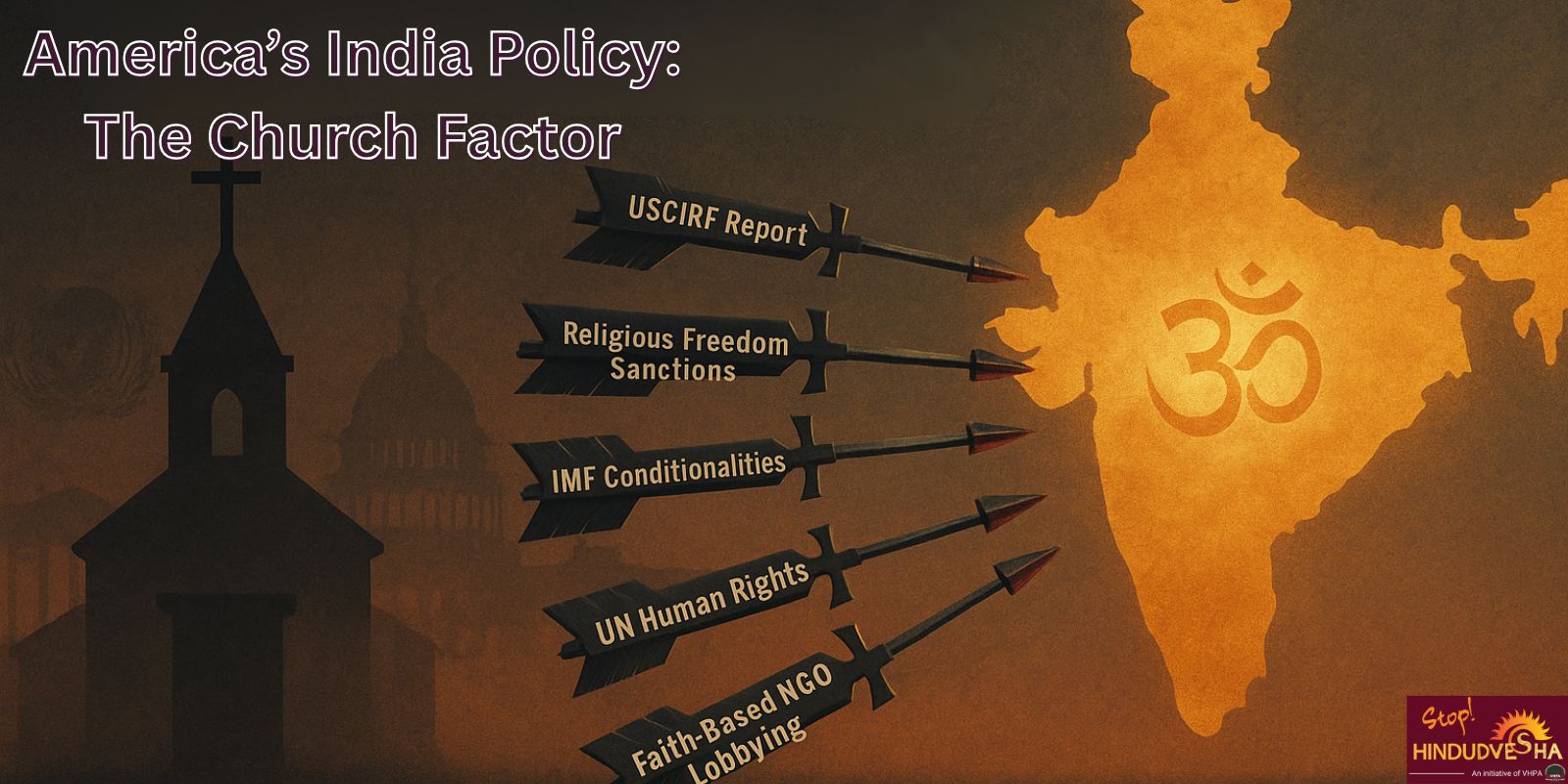
- American foreign policy is largely driven by Church-backed agendas, not just the President or political parties. Its core aim is the global expansion of Christianity.
- India stands as the biggest obstacle to this agenda, as it is a civilization rooted in Sanatan Dharma—an ancient tradition that presents a strong ideological challenge to the spread of Abrahamic religions.
- Church-supported organizations often portray India as “anti-minority” to tarnish its image on global platforms.
- Institutions like the IRFA and USCIRF regularly publish critical reports against India over its anti-conversion laws, yet remain silent on the systematic persecution and near-eradication of Hindus in Pakistan and Bangladesh.
America’s foreign policy is not merely a reflection of its President or ruling political party. In truth, it is deeply influenced by the Church’s global agenda to expand Christianity. India stands as the most significant obstacle to this mission, not because of politics, but because of its civilizational foundation rooted in Sanatan Dharma. Though India’s Constitution is officially secular, the nation’s cultural and spiritual soul remains non-Abrahamic, grounded in an ancient Dharmic worldview. This poses a serious ideological challenge to the expansion of Abrahamic religions like Christianity and Islam.
To achieve the goal of Christianizing India, this civilizational identity must be dismantled. That is why the Western world has consistently supported narratives that divide and fragment India, while extending political and strategic cover to breakaway regions like Pakistan.
This is not a partisan approach; it is a faith-driven strategy. And regardless of who occupies the White House, this policy remains constant.
This article offers a critical analysis of that underlying reality.
Illusion of Friendship
It was an interesting coincidence that Donald Trump became U.S. President around the same time that Narendra Modi took office as India’s Prime Minister. During their first terms, relations between the two countries grew stronger, marked by warmth and increased cooperation. But when Trump lost the next election and Joe Biden became President, that closeness appeared to weaken. A popular belief grew that if Trump returned to power, U.S.-India ties would improve again.
However, the opposite happened. After returning to the office, Trump began reshaping trade relations by imposing heavy tariffs[1] on several countries, including India. Immigration policies also became stricter, impacting Indians living in the U.S.
Meanwhile, during India’s bold counter-terror operation “Operation Sindoor” against Pakistan-sponsored terrorism, the U.S. gave India limited moral support. However, behind the scenes, the Trump administration helped Pakistan secure emergency financial aid from the IMF—something India had openly opposed. At the IMF meeting, India warned that this aid would end up funding Pakistan’s intelligence networks and terror groups like Lashkar-e-Taiba and Jaish-e-Mohammed. Still, Pakistan’s IMF bailout went through, thanks to the U.S.-backed support.
Shocking Global Support for Pakistan
Not long after, in a twist that would be laughable if it weren’t so alarming, Pakistan—the same nation notorious for harboring terrorists—was appointed Chair of the UN’s Taliban Sanctions Committee and Vice-Chair of its Counter-Terrorism Committee.[2] The irony was lost on no one, except perhaps those who orchestrated it. Such appointments don’t happen in a vacuum. Global bodies like the UN and IMF rarely move without a nudge—or a wink—from Washington.
Which begs the question: how did America’s stance shift so drastically under Donald Trump, a man once hailed as Prime Minister Modi’s staunch ally and a supposed friend of India? The answer lies not in the Oval Office, but deeper within the entrenched ideological lobbies, church-backed networks, and strategic establishments that quietly steer U.S. foreign policy. Presidents may come and go, but these shadow forces remain constant.
What’s worth noting is that nearly every U.S. president in history has, in some form, supported Christian evangelism and religious expansionism. For over a century, this religious agenda has significantly influenced American foreign policy, especially in how it views civilizational nations like India.
Evangelism in the Guise of Diplomacy
Leaders like Jimmy Carter and Bill Clinton are often portrayed as liberals, yet both were deeply committed members of the Southern Baptist Church. Even after taking office as U.S. Presidents, they actively supported Christian missionary efforts abroad.[3] This alignment with evangelical goals has become a consistent tradition, one that no American president has ever deviated from.
In today’s America, it has become almost essential for any mainstream political candidate to convincingly present themselves as a “true Christian,”[4] which is a euphemism for being dedicated to spreading Christianity worldwide. Many prominent U.S. lawmakers, as well as influential bureaucrats, have been members of a secretive evangelical network called “The Family.” This group has played a significant role in shaping American foreign policy for decades.[5] Indeed, there exist numerous hardline Christian organizations and ideological platforms in America that have had a direct influence on U.S. foreign policy.
How Missionary Lobbies Target India
One of the most prominent among these powerful institutions is the Policy Institute for Religion and State (PIFRAS). Firmly rooted in Christian expansionist doctrine, PIFRAS routinely advances narratives that stand in sharp contrast to the spiritual and philosophical foundations of Hindu Dharma.[6]
PIFRAS works in close coordination with several other influential Christian organizations in the U.S., including the United Methodist Board of Church and Society, the National Council of Churches of Christ in the USA, the Institute of Religion in Public Policy, the Ethics and Public Policy Center, and the Apostolic Commission for Ethics and Policy. These groups collaborate to construct a consistent image of India as an “anti-Christian” state. This manufactured perception is then leveraged to influence U.S. policymakers when forming foreign policy decisions toward India.
Another major player in this ecosystem is Freedom House, which also operates under the Center for Religious Freedom banner. Closely associated with it is the United Christian Forum for Human Rights. On the ground in India, organizations such as the All India Christian Council, the Indian Social Institute for Human Rights Documentation Center, and the All India Federation of Organizations for Democratic Rights serve as their local partners and information sources.
Together, this network produces and circulates fabricated or exaggerated reports on supposed human rights abuses and religious intolerance in India.[7] These documents are then fed into the U.S. foreign policy machinery, helping shape Washington’s stance on India through a distorted lens.
In addition, legacy institutions like the Asia Society and the Ford Foundation continue to actively participate in this campaign to tarnish India’s global image. Notably, the Ethics and Public Policy Center has long advocated for embedding Judeo-Christian moral frameworks into U.S. foreign policy. Many of its members have held senior positions in the U.S. government and at international bodies such as the United Nations. This very network has also played a role in lobbying for military aid to Pakistan, often at the expense of Indian strategic interests.[8]
A host of other organizations also contribute to this ideological push. These include World Vision, the Christian Community Development Association, the World Evangelical Alliance, the National Baptist Convention, the RAND Corporation, and Global Human Rights and International Operations.
Faith, Power, and Policy
The combined lobbying power of these groups became evident in 1998, when President Bill Clinton enacted the International Religious Freedom Act (IRFA).[9] Although framed as a global human rights initiative, IRFA primarily targets countries that restrict coercive or deceptive conversions to Christianity. It effectively gives the United States sweeping authority to interfere in the domestic affairs of nearly 194 sovereign nations under the pretext of protecting religious freedom.
In reality, the U.S. interpretation of “religious freedom” is narrowly defined—it equates to the unrestricted ability of Christian missionaries to proselytize and convert non-Christians. Any nation that seeks to regulate or curb such missionary activities is swiftly branded a violator of religious freedom, triggering diplomatic pressure and punitive responses from the U.S. government.
India has increasingly faced this backlash. Since the Modi administration began taking steps to curb illegal and coercive religious conversions, U.S. State Department reports—guided by the IRFA framework—have repeatedly criticized India for allegedly infringing on religious freedoms. These accusations are not incidental; they are systematically generated through a powerful three-pronged institutional apparatus:
- An Ambassador-at-Large for International Religious Freedom, who advises the State Department.
- The U.S. Commission on International Religious Freedom (USCIRF), which recommends actions to the President and Congress.
- A Special Adviser on Religious Freedom within the National Security Council.[10]
Together, these bodies form a strategic triad through which church-backed advocacy groups channel their influence into American foreign policy, especially against countries like India that challenge evangelical expansionism.
This influence extends further through the President’s Advisory Council on Faith-Based and Neighborhood Partnerships, a permanent advisory body to the White House. Established in 2001 by President George W. Bush, the council was later renamed and expanded by Barack Obama. During Donald Trump’s presidency, it operated first as the Center for Faith and Opportunity Initiatives and later as the White House Faith Office. Even the official USAID website confirms that “faith” in their programming context refers strictly to Christian and Jewish traditions, thereby excluding India’s indigenous religious systems.[11]
This council serves as the ideological compass for the U.S. President, acting as his eyes and ears on religious matters.[12] Most of its members are affiliated with powerful church missions and evangelical organizations, many of which are linked to Vatican influence or international missionary coalitions. Their mission is unambiguous: to weaken Hindu Dharma, divide Hindu society, and destabilize the Indian civilizational core. Their worldview is anchored in the “one God, one prophet” paradigm, which positions Sanatan Dharma—a pluralistic, non-Abrahamic tradition—as a fundamental obstacle.
When Barack Obama became President, there was initial hope that this evangelical stranglehold might loosen. Instead, he reinforced it by appointing Joshua DuBois, a key figure in the Christian voter mobilization campaign, as his senior advisor on religious affairs.
The harsh reality is that no American president—regardless of political leaning—has been able to resist the influence of this faith-driven council. Even so-called liberals like Jimmy Carter and Bill Clinton aligned with its agenda. It’s no surprise, then, that Donald Trump—despite his populist and outsider image—also followed the same path.
Why America Backs Pakistan Over India
Despite having suffered multiple attacks from Islamic terrorism, the United States has consistently shown remarkable leniency toward Pakistan, the very country that harbors and exports much of that terror. This paradox cannot be explained solely by geopolitics. The deeper reason lies in the shared religious and civilizational identity between the two: Pakistan is an Islamic republic, and the U.S. identifies itself as a Christian nation. Both are rooted in the Abrahamic tradition, whereas India, with its foundation in Sanatan Dharma, exists outside that framework and represents a fundamentally different worldview.
This civilizational divide has a significant impact on America’s foreign policy. Over the past several decades, Hindu populations in both Pakistan and Bangladesh have faced systemic persecution, state-sponsored violence, and demographic erasure. Yet, the U.S. has rarely raised serious objections, let alone initiated international pressure or sanctions.
In stark contrast, when India takes legitimate military action against jihadi terrorists in Kashmir, American officials frequently express concern over “human rights violations.” Under the IRFA framework, the U.S. State Department regularly accuses India of curbing religious freedom, often pointing to laws that restrict fraudulent religious conversions. These accusations are then echoed by the USCIRF, which often recommends placing India on watchlists or even imposing sanctions.
Meanwhile, the U.S. remains conspicuously silent on the openly anti-Hindu policies of Islamic regimes. A recent State Department report even placed India among the “countries of particular concern” for religious freedom, revealing how deeply American policy is entrenched in ideological networks tied to Christian missionary interests.
This bias is not an anomaly. It reflects a long-standing Abrahamic lens through which American policymakers assess civilizational nations like India. As a non-Abrahamic, dharmic civilization, India is treated with suspicion and subjected to disproportionate scrutiny. In contrast, Islamic states often receive diplomatic indulgence, even when they engage in acts of religious oppression or terrorism.
This civilizational lens also helps explain America’s persistent ambiguity on the Kashmir issue. To understand this, one must revisit the strategic calculations of the Anglo-American alliance during the Partition era. In 1947, British Viceroy Lord Mountbatten actively pressured the Maharaja of Kashmir to accede to Pakistan.[13] When those efforts failed, he encouraged Prime Minister Nehru to internationalize the dispute by referring it to the United Nations—a move that aligned with Western interests in preventing Kashmir’s full integration into the Indian Union.
With India’s revocation of Article 370 and full integration of Jammu & Kashmir, Pakistan has become even more vital to America’s regional calculus. That’s why, even amid repeated provocations, the U.S. continues to extend diplomatic and economic lifelines to Islamabad.
Conclusion: Rethinking India’s Foreign Policy
India’s policymakers must come to terms with the fact that U.S. foreign policy toward India is shaped more by enduring institutional priorities than by individual presidents. Among these is a strong alignment with religious and ideological frameworks that often do not resonate with India’s civilizational identity rooted in Sanatan Dharma.
Given this reality, India should consider shaping its foreign policy with greater awareness of its own cultural and spiritual foundations. Just as Western nations align their global outlook with their core values and strategic interests, India must also approach its engagement with the West through the lens of its civilizational heritage and national sovereignty. A principled, long-term strategy rooted in clarity and self-confidence will help safeguard India’s interests while fostering more balanced global relationships.
Citations
[1] Wikipedia, Tariffs in the second Trump administration; https://en.wikipedia.org/wiki/Tariffs_in_the_second_Trump_administration
[2] Dainik Bhaskar, आतंक फैलाने वाले पाकिस्तान को UNSC में बड़ी जिम्मेदारी:तालिबान प्रतिबंध कमेटी का अध्यक्ष बना, आतंक रोकने वाली समिति का उपाध्यक्ष भी बना; https://www.bhaskar.com/international/news/pakistan-unsc-taliban-sanctions-committee-2025-update-russia-135166862.html
[3] Malhotra, Rajiv, and Aravindan Neelakandan. Breaking India: Western Interventions in Dravidian and Dalit Faultlines. Amaryllis (Manjul Publishing House), 2011; (Hindi version, p. 243) .
[4] Malhotra, Rajiv, and Aravindan Neelakandan. Breaking India: Western Interventions in Dravidian and Dalit Faultlines. Amaryllis (Manjul Publishing House), 2011, (Hindi version, p. 243)
[5] Ibid, (Hindi version, p. 259)
[6] Ibid, (Hindi version, p. 261)
[7] Ibid, (Hindi version, p. 265)
[8] Ibid (Hindi version, p. 269)
[9] Ibid, (Hindi version, p. 296)
[10] Ibid (Hindi version, p. 296), and Wikipedia, International Religious Freedom Act of 1998; https://en.wikipedia.org/wiki/International_Religious_Freedom_Act_of_1998
[11] ibid, (Hindi version, p. 315)
[12] ibid, (Hindi version, p. 317)
[13] JK Now, माउंटबेटन नहीं चाहते थे जम्मू कश्मीर का भारत के साथ अधिमिलन, जानिए माउंटबेटन और महाराजा हरि सिंह का आपसी टकराव की पूरी कहानी; https://www.jammukashmirnow.com/hindi/Encyc/2019/6/19/why-Mountbatten-didn-t-want-accession-of-J-K-with-India-A-detailed-Answer-.html

Donate to HINDUDVESHA
Our Mission is to explore and expose Hindudvesha through research analysis, education and response.
SUPPORT US