

The Woke Pipeline to Jihad: Social Media’s Role in Radicalization
 Rati Agnihotri · 06/22/2025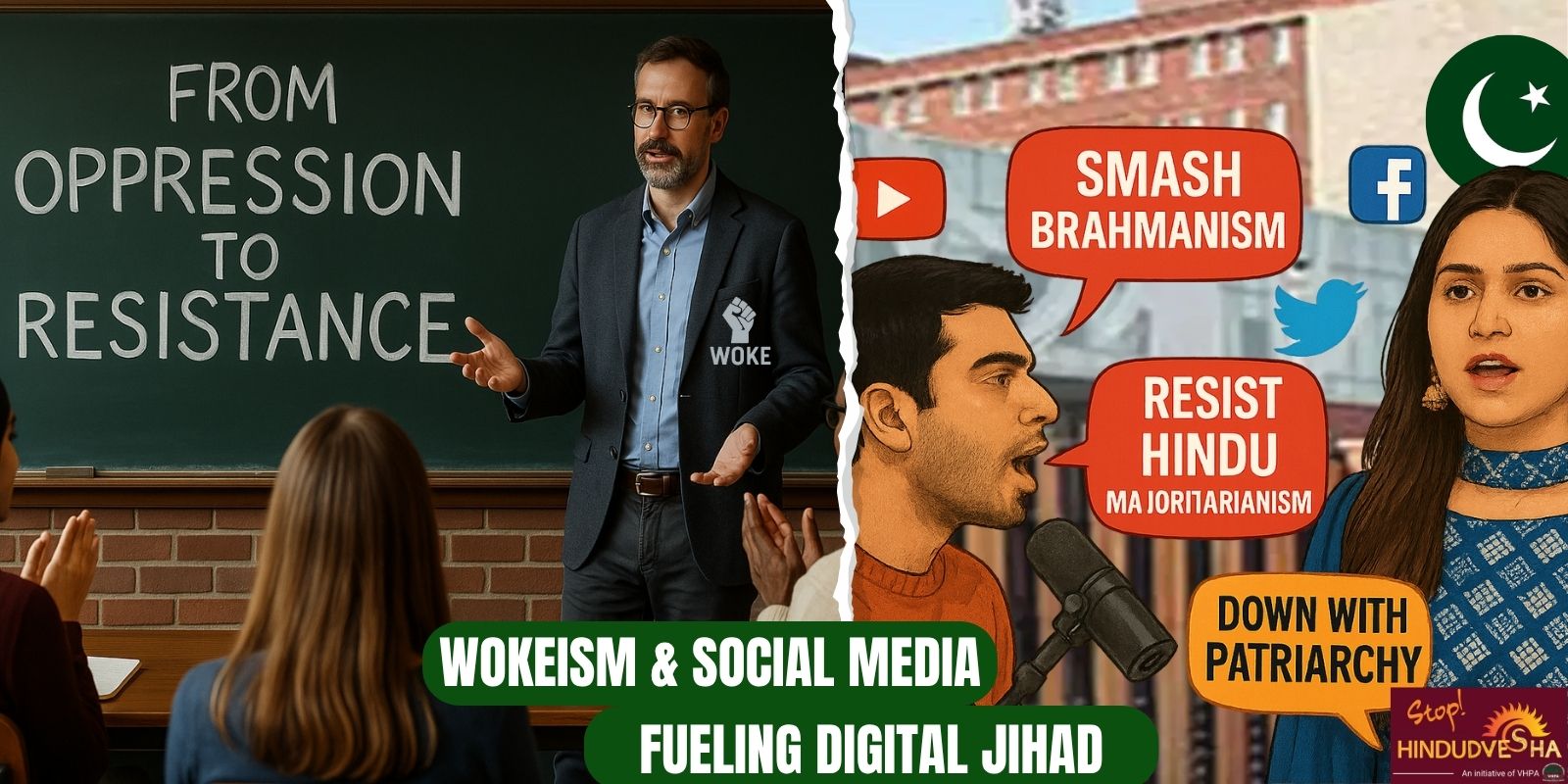
- The rise of wokeism has played a key role in legitimizing and spreading narratives that whitewash and promote radical Islamic extremism and terrorism. It has masked the brutality and fanaticism of religiously motivated violence by giving it a progressive facade.
- Social media, with its vast reach and immense power to influence public opinion, has become a major channel for spreading jihadist narratives — especially those enabled and amplified by woke ideology.
- The arrest of Indian travel influencer Jyoti Malhotra for allegedly spying for Pakistan has brought renewed attention to the growing issue of online radicalization in India, highlighting how social media can serve both as a facilitator and a cover for terrorist operations.
- The global threat of online radicalization is escalating, with the disturbing trend of “TikTok Jihad” gaining traction in Europe.
- Terrorist organizations are increasingly relying on AI tools to push jihadist propaganda. The widespread use of generative AI for producing and distributing mass content is aimed at normalizing and justifying extremist ideologies under the guise of legitimacy.
In the US, the Trump administration is relentlessly cracking down on campus antisemitism and dismantling a vast network of Hamas sympathizers and so-called “terrorism activists.” Meanwhile, in India, dozens of individuals across the country have been arrested[1] for alleged espionage linked to Pakistan, in the aftermath of Operation Sindoor following the Pahalgam attacks.
At first glance, these two events may appear unrelated. But a closer look reveals a common thread: the enabling of jihadist narratives. The normalization and spread of narratives that whitewash and promote radical Islamic extremism and terrorism are closely tied to the dramatic rise of wokeism. What emerges is a web of interlinked developments, driven by a dangerous blend of woke left-liberal rhetoric and propaganda pushed by the radical Islamist ecosystem.
Wokeism has made possible the once-unthinkable alliance between progressive liberals and radical extremists. It has served as a tool to rebrand the brutality and fanaticism of religiously driven terrorism in the language of “self-determination,” “justice,” and “autonomy.” In a disturbing yet predictable trend, sympathizing with — and even promoting — terrorism has been reframed as a virtuous act, casually lumped together with issues like climate change, gender rights, identity politics, and sexuality.
Social media, with its vast reach and powerful influence, has become the newest vehicle for spreading jihadist narratives under the guise of wokeism. Digital platforms and AI tools are now being used by terrorist organizations on an unprecedented global scale. On one front, these tools are being used to secretly recruit young people into the so-called “terror industry.” On another, social media is being weaponized as a soft-power propaganda machine to amplify jihadist messaging.
In the sections that follow, we explore the motivations and tactics behind using social media to spread jihadist narratives around the world. We also examine how wokeism has transformed social media into a powerful tool for radicalization.
Espionage in the Age of Influencers: A National Security Wake-Up Call
The debate around the dangers social media poses to national security has gained renewed urgency in India following the arrest of travel influencer Jyoti Malhotra for allegedly spying for Pakistan. The vlogger was recently arrested in Hisar, Haryana, for reportedly sharing sensitive Indian military information with Pakistan. The 33-year-old YouTuber is said to have come into contact with a now-expelled official from the Pakistan High Commission and to have visited Pakistan at least twice. Reports indicate that Malhotra confessed to passing anti-national information to Pakistani security and intelligence officials through platforms such as Snapchat, Telegram, and WhatsApp. [2]
Media reports further suggest that Malhotra was fully aware that she was interacting with members of Pakistan’s Inter-Services Intelligence (ISI). Data retrieved from three of her mobile phones reportedly contains call logs, chat transcripts, financial records, and video evidence linking her to four Pakistani operatives. She has been charged under the Bharatiya Nyaya Sanhita and the Official Secrets Act for compromising India’s unity, integrity, and sovereignty.[3]
Malhotra’s ties with Pakistan may only be the tip of the iceberg. Evidence is now surfacing of her possible connections to China and Bangladesh as well. In addition to traveling to Pakistan and China, Malhotra reportedly applied for a visa to Bangladesh. Authorities claim to have accessed her visa application submitted to the Bangladesh High Commission. While the exact date is unclear, media sources suggest that the form may have been filled out recently, possibly after the April 22 Pahalgam terror attack.[4]
Interestingly, Malhotra had also visited Pahalgam in January 2025—just three months before the attack. Connecting the emerging pieces of evidence, former Jammu and Kashmir Director General of Police (DGP) Shesh Paul Vaid posted on X:
“Is it a coincidence that u tuber Jyoti Malhotra who was honey trapped by Danish, a Pakistani High Commission employee ( most probably ISI person) visited Pahalgam in January 2025? She was reportedly passing on sensitive information to ISI handlers. Our intelligence services normally keep under surveillance those frequently visiting the countries or High Commissions of enemy nations like Pakistan, China, and now Bangladesh”.[5]
As the investigation unfolds, what becomes evident is the alarming role of social media as both a facilitator and cover for subversive activity. Authorities are exploring the possibility that Malhotra’s YouTube channel may have served as a front for anti-India operations. While she wouldn’t have access to classified military intelligence as a civilian, her extensive travel across sensitive and remote areas in India could have allowed her to relay useful strategic information to foreign handlers.
Influencers like Malhotra can be easily exploited by hostile intelligence agencies to conduct reconnaissance of potential targets. From this perspective, it is deeply concerning that she visited multiple high-security religious sites across India, including the Shree Jagannath Temple in Puri, the Mahakaleshwar Temple in Ujjain, the Golden Temple in Amritsar, and the Maha Kumbh. [6] [7]
The Jyoti Malhotra case highlights the very real risk of social media being used as a smokescreen for terrorist planning, potentially on a scale larger than previously imagined. Apart from Malhotra, at least 11 others have been arrested in the ongoing Pakistan-linked espionage investigation. A close look at the information passed by the accused indicates that social media is increasingly being leveraged by foreign intelligence to recruit local operatives across North India.
25-year-old Devender Singh from Kaithal, Haryana, was arrested for allegedly posting photos with weapons on social media. Reports suggest that he came into contact with Pakistani intelligence operatives during a pilgrimage in 2024 and continued communication with them thereafter. He is also accused of photographing a cantonment area from the outside and sharing the images. Another individual, Armaan, from Nuh in Haryana, allegedly passed on information related to military activities to Pakistan through an employee posted at the Pakistan High Commission in Delhi. Media reports indicate that the accused had been using platforms like WhatsApp for some time to transmit sensitive information. [8]
How Wokeism Is Grooming India’s Youth for Radical Agendas
What stands out in these cases is that most Indians arrested for allegedly spying for Pakistani authorities are young adults in their 20s and 30s. Beyond the lure of quick money, one must ask — what makes the youth so vulnerable to radicalization?
At the core lies the ideology of wokeism, which normalizes, rationalizes, and in many cases even glamorizes terror-sympathizing and terror-mongering. This is done through multiple influential avenues — academia, think tanks, media, pop culture, and especially social media.
Social media has become the primary space where these dangerous narratives filter down to the masses, ultimately leading to widespread psychological manipulation and ideological brainwashing.
These narratives are one of the main reasons why many Indian students at Ivy League universities go out of their way to whitewash the activities of Hamas while demonizing Israel, even at the risk of damaging their own academic and professional futures. Social media sets the tone for woke Indians calling for boycotts of Israeli companies and institutions, all while conveniently ignoring rising antisemitism and the relentless violence inflicted on Jews by terror groups like Hamas.
In Snakes in the Ganga: Breaking India 2.0, authors Rajiv Malhotra and Vijaya Viswanathan expose how elite Western universities serve as breeding grounds for “Breaking India” forces. The book also critiques how elite Indian institutions have blindly imported the American brand of wokeism, particularly through academia. The authors argue that education and research in the humanities and social sciences have become channels for soft propaganda targeting India and Hindus.
A chapter titled Ashoka University: Harvard University’s Junior Partner presents detailed examples showing how many faculty members at Ashoka University pursue research and academic interests that could be harmful to India’s national security, sovereignty, and unity. The chapter provides evidence of how even a former Vice-Chancellor routinely glorified anti-national activities, denied the existence of Hinduphobia by calling it a “Hindu persecution complex,” and praised secessionist movements in Kashmir as well as Maoist insurgencies against the Indian state. [9]
Wokeism brought in through academia lays the ideological groundwork for radicalizing youth, which then spreads across society via social media. Terror networks and their backers exploit this digital media ecosystem to prey on emotionally vulnerable individuals.
According to a report by ETV Bharat, Indian investigators have uncovered a new modus operandi used by terrorist organizations to radicalize youth via social media. Security agencies have termed this the “magic lantern tactic.” The strategy involves handlers posting provocative content on various platforms and closely monitoring user responses. Individuals who react with emotional support or intense passion are identified and targeted for further engagement through personalized, manipulative messaging. [10]
Social Media as Gateway to Terrorism
The threat of online radicalization is becoming a major concern not only in India but across the world. An article by Ynet News[11] highlights the alarming phenomenon of TikTok Jihad making inroads into Europe. The piece cites the 2024 arrest of two teenagers in Austria who pledged allegiance to the Islamic State and had planned a terror attack at a Taylor Swift concert in Vienna. Although the attack was foiled, the fact that Austrian teenagers were involved in planning such a complex and dangerous assault on a concert attended by tens of thousands of people raised serious concerns about the growing menace of online radicalization in Europe.
Social media platforms — especially TikTok — are increasingly being used to recruit young individuals into radical Islamist ideologies — a trend that has fueled a resurgence of jihadist attacks across Europe, with at least six terror attacks in 2024 alone, and “over 20 planned attacks foiled by security and intelligence services”. [12]
The rise in online radicalization has also led to a sharp increase in “lone wolf” attacks in Western democracies. These attacks are typically carried out by radicalized individuals acting independently, without direct operational involvement from an organized terror outfit. Lone wolf attacks are particularly difficult to detect, as the perpetrators often do not fit traditional profiling patterns.
A study by the Institute for Economics and Peace reveals alarming statistics about the rise of lone wolf attacks in the West. According to the study, 93 percent of fatal terrorist attacks in Western countries over the last five years were carried out by lone actors. In 2024, teenagers were involved in nearly two-thirds of ISIS-linked arrests in Europe. The study also reveals a disturbing trend regarding the transition from exposure to radical content to direct violent action: while in 2002, it took an average of 16 months from initial exposure to execution of an attack, by 2015, this period had decreased by over 40 percent.[13]
Commenting on the psychological makeup of lone wolf attackers, the report notes: “Lone wolves blend religious, political and conspirational ideas from multiple sources to create personal narratives that defy conventional labels”.[14]
A study published by the European Foundation for South Asian Studies analyzes the online propaganda and recruitment strategies used by terror groups such as Al-Qaeda, Taliban, ISIS, and Lashkar-e-Taiba. It illustrates how the digital media revolution has dramatically altered the recruitment and expansion models of these outfits. The proliferation of online platforms has made it significantly easier for terrorist organizations to spread extremist ideology rapidly and identify individuals who can be groomed into recruits. [15]
In India, online radicalization poses a serious threat to the country’s unity and pluralistic fabric. Tactics employed in the Indian context often involve the targeted radicalization of Muslim youth. The woke ecosystem plays a central role in this process by consistently spreading narratives of “minority oppression” under India’s so-called “Hindu majoritarian” government. These narratives create a breeding ground for resentment and disaffection among vulnerable Muslim youth, making them prime targets for radicalization through various digital channels.
The explosion of digital platforms has provided terrorist groups with an efficient means to radicalize large numbers of people and scout for recruits. These groups further exploit the vulnerabilities of economically and socially disadvantaged Indian Muslim youth by targeting those at the lowest rungs of society.
Moreover, social media algorithms inadvertently accelerate the radicalization process by amplifying extremist content. These algorithms prioritize clickbait, trending topics, and polarizing hashtags — often without regard for national security or social harmony. As a result, they end up magnifying divisive content and creating an environment ripe for radical influence.[16]
How Digital Media and AI Power Extremism
Media thrives on bizarre stories packed with dramatic tension. Add a dose of shock, and you’ve got the perfect recipe for high TRPs and viral social media content. The story becomes even more gripping when digital media itself becomes part of the plot.
All these elements came together in the infamous Seema Haider case — a 30-year-old married Pakistani woman who illegally entered India with her four children via Nepal in May 2023 to live with her 22-year-old love interest, Sachin Meena, whom she had apparently met through the online game PUBG. Since her illegal entry into India, Haider has been under the scanner of the Intelligence Bureau (IB) and Anti-Terrorism Squad (ATS) for possible links with the Pakistani army and ISI. According to media reports, she had reportedly been in contact with several other individuals in India through PUBG, besides Sachin. [17]
Seema Haider married Sachin Meena in a public ceremony and continues to live in India. Despite ample evidence suggesting her potential role as a spy for Pakistan’s military and intelligence services, Indian media have turned her story into a melodramatic soap opera, calling her “India’s daughter-in-law” [18] and more.
Haider — or perhaps her handlers — appear to have exploited the situation fully by training her thoroughly in the mannerisms of a married Hindu woman from western Uttar Pradesh, as experts have pointed out. Experts further suggest there is concrete evidence indicating that Seema was trained by Pakistani handlers in Nepal before being sent to India. [19]
Her case brings to light the broader issue of how online gaming is being exploited by terrorist organizations. Concerns about the misuse of online gaming by extremists first gained traction during the COVID-19 pandemic, which saw a massive boom in digital media usage. A report by the Observer Research Foundation highlights the darker side of online gaming. It states that a common tactic employed by terror groups is to modify in-game assets such as environments, characters, or storylines to reflect extremist ideologies. A notable example is the game Call of Duty, which has reportedly been altered by Islamic State to normalize radical ideas. The article also highlights how such games are used as virtual training grounds, allowing extremists to simulate coordinated attacks or rehearse combat tactics. In addition, there is evidence that in-game currency systems are being exploited for money laundering and fraudulent financial transactions. [20]
The use of AI tools to propagate jihadist narratives is also becoming increasingly common. The widespread availability of generative AI in recent years has significantly accelerated this trend. Terrorist groups are using AI not only to produce visually appealing propaganda but also to streamline their operations. A report by the Global Network on Extremism & Technology explores AI-driven strategies employed by Hamas and affiliates of Al-Qaeda and ISIS to promote jihadist narratives. Case studies show how these groups use generative AI to distort authentic media narratives and flood digital platforms with fake content. The report also describes the use of audio deepfakes, where well-known characters like SpongeBob SquarePants, Rick Sanchez, and YouTubers such as PewDiePie and MrBeast are made to “sing” battle nasheeds — Islamic war chants traditionally used to inspire fighters. [21]
While the dark web and unregulated platforms like Telegram are commonly used to spread more explicit jihadist propaganda, mainstream social media platforms like Facebook, X, and Instagram are co-opted for “soft propaganda.” This soft propaganda is often pushed by woke influencers who, knowingly or unknowingly, work in tandem with the jihadist ecosystem to whitewash radical Islamic extremism and terrorism. For most young people, exposure to these soft narratives on popular platforms serves as their first contact with jihadist ideology.
Wrapping Up
The growing use of social media by terrorist organizations — and by various actors within the broader woke ecosystem — to spread jihadist narratives poses a serious and multidimensional threat. By leveraging AI and digital technologies, terror outfits have effectively erased geographic boundaries when it comes to recruitment and radicalization. In today’s hyper-connected world, almost anyone is vulnerable.
The woke ecosystem quietly creates a fertile environment for radical ideology to spread through various channels — academia, media, think tanks, social media, and popular culture. The global homogenization of wokeism under the guise of globalization has further weakened people’s defenses, making individuals around the world even more susceptible to radical jihadist brainwashing.
Citations
[1] Pakistan Spy Arrests: 12 Held in Punjab, Haryana, UP Over Espionage Network – Delhi News – Times of India; https://timesofindia.indiatimes.com/city/delhi/youtuber-trader-student-security-guard-12-isi-linked-spies-held-from-punjab-haryana-and-up-come-from-all-walks-of-life/articleshow/121280413.cms
[2] Jyoti Malhotra, Jyoti Rani, Travel With Jo, YouTuber, India, Pakistan, Operation Sindoor: Travel Vlogger Who Visited Pak Twice, Arrested for Spying; https://www.ndtv.com/india-news/jyoti-malhotra-jyoti-rani-travel-with-jo-youtuber-india-pakistan-operation-sindoor-travel-vlogger-who-visited-pak-twice-arrested-for-spying-in-haryana-8438001
[3] YouTuber Jyoti Malhotra was aware her Pakistani friends were ISI operatives, says police | Latest News India–- Hindustan Times; https://www.hindustantimes.com/india-news/youtuber-jyoti-malhotra-was-aware-her-pakistani-friends-were-isi-operatives-says-police-101748347423899.html
[4] Pakistani ‘Spy’ Jyoti Malhotra’s China Visit, Bangladesh Application Under Scanner: What Was Her Plan? | Republic World; https://www.republicworld.com/india/pakistani-spy-jyoti-malhotra-s-china-visit-bangladesh-application-under-scanner-what-was-her-plan
[5] Shesh Paul Vaid on X; https://x.com/spvaid/status/1924038591799586877?ref_src=twsrc%5Etfw%7Ctwcamp%5Etweetembed%7Ctwterm%5E1924038591799586877%7Ctwgr%5Eb82698f48afca52b364f49dd67d3d13d7f2449af%7Ctwcon%5Es1_&ref_url=https%3A%2F%2Fwww.moneycontrol.com%2Fcity%2Fpak-spy-youtuber-jyoti-malhotra-s-pahalgam-trip-before-terror-attack-under-scanner-article-13031035.html
[6] YouTuber Jyoti Malhotra questioned over temple visits amid espionage allegations – India News | The Financial Express; https://www.financialexpress.com/india-news/youtuber-jyoti-malhotra-questioned-over-temple-visits-amid-espionage-allegations/3856039/
[7] Maha Kumbh to Golden Temple: Jyoti Malhotra visited over 10 key religious sites across India| Was it a recce for Pakistan? https://www.wionews.com/india-news/maha-kumbh-to-golden-temple-spy-jyoti-malhotra-visited-over-10-key-religious-sites-across-india-a-recce-for-pakistan-1747741103889
[8] YouTuber Jyoti Malhotra, 11 others arrested so far in Pakistan ‘spy’ probe | What we know | Latest News India – Hindustan Times; https://www.hindustantimes.com/india-news/youtuber-jyoti-malhotra-11-others-arrested-so-far-in-pakistan-spy-probe-what-we-know-101747671321068.html
[9] Ashoka University: Harvard University’s Junior Partner. p.p 517-559.
[10] Terror Outfits Resort To ‘Magic Lantern Tactic’ To Target Youth On Social Media; https://www.etvbharat.com/en/!bharat/terror-outfits-resort-to-magic-lantern-tactic-to-target-youth-on-social-media-enn25052102366
[11] TikTok jihad: Online radicalization threat looms over Europe; https://www.ynetnews.com/article/rjgiduh9c
[12] Ibid.
[13] Lone Wolf and Youth Terrorism by Institute for Economics & Peace; https://www.economicsandpeace.org/wp-content/uploads/2025/03/Lone-Wolf-and-Youth-Terrorism.pdf
[14] Ibid.
[15] Social Media Strategies and Online Narratives of Terrorist Organizations; Case studies of Al-Qaeda, ISIS, Taliban and Lashkar – e- Taiba:: EFSAS; https://www.efsas.org/publications/study-papers/social-media-strategies-online-narratives-of-terrorists-groups-al-qaeda-isis-taliban-lashkar/
[16] From clicks to chaos: How social media algorithms amplify extremism; https://www.orfonline.org/expert-speak/from-clicks-to-chaos-how-social-media-algorithms-amplify-extremism
[17] Seema Haider’s Pakistan Army, ISI link mystery deepens: Multiple PUBG contacts, fluent English – India Today; https://www.indiatoday.in/india/story/seema-haider-sachin-meena-pakistan-army-isi-woman-pubg-love-story-uttar-pradesh-ats-questioning-illegal-entry-india-spy-2408234-2023-07-18
[18] ‘Seema Haider should be shown empathy as she’s India’s daughter-in-law’ | Noida News – Times of India;https://timesofindia.indiatimes.com/city/noida/seema-haider-should-be-shown-empathy-as-shes-indias-daughter-in-law/articleshow/120781829.cms
[19] (45) Passports, Mobiles, Fake ID. What Was Seema’s Mission? | THE CHANAKYA DIALOGUES | Major Gaurva Arya – YouTube; https://www.youtube.com/watch?v=0DQNxolgLIM
[20] Gaming platforms: A new frontier for extremist recruitment and radicalisation; https://www.orfonline.org/expert-speak/gaming-platforms-a-new-frontier-for-extremist-recruitment-and-radicalisation
[21] AI Jihad: Deciphering Hamas, Al-Qaeda and Islamic State’s Generative AI Digital Arsenal – GNET; https://gnet-research.org/2024/02/19/ai-jihad-deciphering-hamas-al-qaeda-and-islamic-states-generative-ai-digital-arsenal/

Donate to HINDUDVESHA
Our Mission is to explore and expose Hindudvesha through research analysis, education and response.
SUPPORT US