
The Theft of Yoga: How the West Embraced the Postures, but Erased the Spirit
 Aditi Joshi · 07/26/2025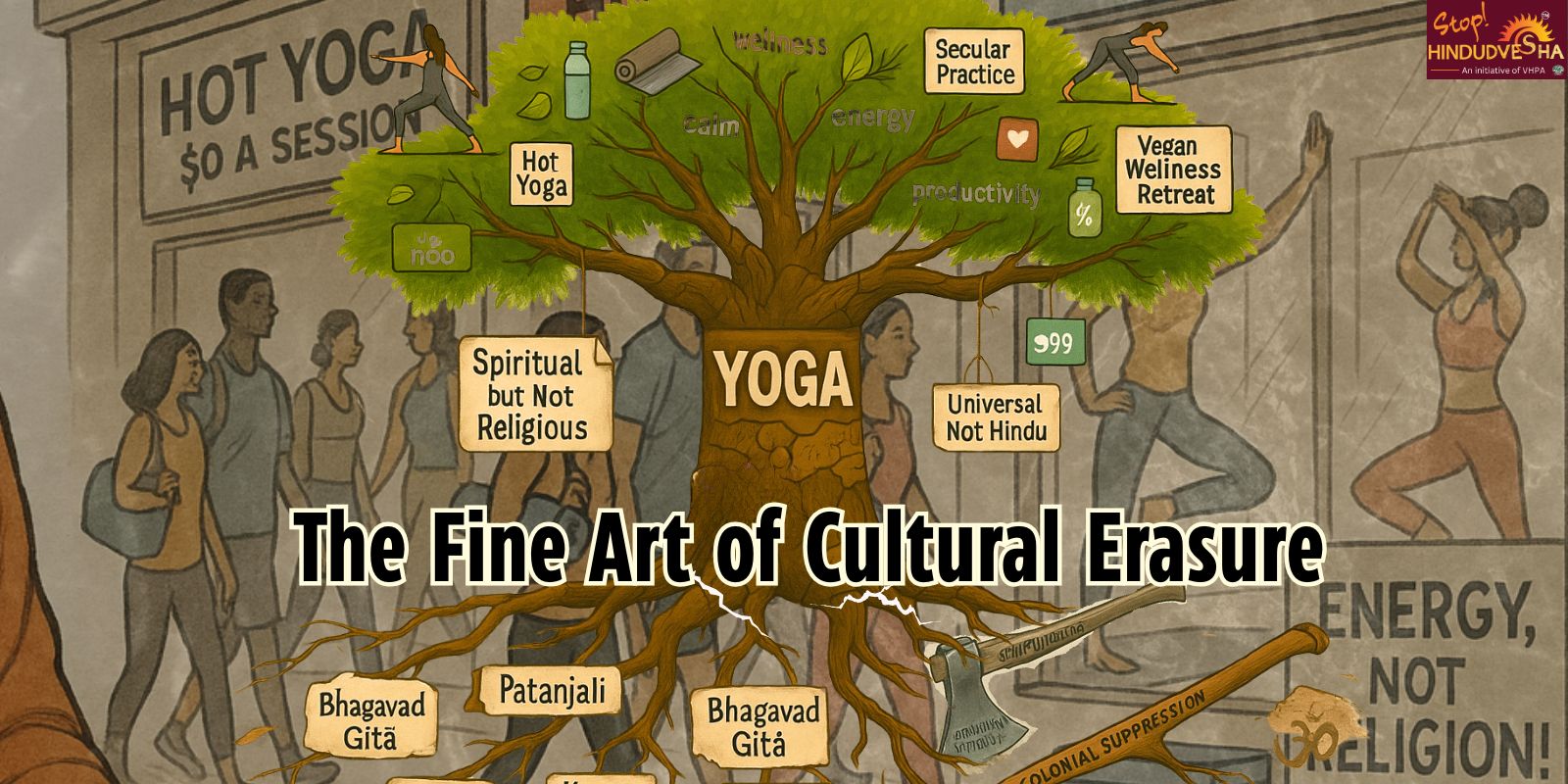
- Yoga, fundamentally a spiritual discipline, is deeply rooted in Hinduism, aiming for liberation (moksha) beyond mere physical fitness.
- Despite its global popularity, Yoga’s Hindu origins are often diluted or ignored, leading to a disconnect between its widespread practice and its true heritage.
- The separation of Yoga from Hinduism is a form of civilizational injustice, stemming from colonial narratives and a reluctance to acknowledge Hinduism’s spiritual depth.
- The notion that “Hindus abandoned Yoga” is a misconception, as Indian revivalists played a crucial role in its preservation and reintroduction after colonial suppression.
- Erasing Yoga’s Hindu roots results in spiritual theft and economic imbalance, underscoring the vital need to honor its origins for true civilizational integrity.
Today, Yoga is a global phenomenon. From luxury lofts in New York to serene rooftops in New Delhi, it is hailed as a universal path to wellness and inner peace. But beneath the calm chants and flowing postures of global yoga studios lies a quiet yet profound act of civilizational erasure. As the world bends and bows in āsana, it often turns its back on the very tradition that birthed it. The sacred Hindu origins of Yoga—rooted in millennia of spiritual discipline, metaphysics, and dharmic philosophy—are routinely erased, diluted, or rebranded to fit Western sensibilities. Stripped of its Sanskrit vocabulary, Hindu symbols, and metaphysical core, Yoga is sold as a secular wellness trend. Studios chant “OM” without acknowledging its Vedic origin; teachers praise “mindfulness” while avoiding the word “Hinduism.” [1] In doing so, the world consumes the fruit while denying the tree that bore it, raising the troubling question: How is it that the world so eagerly embraces Yoga, yet marginalizes, distorts, or even demonizes Hinduism, the very soul of this ancient practice?[2]
This erasure is not innocent. It reflects a colonial hangover, a continuation of orientalist narratives that viewed Hinduism as exotic, irrational, or regressive, even while plundering its knowledge systems. It also reflects a discomfort in the West, and among Westernized elites in India, with acknowledging the spiritual legitimacy and philosophical depth of Hindu dharma.
What Is Yoga?
Yoga is not just a health regimen or a trendy lifestyle accessory; it is a profound spiritual science that emerges from the heart of Sanātana Dharma, the eternal tradition commonly known as Hinduism. The word Yoga itself is derived from the Sanskrit root yuj, which means “to yoke” or “to unite,” signifying the sacred merging of the individual soul (ātman) with the Supreme Consciousness (Brahman), the ultimate reality that underlies all existence. Far from being a collection of physical exercises, Yoga is one of the six orthodox philosophical systems (ṣaḍ-darśanas) of Hindu thought. It offers a roadmap for human liberation, moksha, a means to transcend suffering, ignorance, and ego, and to realize one’s true nature. Yoga in its fullest sense is both a discipline and a worldview, encompassing ethical conduct, mental purification, spiritual insight, and divine communion.[3]
Sanātana Dharma presents four primary paths of Yoga, each catering to different temperaments and inclinations:
- Bhakti Yoga – the path of devotion, where love for the Divine becomes the means to union;
- Karma Yoga – the path of selfless action, in which duty is performed without attachment to results;
- Rāja Yoga – the path of meditation and inner mastery, systematized by Sage Patanjali in the Yoga Sūtras, guiding the practitioner through eight limbs (aṣṭāṅga yoga) from ethical foundations to samādhi, or spiritual absorption;
- Jñāna Yoga – the path of knowledge and discernment, found especially in the Upaniṣads, where inquiry into the nature of the self leads to the realization of the non-dual Brahman.
These are not mutually exclusive silos, but interconnected streams flowing toward the same ocean of truth. The Bhagavad Gītā, a core Hindu scripture, weaves these Yogas together, illustrating that the spiritual journey can be as dynamic and diverse as life itself.
In the Hindu tradition, Yoga is never separated from its metaphysical roots.[4] It is not aimed merely at wellness, flexibility, or mental calm, but at liberation. It is a sādhanā, a sacred discipline, grounded in a vision of the cosmos where every being is inherently divine and capable of awakening to that truth.
To understand Yoga without its Hindu roots is to see only the surface of a vast ocean. What the modern world calls “Yoga” is often just āsana, the physical postures, which form only one small part of a much larger spiritual edifice. Without the context of dharma, karma, ātman, and moksha, Yoga loses its essence and becomes unmoored from its civilizational purpose.
Hijacking of Yoga
Yoga’s journey to the West began on a spiritual note, with profound intent and philosophical depth. Pioneers like Swami Vivekananda, who addressed the World’s Parliament of Religions in 1893, introduced Yoga as a spiritual science rooted in the Vedanta tradition, aiming to awaken the inner divinity in all beings. His message was one of unity, discipline, and self-realization. But as Yoga crossed continents and entered the Western mainstream, its soul was slowly stripped away, leaving behind a shell of postures, playlists, and profit.
Today, what passes off as “Yoga” is a watered-down version, dominated by āsana (physical postures), peppered with feel-good affirmations, and scrubbed clean of its Hindu origins. Spiritual concepts such as mokṣa (liberation), karma (action and consequence), murti (sacred icon), and even the sacred sound ōm are often omitted or replaced with vague, sanitized substitutes like “energy,” “intention,” or “the universe.” What was once a path to transcendence has been repackaged as an exotic fitness routine.
Consider the approach of organizations like Yoga Alliance, one of the largest certifying bodies for Yoga instructors in the West. Their guidelines promote a deliberately “secular” framework, often discouraging the use of murtis (sacred images), downplaying the role of Sanskrit, and avoiding explicit references to Hindu philosophy. Meanwhile, Western brands and influencers freely market the aesthetics of Yoga—its calming vibe, exotic appeal, and flexible poses—without acknowledging the tradition that gave rise to it. Designer mats and yoga pants are everywhere, but Patanjali, Krishna, Shiva, and the Bhagavad Gītā are conspicuously absent. What we are witnessing is not respectful adaptation, but cultural cherry-picking—spiritual symbols and practices stripped of their roots and repackaged for global consumption.[5]
This isn’t mere appropriation—it’s civilizational theft. The West extracts Yoga’s wisdom while erasing its Hindu roots, repeating colonial patterns. Concepts like mindfulness and self-realization stem from Sanātana Dharma, not a cultural vacuum. To truly honor Yoga, its source must be acknowledged.
Why Is Hinduism Deliberately Detached from Yoga?
The global sanitization of Yoga, its decoupling from Hinduism, is not an accidental oversight. It is the outcome of deep-rooted discomfort, colonial distortion, and postcolonial amnesia. Western unease with murti-centric, devotional spirituality is one factor. But the roots of this deracination go much deeper, into the soil of colonial history and cultural erasure.
During British rule, Hinduism was reframed not as a rich philosophical tradition but as a chaotic jumble of idol worship, mysticism, and irrationality. Yogis were among the primary targets of this distortion. Far from being revered seekers of truth, they were vilified as “devil worshippers,” “charlatans,” and “begging sadhus” who wandered naked or performed frightening feats. Haṭha Yoga, which had long flourished in temples, akharas, and forest hermitages, was caricatured as a grotesque display of contortion and occultism, “black magic,” as British missionaries and colonial administrators sneered.
By the 19th century, colonial authorities began systematically suppressing indigenous yogic traditions. Ascetics were criminalized under laws targeting “vagrancy” and “obscenity,” and akharas were disbanded or marginalized. Yogic practices, especially those involving murti puja, tantra, or non-Christian spiritual worldviews, were ridiculed, regulated, and often outlawed by British administrators, missionaries, and orientalists. Public displays of yogic feats were relegated to circus acts and colonial exhibitions, stripping them of spiritual meaning. Yogis were portrayed as exotic curiosities or deceitful beggars, and their knowledge dismissed as irrational or dangerous. This colonial denigration displaced yogic practitioners from their respected roles in Indian society and sowed seeds of cultural shame. Among Western-educated Indian elites, shaped by Macaulayite schooling and colonial inferiority complexes, haṭha yogis came to be viewed as backward relics of a primitive past.[6]
By the early 20th century, haṭha yoga had nearly disappeared from the public landscape of India. What survived went underground or was preserved quietly within certain sampradāyas (traditions). Yoga, once a respected path to liberation, was now regarded by both colonizer and colonized as either superstition or sideshow.
So when Western practitioners “rediscovered” Yoga in the mid-20th century, they were walking through the ruins of a tradition their own civilization had helped dismantle. Yet instead of reckoning with this colonial damage, they cast themselves as cultural saviors—repackaging Yoga through a Western lens, stripped of Sanātana Dharma. They claimed the authority to redefine it, all while ignoring the historical role the West played in its suppression. The very culture that had ridiculed, outlawed, and marginalized Yoga now sought to own it—sanitized, secularized, and ready for mass consumption.
This, then, is the bitter irony: Yoga was oppressed and derided in its homeland, and then re-imported to the world in a decontextualized, depoliticized, and de-Hinduized form. The same traditions once branded as heathen and dangerous are now monetized and marketed, on the condition that they no longer mention Hinduism.
West as the Savior of Yoga…Really?
A popular justification for the Western appropriation of Yoga goes like this: “Hindus abandoned Yoga. The West saved it from oblivion.” It’s a tidy narrative—convenient, guilt-free, and flattering to Western self-image. But like most colonial tropes, it’s a half-truth dressed as history.
Yes, by the early 20th century, the traditional public practice of Yoga had declined in India. Certain forms—ancient rope Yoga, martial-yogic systems, and āsana-based disciplines—survived only in scattered temple lineages and akharas. But this decline wasn’t due to Hindu neglect. It was the direct result of colonial hostility, cultural demonization, and legal repression.
And yet, the revival of Yoga came not from the West, but from within the very culture that birthed it. In the 1920s and ’30s, visionary Indian revivalists—Swami Kuvalayananda, Sri Yogendra, and T. Krishnamacharya—led its renaissance. They rearticulated Yoga in terms of physical health, medical science, and national pride, all while grounding it in śāstric authority and spiritual rigor. This wasn’t dilution—it was strategic adaptation for survival under colonial rule.
Only after this Indian revival did Western interest begin to swell. From Indra Devi, a disciple of Krishnamacharya, to B.K.S. Iyengar and Pattabhi Jois, the Yoga that reached the West had already been revived, refined, and recontextualized by Hindus who had labored to preserve its soul through centuries of disruption.
The truth is clear: Hindus did not abandon Yoga. They protected it. They revived it. They reimagined it for a modern world that had once mocked and suppressed it. And, contrary to the popular narrative, the West didn’t save Yoga—it inherited what Hindus had already saved, often without giving credit where it was due.
Hindu Voices Are Pushing Back
The global rise of Yoga has come at a steep cost to Hindu society. It has paid the price in terms of historical erasure, civilizational indignity, and economic marginalization. In a bitter irony, sacred Hindu knowledge is being commodified and celebrated, while the tradition that gave it life is erased, mocked, or repackaged for Western consumption—a spiritual theft sold as “wellness.” From luxury retreats and wellness apps to billion-dollar brands, āsanas and prāṇāyāma are marketed globally, even as the civilization that preserved them for millennia is derided as “backward.” And while Western entities profit, the traditional Hindu custodians of Yoga are economically sidelined.
Fortunately, Hindu society is beginning to recognize the depth of this injustice. A growing chorus of voices is now rising to reclaim Yoga’s roots, challenge its deracination, and restore the sacred tradition that has long been misrepresented, misused, and monetized by others:
- Legal scholars and Hindu advocacy groups have filed petitions and published academic works demanding formal recognition of Yoga’s Hindu origins.
- Spiritual masters like Swami Vivekananda, Paramahamsa Yogananda, and Sadhguru have consistently emphasized that Yoga is not a stand-alone invention, but a living expression of Hindu philosophy.
- Ashrams and Sanskrit revivalists, many led by Brahmin and traditional Hindu lineages, are offering murti-inclusive, scripture-based Yoga that stays true to its metaphysical core.
While we have begun to push back against the erasure of Yoga’s roots, we can do much more. We can educate more boldly, making it clear that Yoga is born of Hinduism, shaped by its scriptures, and inseparable from its dharmic worldview—whether in schools, studios, or online spaces. We can more actively challenge the studios, brands, and influencers who erase Sanskrit, sanitize symbolism, or sell Yoga as a “spiritual but not religious” trend while profiting off its sacred heritage. We can do more to support teachers, āśrams, and organizations that preserve lineage, context, and tradition. And we can amplify dharmic voices more intentionally—through books, media, podcasts, lectures, and videos that present Yoga Darśana in its full philosophical and spiritual depth. The work has begun, but it’s far from finished—and we all have a role to play.
Wrapping up
To practice Yoga without acknowledging Sanātana Dharma is to animate a body without a soul. As the saying goes: “Yogaḥ śūnyo dehaḥ”, Yoga devoid of dharma is an empty shell.
Reclaiming Yoga is not about exclusion. It is about restoration, of truth, of gratitude, of integrity. Yoga is not a commodity to be consumed; it is a civilizational offering to be honored.
Let us close with the immortal words of Sage Patanjali:
“Yogaḥ citta vṛtti nirodhaḥ” (Yoga is the stilling of the fluctuations of the mind.) – Yoga Sūtra 1.2
This is not merely a philosophical aphorism. It is a spiritual compass that has guided seekers for millennia. To walk this path honestly, one must not forget the civilization that carved it.
Citations
[1] Hinduism, Sanātana Dharma and Yoga | American Institute of Vedic Studies; https://www.vedanet.com/hinduism-sanatana-dharma-and-yoga/
[2] Yoga Could Lead To Non-Compliance, Warns NPR; https://stophindudvesha.org/yoga-could-lead-to-non-compliance-warns-npr/
[3] No, you can’t separate Yoga from Sanātana Dharma; https://www.dharmadispatch.in/culture/no-you-cant-separate-yoga-from-sanatana-dharma
[4] Patanjali Yoga Sutra By Swami Vivekananda: Free Download, Borrow, and Streaming: Internet Archive; https://archive.org/details/PatanjaliYogaSutraBySwamiVivekananda
[5] Indian Gurus on the Western Distortion of Yoga Practice (2003); https://www.youtube.com/watch?v=wcRSgIhnu2k
[6] Revisiting the Early Anti-colonial Rebellions in Bengal and Odisha, 1760–1856 – Smritikumar Sarkar, 2022; https://journals.sagepub.com/doi/10.1177/03769836221105972

Donate to HINDUDVESHA
Our Mission is to explore and expose Hindudvesha through research analysis, education and response.
SUPPORT US