

The Real Model Minority: Hindu Americans vs. High-Welfare Jihadist Enclaves
 Rati Agnihotri · 05/11/2026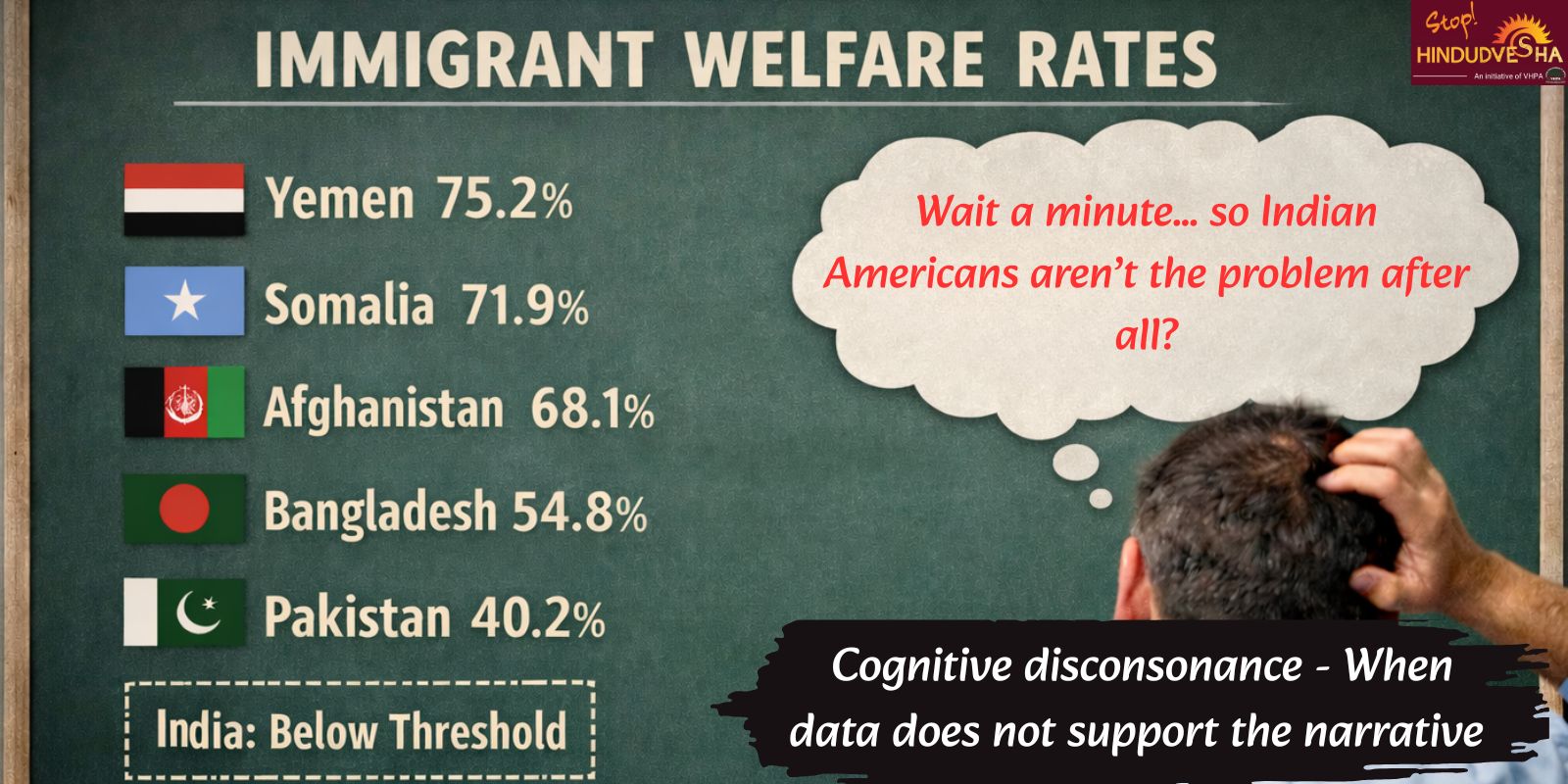
Summary
Recent data on immigrant welfare usage in the United States highlights a striking disparity across communities. While several Muslim-majority countries rank high in welfare dependence, Indian immigrants are notably absent from such lists, indicating minimal reliance on state support. Broader indicators reinforce this pattern: Indian Americans consistently outperform on education, income, and professional representation, particularly in fields like technology and medicine. In contrast, debates around other immigrant groups often center on concerns related to welfare dependence, crime patterns, and challenges of integration. These differences underscore the need to ground immigration discourse in verifiable data rather than ideological narratives. A rational approach must prioritize merit-based immigration, measurable contributions, and social cohesion, ensuring that policy is shaped by outcomes rather than selective perceptions or politically driven rhetoric.
Recent remarks by President Donald Trump, citing a list of 120 countries whose immigrants receive welfare assistance in the United States, have reignited debate around immigrant outcomes. Notably, while countries such as Yemen and Somalia appear among the top three, Indian immigrants are absent from the list, a detail that stands out.
This dataset has revived discussion around the so-called “model minority.” Across societies, certain attributes are typically associated with an ideal minority community: strong work ethic, respect for the law, high educational attainment, professional competence, and meaningful economic contribution. Equally significant is a limited reliance on state support for subsistence. Together, these markers are often used, implicitly or explicitly, to assess a community’s overall contribution to its host country. The absence of Indian immigrants from the welfare list aligns with long-standing data indicating that Indian Americans tend to belong to higher income brackets and occupy critical roles in the professional workforce. From this perspective, it is reasonable to infer that the proportion of Indian immigrants dependent on welfare programs is minimal.
However, these findings are at odds with the increasingly hostile rhetoric directed at Indians within segments of the current immigration discourse. When juxtaposed with patterns of welfare usage across immigrant groups and the rise of online hostility toward people of Indian origin, the disconnect becomes evident.
The discussion that follows examines this disparity in greater detail, drawing on empirical data and lived experiences to assess whether prevailing narratives reflect reality or are shaped by more selective motivations.
[Note: Since more than 80% of Indian immigrants are Hindus, we will use the phrases “Indian immigrants”, “Hindu immigrants”, and “Hindu Americans” interchangeably in the article.]
Welfare Trends: Disproportionate Reliance Among Muslim Immigrants
President Donald Trump shared a chart titled “Immigrant Welfare Recipient Rates by Country of Origin” on Truth Social, covering roughly 120 countries. The chart outlines the share of immigrant households receiving government assistance, offering a comparative view of welfare dependence across nationalities and communities.
The data shows that several Muslim-majority countries rank high on welfare dependence[1]:
- Yemen – 75.2%
- Somalia – 71.9%
- Afghanistan – 68.1%
- Bangladesh – 54.8%
- Pakistan – 40.2%
Notably, India is conspicuously absent from the list, suggesting their welfare usage falls below the study’s minimum reporting threshold.
These findings underscore the importance of grounding immigration debates in verifiable data and clear benchmarks, rather than conjecture or ideologically driven narratives.
Indian Americans: Meritocracy in Action
Indian Americans have often been described as the Model Minority due to their law-abiding behavior, along with various other characteristics, including high levels of educational attainment, professional competence, and higher-than-average per capita income.
Discussion of Indian Americans’ contributions gained momentum around the turn of the 21st century. An article by the American Enterprise Institute highlighted their notable success and its implications for U.S. immigration policy. It pointed to a strong presence in key sectors such as technology and medicine. Although Indian Americans comprise less than 1% of the population, they account for roughly 3% of engineers, 7% of the IT workforce, and 8% of physicians and surgeons.[2] In many rural and underserved areas, Indian-origin physicians form a critical backbone of healthcare delivery[3]. The article attributes the phenomenal success of the Indian American community largely to the culture they bring with them, which places a strong emphasis on academic achievement.
The term “model minority” dates back to the 1960s when East Asian immigrant groups – people of Japanese, Chinese, or Korean descent were largely considered an ideal immigrant group due to their high earnings and impressive educational attainments. There was a paradigm shift in 2007, when the median income of Indian American households stood at approximately $ 83,000, compared with $61,000 for East Asians and $55,000 for the general population.[4]
In recent years, Indian immigrants have consistently ranked highly on key indicators such as education, employment, and income. A November 2024 report by the Migration Policy Institute notes that they are significantly more likely to be proficient in English than the broader foreign-born population. It also highlights their exceptional educational attainment: in 2023, 81% of Indian immigrants aged 25 and older held at least a bachelor’s degree, compared to 36% of U.S.-born adults and 35% of all foreign-born adults. Nearly half (49%) possessed advanced degrees, far exceeding the 14% among U.S.-born individuals and 16% among the total foreign-born population.[5]
Economic indicators reflect a similar trend. Only 6% of Indian immigrants lived below the poverty line, compared to 14% of immigrants overall. Median household income among Indian immigrant-led households was more than double that of native-led households and well above the median for all immigrant-led households.[6]
Alongside these outcomes, Indian Americans are often associated with low crime rates and cultural values that emphasize stability and integration.
Despite aligning with the “model minority” profile, Indian—particularly Hindu—identity is often framed reductively in media and academia, disregarding data that reflects a more nuanced reality.
Law-and-Order Stats No One Talks About
Statistics on prison populations in Western countries reveal a recurring pattern: certain groups appear overrepresented relative to their share of the population. In the U.S., Muslims constitute roughly 1% of the population but are estimated to account for about 12% of federal prisoners and 9% of state prisoners. Data from the Federal Bureau of Investigation has also been cited to show that a large proportion of entries in terrorism screening databases are associated with Muslim-identifying names.
Moreover, out of the 1.5 million names in the FBI’s Terrorism Screening Database, 98% or approximately 1.47 million are Muslim names. The criminal propensity of Muslim groups, which can be defined as the percentage of prison inmates in a country divided by the group’s percentage in the general population, stands at 12 in the USA, an alarming figure considering that a Criminal Propensity figure greater than 1 implies that the group is more likely to commit incarcerable crime than the general population. [7]
In stark contrast, Hindus, who also constitute slightly under 2% of the U.S. population, make up a minuscule 0.2% of the prison population. A comprehensive review of media reports reveals few instances of serious crimes involving Hindu American immigrants. Public and civil society discourse rarely raises concerns about their propensity to commit crimes or disrupt law and order. Instead, the focus tends to be on their prominent presence in the tech industry, coupled with narratives alleging the reinforcement of hierarchical structures of Hindu society within that sector and the propagation of caste-based discrimination. Since Hindu Americans cannot easily be criticized on empirical grounds and are widely associated with peaceful and productive contributions, narratives invoking “Hindutva politics” and “caste bias” often emerge as alternative frames to critique the community.
One observes recurring patterns, in certain contexts, of immigrants from predominantly Muslim countries being linked to serious crimes in specific pockets, at times prompting authorities to consider stricter measures, including targeted enforcement actions aimed at curbing crime. In 2025, the Somali immigrant community in Minnesota drew significant attention following allegations involving the misappropriation of billions in taxpayer funds. According to media reports, several such cases allegedly involved members of the Somali community. Sources further indicate that portions of the diverted funds were transferred to Somalia, where they reportedly reached the Al-Shabaab terror group. [8]
Following reports of the fraud, President Trump deployed federal agents to crack down on illegal immigration, a move that faced opposition from some stakeholders who argued that a specific immigrant group was being unfairly targeted. A report by City Journal contends that concerns about higher crime rates among Somali immigrants in the U.S. are neither unfounded nor overstated. It notes that in countries such as Denmark and Norway, where record-keeping is more detailed, Somali immigrants are convicted or formally charged at several times the rate of native populations.[9]
An article published by the Fillmore County Journal in March 2026 also raises concerns about law-and-order challenges allegedly linked to segments of Muslim immigrant populations. The author argues that, with the exception of countries such as Hungary and Poland, much of Europe faces difficulties related to integration and social cohesion. Referring to conditions in Somalia, the piece comments on what it describes as an entrenched crime culture and raises questions about the extent of cultural assimilation among Somali immigrants in the United States. It also claims that a large proportion of Somali families rely on welfare support.
The article adopts a strongly prescriptive stance, suggesting restrictions on immigration from Muslim-majority countries, arguing that the long-term assimilation remains uncertain. It attributes these concerns to religious and ideological factors, arguing that some individuals interpret global order through the framework of Sharia law and its broader political implications.[10]
In contrast, Indian Americans present a markedly different law-and-order profile. Despite forming a comparable share of the population, their representation in crime statistics remains disproportionately low, with few documented cases of serious offenses. Public discourse rarely associates Indian American communities with law-and-order concerns, reflecting a pattern of stability, compliance, and social integration. This divergence is not incidental but consistent with broader data on education, income, and professional outcomes, reinforcing the contrast between communities frequently scrutinized for security risks and those whose contributions remain largely constructive and non-disruptive.
Radicalization—The Elephant in the Room
Radicalization among some Muslim immigrants in the U.S. remains a serious and well-documented concern, with links to terror attacks, including lone-wolf incidents.
A March 2026 report by the Institute for Strategic Dialogue states that radical activity inspired by the Islamic State (IS) persists in the U.S. and is primarily driven by teenage actors. It further notes that in 2025, IS supporters carried out two successful attacks in the U.S., along with five additional disrupted plots and six arrests for providing material support to a designated foreign terrorist organization (FTO).[11] Similarly, a study by the Institute for Economics & Peace presents alarming statistics on the rise of lone-wolf terror attacks in Western democracies. According to the report, lone actors were responsible for 93% of fatal terrorist attacks in the West over the past five years. Moreover, seven Western countries feature among the worst 50 on the Global Terrorism Index, with the U.S. ranked 34th. The report also includes data on jihadist terror plots in Europe from 1994 to 2021, indicating that over 61% of plots were carried out by lone actors, compared to 18% by groups of two or more.[12]
The increased involvement of individuals influenced by radical Islamist extremism in lone-wolf attacks and mass shootings has also made authorities more cautious in their approach. In March 2026, a gunman wearing clothing bearing the words “Property of Allah” killed two people and wounded 14 at a Texas bar early Sunday morning.[13] Following the incident, Andy Ogles announced plans to introduce a bill to halt immigration from a set of Muslim-majority countries. The proposed legislation would amend the Immigration and Nationality Act to restrict immigration from countries such as Libya, Yemen, Iran, and Syria.[14]
A report funded by the United States Department of Justice notes that prisons in the U.S. are increasingly becoming sites of radicalization, with particular concern around evolving forms of what it terms “Prison Islam.” With several high-profile terrorism offenders serving long sentences, the report describes a complex network in which religious conversions of non-Muslim inmates and exposure to extremist interpretations of Islamist ideology may play a role. Based on extensive primary research, the study draws on interviews with 15 prison chaplains, 9 gang intelligence officials, and 30 inmates incarcerated for violent crimes in Florida and California, and documents instances where religion has been used in the process of grooming individuals toward extremist pathways. [15] [16]
Cultural Integration Vs. Ghettoization
Hindu communities have integrated well into American society while preserving their cultural traditions. In doing so, they have contributed to a form of cultural assimilation that accommodates diversity without displacing local norms. The widespread practice of yoga and meditation, along with the popularity of Indian cuisine, illustrates this synthesis, reflecting a hybrid cultural space that balances continuity with adaptation.[17]
In contrast, some Muslim immigrant communities actively advocate for the accommodation of their religious practices in public life, including the recognition of Sharia in personal or community matters.
The U.S. is also witnessing an emergence of insular or closed Muslim enclaves. For instance, the proposed EPIC City project has raised serious concerns related to the potential exclusion of non-Muslims and the informal adherence to Sharia-based norms. Some analyses point to Sharia arbitration mechanisms operating in areas like North Texas. In cities like Dearborn, many non-Muslim residents report growing marginalization, alongside broader concerns about parallel legal and cultural practices.[18]
By contrast, Indian Americans have played a significant role in merit-based immigration and have made notable contributions to innovation and technology. According to a 2022 report by the National Foundation for American Policy, half of America’s billion-dollar startups had at least one immigrant founder, with Indian immigrants founding 66 of them, the highest share from any one country. Moreover, of the 648 unicorn startups, 72 are led by Indian-origin founders, with a combined valuation of $195 billion and a workforce of nearly 55,000 employees. They have also contributed to public health research and social welfare through philanthropy, as well as through business ownership and job creation.[19]
The contrast suggests that Hindu Americans and Muslim immigrants in the U.S. occupy markedly different positions. While one community is often seen as emphasizing grievance and leveraging political influence to advance religiously driven demands, the other integrates into the mainstream political landscape, aligns with American values, and contributes significantly to the core of American society, polity, culture, and economy.
Closing Remarks
A durable immigration framework cannot be built on selective outrage or narrative convenience. The evidence presented here points to clear differences in outcomes across communities—whether in welfare dependence, educational attainment, crime patterns, or economic contribution. Any serious policy discussion must begin by acknowledging these differences rather than obscuring them.
At the same time, the goal of immigration policy should remain consistent: to strengthen the host society through lawful, merit-based, and socially cohesive integration. This requires prioritizing skill, contribution, and alignment with institutional norms, while addressing legitimate security and governance concerns where they arise.
The current discourse, however, often moves in the opposite direction—penalizing high-performing communities through ideological framing while downplaying more difficult questions. Such an approach not only distorts reality but also risks undermining public trust in the immigration system itself.
Ultimately, a rational and sustainable immigration policy must be grounded in data, fairness, and a clear-eyed assessment of outcomes—not in rhetoric or expediency.
Citations
[1] Trump shares list of 120 countries whose immigrants receive welfare in US – Why was India excluded? – The Times of India; https://timesofindia.indiatimes.com/world/us/trump-shares-list-of-120-countries-whose-immigrants-receive-welfare-in-us-why-was-india-excluded/articleshow/126340688.cms
[2] Indian Americans: The New Model Minority | AEI; https://www.aei.org/articles/indian-americans-the-new-model-minority/
[3] Indian Immigrants: America’s Merit Backbone; https://stophindudvesha.org/how-indian-immigrants-anchor-americas-success-story-setting-the-standard-for-merit-based-immigration/
[4] Indian Americans: The New Model Minority | AEI; https://www.aei.org/articles/indian-americans-the-new-model-minority/
[5] Article: Indian Immigrants in the United States | migrationpolicy.org https://www.migrationpolicy.org/article/indian-immigrants-united-states
[6] Ibid.
[7] Why are Muslims overrepresented in Western prisons?; https://stophindudvesha.org/why-are-muslims-overrepresented-in-western-prisons/
[8] Minnesota Welfare Fraud: Some Funds Went to Al-Shabaab; https://www.city-journal.org/article/minnesota-welfare-fraud-somalia-al-shabaab
[9] Yes, Somali immigrants Commit More Crime Than Natives; https://www.city-journal.org/article/minnesota-somali-fraud-immigration-crime
[10] The Muslim Immigration Problem – Fillmore County Journal; https://fillmorecountyjournal.com/the-muslim-immigration-problem/
[11] Islamic State group activity in the US in 2025 – Institute for Strategic Dialogue; https://www.isdglobal.org/digital-dispatch/islamic-state-group-activity-in-the-us-in-2025/
[12] Lone Wolf and Youth Terrorism; https://www.visionofhumanity.org/wp-content/uploads/2025/03/Lone-Wolf-and-Youth-Terrorism.pdf
[13] Suspect in Texas bar shooting wore ‘Property of Allah’ clothing and Iranian flag emblem according to AP source | PBS News; https://www.pbs.org/newshour/nation/suspect-in-texas-bar-shooting-wore-property-of-allah-clothing-and-iranian-flag-emblem-according-to-ap-source
[14] Fox News: MAGA hardliner pushes ban on immigration from Islamic countries, US adversaries in wake of Texas shooting | Representative Ogles; https://ogles.house.gov/media/press-releases/fox-news-maga-hardliner-pushes-ban-immigration-islamic-countries-us
[15] Why are Muslims overrepresented in Western prisons?; https://stophindudvesha.org/why-are-muslims-overrepresented-in-western-prisons/#_ftn18
[16] Terrorist Recruitment in American Correctional Institutions: An Exploratory Study of Non-Traditional Faith Groups Final Report; https://www.ojp.gov/pdffiles1/nij/grants/220957.pdf
[17] Indian Immigrants: America’s Merit Backbone; https://stophindudvesha.org/how-indian-immigrants-anchor-americas-success-story-setting-the-standard-for-merit-based-immigration/
[18] Democracy on the Defensive: Europe Confronts Radical Islam; https://stophindudvesha.org/democracy-on-the-defensive-europe-confronts-radical-islam/
[19] Indian Immigrants: America’s Merit Backbone; https://stophindudvesha.org/how-indian-immigrants-anchor-americas-success-story-setting-the-standard-for-merit-based-immigration/

Donate to HINDUDVESHA
Our Mission is to explore and expose Hindudvesha through research analysis, education and response.
SUPPORT US