

Weaponized Secularism: The Legal Assault on Hindus in the Name of Minority Rights (Part 1)
 Aditi Joshi · 06/24/2025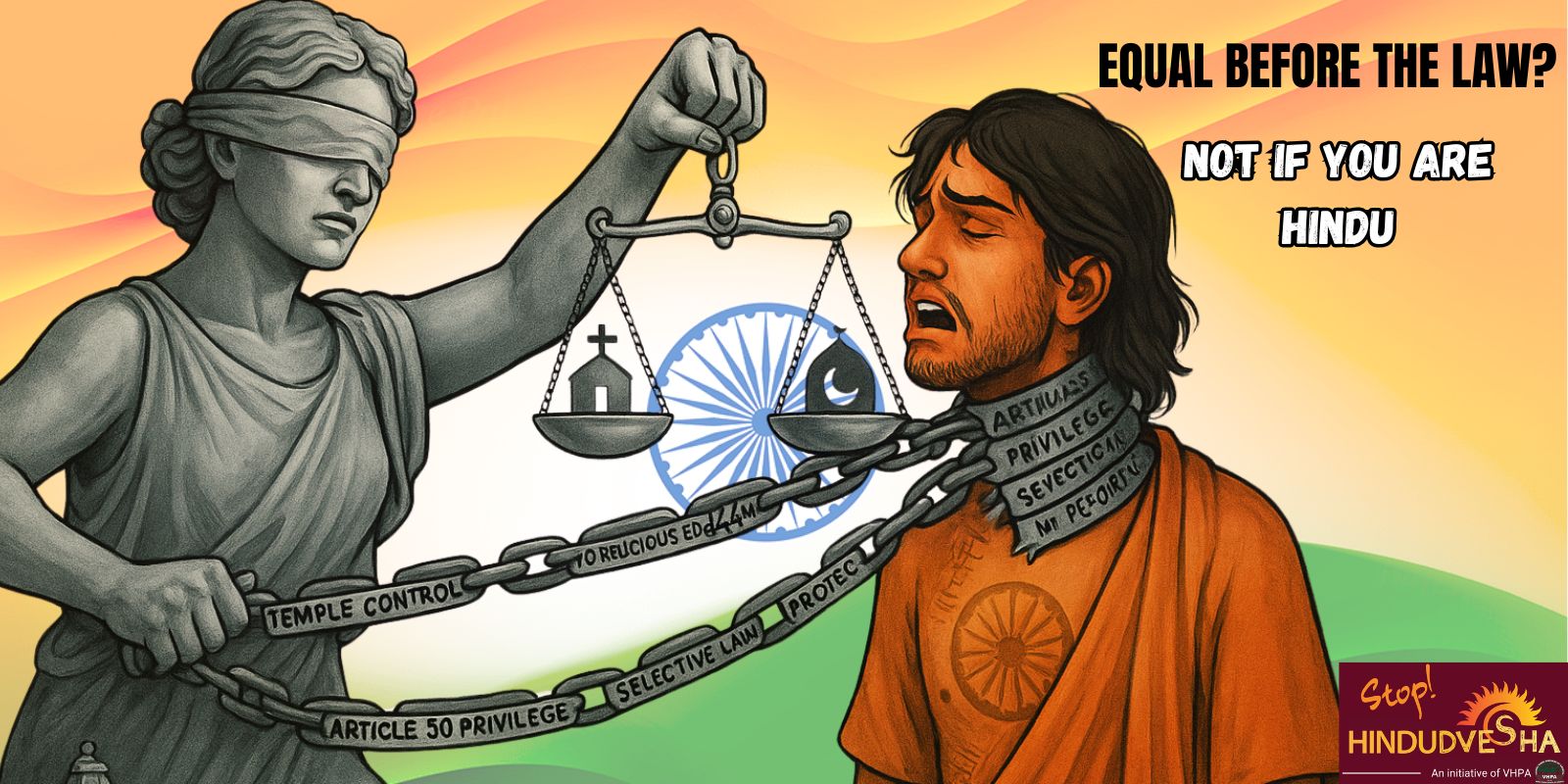
- Unlike Western liberal democracies, India’s identity is rooted in an ancient, pluralistic civilizational ethos shaped by dharma, not by state-enforced secularism or monotheistic exclusivism.
- Religious harmony and diversity in India were not imposed by constitutional fiat but naturally evolved through millennia of coexistence between Sanatana Dharma, Jainism, Buddhism, and other native traditions.
- Post-independence India imported a Western model of secularism that separates church and state but paradoxically allows the state to intrude into Hindu institutions while leaving minority religions autonomous.
- In the name of neutrality, the state regulates Hindu temples, censors dharmic education, and reforms Hindu laws, while empowering Christian and Islamic institutions, creating structural discrimination.
- Far from protecting all faiths equally, Indian secularism has shackled its civilizational core—Hindu society—through legal asymmetries, while privileging religious minorities under constitutional immunity.
India is a Hindu-majority nation—nearly 80% of its population identifies as Hindu. One would, therefore, assume that Hindus would be culturally secure and institutionally empowered in their own homeland. In the global imagination, carefully curated by Western academia and Indian secular elites, Hindus are cast as the dominant group, allegedly oppressing minorities, particularly Muslims and Christians.
Yet, India’s legal and constitutional framework tells a far grimmer tale: not of dominance, but of slow, calculated strangulation of the very civilization it emerged from.
Post-independence India, in its quest to appear secular, adopted a bizarre model: one where Hindu temples are controlled by the state, but mosques and churches are left autonomous; where minority schools can teach religion, but Hindu ones cannot; where Hindu personal law was reformed in the name of progress, but minority personal laws remain untouched for fear of “offending sentiments.” Even the right to religious propagation—innocuous on paper—has become a legal loophole exploited by well-funded missionary networks targeting the poorest and most vulnerable Hindus.
In this two-part series, we will examine a network of laws—some inherited from British colonial rule and others introduced after independence—that have systematically undermined the rights, autonomy, and institutions of the Hindu majority. Rather than upholding equality, these legislative distortions have created a system in which Hindus, the civilizational core of India, are treated as a suspect community in their own country, all under the carefully curated façade of secularism.
Article 25 – Right to Propagate or License to Proselytize?
Article 25(1) of the Indian Constitution grants every citizen the “freedom of conscience and the right freely to profess, practise and propagate religion.”[1] On the surface, it’s a noble promise—an assurance of religious freedom in a pluralistic nation. But hidden in that language is one word—“propagate”—that has proven to be far more than just semantics.
In a country where large sections of the population live in poverty, lack access to education, and remain socially vulnerable, this single word has been used to justify widespread, systematic proselytization—especially by foreign-funded Christian missionaries and Islamic da’wah groups.
Interestingly, this concern isn’t new. As far back as 1948, during the Constituent Assembly Debates, some members warned that including the word “propagate” in Article 25 could open the door to forced or deceptive conversions in the name of religious freedom. Others replied that propagation only meant sharing one’s faith—not the right to convert someone through fraud or pressure.[2] But even then, few could have imagined how large and organized these conversion campaigns would become in the decades that followed.
The reality today is stark. Numerous government records and investigative reports have pointed to the influx of foreign funding under the Foreign Contribution (Regulation) Act (FCRA), which has disproportionately gone to Christian NGOs engaged in missionary work. According to the Ministry of Home Affairs (Annual Report 2019-2020)[3], more than 70% of foreign contributions to religious organizations were received by Christian-affiliated groups. These funds are often directed towards “social service” activities in tribal belts, which frequently overlap with evangelistic objectives.
This has resulted in drastic demographic shifts in regions like Arunachal Pradesh, Nagaland, and parts of Chhattisgarh and Odisha. In Arunachal alone, Christians constituted just 0.7% of the population in 1951—but by 2011, that number had surged to over 30%. This transformation was no accident. Jawaharlal Nehru, by refusing to fully integrate the Northeast and allowing foreign missionaries unregulated access, revealed the real intent behind the inclusion of ‘propagate’ in Article 25(1). Cloaked in the language of liberty, Nehru effectively enabled civilizational subversion, laying the groundwork for large-scale religious and cultural disruption in strategically vital regions.[4]
Moreover, the state has been reluctant to act, citing secular neutrality. Yet, it is precisely this inaction that allows coercive proselytization to continue unchecked. Anti-conversion laws (often called Freedom of Religion Acts) exist in several states like Madhya Pradesh, Himachal Pradesh, and Uttarakhand, but enforcement remains uneven, and judicial scrutiny inconsistent. In Rev. Stainislaus v. State of Madhya Pradesh(1977)[5], the Supreme Court upheld the constitutionality of anti-conversion laws, stating that the right to propagate does not include the right to convert another person.
Despite this legal clarity, there is little proactive governance to curb coercive proselytization. The conversion of economically disadvantaged Scheduled Tribes and Dalits through incentives like education, healthcare, and material support often leads to civilizational dislocation and social fragmentation.
Article 25 was supposedly meant to protect personal beliefs. But in reality, it has served the purpose its architects quietly intended: a legal cover for powerful, well-funded groups to exploit vulnerable communities and alter not just their religion but their entire cultural identity. Unless the state acts with courage and clarity, the future holds more than demographic shifts—it threatens civilizational collapse, village by village.
Articles 28 & 30: Religious Texts Allowed in Classroom—Provided They Aren’t Hindu
Article 28(1) of the Indian Constitution declares: “No religious instruction shall be provided in any educational institution wholly maintained out of State funds.”[6] This provision reflects the state’s commitment to religious neutrality in publicly funded education. However, when juxtaposed with Article 30(1)—which guarantees religious and linguistic minorities the right to “establish and administer educational institutions of their choice”[7]—a structural contradiction becomes evident.
In practice, Article 28 restricts government schools and institutions funded entirely by the state from offering any form of religious or scriptural instruction, which disproportionately affects Hindu students. Hinduism, being the majority religion, is primarily practiced in government schools by the bulk of the student population. As a result, generations of Hindu children grow up without structured or curricular exposure to foundational texts like the Bhagavad Gita, Upanishads, or even basic civilizational values derived from dharma.
In stark contrast, Article 30 has been interpreted by courts and governments to permit minority-run institutions—particularly Christian missionary and Islamic madrasa schools—to impart religious instruction even while receiving government support. Christian schools such as those run by the Jesuits, Salesians, and other missionary orders often receive land grants, tax benefits, and access to public funds for infrastructure development, all while retaining their religious ethos. These schools often display crucifixes in classrooms, celebrate Christian holy days, and integrate Biblical teachings into the curriculum—all under the protection of Article 30.
The Supreme Court’s landmark judgment in T.M.A. Pai Foundation v. State of Karnataka (2002)[8] further deepened this asymmetry. The Court ruled that minority institutions have the fundamental right under Article 30 to manage their own educational affairs, including the content of religious education. However, this ruling did not offer parallel protections to institutions run by the Hindu majority. Even subsequent clarifications in P.A. Inamdar v. State of Maharashtra (2005)[9] and Ashok Thakur v. Union of India (2008)[10] preserved this special status for minorities without addressing the imbalance it creates.
Moreover, the National Curriculum Framework (NCERT, 2005 & 2023 editions)[11][12] has continued to exclude Hindu philosophical and civilizational content under the guise of secularism. In contrast, madrasa education in many states is directly subsidized by the government under schemes such as the Scheme for Providing Quality Education in Madrasas (SPQEM), administered by the Ministry of Minority Affairs.
The net effect is an educational regime where Hindu culture is sidelined in government schools, while minority communities are allowed—and even subsidized—to preserve and propagate their traditions. This has led to a systemic alienation of Hindu youth from their cultural roots and contributes to an inferiority complex regarding their own civilizational identity.
The contradiction between Articles 28 and 30 is not merely legal—it strikes at the heart of cultural fairness and national identity. In a democracy that claims to uphold diversity, the selective application of secularism has produced a deeply unequal system. A truly inclusive framework would ensure that all communities have equal access to cultural and religious education, without granting special privileges to some while denying others.
State Control of Hindu Temples—But Not Mosques or Churches
The continued state control of Hindu temples in India is one of the most egregious examples of institutionalized discrimination masquerading as secular governance. The Hindu Religious and Charitable Endowments (HRCE) Acts, enacted in states like Tamil Nadu, Andhra Pradesh, Karnataka, and Kerala, empower the government to take over the administration of Hindu temples and their extensive endowments. This legal architecture, as documented by Stop Hindu Dvesha in their detailed historical analysis,[13] is not a post-independence innovation—it is a direct carryover from colonial British policy designed to undermine Hindu religious authority and seize temple wealth.
The British began state interference in Hindu temples under the pretext of reform and regulation, using mechanisms like the Madras Regulation VII of 1817. Independent India, instead of dismantling these colonial impositions, expanded them. The Madras HRCE Act of 1951[14] became the model for similar laws in other states, effectively converting Hindu temples into government-administered properties. Under these laws, the state appoints bureaucrats—often with no grounding in Hindu traditions—to control temple finances, appoint priests, and even regulate rituals and festivals. In many cases, these administrators may not even be practicing Hindus.
The consequences have been devastating. According to a 2015 Comptroller and Auditor General (CAG) report, over ₹5,000 crore in temple revenues under Tamil Nadu’s HR&CE Department were either misused or left unaccounted for. Thousands of temples lack full-time priests, with many falling into disrepair due to diverted funds and administrative apathy. Sacred rituals are neglected, festivals are bureaucratized, and temple lands are often illegally leased or encroached upon, while the Hindu public remains powerless to intervene.
Meanwhile, no equivalent laws exist for other religions. Churches and mosques enjoy full autonomy, with Christian institutions managed by ecclesiastical bodies and Muslim religious assets governed by Waqf Boards, which operate under the Waqf Act of 1995. Not only are Waqf Boards immune to the kind of state interference Hindu temples face, they are empowered to declare and seize properties as Waqf, often without legal challenge.
This double standard blatantly violates Article 26 of the Indian Constitution, which guarantees every religious denomination the right to manage its own affairs. Yet in practice, only non-Hindu religious communities enjoy this protection. Hinduism—the very foundation of Indian civilization—is the only major faith in India whose sacred institutions are subject to direct state control.
Courts, too, have largely upheld this discriminatory regime. In Sundararaja Iyengar v. State of Madras (1955)[15], the Madras High Court rationalized the HRCE Act by deeming temple administration a “secular” activity, ignoring the deep integration of the sacred and the secular in Hindu practice. Though the Supreme Court in Adi Saiva Sivachariyargal Nala Sangam v. Government of Tamil Nadu (2015)[16] acknowledged the rights of hereditary temple priests, it stopped short of challenging the state’s overarching control.
The message is clear: in India’s so-called secular democracy, Hindu religious institutions are fair game for government control, while minority institutions remain sacred and untouchable. What began as colonial control has been repackaged as postcolonial “reform,” but its true nature remains the same—a targeted dismantling of Hindu civilizational infrastructure under the guise of neutrality.
Family Law Reforms – Only for Hindus
Between 1955 and 1958, the Indian Parliament passed a series of laws collectively known as the Hindu Code Bills, which marked a significant shift in the personal law landscape for Hindus. These included the Hindu Marriage Act (1955)[17], the Hindu Succession Act (1956)[18], the Hindu Minority and Guardianship Act (1956)[19], and the Hindu Adoptions and Maintenance Act (1956)[20]. These legislative reforms were championed by Prime Minister Jawaharlal Nehru and were intended to codify and modernize Hindu personal law.
The reforms sought to abolish discriminatory practices such as the denial of inheritance rights to daughters, introduced monogamy as a legal standard, and made divorce legally accessible within Hindu marriages. However, these “progressive” reforms were selectively applied only to Hindus—a term defined broadly in law to include Jains, Buddhists, and Sikhs under the Hindu Marriage Act (Section 2).
Muslim and Christian personal laws, by contrast, were left untouched. The Muslim Personal Law (Shariat) Application Act of 1937[21] continued to govern matters such as marriage, divorce, maintenance, and inheritance among Muslims, preserving provisions like polygamy and unilateral divorce (talaq). Christian personal law remained governed primarily by the Indian Christian Marriage Act (1872)[22] and the Indian Divorce Act (1869)[23], with only minor amendments.
Nehru acknowledged the controversy these bills generated. In the Lok Sabha debates of 1955, he stated, “I do not think that there is any doubt that this Bill is the most important measure… for our country” (Lok Sabha Debates, May 5, 1955)[24]. Despite opposition from within his own party and resistance from traditional Hindu leaders, Nehru pushed ahead, viewing Hindu reform as a necessary civilizational step. However, his reluctance to introduce comparable reforms for Muslim or Christian communities—citing communal sensitivities and political risk—exposed the selective moral and legal framework of the Indian state.
This asymmetrical approach created an enduring disparity. Hindu society was subjected to uniform legal codes enforced by the state, while minority communities retained their traditional and often patriarchal norms under the protective cover of religious freedom. This dichotomy persists today. Muslim women’s rights remain constrained by religious personal laws, and successive governments have shied away from confronting these issues directly for fear of political backlash.
Several legal scholars and jurists have noted this imbalance. In Ahmedabad Women’s Action Group v. Union of India(1997)[25], the Supreme Court declined to intervene in Muslim Personal Law, deferring instead to the legislature. The continued exemption of minority personal laws from scrutiny has entrenched legal pluralism, often at the cost of gender justice and equal rights.
In effect, Hindu personal law was nationalized and reformed, while Muslim and Christian personal law was left to religious authorities. This selectively imposed reform reflects not only a legal inconsistency but also a deep ideological reluctance to confront regressive practices within minority communities. For Hindus, however, the state acted with unparalleled urgency and authority, reshaping centuries of cultural and religious tradition through legislation.
Uniform Civil Code: One Law for All…Coming Since 1950
Article 44 of the Indian Constitution directs the state to “endeavour to secure for the citizens a Uniform Civil Code (UCC) throughout the territory of India.”[26] It was intended to create a common set of civil laws—governing marriage, divorce, inheritance, and adoption—for all citizens, irrespective of religion. Yet, more than seven decades since independence, this promise remains unfulfilled.
During the framing of the Constitution, leaders such as Dr. B.R. Ambedkar supported the principle of a UCC. However, instead of making it an enforceable right, it was placed in the Directive Principles—non-justiciable guidelines without legal force. This decision was driven by apprehensions of political backlash from religious minorities, and it laid the foundation for decades of legislative inaction.
One of the most striking examples of this retreat was the Shah Bano case (1985)[27]. The Supreme Court ruled that a Muslim woman was entitled to alimony under Section 125 of the Criminal Procedure Code, a secular provision applicable to all citizens. The judgment triggered intense protests from Islamic clerics and political groups, who accused the state of interfering in Muslim personal law. The government, led by Rajiv Gandhi, responded by passing the Muslim Women (Protection of Rights on Divorce) Act, 1986, which effectively overturned the Court’s verdict and curtailed the woman’s right to maintenance. Rather than upholding constitutional equality, the state yielded to religious orthodoxy for electoral convenience.
Since then, Article 44 has largely functioned as a rhetorical device. Political parties routinely invoke the UCC to appeal to Hindu voters but consistently avoid addressing the unequal application of personal laws across religious lines. Any proposal to reform minority personal laws is quickly dismissed under the banner of protecting religious freedom.
This selective approach has created an unequal legal system. Hindus are required to follow a uniform and modernized personal law, while minority communities continue to operate under religious codes that often remain patriarchal and regressive. The resulting legal pluralism not only undermines gender justice but also violates the constitutional guarantee of equality before the law (Article 14)[28].
The Supreme Court has repeatedly expressed support for implementing the UCC, as seen in judgments such as Sarla Mudgal v. Union of India (1995)[29] and John Vallamattom v. Union of India (2003)[30]. However, the Court has refrained from enforcing it, deferring instead to the legislature, where no meaningful action has followed.
As it stands, Article 44 remains symbolic rather than substantive—a constitutional ideal routinely showcased but rarely acted upon. It is used to signal reformist intent to the majority community while shielding minority practices from critical scrutiny. This duplicity entrenches a legal double standard, preventing India from achieving genuine legal equality.
Unless applied uniformly and fairly across all communities, the Uniform Civil Code will remain a constitutional aspiration—ignored in practice and exploited in politics.
Closing Remarks
As we have seen in this first part, the legal and constitutional framework of independent India has not merely neglected the rights of its Hindu majority—it has actively undermined them. From the selective reform of Hindu personal laws to the denial of religious education for Hindus (only) in schools, from the takeover of temples to the unchecked autonomy of minority institutions, a consistent pattern emerges: laws framed in the name of secularism have, in effect, institutionalized discrimination.
This asymmetric legal treatment has not gone unnoticed—it has sown a deep and growing resentment within the Hindu community. Many Hindus now feel like second-class citizens in their own civilizational homeland, forced to comply with legal burdens that others are exempt from. And yet, this is only the tip of the proverbial iceberg.
In Part 2 of this series, we will explore even more troubling laws, such as the Waqf Act and the Places of Worship Act, that further entrench religious privilege, suppress historical justice, and deepen the civilizational imbalance. The full extent of this legal injustice demands urgent and honest national introspection.
Citations
[1] Constitution of India – Article 25, Freedom of conscience and free profession, practice and propagation of religion; https://www.constitutionofindia.net/articles/article-25-freedom-of-conscience-and-free-profession-practice-and-propagation-of-religion/
[2] Constituent Assembly Debates, Vol. 7, December 6, 1948; https://eparlib.nic.in/bitstream/123456789/762992/1/cad_06-12-1948.pdf
[3] Annual Report 2019–2020 (Ministry of Home Affairs); https://www.mha.gov.in/sites/default/files/AnnualReport_19_20.pdf
[4] Sanjaly Pandey, Alienation of India’s Northeast: Reaping the Fruit of Nehruvian Blunders; https://stophindudvesha.org/alienation-of-indias-northeast-reaping-the-fruit-of-nehruvian-blunders/
[5] Rev. Stainislaus v. State of Madhya Pradesh & Ors. (Civil Appeal Nos. 1489 & 1511 of 1974);
https://indiankanoon.org/doc/1308071/
[6] Constitution of India – Article 28; Freedom as to attendance at religious instruction or religious worship in certain educational institutions; https://www.constitutionofindia.net/articles/article-28-freedom-as-to-attendance-at-religious-instruction-or-religious-worship-in-certain-educational-institutions/
[7] Constitution of India – Article 30; Right of minorities to establish and administer educational institutions; https://www.constitutionofindia.net/articles/article-30-right-of-minorities-to-establish-and-administer-educational-institutions/
[8] T.M.A. Pai Foundation & Ors. v. State of Karnataka & Ors; https://cdnbbsr.s3waas.gov.in/s3ec0490f1f4972d133619a60c30f3559e/documents/aor_notice_circular/18.pdf
[9] P. A. Inamdar & Ors. v. State of Maharashtra & Ors. (12 August 2005); https://indiankanoon.org/doc/1390531/
[10] Ashoka Kumar Thakur v. Union of India; https://indiankanoon.org/doc/1219385/
[11] National Curriculum Framework (2005) — The foundational policy document that guided the 2005 edition of NCERT textbooks; https://ncert.nic.in/pdf/nc-framework/nf2005-english.pdf
[12] 2023 Edition: NCERT Textbooks (Class I–XII); https://ncert.nic.in/textbook.php?iemh1=13-15
[13] Rati Agnihotri, State control of Hindu temples in India: A Historical Perspective; https://stophindudvesha.org/state-control-of-hindu-temples-in-india-a-historical-perspective/
[14] The Madras Hindu Religious & Charitable Endowments Act, 1951;
https://latestlaws.com/wp-content/uploads/2015/07/Madras-Hindu-Religious-and-Charitable-Endowments-Act-19511.pdf
[15] T.V. Sundram Iyengar & Sons (formerly “Sundararaja Iyengar”) v. State of Madras (1955);
https://indiankanoon.org/doc/1594000/
[16] Adi Saiva Sivachariyargal Nala Sangam & Ors. v. Government of Tamil Nadu & Anr. (Dec 16, 2015); https://indiankanoon.org/doc/143215272/
[17] The Hindu Marriage Act, 1955 (India Code); https://indiacode.nic.in/handle/123456789/1560?locale=en
[18] The Hindu Succession Act, 1956 – India Code; https://indiacode.nic.in/handle/123456789/1713?locale=en
[19] The Hindu Minority and Guardianship Act, 1956; https://www.indiacode.nic.in/bitstream/123456789/1649/1/195632.pdf
[20] Hindu Adoptions and Maintenance Act, 1956; https://www.indiacode.nic.in/bitstream/123456789/1638/1/AA1956____78.pdf
[21] Muslim Personal Law (Shariat) Application Act, 1937 – India Code,
https://indiacode.nic.in/bitstream/123456789/2303/1/A1937-26.pdf
[22] The Indian Christian Marriage Act, 1872** (Act No. XV of 1872); https://ncwapps.nic.in/acts/TheIndianChristianMarriageAct1872-15of1872.pdf
[23] The Divorce Act, 1869 (Act No. 4 of 1869);
https://www.indiacode.nic.in/bitstream/123456789/2280/1/A1869-04.pdf
[24] Lok Sabha Debates – May 5, 1955 (Third Reading of the Hindu Marriage Bill);
https://ignca.gov.in/Asi_data/59309.pdf
[25] Ahmedabad Women’s Action Group v. Union of India (AIR 1997, 3 SCC 573);
https://indiankanoon.org/doc/1743680/ pahujalawacademy.com+9indiankanoon.org+9scribd.com+9
[26] Article 44 – Uniform Civil Code for the citizens; “The State shall endeavour to secure for the citizens a uniform civil code throughout the territory of India;” https://www.constitutionofindia.net/articles/article-44-uniform-civil-code-for-the-citizens/
[27] Wikipedia; Mohd. Ahmad Khan v. Shah Bano Begum (1985); https://en.wikipedia.org/wiki/Mohd._Ahmed_Khan_v._Shah_Bano_Begum?utm_source=chatgpt.com
[28] Constitution of India – Article 14, “The State shall not deny to any person equality before the law or the equal protection of the laws within the territory of India.” https://www.constitutionofindia.net/articles/article-14-equality-before-law/
[29] Sarla Mudgal & Ors. v. Union of India (AIR 1995 SC 1531; decided 11 May 1995);
https://indiankanoon.org/doc/1593775/
[30] John Vallamattom & Anr. v. Union of India (Writ Petition (Civil) No. 242 of 1997, decided 21 July 2003); https://indiankanoon.org/doc/49064693/

Donate to HINDUDVESHA
Our Mission is to explore and expose Hindudvesha through research analysis, education and response.
SUPPORT US