

State control of Hindu temples in India: A Historical Perspective
 Rati Agnihotri · 07/27/2024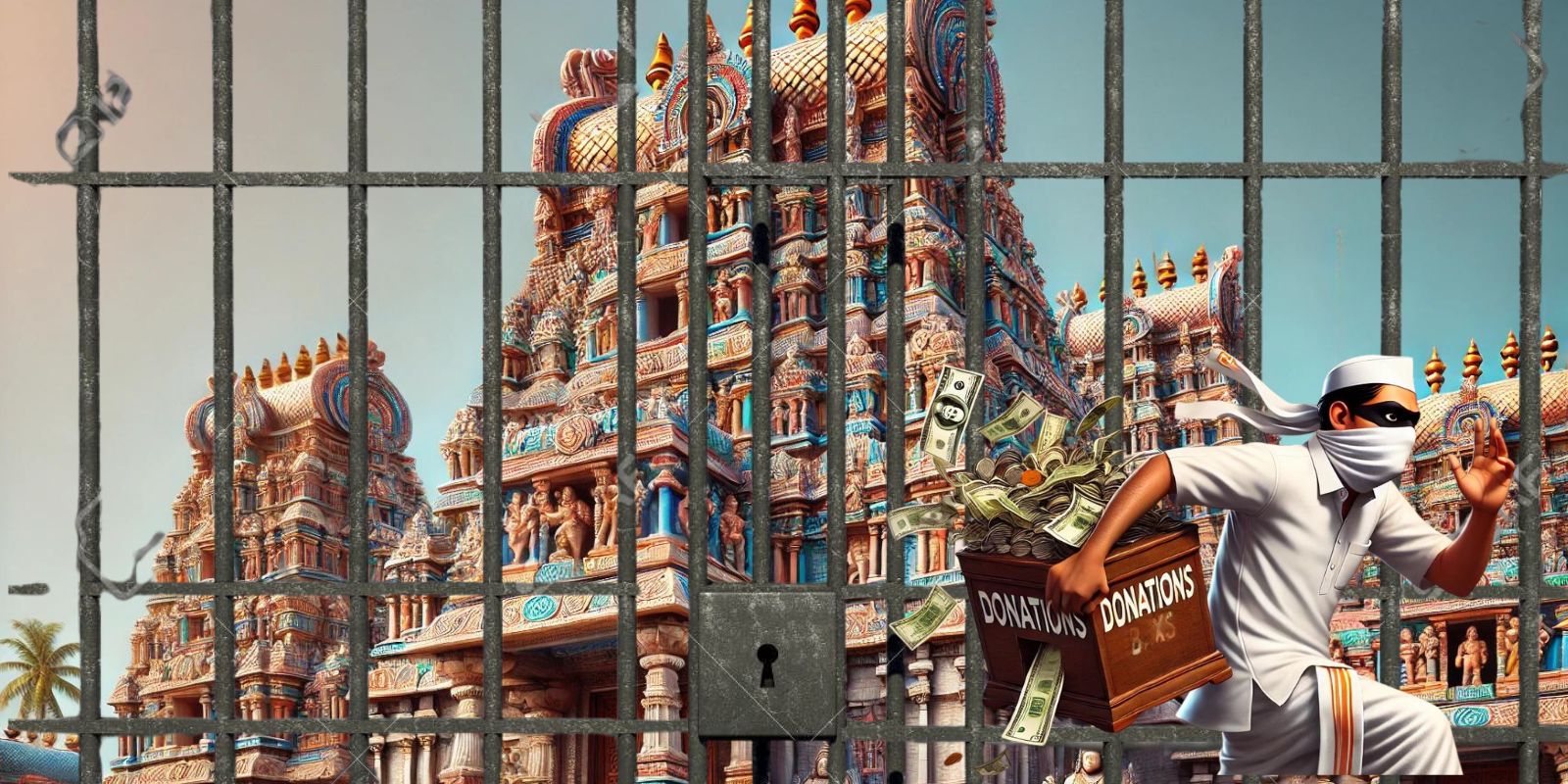
[Editor’s Note: This article is part of a series of write-ups on the issue of state control of Hindu temples in India. The first part contextualizes the pre-independence and post-independence backdrop of the state control of temples and delves deep into the legal and political dynamics. The second part will focus on the ‘free Hindu temple movement’ in India and explore why Hindu temples must be freed from state control.]
- The seeds for the State control of Hindu temples in India had been sown in pre-independence India by the British Empire; even post-independence, Indian governments followed suit in tightening the government control noose around Hindu temples.
- The draconian Tamil Nadu Hindu Religious and Charitable Endowments Act 1959, which was passed defying the Supreme Court 1954 ruling that had declared a similar act passed by the Tamil Nadu government as unconstitutional and void, continues to set the template for state control of Hindu temples.
- The phenomenon of government control of Hindu temples violates provisions of Article 25 of the Indian Constitution, denying Hindus equal rights in terms of practicing, professing, and propagating their religion.
- The distinction between religious and secular affairs in the case of the management of religious institutions is rather arbitrary and ill-founded; the State routinely interferes in the religious functions of temples.
It may come as a shock to many that India is the only country in the world where the majority community, which accounts for nearly 80 percent of the population, is subject to a state-sponsored policy of religious discrimination. It may sound even more incredible that the tool selected for this discriminatory treatment is the principle of secularism, a term that, in its original conception, represents the separation of State and religion!
However, it is an undeniable fact that a vast number of Hindu temples in India are controlled by various state and central governments. This sad state of affairs not only flies in the face of the secularism principle as we know it but also violates Article 25 of India’s Constitution, which guarantees all its citizens the right to freely profess, practice, and propagate their religion.
While the roots of this discriminatory practice go back more than 200 years into India’s colonial history, the real irony is that it continues to survive after nearly eight decades of India’s freedom from colonial rule. In fact, the number of temples under State and central government control has only increased, and alarmingly so! Not only that, the successive Indian governments, regardless of their ideologies, have generally supported keeping Hindu temples under state control.
This state-sponsored discrimination against Hindus stands in stark contrast to the treatment of other religions. Muslims and Christians enjoy complete freedom to run their places of worship without any state interference, as do the Sikhs, Jews, Parsis, Baha’i, and numerous other religions that make up the diverse Indian society.
While the roots of this discriminatory practice go back more than 200 years into India’s colonial history, the real irony is that it continues to survive after nearly eight decades of India’s freedom from colonial rule.
One result of this reverse discrimination is that the institutions of India’s two largest minority communities, Muslims and Christians, have become so powerful that even the State is intimidated by their influence. A prime example of this is the Islamic Waqf board. Very few people realize that this Islamic institution is the third-largest landowner in India, after the defense and railway sectors. Indeed, nearly seventy-seven percent of Delhi is on Waqf land, including the Delhi High Court, the recently renovated Central Vista, Jawaharlal Nehru Stadium, and the CGO complex.[1]
However, the Hindus, representing nearly eighty percent of India’s population, have no legal rights over the lands owned by their temples. Instead, their assets are often repurposed for “secular” projects at the State’s discretion, placing the Hindu community at a significant disadvantage in terms of propagating their religion.
With their biggest temples under state control, the Hindus have little to no ability to access the temple funds for charitable activities or to preserve Hindu culture and knowledge traditions. On the contrary, the funds that could be used to set up Vedic pathshalas, support Indigenous arts, music, and dance, and build hospitals for the community are being directed to projects that typically benefit non-Hindus.
In his incisive work Hindus in Hindu Rashtra, Anand Ranganathan aptly comments on the “not so benign” motives of the Indian State in sanctioning the secular loot and pilferage of Hindu temples in India:
State control of Hindu temples and their property is by far the largest, financially most damaging scam of independent India. That it not only continues but flourishes under the present government is a sad reflection of how politicians in our country treat Hindus. Even using the petroleum sector as a cash cow pales in comparison to the loot and pillaging of Hindu temples. I do not know how and why it is beyond the limits of comprehension of the flagbearers of secularism that if you truly believe that religion should be kept out of the State, the corollary is equally applicable – that the State should be kept out of religion. …Our State declares itself to be secular but is shamelessly not so, regulating, governing, and controlling, as it does Hindu places of worship”. [2]
Pre-Independence Period
The encroachment of Hindu authority over their religious institutions began in earnest when the British colonizers first discovered these institutions’ enormous wealth and socio-political significance.
Sanjeev Sanyal, in his book on the fascinating maritime history of the Indian subcontinent, points out that before the arrival of Turkish invaders in India, they were powerful sponsors of maritime trade networks. He explained that during the rise of the Chola Empire in southern India in the 11th century, corporatized trade guilds financed by Hindu temples were actively involved in maritime trade. One reason many temples amassed so much gold was because they functioned as banks, with contracts between the merchant guilds and the temples, which served as financiers, he says.[3]
Sanyal further notes that around the 13th century, this structure suddenly collapsed, suggesting that the destruction of Hindu temples by Turkish invaders disrupted the financing of the entire network during that period.[4]
Thus, the dynastic rulers of southern India, including the Cholas, Pallavas, Pandyas, Vijayanagara Empire, Nayakas, and Marathas, made significant contributions to the aesthetic and cultural development of temples in South India. Additionally, the emperors of the land of Tamil Nadu endowed the temples with large tracts of agricultural lands and jewelry.[5]
When the British first entered India, temples served as vital centers of cohesion for the Hindu community. To further their colonization agenda and support Christian missionary efforts, the British deemed it necessary to dismantle the Hindu temple ecosystem. Thus, the Madras Regulation VII was passed in 1817 to take over the administration of temples in South India. Similar regulations were also enacted in other parts of India, such as Regulation XIX in Bengal in 1810 and a comparable regulation in Bombay in 1827.
To further their colonization agenda and support Christian missionary efforts, the British deemed it necessary to dismantle the Hindu temple ecosystem.
However, the British involvement in the administration of Hindu temples became controversial for their colonial Empire in India. The ruling establishment in England believed that managing “heathen” institutions contradicted the tenets of Christianity. Consequently, they ordered the colonial government in India to withdraw from the administration of Hindu religious institutions.[6] In February 1833, the British administration issued a directive to withdraw its involvement in Hindu institutions, gradually handing over the management to trustees and Muths for prominent temples by 1945. The Religious Endowments Act of 1863 further facilitated this process by transferring the administration of Hindu temples from the British government to trustees.[7] Suddenly, hundreds of temples in the Madras Presidency became free to manage their affairs with little or no interference from the government.
This reprieve proved to be short-lived. Soon enough, the British Empire’s rapacious greed resurfaced, and the Madras Religious and Charitable Endowments Act of 1925 was enacted, bringing Hindu temples under state control once again.
… by 1927, the British Raj had implemented a series of blatantly discriminatory regulations that imposed strict state control on Hindu religious institutions while excluding other religions like Islam, Christianity, and Sikhism from such control.
Importantly, this Act applied to not only Hindu temples but all religious institutions, including churches and mosques, drawing widespread protests from the Christian and Muslim communities. However, since the British government did not hear significant protests from Hindus, they simply redrafted it as the ‘Madras Hindu Religious and Endowment Act of 1927′ and made it applicable to Hindus only.
The 1927 regulation was the decisive step in setting the precedence for normalizing state-sanctioned discrimination against Hindus while letting the other religious communities manage their religious institutions. The anti-Hindu policy was made even more poignant by the enactment of the Sikh Gurudwara Act in 1925, which transferred the control of all Gurudwaras to an independent Sikh body. [8] This was the first time in the nearly 400-year history of these two communities that a state-sponsored distinction was imposed upon their respective places of worship.
The bottom line is that by 1927, the British Raj had implemented a series of blatantly discriminatory regulations that imposed strict state control on Hindu religious institutions while excluding other religions like Islam, Christianity, and Sikhism from such control.
Post-Independence Period
In 1947, India finally bade good riddance to the British Raj, and a new government composed of its native citizens took its place. However, if Hindus had thought the newly formed government would go out of its way to undo the discriminatory policies of the colonizers, they were soon to be disillusioned. The newly formed government did go out of its way – not to remove the anti-Hindu policies of the colonial era, but to perpetuate and normalize them. The politics of appeasement had officially arrived in the post-independence India!
Within four years of India’s independence, the Madras Government enacted the Madras Hindu Religious and Charitable Endowments Act 1951. This Act replaced the Religious Endowment Boards with a government department called the Hindu Religious and Charitable Endowments Department, paving the way to bring temples even further within the ambit of state control.[9]
The Department, led by a commissioner and supported by a hierarchy of officials, had the authority to oversee the secular affairs of Hindu temples and Muths. This resulted in dismantling the traditional system of managing temples and introducing a new structure that defined and designated duties, responsibilities, and authority at different levels.[10]
However, the provisions of the 1951 Act were soon challenged in the Madras High Court and, later, in the Supreme Court in the Shirur Mutt case. The latter case revolved around the autonomy and rights of religious institutions, specifically Hindu mutts, in managing their affairs without undue government interference.
The Madras High Court delivered its 1951 landmark judgment in the case, striking down nearly 20 sections of the 1951 Charitable Endowment Act as unconstitutional and in violation of the fundamental rights of Hindus. More importantly, the court found the sections in the Act that allowed the takeover of Hindu temples by issuing notifications as unconstitutional.
The Shirur Mutt judgment set a precedent for protecting religious freedoms in India, as guaranteed by Article 25 of the Indian Constitution. It also explicitly addressed constitutional issues related to religious denominations (Article 26 of the Constitution) and the taxation of religious institutions.[11] However, the Madras government filed an appeal before the Supreme Court and refused to follow the court’s orders to exit from the administration of 50 prominent Hindu temples.
…instead of abiding by the court judgment, the Madras government passed yet another law, the Tamil Nadu Hindu Religious and Charitable Endowments Act of 1959, reintroducing the sections previously held unconstitutional by the Supreme Court
In yet another landmark verdict safeguarding the rights of Hindus, the Supreme Court in 1954 ruled that religious institutions possessed the right to manage their religious affairs independently, without the undue interference of the State, as long as their activities did not infringe on public order, health, morality, etc. The judgment further clarified the scope of religious denominations and their rights to protect their faith and administer property. [12] Once again, the Madras government defied the court ruling and refused to give up its hold on the temples under their control.
In yet another blatant violation of the Supreme Court ruling, the Madras government, in 1956, extended the notifications for the state control of temples. This government’s overreach was challenged in the Madras High Court and later in the Supreme Court. However, instead of abiding by the court judgment, the Madras government passed yet another law, the Tamil Nadu Hindu Religious and Charitable Endowments Act of 1959, reintroducing the sections previously held unconstitutional by the Supreme Court.[13]
The passage of the 1959 Act was not without challenge. There were widespread protests from prominent figures. Sri Patanjali Sastri, a member of the Madras Legislative Council and former Chief Justice of India, was one of the most vocal critics of this Bill. He was among the first to point out the simple fact that the responsibility of the secular State was not merely limited to protecting the rights of minorities but also included safeguarding the rights of the majority. Nevertheless, the hubris of the Madras Legislative Assembly prevailed. [14]
Tamil Nadu Politics and its Role in Targeted Discrimination of Hindus
On the issue of the government control of Hindu temples in India, the State of Tamil Nadu pretty much sets the narrative. Several thousand of Hindu religious institutions in the State continue to be administered under the ‘Endowment Act of 1959’. Despite numerous legal challenges questioning the constitutional validity of the Act [15], this monster continues to thrive and usurp more and more Hindu temples on the pretext of mismanagement and prevailing corruption.
In 2022, the Supreme Court issued a notice on a plea by BJP leader Subramanian Swamy, challenging a Tamil Nadu government order that placed approximately 40,000 Hindu temples under state control. Swamy also challenged the government order allowing the appointment of non-Brahmins as “archakas” (Hindu priests) at the temples.[16] Swamy’s plea questioned the motives of the Tamil Nadu government, arguing that matters such as the appointment of priests do not come under the secular tag and have been traditionally decided under the religious protocol. It further sought a stay on the appointments of the archakas ordered by the state government.
However, the Supreme Court refused to stay the Tamil Nadu government’s decision to appoint temple priests. It instead supported an earlier verdict by the Madras High Court that upheld the validity of the government of Tamil Nadu’s policy governing the appointment of archakas. [17]
It defies logic that an act raised in direct violation of the 1954 Supreme Court ruling continues to stand for more than six decades after its passage. Not only does it make a mockery of the ‘principle of equal treatment for all citizens’ guaranteed by the Indian Constitution, but also insultingly suggests that, unlike people of other faiths, Hindus have something intrinsically wrong about them that makes them unsuitable for managing their affairs.
Tamil Nadu’s long-ruling DMK party has a long history of promoting anti-Hindu rhetoric and propaganda. In 2023, one of its prominent leaders, Udhayanidhi Stalin, compared Sanatan Dharma to diseases like dengue and malaria and called for its eradication. Similarly, P.K. Sekar Babu, another Tamil Nadu political leader, called for the annihilation of Sanatan Dharma.
It defies logic that an act raised in direct violation of the 1954 Supreme Court ruling continues to stand for more than six decades after its passage.
Subsequently, petitions were filed in the Madras High Court, questioning the rights of the two leaders to hold public office given their public statements calling for the Hindu genocide.[18] In March 2024, the Madras High Court dismissed the petitions with an innocuous observation that persons holding high posts must act more responsibly and verify historical events before making such statements. However, it rejected the petitions, questioning their suitability to hold public office.[19]
This pretty much sums up the sorry position of the Hindus in a “Hindu majority” India!
A Nationwide Issue, Not Just Tamil Nadu
The following figures should give readers a good understanding of the problem’s magnitude. Governments of just ten states control more than 110,000 Hindu temples. The Tamil Nadu Temple Trusts collectively own at least 478,000 acres of temple land. The government of Karnataka controls more than 34,000 temples. The communist State of Kerala has five Dewaswam boards (socio-religious trusts in India) that manage approximately 3,058 temples.[20]
Critics have repeatedly highlighted the inherent contradictions in communist governments managing Hindu temples. This approach, they argue, is a sure-shot recipe for the gradual destruction of Hindu Dharma. Communists, who have been at the forefront of promoting anti-Hindu rhetoric and, by their admission, do not believe in the concept of religion, raise questions about their overwhelming interest in managing Hindu temples.
Governments of just ten states control more than 110,000 Hindu temples.
Karnataka’s ‘Hindu Religious Institutions and Charitable Endowments (Amendment) Bill 2024’ is the latest piece of legislation designed to fleece Hindu temples. The Bill proposes taking anywhere from 5 to 10 percent of the temple collections, depending on the temple’s annual income. These funds will be pooled into a Common Pool Fund.[21] The BJP, the opposition party in the Karnataka legislature, labeled the Act as anti-Hindu, arguing that the ruling Congress party was trying to fill its coffers with temple money. Some opposition leaders also suggested that the government would divert the revenue generated from temples to support other religions.[22]
Unfortunately, there is no way to monitor what the State does with temple funds. Most of these funds are invested in “secular projects” and possibly in specific welfare projects for “religious minorities.” Hindu temple funds come from generous donations and offerings from devotees who intend for the money to be used for the welfare of the Hindu community, the development and upkeep of the temple, and other projects related to Hindu Dharma. By using this money for “secular” projects, the State clearly violates the devotees’ right to freely practice, profess, and propagate their religion, as guaranteed by the Indian Constitution.
Similar acts exist in many other Indian states to control and administer Hindu temples. In Andhra Pradesh alone, at least 22,000 temples are managed by the endowments department. Almost every state government in independent India has enacted laws or regulations to take control of Hindu religious institutions.[23] All major Hindu temples across India are directly or indirectly under government control. The Badrinath and Kedarnath temples in Uttarakhand are managed by a committee nominated by the state government. The affairs of the Shri Jagannatha Temple in Puri, Orissa, are also managed by a committee constituted by the state government. The Mahakaleshwar Temple in Madhya Pradesh is tightly controlled by the state government through the Mahakaleshwar Mandir Act.
The frustration of the Hindu community is further exacerbated by the judiciary’s continued disregard for their pleas for help. In October 2023, the Supreme Court of India dismissed a plea filed by advocate Ashwini Upadhyay, which challenged various provisions of the Hindu Endowments Acts across the country. The plea argued that these provisions violate the right to equality since other religions have no such regulations governing their places of worship. The plea reportedly challenged the Endowment Acts of Karnataka, Andhra Pradesh, Telangana, Puducherry, and Tamil Nadu.[24]
To sum up…
The state control of Hindu temples in India is often justified using Article 25 (2) (a) of the Indian Constitution, which allows the State to regulate or restrict any financial, political, or secular activity associated with religious practice. However, Supreme Court lawyer and writer J. Sai Deepak argues that the provisions of Article 25 (2) (a) have been distorted to justify this control. He contends that the supposed distinction between religious and secular affairs doesn’t exist in managing religious places. For example, religious activities like organizing poojas and other ceremonies require funds, which is considered a secular activity. Since temple funds are tightly controlled by the State, it is the State that decides how much money will be allocated for religious activities and when. This, he argues, clearly amounts to state interference in religious matters.[25]
Moreover, there are many examples of how the State regulates even the religious functions of temples, infringing on Hindu traditions. For instance, at the Mahakaleshwar Temple in Madhya Pradesh, the state government controls everything from appointing pujaris to deciding the size of laddus distributed as prasad to devotees![26]
We shall leave the reader with these parting words from Anand Ranganathan’s Hindus in Hindu Rashtra:
Only in India can you step aside and watch as the State appoints non-Hindus – Muslims like Firhad Hakim, Christians like Vangalpudi Anita – on boards that control Hindu temples. Only in India will the Hindus remain silent as their temple idols are stolen, temple property auctioned, and the whole temple-driven ecosystem and its way of life dismantled. Assault on temples has turned into an assault on Hinduism itself. Imagine a Hindu priest or a politician controlling and dictating how St. Frances Church or the Jama Masjid should be run. If that happens, perhaps our judiciary would indeed conduct a midnight hearing, crying death of secularism. [27]
Citations
[1] Hindus in Hindu Rashtra by Anand Ranganathan, Ch 3. The Waqf Act, 1995 p.27
[2] Ibid, p.2
[3] The Forgotten History of India’s Maritime Past | Sanjeev Sanyal | #SangamTalks (youtube.com) ; https://www.youtube.com/watch?v=SoyPwRh4nRg
[4] Ibid.
[5] The Colonisation of Temples by the Secular State (myind.net); https://myind.net/Home/viewArticle/the-colonisation-of-temples-by-the-secular-state#
[6] Temples and the State in the Indian Tradition: Part V – Indic Today (indica.today); https://www.indica.today/long-reads/temples-and-the-state-in-the-indian-tradition-part-v/
[7] How Hindu temples came under Government control (esamskriti.com); https://www.esamskriti.com/e/National-Affairs/Ideas-ad-Policy/How-Hindu-temples-came-under-Government-control-1.aspx
[8] Ibid
[9] Free Temples: Government control of Hindu temples is a violation of the Constitution (organiser.org); https://organiser.org/2023/08/29/192780/bharat/free-temples-government-control-of-hindu-temples-is-violation-of-constitution/
[10] Opinion | Time to Repeal Hindu Religious Institutions and Charitable Endowments Act – News18 ; https://www.news18.com/opinion/opinion-time-to-repeal-hindu-religious-institutions-and-charitable-endowments-act-8795666.html
[11] Shirur Mutt Case (lawbhoomi.com) ; https://lawbhoomi.com/shirur-muth-case/
[12] Ibid.
[13] Free Temples: Government control of Hindu temples is a violation of the Constitution (organiser.org); https://organiser.org/2023/08/29/192780/bharat/free-temples-government-control-of-hindu-temples-is-violation-of-constitution/
[14] Temples and the State in the Indian Tradition: Part 8 | IndiaFacts; http://indiafacts.org/temples-and-the-state-in-the-indian-tradition-part-8/#google_vignette
[15] Madras High Court Admits Petition Against Tamil Nadu HRCE Act Seeking Freeing Of Temples From Government Control (swarajyamag.com); https://swarajyamag.com/news-brief/madras-high-court-admits-petition-against-tamil-nadu-hrce-act-seeking-freeing-of-temples-from-government-control#:~:text=World-,Madras%20High%20Court%20Admits%20Petition%20Against%20Tamil%20Nadu%20HRCE%20Act,Of%20Temples%20From%20Government%20Control&text=The%20Madras%20High%20Court%20admitted,the%20matter%20within%20four%20weeks.
[16] LawBeat | Supreme Court issues notice in Subramanian Swamy’s plea against TN govt order giving control over 40,000 Hindu Temples to State; https://lawbeat.in/amp/top-stories/supreme-court-issues-notice-subramanian-swamys-plea-against-tamil-nadu-govt-order-giving-control-hindu-temples-state
[17] SC refuses to stay Tamil Nadu government’s decision to appoint Archakas in temples, supports the earlier HC verdict (organiser.org); https://organiser.org/2022/08/30/92596/bharat/sc-refuses-to-stay-tamil-nadu-governments-decision-to-appoint-of-archakas-in-temples-supports-the-earlier-hc-verdict/
[18] Sanatana Dharma row | Petitions in Madras HC ask how T.N. Ministers Udhayanidhi and Sekarbabu are still holding posts – The Hindu; https://www.thehindu.com/news/national/tamil-nadu/petitions-in-madras-high-court-ask-how-tn-ministers-udhayanidhi-sekar-babu-were-holding-posts-despite-speaking-against-sanatana-dharma/article67387446.ece
[19] Udhayanidhi Stalin: HC dismisses quo warranto petitions against DMK’s Udhayanidhi Stalin, Sekar Babu, MP A Raja – The Economic Times (indiatimes.com); https://economictimes.indiatimes.com/news/politics-and-nation/hc-dismisses-quo-warranto-petitions-against-dmks-udhayanidhi-stalin-sekar-babu-mp-a-raja/articleshow/108266000.cms?from=mdr
[20] Hindus in Hindu Rashtra by Anand Ranganathan. Ch 2. State Control of Hindu Temples, p 4.
[21] Karnataka temple bill: Know revenue collection rules, controversies | Explainer | Today News (livemint.com); https://www.livemint.com/news/india/karnataka-temple-bill-passed-know-features-controversies-revenue-collection-system-explainer-11709281171614.html
[22] Ibid.
[23] Free Temples: Government Control of Hindu Temples Is Violation of Constitution – Hindu Press International (hinduismtoday.com); https://www.hinduismtoday.com/hpi/2023/09/02/free-temples-government-control-of-hindu-temples-is-violation-of-constitution/
[24] LawBeat | Supreme court dismisses plea challenging provisions of various Hindu Endowments Acts; https://lawbeat.in/top-stories/supreme-court-dismisses-plea-challenging-provisions-various-hindu-endowments-acts
[25] Freeing Hindu Temples from Government Control | Advocate J Sai Deepak | #SangamTalks – YouTube ; https://www.youtube.com/watch?v=BA_VQdUMdeY
[26] Hindus in Hindu Rashtra by Anand Ranganathan, Ch1. State Control of Hindu Temples, p 8.
[27] Ibid. p.6

Donate to HINDUDVESHA
Our Mission is to explore and expose Hindudvesha through research analysis, education and response.
SUPPORT US