

The Apostle of Hesitation: Nehru’s Moral Vanity and the Long Delay of Goa’s Liberation
 Aditi Joshi · 11/07/2025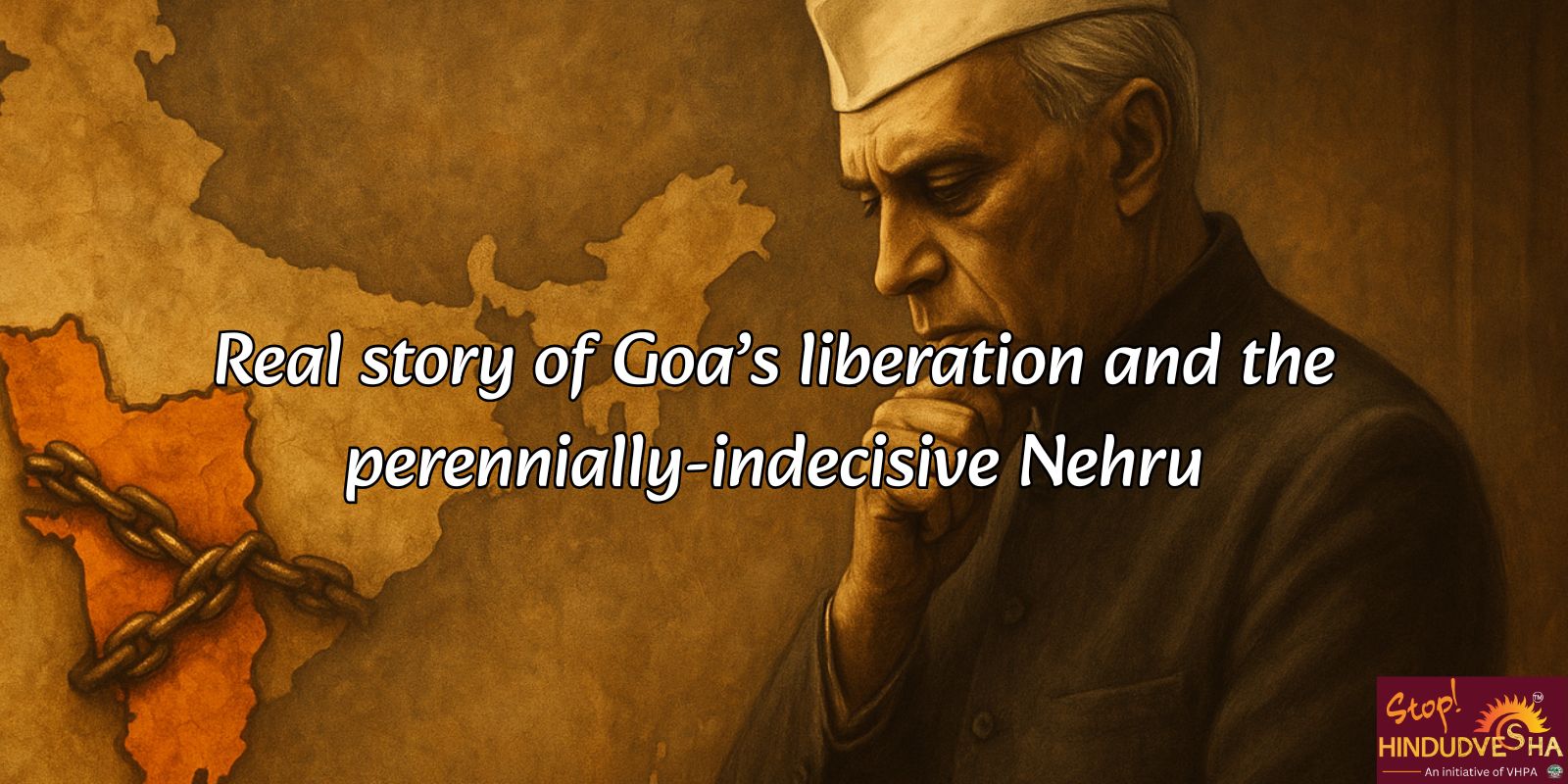
- The true story of Goa’s liberation—driven by nationalist pressure and popular defiance—was long obscured to sustain Nehru’s carefully crafted persona as a peace-loving statesman above politics.
- Archival evidence shows that Nehru’s indecision and moral posturing, not strategic foresight, delayed Goa’s freedom for over a decade, yet official histories portrayed his eventual action as enlightened restraint.
- The contributions of grassroots satyagrahis, revolutionaries, and volunteer groups like the RSS and Azad Gomantak Dal were minimized to maintain the illusion of Nehru’s singular moral leadership.
- Media and academic narratives sanitized Nehru’s hesitations, turning a reluctant capitulation to nationalist pressure into a triumph of diplomacy and “non-violence.”
- By hiding the moral and political cost of his temporizing, post-Nehruvian historiography turned Operation Vijay into a myth of visionary statesmanship rather than the exposure of a decade-long failure of will.
Following India’s independence in 1947, Prime Minister Jawaharlal Nehru envisioned the nation’s foreign policy as an extension of his own moral and intellectual persona rather than a pragmatic articulation of India’s national interests. Draped in the rhetoric of Panchsheel, non-alignment, and internationalism, Nehru’s framework sought not so much to safeguard India’s sovereignty as to project himself and, by extension, India as a moral arbiter between global powers. The policy was less an assertion of national strength and more an exercise in moral posturing, carefully calibrated to preserve Nehru’s image as the apostle of peace and the heir to Gandhi’s pacifist idealism.
Within this paradigm, decisive action, especially the use of force to secure India’s territorial integrity, was continually deferred in favor of symbolic restraint. Nehru’s handling of the European colonial enclaves that lingered within Indian borders: Goa, Daman, Diu under Portuguese rule, and Pondicherry, Karaikal, Chandernagore, and Mahé under French control, revealed this chronic hesitation. His reluctance to act decisively was not born of moral conviction alone, but of an overweening concern that any military initiative might blemish the carefully cultivated aura of moral superiority he so prized on the world stage. In the end, his temporizing posture allowed foreign powers to defy Indian sovereignty long after independence, an abdication of responsibility disguised as moral restraint.
Perrennially Indecisive Nehru
Portugal’s dictatorial regime under António de Oliveira Salazar advanced an obstinate legal fiction: that Goa and its sister territories were not colonies but integral provinces of metropolitan Portugal. This claim was designed to evade the rising global tide of decolonization, allowing Lisbon to deny the applicability of United Nations resolutions on self-determination.[1]
Nehru, though publicly rejecting the Portuguese claim, consistently refused to confront it through decisive action. His rhetoric of restraint, couched in phrases such as India being “civilized” and “peace-loving,” became a convenient moral alibi for political inaction. Beneath this façade of ethical diplomacy lay a deeper apprehension: that any assertion of military strength might tarnish his carefully crafted image as a statesman of conscience. Nehru’s obsession with how India was perceived in Western capitals, particularly London and Washington, often overshadowed the imperatives of national unity and sovereignty. In the early 1950s, his speeches betrayed a chronic anxiety about international opinion, as though India’s legitimacy depended not on the fulfillment of its civilizational destiny but on the approval of Western democracies whose recognition he coveted for his self-fashioned role as the moral leader of the “Third World.”[2]
This approach, while consistent with Nehru’s self-styled globalism, stood in glaring contrast to the postcolonial public’s expectation that India’s unification and decolonization be completed with urgency and resolve. For a nation freshly emerged from centuries of subjugation, Goa’s continued bondage under Portuguese rule symbolized a festering humiliation, a colonial relic surviving mockingly within independent India’s borders. Yet Nehru, captive to his own idealism, allowed this anomaly to persist. His diplomacy, bound to what B. R. Nanda aptly describes as his “moral internationalism,” reflected a statesman more anxious about how history, and the Western world, would judge him than about how posterity would judge his failure to act. In Nehru’s calculus, India’s moral stature was to be preserved even at the cost of its territorial dignity; image triumphed over urgency, and moral exhibitionism masqueraded as strategic patience.[3]
While the French negotiated a peaceful withdrawal from their Indian possessions, the Portuguese impasse persisted. Salazar’s intransigence met with Nehru’s restraint, creating a decade-long diplomatic stalemate that alienated nationalist opinion at home.
Suppression of Popular Movements and the Paradox of Nonviolence
The contradiction in Nehru’s policy became stark when his government, despite its professed faith in nonviolence, began actively discouraging indigenous movements that sought Goa’s liberation through precisely that means. Grassroots nationalist groups and Gandhian satyagrahis from Maharashtra and Karnataka had mobilized as early as 1946–47, invoking the very moral idiom that Nehru claimed as the cornerstone of India’s diplomacy. Yet, when the same moral force arose organically from within the nation, his government recoiled. Instead of harnessing this popular idealism, Nehru chose to suppress it, fearing that a spontaneous people’s movement might spiral beyond his control, provoke Portuguese retaliation, and, more crucially, blemish his carefully cultivated image of diplomatic restraint before the West. The result was a striking paradox: the apostle of moral internationalism silenced moral nationalism at home, sacrificing India’s self-respect to preserve his own aura of moderation abroad.
The tragic culmination of this hesitation occurred in August 1955, when hundreds of peaceful Satyagrahis attempted to march into Goa and were fired upon by Portuguese troops. Official estimates recorded over 30 fatalities, though independent accounts suggest the toll was higher.[4] Despite widespread outrage and condemnations in Parliament, Nehru refused to authorize a military response. His justification —that India must not “complicate international relations” by resorting to force —epitomized what later historians, such as T. R. Sareen, described as “diplomatic inertia.”[5]
Ironically, Nehru’s absolutist adherence to nonviolence, divorced from political realism, ended up subverting the very moral purpose it sought to serve. What began as a lofty ideal of restraint degenerated into a paralysis of will, emboldening the oppressor and humiliating the liberated. As the Portuguese regime continued to imprison, torture, and execute Goan activists, India’s conspicuous passivity lent colonial arrogance a perverse legitimacy. Far from elevating India’s moral stature, Nehru’s timidity made the Republic appear indecisive and complicit in the perpetuation of foreign tyranny. Within India, nationalist critics denounced this as moral exhibitionism, a theatre of virtue that trivialized human suffering. They argued, with growing conviction, that Nehru’s obsession with international approval had betrayed the very anti-imperialist ethos that had once animated India’s freedom struggle, turning the rhetoric of peace into an instrument of political vanity.
The “Pimple” Analogy and the Politics of Delay
Perhaps the most striking symbol of Nehru’s dismissive attitude toward Goa’s plight is the oft-cited remark, recorded by several contemporaries, that he regarded Goa as “a small pimple that could be pinched off once the rest of the body was healthy.” Whether apocryphal or not, this statement encapsulates the psychological dimension of Nehru’s foreign policy: an inclination to prioritize image and gradualism over decisive action.[6]
Historians like P. N. Chopra and Sareen argue that this “pimple analogy” was more than mere rhetoric; it reflected Nehru’s belief that India must first consolidate economically, politically, and diplomatically before asserting itself militarily.[7] Yet, such caution effectively postponed Goa’s liberation for nearly fourteen years after independence. During this period, Goan revolutionaries like Mohan Ranade, Purushottam Kakodkar, and Tristão de Bragança Cunha endured imprisonment, exile, and torture under Portuguese repression.[8]
The delay also exposed the inherent contradictions of Nehruvian idealism. While professing anti-colonial solidarity at the United Nations, India tolerated colonial rule within its own territory. Goa thus became a moral and strategic anomaly, a relic of European imperialism tolerated by a postcolonial state that prided itself on moral consistency.[9]
In retrospect, Nehru’s reluctance to act decisively in Goa epitomizes a broader pattern that defined much of his foreign policy, an unending struggle between ethical universalism and civilizational realism. Time and again, his lofty ideals clashed with the pragmatic imperatives of statecraft, leaving India suspended between moral rhetoric and strategic hesitation. Goa thus became not merely a territorial question, but a microcosm of Nehru’s larger dilemma: the preference for appearing righteous over being resolute. It was only when mounting nationalist pressure, public disillusionment, and inescapable geopolitical compulsions converged by 1961 that Nehru’s idealism finally capitulated to necessity, giving way, almost reluctantly, to the pragmatism that culminated in the swift and successful Operation Vijay.
Nationalist Mobilization
In stark contrast to Nehru’s “cautious diplomacy,” nationalist and volunteer organizations carried forward the momentum for Goa’s liberation through a decade of grassroots mobilization, nonviolent protest, and underground resistance. Between 1946 and 1961, a complex tapestry of movements, ranging from Gandhian satyagrahas to revolutionary militancy, sustained public pressure on both the Portuguese regime and the Indian state. These movements, operating largely outside formal political channels, reflected the moral impatience of postcolonial India, where civil society often outpaced the state in fulfilling the unfinished task of decolonization.
Rashtriya Swayamsevak Sangh (RSS) and Volunteer Nationalism
Archival accounts, oral testimonies, and organizational histories reveal that the Rashtriya Swayamsevak Sangh (RSS) played a discernible role in the anti-Portuguese mobilizations that kept the Goa issue alive through the 1950s.[10] At a time when the Indian government prioritized diplomatic caution, the RSS embodied a grassroots model of patriotic activism, motivated by civilizational duty rather than geopolitical calculation.[11]
Throughout the 1950s, RSS swayamsevaks participated in Satyagrahas led by figures such as Jagannath Rao Joshi, attempting to enter Portuguese-held Goa in defiance of colonial authority. Many were arrested, beaten, or imprisoned by Portuguese troops. These movements were remarkable not for their size but for their symbolic defiance; they asserted the moral illegitimacy of colonial rule at a time when official India preferred silence.
The RSS’s participation in these campaigns reflected its broader ideological commitment to national unity and territorial integrity, a principle it viewed as non-negotiable in the face of foreign occupation. This ideological clarity contrasted with the ambivalence of state policy, situating the organization as a custodian of public conscience rather than a political actor.
The RSS’s most decisive contribution came in the liberation of Dadra and Nagar Haveli in 1954, a watershed event that served as a strategic and psychological prelude to Goa’s eventual freedom.[12]
Leaders such as Raja Wakankar and Nana Kajrekar, operating under severe resource constraints, conducted detailed reconnaissance of the territory, established covert communication networks with local nationalist groups, and coordinated with parallel organizations, including the Azad Gomantak Dal (AGD) and the National Liberation Movement Organization (NMLO).[13]
In a series of coordinated actions between July 21 and July 28, 1954, volunteers from these groups successfully captured outposts and administrative centers. On 28 July, Portuguese forces in Naroly capitulated after being surrounded by armed volunteers, effectively ending Portuguese control over the enclave. Within weeks, Dadra and Nagar Haveli became de facto free territories, administered by a pro-Indian provisional government.
This campaign demonstrated the viability of decentralized, volunteer-driven operations independent of state machinery. It combined patriotic fervor, strategic planning, and moral conviction, elements that would later characterize the broader nationalist agitation in Goa. The success emboldened liberationists, proving that Portuguese power could be challenged without direct Indian military intervention.
Azad Gomantak Dal and Mohan Ranade
While Gandhian nonviolence remained one strand of the liberation struggle, another, more militant current emerged under the leadership of Mohan Ranade and the AGD.
A devoted follower of Vinayak Damodar Savarkar, Ranade entered Goa clandestinely in 1950, disguised as a schoolteacher. His mission was not only to awaken local consciousness but to organize armed resistance against Portuguese rule. Through the AGD, Ranade trained local youth, procured weapons, and executed sabotage operations against Portuguese police stations and communication lines.
Ranade’s arrest in 1955 marked a turning point in the movement. He was tried under draconian colonial laws, sentenced to prolonged imprisonment, and held in solitary confinement in Lisbon for fourteen years. His incarceration until 1969, long after Goa’s liberation, became a powerful symbol of individual sacrifice and the moral cost of India’s diplomatic hesitation.
The AGD’s operations were complemented by a mosaic of nationalist and political organizations that collaborated across ideological lines. The United Front of Goans, the Goan People’s Party, and the Communist Party of India (CPI) all played roles in mobilizing resources, disseminating propaganda, and sustaining underground networks.
What is striking about these alliances is their transregional character; activists from Maharashtra, Karnataka, and Gujarat worked alongside Goan revolutionaries, transforming a regional issue into a pan-Indian liberation cause. The ideological diversity of these movements, from Savarkarite nationalism to Marxist anti-imperialism, underscored the shared conviction that foreign rule in Goa was incompatible with India’s independence.
Ram Manohar Lohia and the Spark of 1946
The earliest and perhaps most catalytic phase of Goa’s freedom struggle can be traced to June 1946, when Ram Manohar Lohia, the prominent socialist leader, entered Goa and addressed a mass gathering at Margao. His fiery call for civil liberties and national freedom electrified the Goan youth, initiating a new phase of open defiance against Portuguese authority.[14]
Lohia’s subsequent arrest and deportation triggered waves of protest across Goa and the Konkan region. The event had far-reaching symbolic consequences; it transformed Goa’s struggle from a local grievance into a national cause. Newspapers in Bombay, Poona, and Delhi carried reports of Portuguese repression, while public meetings condemned the colonial government’s brutality.
The movement that followed, driven by students, journalists, and underground pamphleteers, kept the flame of resistance alive through a combination of nonviolent demonstrations, secret publications, and cross-border activism. Lohia’s intervention thus bridged the ideological spectrum of India’s freedom heritage, connecting Gandhian moral resistance with the post-independence drive for total decolonization.
Continuity of Resistance
Together, the efforts of the RSS, AGD, and socialist leaders like Lohia represent a continuum of resistance that transcended ideological and methodological divides. Nonviolent idealism, militant nationalism, and socialist activism coexisted within a single historical project, the assertion that India’s independence remained incomplete so long as a single inch of its soil lay under colonial rule.
By the late 1950s, the moral and political tide had turned decisively against Nehru’s policy of inertia. His diplomatic overtures to Lisbon increasingly appeared not as statesmanship but as evasion, a desperate attempt to preserve a crumbling façade of moral superiority. Across India, the nationalist underground and regional movements had gathered unstoppable momentum, their courage and sacrifice exposing the hollowness of the government’s restraint. The state could no longer suppress the moral legitimacy or the emotional force of this public sentiment without alienating its own people. Cornered by the convergence of popular outrage, political pressure, and strategic necessity, Nehru’s government finally abandoned its moral grandstanding. Thus, what began as a reluctant concession rather than visionary leadership culminated in Operation Vijay in December 1961, an overdue assertion of sovereignty that vindicated the very realism Nehru had long resisted.
Operation Vijay and the Breaking Point of 1961
By 1961, the Nehruvian policy of “patient diplomacy” had reached its natural limits. What had once appeared as principled restraint increasingly came to be perceived as diplomatic paralysis. The Portuguese regime, entrenched in its imperial delusions, had made it clear that it would neither negotiate nor recognize the United Nations’ decolonization resolutions. At the same time, Nehru’s carefully cultivated international image, as a global statesman and apostle of peace, was under strain.
The late 1950s were marked by a steady erosion of Nehru’s diplomatic standing. The Sino-Indian border tensions, including the 1959 skirmishes at Longju and Kongka Pass, exposed the vulnerability of India’s idealistic foreign policy. Nehru’s insistence on moral persuasion as a substitute for strategic preparedness began to face criticism not only from opposition leaders but also from within the Congress Party itself.
Domestically, the climate was equally volatile. The massacre of August 1955, in which Portuguese troops opened fire on unarmed Indian Satyagrahis, killing and wounding dozens, became a turning point in public sentiment. Reports of torture, imprisonment, and censorship within Goa further inflamed nationalist opinion. Indian newspapers carried editorials demanding immediate action, and Parliament witnessed heated debates questioning the government’s passivity.
The Goa Liberation Council, formed by exiled Goan leaders in Bombay and Pune, intensified propaganda efforts and urged the government to abandon its “sterile diplomacy.” By 1960, with Portugal joining NATO and fortifying its positions in Goa, the moral and political cost of inaction had become untenable.
Cabinet papers, intelligence briefings, and military correspondence from the period indicate that Nehru’s eventual decision to authorize Operation Vijay was not an act of political will but one of reluctant inevitability.[15]
Defense Minister V. K. Krishna Menon, despite his own ideological affinities with Nehru, argued forcefully that continued restraint would erode India’s credibility as a sovereign state. The Chiefs of Staff, General P. N. Thapar, Air Marshal A. M. Engineer, and Admiral Nanda, presented detailed operational plans, emphasizing that the Portuguese military presence was negligible and that the operation could be completed with minimal resistance.
According to several contemporaneous accounts, including those of senior bureaucrats in the Ministry of External Affairs, Nehru vacillated until mid-December 1961. He feared that military intervention might invite condemnation from Western powers and complicate India’s standing in the Non-Aligned Movement. However, mounting cabinet pressure, particularly from Home Minister Lal Bahadur Shastri and Krishna Menon, eventually tipped the balance.
On 14 December 1961, Nehru gave his final consent to the operation. His directive, characteristically cautious, framed the campaign as a limited “police action,” a linguistic choice meant to soften its military implications and preserve India’s moral high ground in international diplomacy.
Operation Vijay commenced in the early hours of 17 December 1961 under the unified command of Lieutenant General J. N. Chaudhuri, then head of the Southern Command. On 19 December 1961, after just 36 hours of combat, Portuguese Governor-General Manuel António Vassalo e Silva surrendered unconditionally to Major General K. P. Candeth. Goa, Daman, and Diu were thus integrated into the Indian Union, bringing to an end 451 years of European colonial presence on the subcontinent.
In public, Nehru sought to preserve his moral narrative by framing the military action as a reluctant “last resort.” Addressing Parliament, he declared that “the Portuguese left no choice open to us,” and lamented that India’s patience had been “strained to the utmost.” This rhetoric, though diplomatically convenient, masked the deep ideological unease that had long defined his leadership, a man torn between the imperatives of statecraft and the sanctity of his own image. Private communications, now accessible through declassified archives and memoirs of his contemporaries, reveal a far more conflicted Nehru: one painfully aware that prolonged inaction risked undermining India’s sovereignty, yet fearful that assertive action would expose the hollowness of his pacifist idealism. The result was a reluctant statesman compelled to act not from conviction, but from the exhaustion of every other possibility, a man forced by history to betray the very illusions that had once sustained his stature.
Wrapping Up
The liberation of Goa stands as both a military victory and a moral reckoning. Far from being the product of Nehru’s principled diplomacy, it was the inevitable breaking point of his long hesitation, where image triumphed over integrity and restraint replaced resolve. For fourteen years, Goa’s suffering was prolonged to protect the Prime Minister’s carefully cultivated stature as a moral statesman admired by Western powers. Yet, it was not his government but the courage of grassroots nationalists, volunteers, and satyagrahis that kept India’s conscience alive. When Operation Vijay finally unfolded, it was less an act of visionary leadership than of reluctant necessity—forced by public pressure and the undeniable call of unfinished decolonization. The true story of Goa’s freedom dismantles the myth of Nehruvian moralism, revealing how a nation’s sovereignty was reclaimed not through diplomacy or doctrine, but through the unyielding spirit of those who refused to accept subjugation in any form.
Citations
[1] British Modern Military History Society – The Annexation of Goa; https://bmmhs.org/the-annexation-of-goa/#:~:text=He%20explained%20to%20Salazar%20that,upstart%E2%80%9D%20like%20Nehru%20threatening%20him.
[2] How Nehru and Congress had betrayed Goa: Declined to send armed forces, denied support to liberation efforts; https://www.opindia.com/2022/02/pm-reminds-of-nehru-and-congress-treachery-goan-liberation-delayed-refusal-to-send-forces/
[3] IN CONVERSATION- B R NANDA; https://www.youtube.com/watch?v=EijQbXcwrAU
[4] The story of Bloodstained Satyagraha of 15 August 1955.; https://www.youtube.com/watch?v=piggbgbH1Wg
[5] Anniversary tribute: How TR Sareen helped scholars researching Indian freedom fighters overseas; https://scroll.in/article/1079986/anniversary-tribute-how-tr-sareen-helped-scholars-researching-indian-freedom-fighters-overseas
[6] Liberation of Goa: Removing The Portuguese Pimple On The Face Of Mother India – Indiafacts; https://www.indiafacts.org.in/liberation-of-goa-removing-the-portuguese-pimple-on-the-face-of-mother-india/
[7] Book review: Inside Goa by Manohar Malgonkar; https://www.indiatoday.in/magazine/society-and-the-arts/books/story/19830831-book-review-inside-goa-by-manohar-malgonkar-770951-2013-07-17#
[8] An Expert Explains: Politics and history in Goa; https://indianexpress.com/article/explained/explained-goa-politics-history-liberation-movement-7768271/
[9] A Forgotten Chapter of Goa’s Freedom Struggle: Vishwanath Narayan Lawande and the RSS-Led Struggle Against Portuguese Tyranny; https://tfipost.com/2025/09/a-forgotten-chapter-of-goas-freedom-struggle-vishwanath-narayan-lawande-and-the-rss-led-struggle-against-portuguese-tyranny/
[10] Goa Liberation Day: Role of Bharatiya Jan Sangh and RSS; https://organiser.org/2024/12/19/102026/bharat/goa-liberation-day-role-of-bharatiya-jan-sangh-and-rss-in-the-liberation-of-goa-2/
[11] Goa Liberation Struggle and RSS Swayamsevaks – Arise Bharat; https://arisebharat.com/2017/12/19/goa-liberation-struggle-and-rss-swayamsevaks/
[12] Dadra and Nagar Haveli: RSS Swayamsevaks, freedom struggle against the Portuguese and the story of ‘one-day Prime Minister’; https://www.opindia.com/2021/08/dadra-and-nagar-haveli-liberation-freedom-struggle-rss-swayamsevaks-ias-prime-minister-story/
[13] Goa’s First Movement For Independence; https://newindiasamachar.pib.gov.in/WriteReadData/story/2022/Jun/S202206166265.pdf
[14] Lohia: Father of Anti-Congressism? | Biography and Political Thought; https://www.youtube.com/watch?v=E3MoLeRKQo8
[15] How Goa Became Part of India | Operation Vijay; https://www.youtube.com/watch?v=-2Kf4mvz49w

Donate to HINDUDVESHA
Our Mission is to explore and expose Hindudvesha through research analysis, education and response.
SUPPORT US