

Religious Liberty Under Siege: Why Duncan’s “False God” Rhetoric Undermines America’s Ideals
 Dr. Jai G. Bansal · 09/28/2025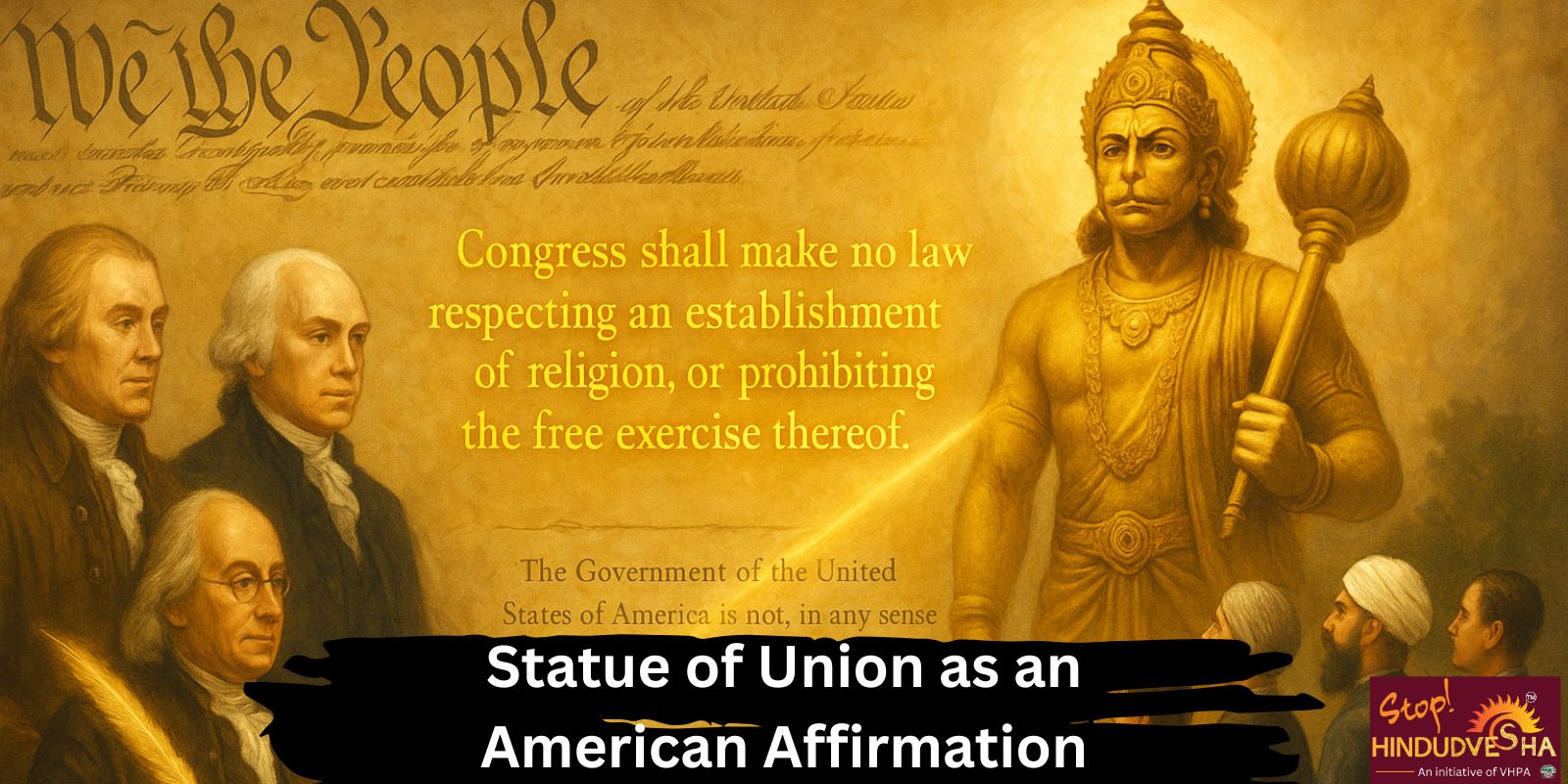
- Duncan’s “false god” remark defies the First Amendment’s guarantees of free exercise and prohibition of religious establishment, ignoring Supreme Court precedent that forbids officials from judging the truth of any religion.
- Declaring Hanuman “false” assumes a power no person holds—the authority to define the true form of God.
- The 90-foot Sugar Land statue affirms America’s pluralism, not threatens it, while Duncan’s “Christian nation” claim distorts U.S. history.
- Such rhetoric marginalizes Hindus, fosters fear, and risks emboldening prejudice. History shows how legitimized hostility against minorities translates into exclusion, discrimination, and even violence.
- Duncan’s stance is both ironic and damaging to America’s credibility as a global champion of religious liberty.
In September 2025, Alexander Duncan, a Texas Republican running for the United States Senate, sparked outrage by denouncing a 90-foot statue of Lord Hanuman in Sugar Land as “a false statue of a false Hindu God.” He went further, invoking the Bible to declare that America is a “Christian nation” where such symbols should not exist. These remarks were not casual slips of the tongue. They represent an open attempt by a political aspirant to delegitimize one of the world’s oldest faith traditions and to elevate his personal theology above the constitutional framework of the United States.
At stake is not merely the dignity of Hindu Americans, but the very principle of religious liberty that defines the American republic. Duncan’s words revive the old specter of majoritarian arrogance—one that has historically targeted Jews, Catholics, Muslims, and others before turning toward Hindus. His claim that a community’s sacred deity is “false” undermines the First Amendment, insults millions of American Hindus, and sows seeds of religious hostility in an increasingly diverse society.
This rebuttal dismantles his arguments point by point—through constitutional reasoning, philosophical analysis, historical context, and ethical reflection—demonstrating why Duncan’s diatribe is not only offensive but fundamentally un-American.
Duncan vs. the First Amendment
At the heart of Alexander Duncan’s statement is a direct affront to the U.S. Constitution. By declaring that America is a “Christian nation” and branding Hindu deities as “false,” he disregards the very words of the First Amendment: “Congress shall make no law respecting an establishment of religion, or prohibiting the free exercise thereof; or abridging the freedom of speech, or of the press; or the right of the people peaceably to assemble, and to petition the Government for a redress of grievances.”[1]
These provisions are not symbolic ideals but binding constitutional law. For Hindu Americans, the right to build temples, worship Hanuman, and install sacred statues flows directly from the protection against prohibiting the “free exercise” of religion. Duncan’s words seek to delegitimize that right by suggesting that one community’s worship is invalid. At the same time, his assertion that Christianity alone is “true” echoes the kind of preference the Establishment Clause forbids by prohibiting government from “respecting an establishment of religion.” His rhetoric, therefore, stands in direct conflict with the constitutional principles he aspires to uphold.
Supreme Court precedent has consistently reiterated this point. In United States v. Ballard (1944)[2], the Court ruled that no government body has the authority to decide whether a religion’s beliefs are true or false, only whether they are sincerely held. Duncan’s claim that Hanuman is a “false god” is precisely the kind of theological judgment the Court has said government cannot make. In Church of Lukumi Babalu Aye v. Hialeah (1993)[3], the Court struck down ordinances that targeted the Santería faith, holding that hostility toward a particular religion is unconstitutional. Duncan’s hostility toward Hindu Dharma, if translated into action—say, in zoning disputes or public policy—would be vulnerable to the same condemnation. More recently, in Masterpiece Cakeshop v. Colorado (2018)[4], the Court emphasized that public officials must not act with hostility toward religion, but instead with neutrality. Duncan’s rhetoric is anything but neutral; it carries the hallmarks of prejudice.
The Equal Protection Clause of the Fourteenth Amendment reinforces this analysis. In Larson v. Valente (1982)[5], the Court held that the government cannot prefer one denomination over another. When Duncan insists that America is Christian and that Hindu worship is illegitimate, he is effectively advocating for state preference of one faith over others. If Christian symbols such as crosses and nativity scenes are permitted without challenge, then Hindu statues deserve the same recognition.
Some may argue that Duncan’s words are shielded by free speech, but that defense misses the point. He is not an ordinary private citizen; he is a candidate for public office. The speech of political figures carries broader consequences, shaping policy, public opinion, and the treatment of vulnerable communities. When a man who seeks to sit in the U.S. Senate proclaims Hindu Dharma “false,” it is not just an opinion but a signal of bias that could influence governance. Courts have long recognized that government officials and those aspiring to public authority are held to a higher standard of neutrality in matters of faith. The Constitution does not permit them to weaponize theology against minority religions.
No One Owns the Image of the Divine
Duncan’s declaration that Hanuman is a “false god” collapses under the slightest scrutiny. To make such a claim is to assume power that no person possesses—the ability to define the true form of divinity. If he insists that Hanuman cannot be God, then he must also establish what God looks like and explain how such knowledge can be objectively proven. Yet no human being can empirically prove or disprove the divine. Across traditions, the sacred remains beyond the reach of scientific demonstration.
The subjectivity of divine imagery further exposes the weakness of his claim. Every religion expresses the sacred differently. Christians revere the cross and statues of Jesus and Mary, Buddhists venerate images of the Buddha, Muslims honor the Qur’an, and Hindus worship murtis that embody aspects of the divine, such as Hanuman. If one representation is dismissed as idolatry, fairness demands that all others be measured by the same standard. By his logic, the crucifix or the stained-glass window would be as much an “idol” as the Hanuman murti.
Even his scriptural reasoning falters. He cites the Old Testament commandment against graven images, yet Christianity itself is rich with religious art—cathedrals lined with sculptures, paintings of saints, and icons of the Virgin Mary.
Beyond logic and scripture lies a broader comparison. In India, where Hindu Dharma has flourished for millennia, religious minorities have long enjoyed the freedom to build churches, mosques, and synagogues. The Indian Constitution explicitly protects the right to practice and propagate one’s faith, and Christian and Muslim communities have flourished under this protection. It is therefore deeply ironic that Hindu Dharma, a tradition that has historically extended tolerance to others, should now be branded “false” in the United States—a country that claims to stand as the global champion of liberty.
The implications are troubling. America’s reputation as a defender of religious freedom depends on its willingness to uphold that freedom at home. When politicians like Duncan demean one religion while elevating another, they tarnish not only the dignity of Hindu Americans but also the credibility of the nation itself.
Statue of Union as an American Affirmation
To dismiss Hanuman as a “false god” is also to ignore the profound historical and cultural depth the deity represents. For Hindus, Hanuman is not merely a figure of worship but a symbol of devotion, courage, and selfless service. In the Ramayana, he stands as the ideal devotee—fearless in battle, unwavering in loyalty, and selfless in service to righteousness. His presence in temples, homes, and public life has, for centuries, reminded millions of the strength found in humility and the power found in faith. To demean such a figure is to dismiss an entire civilizational heritage.
Hindu Dharma itself has been part of the American landscape for well over a century. The earliest Vedanta societies introduced Americans to Hindu philosophy in the late 1800s, and waves of immigrants since then have built temples, organized festivals, and shared practices such as yoga and meditation with the broader culture. Today, Diwali lights up American cities, Holi is celebrated on college campuses, and Ayurveda is a growing field of wellness. The 90-foot Hanuman statue in Sugar Land, called the “Statue of Union,” is the largest of its kind in North America and a community-funded project that embodies harmony, strength, and devotion. It is not a threat to America’s identity but an affirmation of it: the promise that people of all faiths can freely practice and contribute to the civic fabric.
Duncan’s invocation of a “Christian nation” ignores the nation’s own history. The Founding Fathers made clear that no religion would hold official status. Jefferson and Madison argued fiercely for religious liberty, and the Treaty of Tripoli, ratified by the Senate in 1797[6], plainly stated that “the Government of the United States of America is not, in any sense, founded on the Christian religion.” To deny this history is to rewrite the foundations of the republic.
Social Cost of Duncan’s Rhetoric
The dangers of Duncan’s remarks cannot be measured only in constitutional terms. They cut deeply into the social fabric of a pluralistic nation. The United States draws its strength from the ability of different communities to live side by side, each practicing its faith without fear. When a candidate for public office calls the deity of an entire community “false,” he does more than express a personal opinion—he signals that certain citizens do not belong fully to the nation. That message corrodes trust, breeds suspicion, and weakens the civic bonds that hold a diverse society together.
For Hindu Americans, the impact is immediate. Public rhetoric of this kind creates a climate where families celebrating Diwali, children wearing sacred symbols, or temples planning festivals may feel unsafe. History offers sobering parallels. Jews in Europe, Catholics in early America, and Muslims in the years after 9/11 all endured marginalization when leaders gave voice to prejudice. When discrimination is legitimized from the podium, it rarely remains confined to words; it filters down into daily interactions, into policies, and sometimes into violence.
This danger is not limited to one community. If it becomes acceptable to declare Hindu Dharma illegitimate, it opens the door for similar attacks on Sikhs, Buddhists, Jews, or even Christian denominations outside the mainstream. America’s founders understood this slippery slope and designed a constitutional order to prevent it, insisting that liberty for one group is inseparable from liberty for all.
The irony of Duncan’s stance becomes sharper when seen against a global backdrop. In India, the birthplace of Hindu Dharma, churches, mosques, and synagogues have coexisted alongside temples for centuries. The Indian Constitution explicitly guarantees minorities the freedom to practice and propagate their faith, and Christian and Muslim communities have flourished under that protection. Hindu Dharma’s own history demonstrates tolerance, making Duncan’s attempt to brand it “false” in the United States especially hollow.
America has long presented itself as the world’s champion of religious liberty. When its politicians demean one faith while elevating another, they undermine that reputation and weaken the nation’s moral authority. To safeguard its credibility abroad and preserve harmony at home, the United States must reject rhetoric that treats any community’s faith as counterfeit. Protecting pluralism is not a concession to minorities—it is the very essence of America’s civic promise.
Closing Reflections
Alexander Duncan’s rhetoric collapses under its own contradictions. He dismisses Hindu Dharma as “false” without offering proof—and more importantly, without any authority to make such a judgment. The U.S. Constitution grants no politician the power to declare which faith is valid. On the contrary, it demands strict neutrality, protecting the right of every community to worship freely, without intimidation or exclusion. Duncan’s statement is therefore not a harmless opinion; it betrays the very principles he seeks to uphold as a candidate for public office.
The real danger lies in its consequences. To call the God of millions “false” is to mark an entire community for suspicion and scorn. Hindu Americans have lived, worked, and contributed to the United States for generations. The Hanuman statue in Sugar Land symbolizes devotion and harmony, not division. Rejecting Duncan’s remarks is not only a defense of Hindus—it is a defense of the American ideal itself.
Citations
[1] Bill of Rights as Ratified by the States December 15, 1791 (National Archives); https://www.archives.gov/files/legislative/resources/education/bill-of-rights/images/ratified.pdf
[2] United States v. Ballard, 322 U.S. 78 (1944) (Justia); https://supreme.justia.com/cases/federal/us/322/78/
[3] Church of the Lukumi Babalu Aye, Inc. v. City of Hialeah, 508 U.S. 520 (1993) (Justia); https://supreme.justia.com/cases/federal/us/508/520/
[4] Masterpiece Cakeshop, Ltd. v. Colorado Civil Rights Commission, 584 U.S. (2018) (Justia); https://supreme.justia.com/cases/federal/us/584/16-111/
[5] U.S. Reports: Larson v. Valente, 456 U.S. 228 (1982) (Library of Congress); https://www.loc.gov/item/usrep456228/
[6] Treaty Between the United States and Tripoli (U.S. Constitution.net); https://www.usconstitution.net/tripoli-html/

Donate to HINDUDVESHA
Our Mission is to explore and expose Hindudvesha through research analysis, education and response.
SUPPORT US