

Project 2025: How a Republican Plan Could Rock the Indian American Dream
 Rakesh Krishnan Simha · 11/25/2025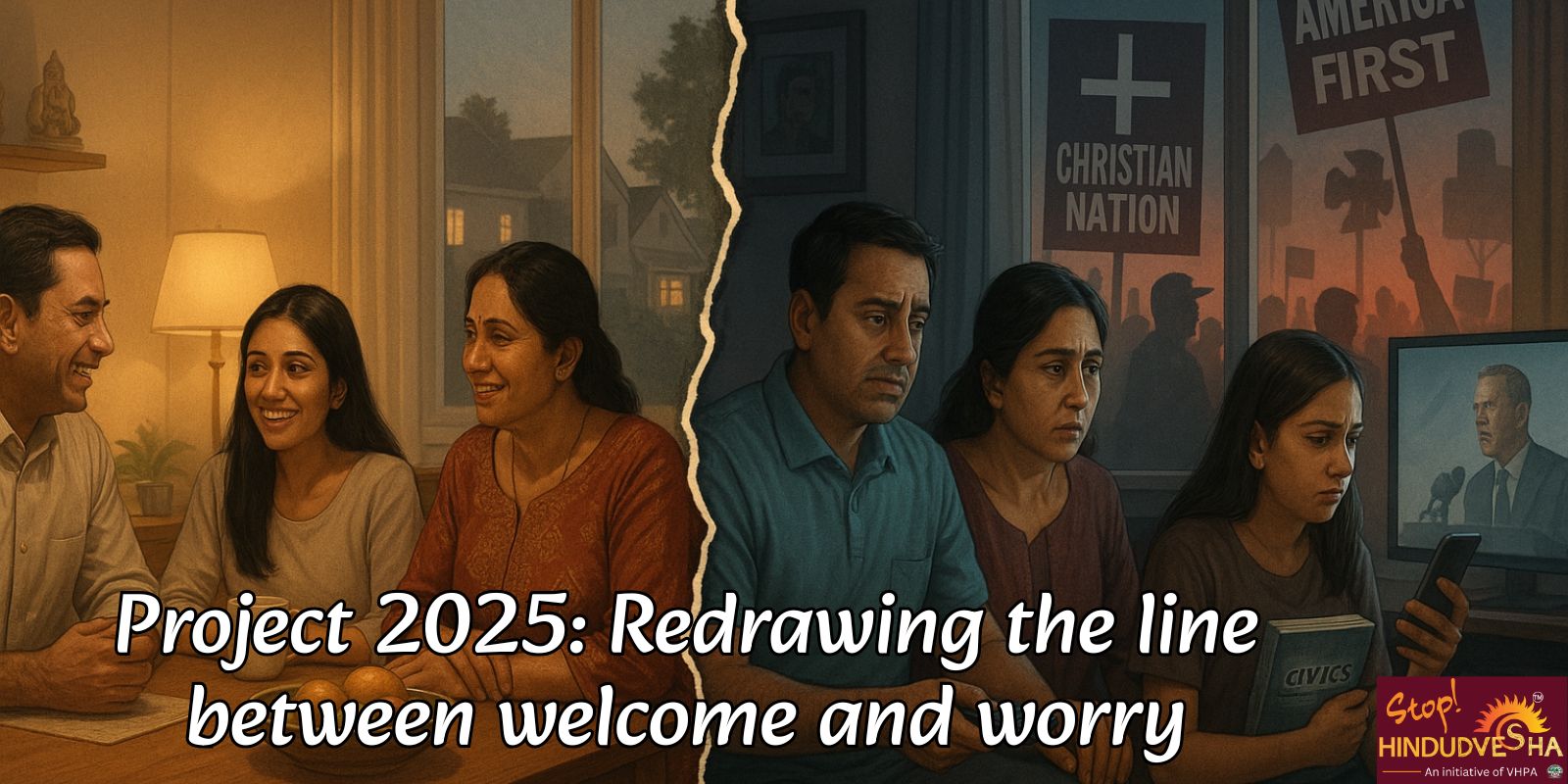
- Many Indian American families who once felt fully integrated into the country are now confronting rising discomfort as anti-immigrant and anti-Asian sentiment becomes more visible in public and political spaces.
- Remarks from senior political leaders and the rise of Christian nationalist groups deepen their alarm, prompting a closer investigation of Project 2025 and its implications.
- Project 2025 outlines sweeping federal restructuring, restrictive immigration reforms, weakened civil rights protections, and an elevation of Christian identity in public life, posing risks for religious and ethnic minorities.
- Tighter controls on H-1B visas, cuts to family-based immigration, and a harsher enforcement climate threaten professional stability, mobility, and long-term innovation linked to immigrant talent.
- Growing cultural hostility, uncertainty in workplaces and schools, and fears of diminished rights force many Indian Americans to question their belonging and consider contingency plans for the future.
Amit Gupta (all names changed to protect privacy) embodies the quintessential Indian American success story. Born in Edison, New Jersey — a hub for Indian immigrants — to parents who arrived from Delhi in the 1970s, the 48-year-old grew up navigating the dual worlds of Diwali celebrations and Fourth of July barbecues. His father, a chemical engineer, and mother, a schoolteacher, instilled in him the immigrant ethos: work hard, assimilate, and seize opportunities. Amit excelled at Rutgers University, earning a degree in computer science, and climbed the ranks at a Silicon Valley tech firm, now serving as a senior VP in San Jose. Married to Alpana, a fellow second-generation Indian American and doctor, they raised two daughters: Maya, 19, a freshman at UC Berkeley studying environmental science, and Tara, 16, a high school junior passionate about debate and ballet. All four are US citizens, deeply rooted in America’s multicultural fabric, with no direct ties to India beyond family trips every two years.
For decades, the Guptas thrived in California’s diverse landscape. Gupta’s career afforded a comfortable life in a Fremont suburb, where neighbors span every ethnicity. Maya and Tara, born and bred in the Bay Area, embody Gen Z optimism — protesting climate inaction, advocating for a liberal America, and dating across cultures without a second thought. Gupta often reflected on his parents’ sacrifices, viewing his family’s story as proof of America’s promise: a meritocracy where faith, skin color, or accent mattered less than drive. “We’re as American as apple pie with a side of samosas,” he’d joke at company gatherings.
Project 2025: Climate of Fear
That world cratered on Saturday, November 1, 2025, when US Vice President JD Vance said, addressing a rally of 10,000 white Christians, that he hoped his wife, raised in a Hindu household, would convert to Christianity.[1] Vance’s comment highlighted the growing anti-Indian sentiment in America. Since Donald Trump’s re-election in 2024, Indian Americans — of all religious denominations — have witnessed a spate of racist anti-Asian voices from Republicans, MAGA, and Groypers (a growing and vocal group of Christian nationalists led by right-wing rabble-rouser Nick Fuentes).[2] They have also been at the receiving end of violent attacks motivated by xenophobia.[3]
For the first time in his life, Gupta was experiencing an existential crisis. Confronted by the sudden onrush of anti-Indian hatred, he decided to find out if this was a fringe movement or whether the Republicans were in the process of engineering social change that would potentially leave people like him and his family out in the lurch. During a late-night scroll, he stumbled upon the “2025 Presidential Transition Project,” or Project 2025. This 900-page blueprint, crafted by the Heritage Foundation and over 100 conservative allies for the second Trump administration, wasn’t just policy wonkery — it was a roadmap to reshape America in the image of white Christian nationalism.[4]
As Gupta delved deeper, reading analyses from civil rights groups, his unease turned to dread. The document proposes gutting federal agencies to enforce “biblically based” family policies, prioritizing Christian values in education and public life, and rolling back protections for religious minorities. It distorts civil rights laws to enable discrimination against non-Christians, LGBTQ+ individuals, and immigrants — real or perceived — framing them as threats to a Judeo-Christian heritage.
For Gupta, a practicing Hindu who recites daily prayers, this felt personal. Project 2025’s immigration overhaul — ending birthright citizenship, mass deportations, and surveillance of “high-risk” communities — targeted his extended family, many on visas. But worse were the cultural incursions: banning “critical race theory” in schools (erasing stories like his parents’ journey), defunding public education for indoctrination, and embedding evangelical ideology in government, potentially relegating non-Christians to second-class status. “It’s not just policy,” he confided to his wife one evening. “It’s erasure. Our daughters could grow up hiding their faith or questioning their place at the table.”
Unpacking the Project
Released in April 2023, Project 2025 builds on the Heritage Foundation’s long-standing “Mandate for Leadership” series, which has shaped conservative governance since the Reagan era. The document outlines a radical dismantling of the government, including the replacement of up to 50,000 civil servants with political loyalists drawn in all likelihood from fundamentalist evangelical churches; the dismantling of agencies like the Department of Education; complete takeover of the judiciary and making it subservient to the executive; and aggressive rollbacks on environmental regulations, reproductive rights, and immigration policies.[5]
While its backers frame the Project as a necessary corrective to woke excesses and bureaucratic overreach, critics across the political spectrum warn of its authoritarian undertones and long-term societal costs. At its core, Project 2025 envisions a unitary executive model that centralizes power in the presidency, echoing the “Schedule F” executive order from Trump’s first term, which sought to reclassify federal employees for easier dismissal.[6] As of November 2025, elements of this blueprint are already being floated in transition planning, raising urgent questions about its real-world fallout.
The Immigration Blueprint
In immigration, the Project 2025 document outlines a doctrinal shift from global recruitment toward domestic consolidation.[7] It proposes shifting to a “merit-based” system that favors nuclear families and high-wage, high-skilled workers while curbing broader family reunification and guest-worker programs.[8]
The plan supports retaining the H-1B program but with strict reforms, including admitting only the “highest-skilled” and “highest-paid” workers, raising wage requirements, reducing overall caps, and increasing oversight to curb “abuses” such as outsourcing firms using the visa to obtain lower-cost labor.[9] This could limit new H-1B approvals for entry- or mid-level roles, disproportionately impacting Indian IT professionals and recent graduates transitioning from student visas. Backlogs in employment-based green cards (already decades-long for Indians due to per-country caps) could worsen if family-sponsored paths are restricted, trapping more H-1B holders in temporary status.[10]
For Indian Americans born in the US, or children of earlier immigrants (whether via H-1B or family-based immigration), the implications are somewhat indirect but real[11]. On the one hand, if fewer foreign skilled workers are brought in and fewer family-based immigrants arrive, the competition for certain jobs might shift modestly in favor of US-born workers, including second- and third-generation Indian Americans. On the other hand, many US-born Indian Americans work in sectors (technology, professional services, health) that rely on global talent flows, international collaboration, immigrant networks for innovation, and family/immigrant linkages. A significant contraction in immigration could reduce network effects, entrepreneurial vitality, and the size of immigrant-led or immigrant-augmented ecosystems that benefit US-born Indians as well.
In addition, if a stricter immigration environment fosters broader anti-immigrant sentiment, US-born Indian Americans may feel collateral effects: social tension, potential discrimination, or a more difficult environment for engagement in diaspora networks.
Thus, second- and third-generation Indian Americans may see some job-market benefits if foreign-worker inflows decline, but also face potential downsides if immigration restrictions harm the broader ecosystem in which they participate.
Addressing Misuse of H-1B Visa Program
Critics of the H-1B program argue that some employers, particularly outsourcing firms, misuse it by hiring foreign workers (around 72 percent Indian and 12 percent Chinese) at lower wages than comparable US workers, displacing Americans — especially entry-level tech graduates — and suppressing wages in certain sectors.[12]
Many US citizens report feeling they are at a disadvantage: a survey found 56 percent of Americans believed H-1B visa holders are taking jobs away from Americans.[13] Investigations and enforcement actions show systemic misuse. For instance, the Department of Labor has launched investigations into 175 cases of H-1B abuse (including underpayment of workers, false work sites, and benching of employees) as of September 2025.[14]
According to a proposed class action filed in San Francisco federal court, Tesla violates federal civil rights law through its “systematic preference” to hire visa holders and fire US citizens at disproportionate rates compared with visa holders. ”While visa workers make up just a fraction of the United States labor market, Tesla prefers to hire these candidates over US citizens, as it can pay visa-dependent employees less than American employees performing the same work, a practice in the industry known as wage theft,” the complaint said. [15] Analysts have argued that, under the “body-shop” model (contracting H-1B visa holders at low wages and rotating them), the program can suppress wages for US workers and reduce mobility for visa holders.[16]
Given this, there is a fair argument that ensuring proper enforcement of H-1B rules is important to maintain trust in the system, to protect US workers, and to preserve the integrity of the immigration-for-skill model. A program that is viewed as being abused undermines both the social and political foundations for high-skilled immigration. For young Americans worried about their career prospects, assurance that jobs are not routinely outsourced or replaced by cheaper foreign labor is an essential element of fairness and social cohesion.
Thus, Project 2025’s plan for a crackdown on misuse — stronger oversight, wage enforcement, fewer loopholes, better checks on employer compliance — is not inherently anti-immigrant but is about ensuring the system works as intended: to bring in truly skilled foreign talent to complement, not displace, US workers.
Chain Migration and Illegal Cross-Border Entries
Project 2025 explicitly calls for Congress to “end chain migration” by eliminating most family-based visa categories beyond the nuclear family, arguing it leads to uncontrolled growth in low-skilled immigration and strains resources.[17] This would require legislative action but aligns with broader Republican goals to refocus on skills over family ties.
On illegal immigration, the plan prioritizes mass deportations, border wall expansion, and expedited removals, viewing unauthorized entries as a national security and economic threat.[18] While distinct from legal pathways used by most Indian Americans, stricter enforcement could indirectly heighten scrutiny on all immigrants.
Should the administration invoke Project 2025’s proposed USCIS “pause authority,” which allows for filing freezes during program-integrity reviews, employment-based adjustments could halt altogether, pushing tens of thousands toward forced repatriation.[19]
Strategic Implications
Restrictive immigration is not merely a demographic issue; it is a strategic one. The post‑war supremacy of the United States drew sustenance from its capacity to attract and retain the world’s brightest minds. From Cold War physicists to 21st‑century data scientists, immigrant talent repeatedly rejuvenated US technological leadership. A system oriented toward closure threatens to invert that dynamic.
While Groypers and MAGA backers are entitled to believe they can replace non-whites with white European immigrants, the reality is different. Unlike the post-World War II era, when waves of European scientists, mostly refugees, migrated to the US and spurred the tech sector and Silicon Valley, such a mass exodus is highly unlikely today. Europe, currently in the midst of a prolonged population decline, doesn’t have the capacity to export people, let alone qualified scientists, to America. Plus, European citizens, who enjoy cradle-to-grave security, have very little incentive to leave their continent.
Projected over two decades, reduced inflows of high‑skill migrants could lower US GDP growth by 0.3–0.5 percentage points annually, according to simulations by the Congressional Budget Office.[20]
Patent filings, startup formation, and STEM graduate enrollment all correlate directly with immigrant participation rates. As innovation migrates eastward — to India’s technology clusters, China’s AI corridors, and Europe’s integrated research area — America’s long‑term competitiveness could weaken, even as domestic employment temporarily stabilizes.
Strategically, constricting exchange with India’s talent pool risks dulling one of Washington’s most potent soft‑power instruments: educational and scientific collaboration. The intellectual affinity between Silicon Valley and the Indian Institutes of Technology has been central to the partnership. If America becomes perceived as unwelcoming, the next generation of Indian engineers may pursue education in Canada or the United Kingdom instead, altering global talent flows irreversibly.[21]
Navigating a Fractured Partnership
Despite setbacks, US-India relations possess deep institutional ballast. Shared strategic objectives — Indo‑Pacific stability, counterterrorism, and advanced technology cooperation — will sustain engagement. Yet the quality of this partnership depends increasingly on mobility diplomacy. Unless the Trump administration differentiates between economic nationalism and academic or professional exchange, goodwill will erode faster than strategic imperatives can compensate.
In the near term, India is likely to amplify its self‑reliant digital and defense industries while seeking reciprocal concessions: easing US market access in return for collaboration. Washington, if pragmatic, may pivot to partial relaxations, such as sector‑specific visas for AI, quantum computing, and semiconductor research. Without such course corrections, Project 2025 could inadvertently push India to diversify partnerships, diminishing American leverage in the Indian subcontinent’s balance of power.
Perhaps sense will prevail in the end. The surge in hatred towards immigrants has alarmed some ultra-conservative commentators like Ben Shapiro, who commented that Fuentes’ followers “are white supremacists, hate women, Jews, Hindus, many types of Christians, brown people of a wide variety of backgrounds, Blacks, America’s foreign policy, and America’s constitution. They admire Hitler and Stalin, and that splinter faction is now being facilitated and normalized within the mainstream Republican Party.”[22]
Ripples of Fear and Family Impact
Meanwhile, within the diaspora, Project 2025 has triggered an identity reckoning. Many first-generation Indian Americans historically leaned Democratic due to pro-immigrant and secular values, but recent GOP gains among younger male voters reflected both economic conservatism and admiration for assertive governance models. The policy realities of 2025 — visa hardship, deportation anxieties — may recalibrate these orientations once again.
Beyond partisan calculations, the ‘America First’ inward-looking policies could erode institutional inclusiveness in workplaces and universities. Although Indian Americans, with high educational attainment, may not be primary targets, the broader reduction in multicultural sensitivity diminishes social cohesion. Reports from civic organizations already note an uptick in microaggressions and online hostility conflating Indian professionals with outsourcing stereotypes.
This sociocultural unease compounds professional vulnerability, amplifying feelings of conditional belonging. The community that once epitomized the immigrant success story now finds itself at the fault line of America’s identity debate. Congressman Raja Krishnamoorthi criticized JD Vance for talking of mass deportations “at a time when Hindu and Indian-American communities are confronting a climate of rising prejudice.”[23]
That’s not an alarmist view. Recently, US Immigration and Customs Enforcement (ICE) tried to deport a Native American woman — yes, a person whose ancestors have been in America for thousands of years. Leticia Jacobo was born in Phoenix, Arizona — but that didn’t stop ICE from trying to ship the 24-year-old Native American “back” to a country she doesn’t even belong to. Such incidents, even if isolated, are contributing to a climate of fear among naturalized immigrants in America. [24]
Within the Gupta home, uncertainty permeates. Maya, once vocal about social justice, now whispers fears of curtailed reproductive rights being axed under Project 2025’s all-encompassing purge. Kira, eyeing Ivy League dreams, worries that her brown skin will become a liability in a hierarchy that favors Christian whites. Gupta, sleepless, pores over relocation options: Canada? Singapore? India feels alien after 48 years in the US. At work, colleagues joke about “MAGA 2.0,” but Gupta sees omens in rising hate against Indians from the subcontinent, with as many as 80,000 online slurs post the 2024 elections won by Trump.[25]
Professionally, he treads carefully, muting political posts to avoid backlash in Trump’s tech-skeptical orbit. Family dinners, once lively with debates, now pivot to “what ifs”: What if federal jobs demand loyalty oaths echoing Christian tenets? What if Indians have to stop celebrating Diwali publicly? The emotional toll is profound — Gupta’s optimism curdles into quiet rage, rekindling generational trauma his parents buried.
Gupta isn’t packing his bag, though; he’s doubled down on activism against Project 2025’s dystopian vision yet, as polls show conservative gains, his faith in America’s pluralism wavers. “I built my life here believing in e pluribus unum,” he says. “Now, it feels like out of many, one faith rules.”
For the Guptas, the American Dream persists, but shadowed by contingency plans — a stark reminder that belonging can be revoked. Their story underscores a broader anxiety among 5 million Indian Americans: In a nation of immigrants, who gets to define “us”?
Citations
[1] “U.S. News: ‘I Hope Eventually My Wife…’: JD Vance Faces Severe Backlash for His Comments on Usha Vance’s Faith.” The Economic Times. https://economictimes.indiatimes.com/news/international/global-trends/us-news-i-hope-eventually-my-wife-jd-vance-faces-severe-backlash-for-his-comments-on-usha-vances-faith/articleshow/124984069.cms.
[2] Chabria, Anita. “MAGA’s JD Vance: Tucker Carlson, Nick Fuentes, and the Rise of a Dangerous Movement.” Los Angeles Times, November 4, 2025. https://www.latimes.com/california/story/2025-11-04/chabria-column-maga-jd-vance-tucker-carlson-nick-fuentes.
[3] “Amid Rising Hate Crimes Against Indians in US: Here’s a List of Incidents of Violence in 2025.” Republic World. https://www.republicworld.com/world-news/amid-rising-hate-crimes-against-indians-in-us-here-s-a-list-of-incidents-of-violence-in-2025.
[4] Mandate for Leadership 2025: The Conservative Promise. The Heritage Foundation. https://static.heritage.org/project2025/2025_MandateForLeadership_FULL.pdf.
[5] Pengelly, Martin. “Project 2025: Trump’s Plan to Fire Civil Service Employees Raises Alarm.” The Guardian, September 25, 2024. https://www.theguardian.com/us-news/2024/sep/25/project-2025-trump-plan-fire-civil-service-employees.
[6] “Trump’s Schedule F Plan Explained.” Protect Democracy. https://protectdemocracy.org/work/trumps-schedule-f-plan-explained/.
[7] “What Project 2025 Says About Immigration.” American Immigration Council. https://www.americanimmigrationcouncil.org/blog/what-project-2025-says-about-immigration/.
[8] “What Project 2025 Says About Immigration.” American Immigration Council. https://www.americanimmigrationcouncil.org/blog/what-project-2025-says-about-immigration/.
[9] “Project 2025 and Work-Based Immigration: Repercussions of H-1B Visa Changes.” RN Law Group. https://www.rnlawgroup.com/project-2025-and-work-based-immigration-repercussions-of-h-1b-visa-changes/.
[10] “Project 2025’s Impact on Immigration.” Nolo Legal Encyclopedia. https://www.nolo.com/legal-encyclopedia/project-2025-s-impact-on-immigration.html.
[11] “How to Keep Up with the Changes in Immigration Law.” Docketwise. https://www.docketwise.com/blog/how-to-keep-up-with-the-changes-in-immigration-law/.
[12] Martin, Jeffery. “What Project 2025 Says About H-1B Visas.” Newsweek. https://www.newsweek.com/what-project-2025-says-about-h-1b-visas-2007161.
[13] “H-1B Backlash Grows as Majority of US Citizens See Foreign Talent as Job Competitors.” Financial Express. https://www.financialexpress.com/business/investing-abroad-h-1b-backlash-grows-as-majority-of-us-citizens-see-foreign-talent-as-job-competitors-3973182/.
[14] “Trump Administration Probes 175 Cases of H-1B Visa Misuse, Says US Labour Department.” Outlook India. https://www.outlookindia.com/international/trump-administration-probes-175-cases-of-h-1b-visa-misuse-says-us-labour-department.
[15] Shepardson, David. “Lawsuit Says Musk’s Tesla Hires Visa Holders Instead of Americans So It Can Pay Less.” Reuters, September 12, 2025. https://www.reuters.com/business/world-at-work/lawsuit-says-musks-tesla-hires-visa-holders-instead-americans-so-it-can-pay-less-2025-09-12/.
[16] “Caught Between a Visa and a Job: An American Woman Exposes How the H-1B System Exploits Both Immigrants and US Workers.” The Times of India. https://timesofindia.indiatimes.com/education/news/caught-between-a-visa-and-a-job-an-american-woman-exposes-how-the-h-1b-system-exploits-both-immigrants-and-us-workers/amp_articleshow/124322754.cms.
[17] “Project 2025: Unveiling the Far Right’s Plan to Demolish Immigration in a Second Trump Term.” Niskanen Center. https://www.niskanencenter.org/project-2025-unveiling-the-far-rights-plan-to-demolish-immigration-in-a-second-trump-term/.
[18] “Project 2025 Immigration Overview.” America’s Voice. https://americasvoice.org/blog/project-2025-immigration/.
[19] Mandate for Leadership 2025: The Conservative Promise. The Heritage Foundation. https://static.heritage.org/project2025/2025_MandateForLeadership_FULL.pdf.
[20] Clemens, Michael A. “The Effect of High-Skill Immigration on U.S. Wages and Employment: Working Paper 25836.” National Bureau of Economic Research, 2019. https://www.nber.org/system/files/working_papers/w25836/w25836.pdf.
[21] “Project 2025 and Work-Based Immigration: Repercussions of H-1B Visa Changes.” RN Law Group. https://www.rnlawgroup.com/project-2025-and-work-based-immigration-repercussions-of-h-1b-visa-changes/.
[22] Chabria, Anita. “MAGA’s JD Vance: Tucker Carlson, Nick Fuentes, and the Rise of a Dangerous Movement.” Los Angeles Times, November 4, 2025. https://www.latimes.com/california/story/2025-11-04/chabria-column-maga-jd-vance-tucker-carlson-nick-fuentes.
[23] Raja Krishnamoorthi (@CongressmanRaja). “Post on anti-immigrant rhetoric and threats.” X (Twitter). https://x.com/CongressmanRaja/status/1985127113318453249.
[24] “Arizona tribal member nearly deported after Iowa jail issues ICE detainer by mistake.” AZMirror. https://azmirror.com/2025/11/12/arizona-tribal-member-nearly-deported-after-iowa-jail-issues-ice-detainer-by-mistake/
[25] “Anti–South Asian Online Hate Surged.” NBC News. https://www.nbcnews.com/news/asian-america/anti-south-asian-online-hate-surged-rcna193006.

Donate to HINDUDVESHA
Our Mission is to explore and expose Hindudvesha through research analysis, education and response.
SUPPORT US