

Operation Sindoor: India’s Civilizational Strike Against Jihadi Terrorism
 Rati Agnihotri · 05/15/2025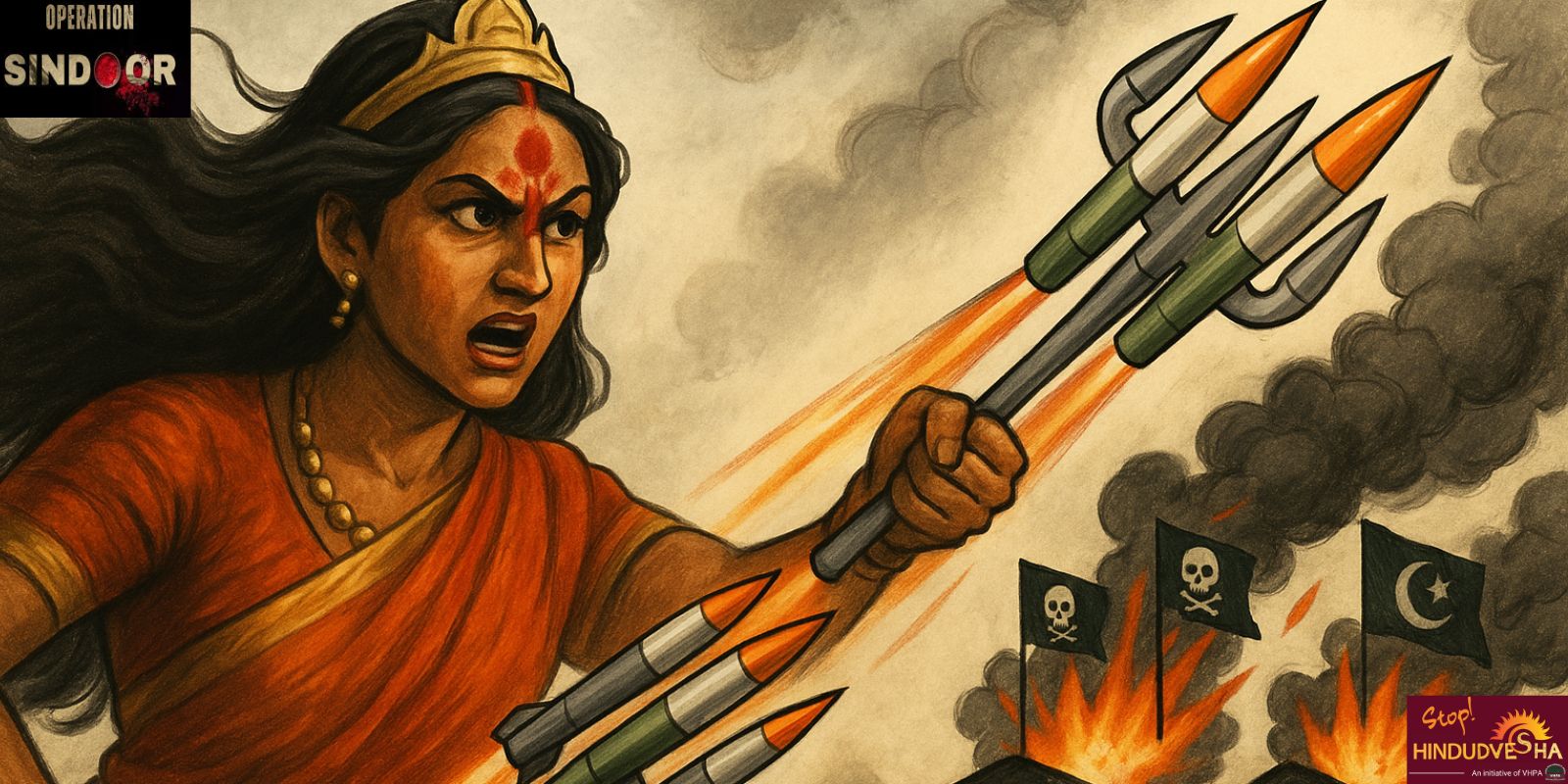
- The naming of Operation Sindoor sends a clear message to the perpetrators, underscoring the victims’ Hindu identity and the deeper Dharmic and cultural significance of sindoor, a symbol of pride for Hindu married women.
- India’s geopolitical ascent is closely tied to its Hindu awakening. The swift retaliation to the Pahalgam attacks reflects a shift in leadership priorities toward addressing Hindu concerns.
- The global response to Operation Sindoor has been measured. It largely avoids virtue signaling or pressuring India to de-escalate unilaterally, though it still falls short of explicitly supporting its right to self-defense.
- The rapid planning and execution of Operation Sindoor marks a decisive evolution in India’s counter-terror strategy.
- Despite the relentless propaganda from left-liberal media outlets, India is firmly holding its ground in the ongoing narrative battle.
Launched by the Indian Armed Forces on May 7, Operation Sindoor was a decisive and focused response to the April 22, 2025, Pakistani terrorist attack in Pahalgam, Kashmir. The first phase of the operation targeted terrorist sites long used to plan and direct attacks against India. India’s response was calibrated and restrained, ensuring that no Pakistani military installations or civilian areas were targeted, underscoring India’s commitment to justice without needless provocation.[1]
In an unprecedented military operation, India struck nine different locations inside Pakistan and Pakistan-occupied Jammu and Kashmir, including facilities of terrorist organizations like Lashkar-e-Taiba ( LeT ) and Jaish-e-Mohammed ( JeM). At least 100 terrorists are reported to have been eliminated[2] during the initial phase, a synchronized 25-minute strike using precision weapons. [3]
By invoking Sindoor—the sacred symbol of Hindu family sanctity and a core part of a married woman’s identity—Operation Sindoor stood as India’s civilizational response to the Pahalgam massacre, where 26 Hindus were brutally killed, some before the eyes of their wives. In this context, the operation’s name sends a clear and deliberate message: affirming the victims’ Hindu identity while underscoring the deeper cultural and Dharmic significance of sindoor as a symbol of dignity, devotion, and sacred bond in Hindu womanhood.
“Operation Sindoor” also serves as a sharp rebuke to the woke pseudo-feminist narrative that wrongly equates sacred Hindu traditions with patriarchy and female subjugation. For India, sindoor stands not just as a cultural marker but as a powerful symbol of national identity and resistance against evil, highlighting the central role of Shakti in the Dharmic and cultural consciousness of Bharat. The striking presence of two women military officers—Colonel Sophia Qureshi and Wing Commander Vyomika Singh—delivers a symbolic blow to the jihadi terror network, where it hurts the most. Few moments could have more aptly demonstrated India’s model of women’s empowerment and its enduring ethos of unity in diversity, in stark contrast to Pakistan’s radical Islamist machinery.
With the revival of its ancient cultural consciousness, India is now engaging with the world on its own civilizational terms. Its geopolitical assertiveness is inseparable from its Hindu awakening. That is why Operation Sindoor must be seen not merely as a tactical military response, but as a bold civilizational statement in a rapidly shifting global order.
The urgency with which the Pahalgam attacks have been avenged also signals a shift in leadership priorities when it comes to addressing Hindu issues.
A New Era in India’s Response to Terror
India seems to have come a long way from the time when it focused primarily on appeasing the international community and virtue signalling in dialogue and diplomacy. An article published by News18[4] elaborates on the significant policy shift in India’s response to terrorism over the past two decades. Drawing a sharp contrast between the swift, decisive action taken after the Pahalgam terror attacks and the restrained response to the 26/11 Mumbai attacks, the article notes that despite Ajmal Kasab, one of the 26/11 terrorists, being captured alive, the then government limited itself to diplomatic isolation of Pakistan, showing little interest in retaliation. It continued to repeat worn-out platitudes of “peace” and “brotherhood” even as civilians were massacred and hostages were held at gunpoint.
In sharp contrast to past restraint, India has adopted a bold and strategic approach in the wake of the Pahalgam terror attacks—deploying a calibrated mix of military, diplomatic, and economic measures aimed at isolating Pakistan globally, weakening its economy, and dismantling its terror infrastructure.
Between the attacks and the launch of Operation Sindoor, India has maintained a firm stance—unequivocally exposing the nexus between Pakistan’s military and terrorist networks and calling out Western hypocrisy on terrorism whenever necessary. In the lead-up to Operation Sindoor, External Affairs Minister S. Jaishankar publicly criticized European nations for their double standards[5], stating, “When we look out at the world… we look for partners. We don’t look for preachers, particularly preachers who don’t practice at home what they preach abroad. And I think some of Europe is still struggling with that problem. Some of it is changing.”
Though Jaishankar’s remarks at the Arctic Circle India Forum were made in response to a specific question, they carry significant weight in light of the West’s hypocritical response to the Pahalgam terror attacks.[6] While Western nations have moved somewhat beyond their earlier posture of appeasing Pakistan, they continue to place India and Pakistan on the same footing, repeating calls for mutual dialogue and engagement, while ignoring the stark reality that India, a democracy, has long been the victim of cross-border terrorism sponsored by Pakistan. Equating the perpetrator with the victim not only distorts the truth but also undermines justice.
In the aftermath of the Pahalgam attacks, India has effectively used international diplomacy to build a global consensus, briefing major powers and asserting its sovereign right to respond to the killing of its citizens. This sustained effort has gradually but decisively pushed Pakistan toward global isolation, as reflected in its recent setback at the United Nations Security Council, a clear marker of the success of India’s multi-pronged strategy.
On May 5, the UN Security Council held a closed-door meeting on rising India-Pakistan tensions, convened at Pakistan’s request as a non-permanent member. However, the move backfired, resulting in a major diplomatic embarrassment for Islamabad. Its attempt to peddle a “false flag” narrative around the Pahalgam terror attacks was met with scepticism and gained no traction. Instead, Pakistan faced pointed questions about the suspected involvement of Lashkar-e-Taiba in the attacks. Most notably, UNSC members issued a broad condemnation of the Pahalgam massacre and called for accountability from Islamabad, effectively dismantling Pakistan’s victimhood narrative and marking a significant diplomatic win for India.[7]
Shift in Global Optics
During the 1971 India-Pakistan war, the United States openly sided with Pakistan, sending its 7th Fleet to support the military dictatorship of President Yahya Khan and to intimidate democratic India. Although India emerged victorious, leading to the creation of Bangladesh, America’s overt backing of Pakistan dealt a serious blow to India–U.S. relations at the time.[8]
Fifty-five years later, the picture has dramatically changed. India and the United States now enjoy perhaps their strongest bilateral relationship since independence, anchored in a Comprehensive Global Strategic Partnership that spans defense, energy, trade, technology, and more. Under President Donald Trump’s leadership, both India and the United States have reaffirmed their commitment to combating terrorism, particularly radical Islamic extremism.[9] The U.S. decision to extradite Tahawwur Rana, one of the masterminds behind the 26/11 Mumbai attacks, further underscored Washington’s stance and sent a strong message to Pakistan regarding its continued sponsorship of cross-border terrorism.
In the aftermath of Operation Sindoor, several statements have been issued by U.S. leaders, including President Trump and Vice President JD Vance. While these remarks have largely adopted a neutral tone, their very nature marks a significant departure from the era when the U.S. might have quietly backed Pakistan. In a notable comment, Vice President Vance stated that while the U.S. can encourage both sides to de-escalate, “we’re not going to get involved in the middle of a war that’s fundamentally none of our business and has nothing to do with America’s ability to control it.”[10]
The West’s visible disinterest in “encouraging” Pakistan and its seemingly neutral stance in the current conflict marks a major diplomatic win for India—a stark contrast to earlier scenarios where the West might have covertly pressured New Delhi with threats of sanctions and placed the burden of de-escalation solely on India. Nevertheless, many Western powers still appear stuck in a colonial-era mindset, hesitant to fully acknowledge India’s transformed global stature and respond with the strategic respect it now commands. The persistent tendency to equate India and Pakistan overlooks the reality of India’s rising geopolitical influence and its consistent role as a responsible democracy.
Aside from Israel, few major powers have explicitly backed India’s right to self-defense following Operation Sindoor. France, while acknowledging India’s need to protect itself from terrorism, tempered its support by urging both sides to remain calm. The UK’s official response, wrapped in diplomatic ambiguity, called on both India and Pakistan to exercise restraint and resolve issues through dialogue[11]—conspicuously omitting any reference to the Pakistan-sponsored terror attack that triggered the operation.
However, several Western lawmakers have independently expressed strong support for India’s firm stance against terrorism. Among them are former UK Prime Minister Rishi Sunak, Conservative MP Bob Blackman, Shadow Foreign Secretary Priti Patel, and Dutch MP Geert Wilders—all of whom have explicitly affirmed India’s sovereign right to defend its citizens.[12] [13] [14]
India’s growing economic and commercial influence is increasingly shaping how global reactions unfold in the context of the India–Pakistan conflict. A key example is the recently finalized free trade agreement (FTA) with the United Kingdom—an announcement made just hours before the launch of Operation Sindoor.[15] Whether intentional or coincidental, the timing carries unmistakable symbolic weight. It projected a message of strategic foresight and internal stability, signaling to the international community that India remains focused, capable, and economically forward-looking even amidst security challenges.
The contrast is striking. On one side stands a failed state that harbors terrorists and seems to exist solely to oppose and destabilize India. Its economy is in freefall, its population grapples with basic survival, and its military elite faces serious allegations of corruption and money laundering. On the other side is a stable, democratic nation calmly conducting diplomatic and strategic affairs, even in the midst of conflict. These starkly divergent realities are bound to influence how the global community responds to Operation Sindoor as events continue to unfold.
At the time of writing, India and Pakistan have agreed to a full and immediate ceasefire. While the United States has claimed credit for facilitating the agreement, India’s official briefing made no mention of any U.S. involvement.[16] These developments come even as the Indian government sets a new precedent by declaring that any future terrorist attack on its soil will be treated as an act of war—a clear signal of its hardened stance against cross-border terrorism.[17]
How India Is Confronting Global Media Distortions
In the aftermath of Operation Sindoor, sections of the elite Western media once again engaged in full-fledged propaganda, offering biased and misleading coverage that painted India as the aggressor, while downplaying or ignoring Pakistan’s well-documented role as a hub for terrorist networks.
“In a dramatic overnight operation, India said it launched missile and air strikes on nine sites across Pakistan and Pakistan-administered Kashmir, targeting what it called militant positions based on ‘credible intelligence’,” reported the BBC in its initial coverage of Operation Sindoor. [18] True to form, the BBC once again adhered to its familiar editorial line—referring to terrorists as “militants” and effectively whitewashing Pakistan’s jihadi terror apparatus.
The Washington Post subtly cast India as the aggressor with its headline: “India strikes Pakistan after Kashmir attack, raising fears of war.” True to the woke editorial playbook, it referred to the terrorist attack as a “militant” strike and framed the situation as escalating tensions between two “nuclear-armed neighbours”—thereby creating a false equivalence between India and Pakistan, while conspicuously avoiding any mention of Pakistan’s role in sponsoring terrorism.[19] Other global outlets such as Deutsche Welle, Bloomberg, and Global Times followed a similar template in their coverage—carefully avoiding the word “terrorist,” subtly legitimizing Pakistani propaganda, and refusing to call out the jihadi infrastructure that India was targeting.[20]
There is nothing new about the elite left-liberal ecosystem’s ongoing disinformation campaign against India. What has changed significantly over the past decade, however, is India’s assertive and unapologetic response. The new India engages from a fundamentally different position—one that is confident in its Hindu identity and actively reshaping its cultural narrative. It is no longer a passive observer of biased portrayals by international media.
This new, assertive India was clearly visible during Operation Sindoor, as it regularly issued official briefings and consistently called out the international media for its biased coverage of the operation. Notably, India strongly objected to the BBC’s use of “militant” instead of “terrorist” and reportedly warned it that future reporting will be closely monitored.[21] India also publicly criticized the Chinese state-run outlet Global Times for spreading disinformation, urging it to verify sources and cross-check facts before publishing.[22] At the same time, Indian netizens actively challenged the slanted reporting of domestic left-leaning media houses such as The Hindu, exposing their bias and double standards on social media platforms.[23] [24]
India’s pursuit of a grand narrative rooted in its civilizational and cultural ethos is steadily turning the tide in the global narrative war. No longer content with being defined through Western lenses, India is actively challenging long-held Western narratives on its society, politics, development, economy, and culture.[25] In doing so, it is confronting the neocolonial assumptions embedded in the global discourse about India and asserting a thought paradigm of its own. The decisive response to Pakistan-sponsored terrorism through Operation Sindoor is not just a strategic act—it is emblematic of this larger civilizational shift.
Closing Thoughts
India is the land of Savitri—the Pativrata whose love, devotion, intelligence, and courage have echoed through the ages. In the timeless tale of Satyavan and Savitri, it is not blind submission but profound strength that defines her. Facing Yamraj, the God of Death, Savitri engages in a battle of wits and spiritual resolve to reclaim her husband’s life. Her unwavering devotion, strategic intellect, and moral clarity ultimately compel Yamraj to yield, restoring Satyavan to life.
Operation Sindoor assumes symbolic significance against this cultural backdrop. Far from the distorted portrayal by the anti-Hindu ecosystem, Savitri is not helpless or regressive—she embodies agency, resilience, and fierce intelligence. Likewise, India’s cultural and civilizational resurgence is not a rejection of modernity but a conscious negotiation with it, on India’s own terms. It represents a synthesis of Vedic wisdom and contemporary thought.
Operation Sindoor can thus be seen as a microcosm of this resurgence. From the Ram Mandir inauguration to rising Hindu political representation, India is reclaiming its civilizational confidence. This cultural self-assurance shaped its response to the Pahalgam terror attack, marking a decisive assertion of identity and justice rooted in Dharma.
Citations
[1] Press Release: Press Information Bureau; https://www.pib.gov.in/PressReleasePage.aspx?PRID=2127370
[2] ऑपरेशन सिंदूर में मारे गये पाकिस्तान के 100 आतंकी, सरकार ने सर्वदलीय बैठक में किया खुलासा; https://www.abplive.com/news/india/operation-sindoor-100-terrorists-killed-government-said-operation-sindoor-is-still-underway-2939868
[3] 100 Terrorists Killed, Rajnath Singh Tells All-Party Meet On Op Sindoor; https://www.ndtv.com/india-news/100-terrorists-killed-rajnath-singh-tells-all-party-meet-on-op-sindoor-8360900
[4] Opinion | From Defence To Dominance: Bharat’s Shifting Response To Terrorism – News18; https://www.news18.com/opinion/opinion-from-defence-to-dominance-bharats-shifting-response-to-terrorism-ws-l-9327593.html
[5] ‘India needs partners, not preachers’: Jaishankar once again tears into EU| India News – The Times of India; https://timesofindia.indiatimes.com/india/india-needs-partners-not-preachers-jaishankar-once-again-tears-into-eu/articleshow/120869425.cms
[6] Pahalgam terror attack: EAM Jaishankar speaks to European Union counterpart Kaja Kallas – The Hindu; https://www.thehindu.com/news/national/pahalgam-terror-attack-eam-jaishankar-speaks-to-european-union-counterpart-kaja-kallas/article69533208.ece
[7] Pakistan rebuked at UNSC over Pahalgam attack; members reject ‘false flag’ narrative, call missile tests escalatory | Today News; https://www.livemint.com/news/pakistan-rebuked-at-unsc-over-pahalgam-attack-members-reject-false-flag-narrative-call-missile-tests-escalatory-11746504940172.html
[8] Role of the United States in the 1971 War: Implications for India-US Relations – MP – IDSA; https://www.idsa.in/publisher/journal-of-defence-studies/role-of-the-united-states-in-the-1971-war-implications-for-india-us-relations/
[9] MAGA Meets MIGA: Modi, Trump & US-India’s Future; https://stophindudvesha.org/when-maga-meets-miga-modi-trump-and-the-future-of-u-s-india-relations/
[10] JD Vance on India-Pakistan tensions: U.S. to stay out of war that’s none of our business – The Hindu; https://www.thehindu.com/news/international/us-to-stay-out-of-war-thats-none-of-our-business-vance-on-india-pak-tensions/article69555861.ece
[11] UK, France, Israel, Netherlands and more nations back Operation Sindoor, acknowledge India’s right to self-defence – The Economic Times; https://economictimes.indiatimes.com/news/india/uk-france-israel-netherlands-and-more-nations-back-operation-sindoor-acknowledge-indias-right-to-self-defence/articleshow/120990001.cms?from=mdr
[12] Ibid.
[13] UK Parliament debates India-Pakistan conflict, appeals for de-escalation; https://www.newindianexpress.com/world/2025/May/08/uk-parliament-debates-india-pakistan-conflict-appeals-for-de-escalation-2
[14] (290) “Justified Retaliation” UK MP Backs India’s Operation Sindoor Against Pakistan | N18G – YouTube;
https://www.youtube.com/watch?v=XVeNAO85QKU
[15] India-UK FTA | Pact Britannica – India Today; https://www.indiatoday.in/amp/magazine/up-front/story/20250519-india-uk-fta-pact-britannica-2722232-2025-05-10#
[16] ‘India and Pakistan have agreed to a full and immediate ceasefire’: Donald Trump – Firstpost; https://www.firstpost.com/world/trump-announces-full-and-immediate-ceasefire-india-pakistan-operation-sindoor-pahalgam-attack-terrorism-tensions-13887350.html
[17] India-Pakistan agree to pause military action, but what makes an act of war? – CNBC TV18;https://www.cnbctv18.com/india/india-pakistan-war-ceasfire-act-of-war-meaning-provisions-explained-ws-l-19602707.htm
[18] India strikes – how will Pakistan respond? Four key questions; https://www.bbc.com/news/articles/cd020710v1ko
[19] India strikes Pakistan after Kashmir attack, raising fear of war – The Washington Post; https://www.washingtonpost.com/world/2025/05/06/india-strikes-pakistan-war-kashmir/
[20] ग्लोबल टाइम्स, ब्लूमबर्ग, DW…’ऑपरेशन सिंदूर’पर प्रोपेगंडा, आतंकी को आतंकी कहने में शर्म | DW, Global Times & Bloomberg spread propaganda against ‘Operation Sindoor’ and India; https://hindi.opindia.com/reports/media/foreign-media-propaganda-against-operation-sindoor-dw-bloomberg-global-times/
[21] Pahalgam terror attack: Government calls out BBC for biased coverage of Pahalgam terror attack – India Today; https://www.indiatoday.in/india/story/government-writes-to-bbc-india-head-strong-sentiments-pahalgam-terror-attack-reporting-ib-ministry-watchlist-2716097-2025-04-28
[22] India slams China’s Global Times on false info on Operation Sindoor:’Verify your facts’ | Latest News India – Hindustan Times; https://www.hindustantimes.com/india-news/india-slams-chinas-global-times-on-false-info-on-operation-sindoor-verify-your-facts-101746619354014.html
[23] Manisha Singh on X https://x.com/Mini2411Singh/status/1920183413819990527
[24] Sabyasachi Upadhyay on X; https://x.com/sabyasachi4441/status/1920071244218847457
[25] “Decolonizing India: Shaping Its Own Grand Narrative; https://stophindudvesha.org/decolonizing-indias-mindset-why-india-needs-to-create-its-own-grand-narrative/

Donate to HINDUDVESHA
Our Mission is to explore and expose Hindudvesha through research analysis, education and response.
SUPPORT US