

When MAGA Meets MIGA: Modi, Trump, and the Future of US-India Relations
 Rati Agnihotri · 02/27/2025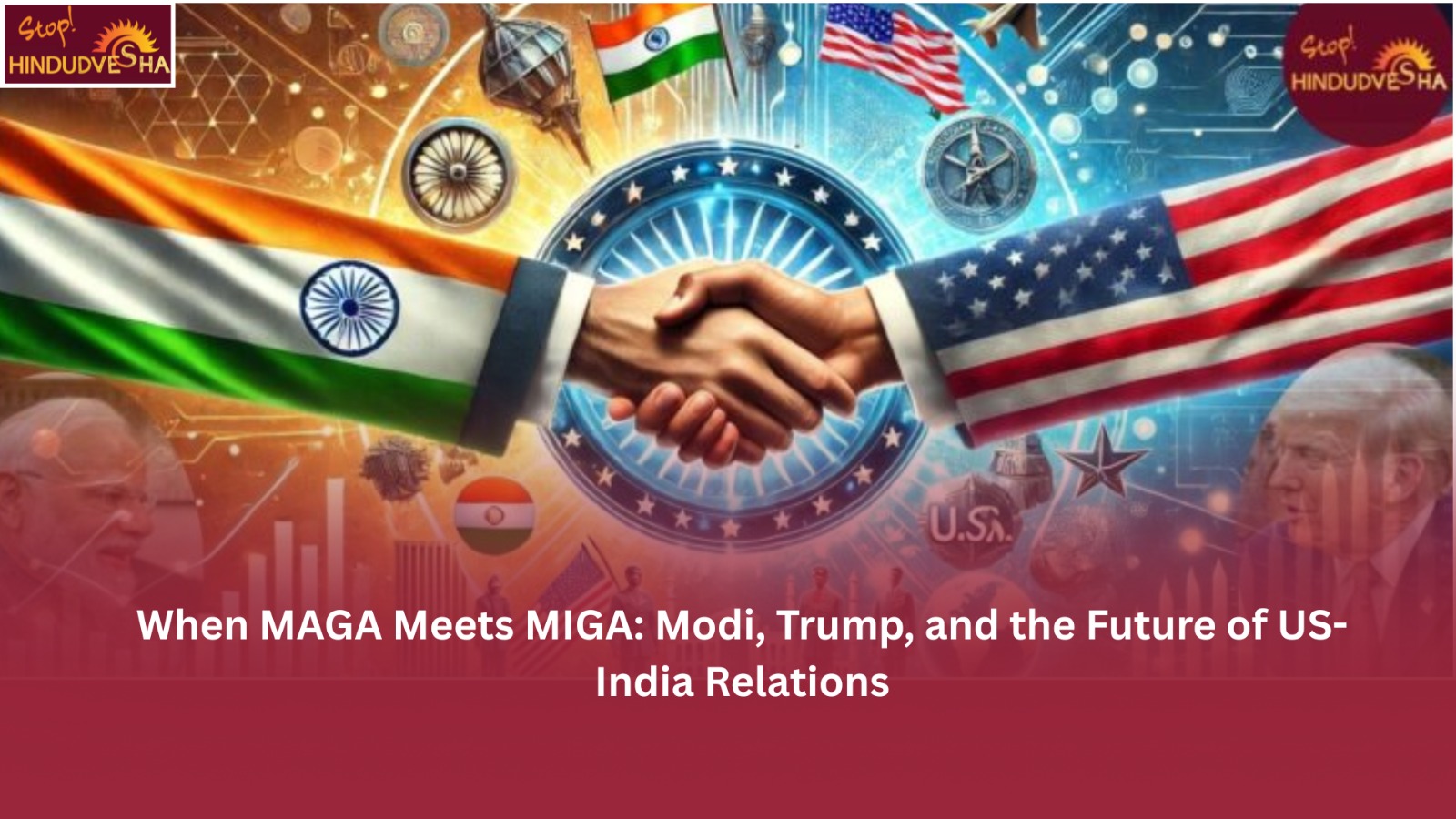
- Multiple points of convergence exist between Indian Prime Minister Modi’s and US President Donald Trump’s governance style and policies. India and the US can leverage these convergences judiciously to further bilateral relations.
- Remarkable parallels exist between Modi’s conception of nationalism and Trump’s vision of Make America Great Again.
- Both the Modi government and the Trump government focused on dismantling the global deep-state nexus and taking up cudgels against wokesim.
- Both Trump and Modi take a tough stance against extremism and terrorism, especially radical Islamic terrorism.
- The recently held bilateral meet between the Indian Prime Minister Modi and the US President Trump focused on leveraging the mutual dynamics of MAGA and MIGA to arrive at a mega partnership.
- India and the US should focus on leveraging convergences while judiciously managing divergences.
Nationalism is on the rise in global politics. Just two decades ago, globalization dominated the world stage. However, growing concerns over radical Islam and immigration led many Western nations to question its benefits, shifting their focus inward and prioritizing domestic policies over global integration.
The rise of nationalist and anti-left-wing governments across Europe vividly exemplify this shift. Likewise, former U.S. President Donald Trump’s political success fits this trend. His campaign focused on revitalizing the American economy by bringing manufacturing jobs back, tightening immigration policies, and reducing the influence of progressive politics. His message resonated with many working-class Americans who felt previous administrations prioritized foreign affairs over domestic economic challenges. Many saw his leadership as a clear break from past policies, offering a renewed focus on national interests and economic security.
In the Indian context, Prime Minister Narendra Modi’s re-election in 2024 for a third consecutive term reflects a similar trend.
While the “Make America Great Again” (MAGA) movement’s anti-immigration rhetoric sometimes appears to carry echoes of “white supremacy,” which fundamentally diverges from Modi’s vision of nationalism in India, there are nonetheless significant parallels between the Trump administration’s broader geopolitical outlook and Modi’s. Setting aside the more extreme elements of MAGA discourse, both leaders share a perspective on global affairs that emphasizes national sovereignty, economic self-reliance, and a recalibration of international alignments. Given the personal rapport between Trump and Modi, there is considerable potential for the two nations to leverage this dynamic to advance bilateral cooperation and shape the larger global order.
However, it is essential to acknowledge that the contemporary geopolitical landscape is increasingly volatile, marked by uncertainty and fragmentation. The U.S.-India relationship hinges on identifying areas of convergence while adeptly managing divergences. As the United States navigates its evolving relationship with India, tensions are inevitable as India’s global influence grows and it asserts itself as a rising power on the world stage.
India’s External Affairs Minister S. Jaishankar, in The India Way: Strategies for an Uncertain World, explains that international relations are no longer defined by permanent friendships or rivalries. Instead, today’s world follows a “frenemies” dynamic, where even close allies experience friction, traditional adversaries collaborate on specific issues, and nations prioritize their interests over ideological commitments:
New equations and interests would have come into being. Single-minded pursuit of national interest will make our world look like a bazaar, with more players, less rules and greater volatility. As a result, goals are more immediate and approaches more tactical. Structures have weakened as interest in finding common ground recedes. New York, Geneva and Brussels are now symbols to run against. Advantages are asserted in a more transactional ethos with negotiators learning that to their cost. Erosion in trust has been sharp, especially for nations that are part of alliance systems. Dependability is now a growing question mark and friends and allies are no longer immune to pressures. In fact, everybody is fair game when big affinities no longer overlook smaller differences. As nationalism sharpens across regions, so does the characterization of diverging interests. Black and white are redefined even as ‘Green on Blue’ attacks enter the political domain.[1]
Most notably, Modi’s and Trump’s policies challenge the influence of the global deep state—a transnational entity widely perceived as promoting woke ideology in the American context and undermining India’s unity and integrity through the dissemination of anti-India narratives and anti-Hindu rhetoric. The following sections will explore how these perspectives can converge to reshape the global geopolitical order and address emerging threats to world peace.
Parallels between MAGA and Modi’s focus on Nationalism
Both Donald Trump’s Make America Great Again (MAGA) agenda and Narendra Modi’s nationalist vision have faced significant opposition from the global woke establishment, which tends to reject notions of national pride, cultural identity, and patriotism. This ideological bloc, deeply entrenched in global media, academia, and influential think tanks, frequently portrays left-leaning governments as the ultimate solution to global challenges while fostering an exaggerated fear of nationalist and non-left-wing leadership.
While the right wing’s historical legacy in the West, particularly in Europe, has been controversial, far-left radicalism is not without its own troubling record of promoting anarchy, violence, and authoritarian tendencies. The tendency to demonize all non-leftist political movements under the broad label of “right-wing” overlooks the complex socio-political realities that have led to the rise of nationalist governments in various parts of the world.
In Europe and the United States, the backlash against progressive politics stems from a combination of economic decline, the weakening of the welfare state, rising crime often linked to illegal immigration, and growing concerns over radical Islam. Disillusioned by these challenges, many local populations are increasingly demanding leadership that prioritizes internal stability over globalist posturing. The rise of nationalist politics in these regions cannot be understood in isolation from these socio-economic and cultural anxieties.
Furthermore, this tendency to generalize all non-leftist ideologies under a single right-wing framework fails to account for the unique characteristics of nationalist movements outside the Western context. Indian nationalism, for instance, is deeply rooted in the revival of India’s civilizational and cultural identity—an identity that was suppressed under centuries of Islamic invasions and European colonization. However, Western media and academic discourse frequently misrepresent Modi’s nationalist rhetoric as anti-minority, divisive, or even fascist, overlooking its deeper historical significance as an assertion of indigenous cultural identity rather than an exclusionary ideology.
An India Today article draws an interesting parallel between Trump’s MAGA vision and Modi’s nationalist outlook, highlighting the similarities between Trump’s ambition to restore American greatness and Modi’s emphasis on India’s role as a Vishwa Guru (teacher of the world). While the term Vishwa Mitra (friend of the world) has recently gained traction in Indian diplomatic discourse, the underlying essence remains the same. The Modi government’s vision of positioning India as a global leader closely aligns with Trump’s goal of reinforcing America’s preeminence on the world stage.[2]
Donald Trump’s inaugural address was firmly rooted in the ideals of national pride and a unifying American identity built on merit and competence. His speech emphasized reclaiming America’s sovereignty, ensuring national security, and prioritizing the creation of a proud, prosperous, and free nation. Contrary to accusations that his vision for American nationalism serves as a vehicle for white supremacy, Trump’s rhetoric, as reflected in his speech, acknowledged the diversity of American society. He highlighted the broad-based support for his agenda, stating, “As our victory showed, the entire nation is rapidly unifying behind our agenda with dramatic increases in support from virtually every element of our society: young and old, men and women, African Americans, Hispanic Americans, Asian Americans, urban, suburban, rural.” He further underscored the importance of national unity by honoring Martin Luther King Jr. Day and expressing confidence in the resurgence of American solidarity. [3]
Trump’s invocation of national pride closely mirrors Narendra Modi’s discourse on nationalism. Through his policies and speeches, Modi envisions an India where national identity and cultural ethos serve as unifying forces, transcending differences. Just as Trump views America as a victim of woke politics that threatens its foundational values, Modi portrays nationalism and patriotism as shields against forces seeking to undermine India’s unity and integrity.
Modi’s nationalist vision, however, has been heavily criticized by left-liberal media, which often portrays it as an imposition of a Hindu majoritarian agenda. Legislative actions such as the abrogation of Article 370 in Jammu and Kashmir and the Citizenship Amendment Act (CAA), which grants refuge to persecuted minorities from neighboring Islamic nations, have been labeled as expressions of “Hindu nationalism.” Similarly, Trump’s firm stance against woke politics, his crackdown on illegal immigration, and stricter citizenship policies have been cast by the left-liberal media as authoritarian and fascist.
At their core, both Modi’s and Trump’s nationalist ideologies challenge the dominance of leftist narratives in society and culture. While the manifestations of woke politics differ across cultural contexts, its influence is global. Modi’s nationalist vision, rooted in India’s civilizational and cultural revival, directly challenges left-liberal frameworks that define India’s history through the lens of colonialism and foreign rule. Likewise, Trump’s Make America Great Again agenda confronts woke ideology by reinstating national pride, patriotism, and a strong sense of identity at the heart of American politics and society.
Unequivocal Rejection of Terrorism and Violence
Both Modi and Trump’s policies have been characterized by the rejection of terrorism in all forms. Trump has categorically rejected the woke lobby’s soft selling of Islamic terrorism in the garb of diversity, human rights, and multiculturalism rhetoric. Similarly, the Indian Prime Minister Modi has come out strongly against Islamic radicalism and cross-border terrorism emanating from Pakistan.
Modi government’s boldest move against Islamic extremism has been the abrogation of Article 370 in Jammu and Kashmir, thus taking away the special status of the Muslim-majority state in August 2019 in a bid to restore normalcy and foster growth and development in the valley, once torn by violence.[4] US President Trump has taken a similar tough stance against Islamic radicalism and terrorism. Although Trump’s Gaza plan involving the proposed taking over of the Gaza strip by the US [5] has received flak the world over, especially from Middle-Eastern countries, it cannot be denied that the Gaza ceasefire deal started getting implemented on the ground only after Donald Trump assumed office.
The slew of executive orders Trump signed immediately after assuming the Presidency involved the declaration of illegal immigration at the US-Mexico border as a national emergency and the designation of Mexican drug cartels as terrorist organizations.[6] After taking oath as the new Intelligence Chief of the US, one of the first tasks Tulsi Gabbard was reportedly assigned involved dealing with the threat of radical Islamic terrorism.[7] Trump has also repeatedly criticized Joe Biden’s immigration policies for fueling radical Islamic terrorism and other forms of violent crime. [8]
The Modi government has implemented strict measures to combat violence and extremism. In a major crackdown on radical Islamic terrorism, India’s Ministry of External Affairs banned the Popular Front of India (PFI) and its affiliates under the Unlawful Activities (Prevention) Act of 1967 to safeguard the nation’s integrity, security, and sovereignty. [9] The group has been linked to serious offenses, including terrorism, terror financing, targeted killings, disrupting public order, and undermining the country’s constitutional framework.
In another significant move aimed at cracking down on terrorist organizations and individuals involved in terrorist activities, the Modi government amended the UAPA Act in August 2019 to include the provision of designating an individual as a terrorist. Prior to the amendment, only organizations could be designated as terrorists.[10]
There is an uncanny parallel between how both Trump and Modi are routinely vilified by the left-liberal press and academia for their tough stance on terrorism, particularly radical Islamic terrorism. For instance, a December 2021 Guardian article titled “How a terrorism law in India is being used to silence Modi’s critics” [11] claimed that the BJP government was using the law to intimidate journalists, lawyers, poets, priests, and Kashmiri civilians. Similarly, during Trump’s first term, he was repeatedly accused of Islamophobia by global left-liberal outlets. In his second term, the media has framed his crackdown on pro-Palestine protests on university campuses as an attack on free speech. [12]
Trump’s conception of Make America Great Again involves looking inward to further the US economy and make America an economic powerhouse. A key aspect of this policy is to disengage the U.S. from messy foreign entanglements. In other words, the U.S. President envisions a non-interventionist America that avoids meddling in other nation’s internal affairs or engaging in unnecessary wars under the guise of defending democracy. As a result, during Trump’s presidency, the deep-state network that fuels global conflicts is likely to be weakened, if not entirely dismantled.
Indian Prime Minister Narendra Modi envisions India as a Vishwa Mitra (a global friend), rooted in the principles of sustainable global growth and development, while advocating for a more assertive leadership role on the world stage. He believes this is a time for peace, not war. Amid the Russia-Ukraine and Israel-Palestine conflicts, the Modi government has consistently condemned violence, stressing that solutions should come through dialogue and negotiation.
Taking on the Global Deep State & Wokeism
Trump and Modi’s policies have been marked by efforts to dismantle the global deep state. While there is no official definition, the term generally refers to an elite network of individuals, organizations, and transnational corporations wielding immense influence to clandestinely control governments and orchestrate regime changes. Billionaire philanthropist George Soros is frequently linked to the deep state, accused of leveraging his vast network to spread propaganda against non-left-wing governments and influence political outcomes.
In the U.S., the deep state is often alleged to operate as a shadow government, where unseen entities dictate policies and societal values. This perception has fueled concerns over the extent of unelected influence on governance and decision-making in both domestic and international affairs.
Trump’s Make America Great Again vision strongly opposes wokeism, emphasizing a return to America’s perceived original order. His campaign promised a crackdown on woke politics, reflected in a series of executive orders signed soon after taking office, reinforcing his commitment to reshaping American politics, culture, and society.
Some of the most significant executive orders signed by him in the confrontation of wokeism and the deep state include
- Termination of diversity, equity, and inclusion (DEI) programs in the federal government.
- Reformation of the Federal Hiring Process and Restoration of Merit in Government Services.
- Official recognition of only two sexes, male and female. Mandate to the federal government to refer to individuals by their “sex” instead of their gender identity. Prohibition of the use of federal funds to “promote gender ideology.”
- Establishing and Implementing the President’s Department of Government Efficiency (DOGE) to cut government spending. [13]
The U.S. President’s decision to suspend funding for the United States Agency for International Development (USAID) is widely viewed as a major step toward dismantling the global deep-state network. This move has sparked global criticism, as the 90-day funding suspension has disrupted humanitarian aid projects in regions reliant on U.S. assistance. [14] However, USAID has frequently faced allegations of advancing anti-national agendas and engaging in ideological subversion under the guise of development aid.[15] It has also been accused of financing media outlets, NGOs, and activist networks that promote narratives that are seen as undermining cultural values and national sovereignty, including in India. [16]
A recent article in The Organiser highlights the significance of dismantling USAID for India, alleging its involvement in funding movements like the Farmers’ Protests and Shaheen Bagh protests. It claims that USAID serves as a key financial channel for activities aimed at creating anarchy and destabilizing the Indian state. The write-up further asserts that USAID has links to terrorist activities, including Maoism and radical Islamic terrorism. It provides multiple examples of how USAID funds have allegedly been misused for anti-humanitarian operations in India and other developing nations.[17]
Indian Prime Minister Narendra Modi’s emphasis on reviving India’s civilizational and cultural ethos parallels the U.S. President’s efforts to dismantle wokeism and restore traditional family values. While wokeism is not as deeply entrenched in Indian society as in the U.S., its influence is growing. In Snakes in the Ganga: Breaking India 2.0, Rajiv Malhotra and Vijaya Viswanathan argue that elite institutions like Ashoka University act as conduits for woke ideologies imported from American universities, particularly on issues like gender and sexuality.
In the Indian context, woke discourse is also strongly anti-Hindu, portraying Hinduism as a system of patriarchy and oppression. The Modi government’s push to revive India’s cultural heritage and reject colonial narratives directly challenges this narrative. Wokeism, though presented as progressive, often reinforces regressive colonial ideologies and dismisses decolonization efforts in India. This ideological battle mirrors U.S. President Donald Trump’s opposition to wokeism in American society.
The Modi government has also taken steps to curb deep-state funding networks. The Foreign Contributions Regulation Act (FCRA) was amended multiple times, including in 2020, 2022, and 2024, to regulate the foreign funding of NGOs. As a result, several prominent NGOs have been blacklisted under the FCRA, with their licenses revoked due to alleged anti-development activities and religious conversions. In 2024, India’s Home Ministry canceled the licenses of organizations such as the Church of North India – Synodical Board of Social Service (CNI-SBSS), Indo-Global Social Service Society (IGSSS), Voluntary Health Association of India (VHAI), and Evangelical Fellowship of India (EFOI). These measures reflect the government’s broader strategy to prevent foreign influence from undermining India’s sovereignty and cultural fabric.[18]
The Modi government has also strongly opposed foreign journalists indulging in activities that could be detrimental to India’s unity and integrity in the name of journalistic reporting. The entry of many such foreign journalists has been prohibited or regulated by the Indian government, in another move that is being seen as a crackdown on the deep-state nexus.
Further, the Modi government has also categorically rejected many global indices, such as the Press Freedom Index, Democracy Index, Religious Freedom Index, etc., as anti-India propaganda. It is significant because all these woke rankings and pronouncements against India have their roots in the woke organizational framework of the US deep state, which the Trump administration is trying to dismantle. Thus, it’s all interconnected. The Modi government has also raised the issue of George Soros allegedly interfering in the internal affairs of India by systematically grooming India’s main opposition party, Congress, to raise select issues at the beginning of each Parliamentary session.
Modi-Trump Meet Highlights
Indian Prime Minister Narendra Modi’s February 2025 visit to the U.S. set the stage for India-U.S. bilateral relations under the Trump presidency.
In this meeting, both leaders took a strong stance against terrorism, agreeing to counter cross-border threats. In a significant move, the U.S. approved the extradition of Tahawwur Rana, accused in the 26/11 terror attacks, to India. Trump emphasized the commitment to combat radical Islamic terrorism jointly, highlighting the importance of global security cooperation.[19]
Defense collaboration was another key focus, with Trump announcing increased military sales to India, including F-35 fighter jets. Modi also discussed establishing a defense cooperation framework to strengthen strategic ties. Other crucial topics included trade tariffs, nuclear energy, oil and gas trade, and regional security. Both leaders underscored their commitment to enhancing Indo-Pacific cooperation through the Quad mechanism, reinforcing India-U.S. ties in defense, economic, and geopolitical domains.[20]
India and the U.S. have set a joint target to double their bilateral trade to $500 billion by 2030. Both nations are also working toward finalizing a mutually beneficial trade agreement shortly to strengthen economic ties and enhance cooperation across various sectors.[21]
On the issue of illegal immigration, India expressed support for the U.S. President’s stance, affirming its willingness to take back verified illegal immigrants. Acknowledging that many of these individuals come from ordinary backgrounds and are often misled into illegal migration, there was an emphasis on tackling human trafficking at its roots. Both nations were urged to develop collaborative mechanisms to dismantle this ecosystem and end trafficking networks. [22]
The discussion also touched upon India’s Make India Great Again (MIGA) vision, a phrase inspired by Trump’s Make America Great Again (MAGA) slogan. Shortly after meeting the U.S. President at the White House, Modi highlighted the similarities between the two visions, emphasizing that India’s pursuit of Viksit Bharat aligns with America’s aspirations under MAGA. This common goal, he suggested, creates an opportunity for India and the U.S. to work together toward shared prosperity. [23]
The synergy between MAGA and MIGA was described as a “mega partnership for prosperity,” reinforcing the idea that both nations while focusing on their respective heritage and development, can collaborate to achieve long-term growth. With India advancing rapidly toward Viksit Bharat 2047, aligning these national goals presents a significant opportunity for deeper bilateral cooperation and mutual progress. [24]
Trump and Modi divergences
While Trump and Modi share similar policies and governance styles, they also have key differences.
The Modi government prioritizes engagement within the multilateral world order, whereas Trump’s approach to geopolitics leans toward unilateralism and a rejection of global institutions. His administration’s withdrawal from international agreements such as the Paris Accord and its skepticism toward organizations like the WHO contrast sharply with Modi’s strategy of leveraging multilateral platforms to advance India’s interests. Additionally, while the Trump administration embraces extreme protectionism and imposes tariffs to safeguard U.S. economic priorities, Modi’s approach focuses on navigating the multilateral system to secure favorable outcomes for India.
Despite these differences, India-U.S. relations are expected to remain strong, though careful management is needed. India remains committed to initiatives such as UN reform, seeking a permanent seat on the UN Security Council (UNSC) and greater representation for the Global South in decision-making processes. While the Trump administration may not actively oppose these efforts, its differing global priorities could result in a passive stance.
On the other hand, Trump’s assertive, results-driven approach might also accelerate long-delayed UN reforms if his administration can be convinced of their necessity. His stance could further pressure the UN to take a stronger position against radical Islamic terrorism, forcing it to abandon its often passive response.
Wrapping up
There is a significant convergence in the policy frameworks and ideological orientations of the U.S. government under President Trump and the Indian government under Prime Minister Modi. This alignment holds promising implications for U.S.-India bilateral relations, particularly in fostering a united front against global terrorism and left-liberal or woke ideological movements.
However, a cautious and pragmatic approach is essential. In geopolitics and international affairs, alliances are predominantly shaped by mutual interests rather than ideological alignment. An America First policy does not inherently align with India’s strategic priorities, making it imperative for India to navigate these dynamics to secure favorable outcomes adeptly. Likewise, India’s VishwaGuru or VishwaMitra approach complements Trump’s America First policy only to the extent that both nations can effectively capitalize on their shared interests. Thus, while ideological synergy provides a foundation for cooperation, sustained collaboration will ultimately depend on how well each country leverages common ground for mutual benefit.
Citations
[1] The India Way: Strategies for An Uncertain World by S Jaishankar, p/28
[2] Donald Trump could have been reading from Narendra Modi’s script – India Today; https://www.indiatoday.in/world/story/donald-trump-narendra-modi-script-similarities-inaugration-january-20-golden-age-vishwaguru-similarities-america-great-unity-2668688-2025-01-22
[3] The Inaugural Address – The White House; https://www.whitehouse.gov/remarks/2025/01/the-inaugural-address/
[4] Press Release: Press Information Bureau; https://pib.gov.in/PressReleasePage.aspx?PRID=1984951#:~:text=On%20the%205th%20of%20August,valley%20once%20torn%20by%20violence.
[5] Trump says the U.S. will ‘own’ Gaza – what that could mean for the Middle East: Consider This from NPR: NPR; https://www.npr.org/2025/02/12/1230862336/trump-says-the-us-will-own-gaza-what-that-could-mean-for-the-middle-east
[6] President Trump orders biggest immigration crackdown, Mexican drug cartels designated terror outfits – The Economic Times Video | ET Now; https://economictimes.indiatimes.com/news/international/world-news/presdent-trump-orders-biggest-immigration-crackdown-mexican-drug-cartels-designated-terror-outfits/videoshow/117412114.cms?from=mdr
[7] ‘Radical Islamic Terrorism…’ : Trump Assigns First Task To New U.S. Intel Chief Tulsi Gabbard; https://timesofindia.indiatimes.com/videos/international/radical-islamic-terrorism-trump-assigns-first-task-to-new-u-s-intel-chief-tulsi-gabbard/videoshow/118198712.cms
[8] ‘A total disaster’: Donald Trump blames Joe Biden’s Open Borders Policy for ‘radical Islamic terrorism’ – The Economic Times; https://economictimes.indiatimes.com/news/international/world-news/a-total-disaster-donald-trump-links-joe-bidens-open-borders-policy-to-radical-islamic-terrorism/articleshow/116903772.cms?from=mdr
[9] Press Release: Press Information Bureau; https://pib.gov.in/PressReleaseIframePage.aspx?PRID=1862754
[10] Press Release: Press Information Bureau; https://pib.gov.in/PressReleaseIframePage.aspx?PRID=1900222
[11] How a terrorism law in India is being used to silence Modi’s critics | India | The Guardian; https://www.theguardian.com/world/2021/dec/10/how-terrorism-law-india-used-to-silence-modis-critics
[12] Trump threat to deport pro-Palestinian students mirrors rightwing Heritage blueprint | Trump administration | The Guardian; https://www.theguardian.com/us-news/2025/feb/02/trump-palestine-gaza-protest-project-esther
[13] All of Trump’s executive orders from Week 1: NPR; https://www.npr.org/2025/01/28/nx-s1-5276293/trump-executive-orders
[14] USAID: How Donald Trump’s suspension of USAID helps China | World News – The Times of India; https://timesofindia.indiatimes.com/world/us/handing-on-a-silver-platter-how-donald-trumps-suspension-of-usaid-helps-china/articleshow/118161364.cms
[15] Strings Attached: USAID and the Dark Side of Foreign Charity (StopHinduDvesha.org); https://stophindudvesha.org/strings-attached-usaid-and-the-dark-side-of-foreign-charity
[16] Left ecosystem and their anti-humanitarian efforts utililising USAID; https://organiser.org/2025/02/13/277953/bharat/left-ecosystem-and-their-anti-humanitarian-efforts-utilising-usaid/
[17] Ibid.
[18] No FCRA for NGOs linked to conversions, radical groups: Govt | Latest News India – Hindustan Times; https://www.hindustantimes.com/india-news/no-fcra-for-ngos-linked-to-conversions-radical-groups-govt-101731350776141.html
[19] Tariffs, trade, terrorism: PM Modi, Prez Trump discuss key India-US issues | External Affairs & Defence Security News – Business Standard; https://www.business-standard.com/external-affairs-defence-security/news/tariffs-trade-terrorism-pm-modi-prez-trump-discuss-key-india-us-issues-125021400137_1.html
[20] ibid
[21] From Tahawwur Rana to F-35 fighter jets – 10 key takeaways from Donald Trump’s meeting with PM Modi in US | Today News; https://www.livemint.com/news/us-news/from-tahawwur-rana-to-f-35-fighter-jets-10-key-takeaways-from-donald-trump-s-meeting-with-pm-modi-in-us-11739501866089.html
[22] PM Modi US Visit: India to take back ‘verified illegals’ residing in US: PM Modi on issue of illegal immigration – Business Today; https://www.businesstoday.in/india/story/india-to-take-back-verified-illegals-residing-in-us-pm-modi-on-issue-of-illegal-immigration-464601-2025-02-14
[23] From Tahawwur Rana to F-35 fighter jets – 10 key takeaways from Donald Trump’s meeting with PM Modi in US | Today News https://www.livemint.com/news/us-news/from-tahawwur-rana-to-f-35-fighter-jets-10-key-takeaways-from-donald-trump-s-meeting-with-pm-modi-in-us-11739501866089.html
[24] ‘MIGA+MAGA=MEGA partnership’: Key takeaways from PM Modi’s US visit | India News – The Times of India; https://timesofindia.indiatimes.com/india/miga-maga-mega-partnership-key-takeaways-from-pm-modis-us-visit-donald-trump-tariffs-f-35-jets-26/11-accused-extradition-brics-illegal-immigration-india-china-energy/articleshow/118230540.cms

Donate to HINDUDVESHA
Our Mission is to explore and expose Hindudvesha through research analysis, education and response.
SUPPORT US