

Decolonizing India’s Mindset: Why India Needs to Create Its Own Grand Narrative
 Rati Agnihotri · 03/20/2025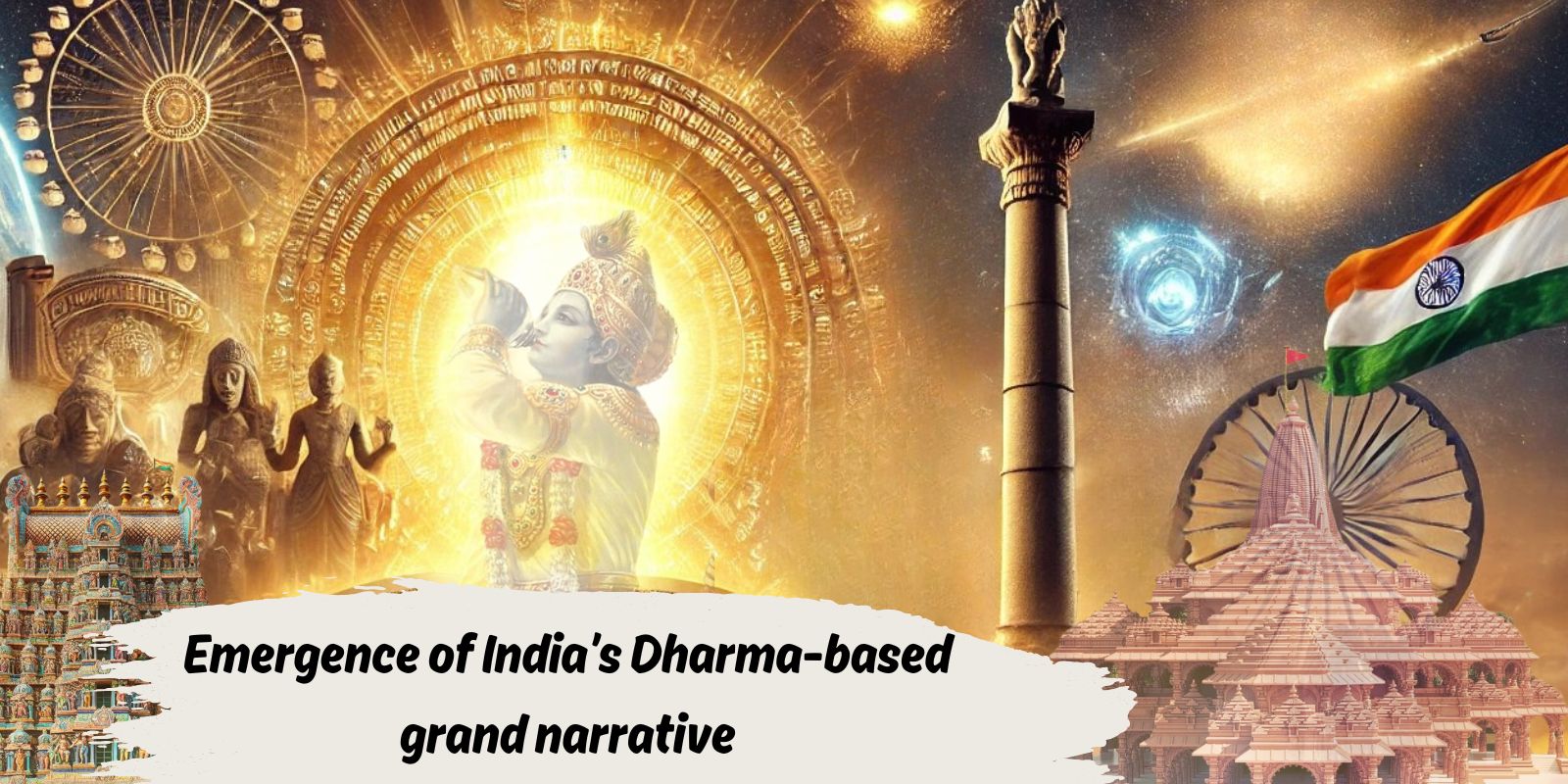
- India lacks a unified grand narrative, making it vulnerable to conflicting ideologies, leftist propaganda, and anti-Hindu narratives that weaken national identity and cultural pride.
- All major civilizations have grand narratives, shaping internal unity and global perception; India must establish its own, rooted in its civilizational ethos and Hindu Dharma.
- Decolonizing education is crucial, as India’s social sciences and humanities remain heavily influenced by Western frameworks; a non-Western perspective is needed to reclaim India’s intellectual and cultural legacy.
- The rise of Hinduphobia and anti-India narratives highlights the urgent need for a grand narrative to protect Hindu identity, counter ideological subversion, and foster nationalism.
- India has begun forging its grand narrative, emphasizing cultural revival, historical reclamation, and policy shifts, but sustained efforts are needed to fully establish it on the global stage.
In a rather bizarre though predictable sequence of events, the state government of Tamil Nadu is up in arms about the alleged imposition of the National Education Policy (NEP) 2020 by the central government. It is especially miffed about the NEP’s three-language formula, which recommends that students also learn a third language alongside their mother tongue and English. The ruling DMK sees this as a conspiracy to impose Hindi on Tamil people.[1] The state Chief Minister MK Stalin went to the extent of accusing the center of imposing a “monolithic Hindi identity” at the cost of regional languages. MK Stalin’s diatribe against the perceived imposition of Hindi got further intensified as he took to X to allege that the overt focus on promoting Hindi language is destroying “ancient mother tongues” and regional languages like Maithili, Bhojpuri, Garhwali, Kumaoni, etc.[2]
The anti-Hindi tirade of DMK, a hardcore communist party, the leaders of which have on multiple occasions also viciously attacked Sanatan Dharma, even comparing it to dengue and malaria, is rooted in a far-left mindset that harbors feelings of hatred and derision for anything remotely connected with the agenda of fostering pan-national cultural identity.
The reason why such statements are routinely made, and such debates get such prominence in Indian media is that India hasn’t yet created a grand narrative of its own. In the absence of a unifying grand narrative presenting India in the light of its civilizational and cultural ethos, multiple conflicting narratives jostle for attention – the narrative of secularism, the narrative peddled by the left-liberal ecosystem, the narrative of radical Islam, the narrative of glorification of colonialism and imperialism, etc.
Logically speaking, Indians should be up in arms against the deliberate imposition of English rather than Hindi, a foreign language that the country was introduced to through the painful history of imperialism. However, English is widely celebrated and uncritically hailed in India, while Hindi is vilified and demonized as a “non-language” as having no real history whatsoever, etc. The left-liberal cabal has been rather opportunistic in exploring the regional languages’ faultlines of India and prying on the emotional vulnerabilities of speakers to attack the Hindi language ecosystem. If India had a robust grand narrative of its own, Hindi would be seen as a pan-Indian binding force, conducive to the flourishing of regional languages rather than being portrayed as antithetical to their existence. The whole picture would have looked dramatically different. However, the lack of a coherent grand narrative celebrating Indian culture and civilization and finding points of synthesis between ancient India and modern India has led to vitriolic leftist propaganda against India.
In the following sections, we will delve deep into why India urgently needs to create a unique grand narrative and what the broad contours of such a narrative can be.
What is a Grand Narrative?
A grand narrative is the universal presentation and projection of a culture and its values and belief system. In the context of a nation, it is a broad, overarching story that would creatively simplify and unify its history, politics, culture, civilizational ethos, value system, knowledge systems, development paradigms, etc. A grand narrative is a broad-based and overarching term; thus, when one talks about a country’s grand narrative, it includes the large-scale projection of everything it stands for. Most importantly, it sets the frames through which an international audience will view the country. The grand narrative covertly sets the agenda for media, academia, think tanks, and civil society regarding the discursive lens through which the issues concerning that country will be portrayed.
The term “Grand Narrative,” also known as “Master Narrative,” was initially coined by French philosopher Jean-Francois Lyotard. Lyotard defined grand narratives as a form of storytelling that leads to the formation of myths that “functioned as a legitimation of the existing power relations, customs, and so on.”[3]
Although the concept of grand narrative has predominantly been studied in Marxist schools of thought, which typically view it as an instrument of ideological and political control, it is immensely useful for creating an overarching nationalist and civilizational discourse to influence a nation’s perception on the world stage.
Thus, grand narratives can be empowering for the Global South, which can take advantage of the fast-changing global order to challenge the hegemony of colonial discourse by creating its own meta-narratives rooted in non-Western frameworks.
All Major Civilizations Have their Grand Narratives
All major civilizations across the world have their respective grand narratives, which lay out the roadmap for their perception both internally and externally. For example, the United States of America is known for the “American Dream,” a country that assimilates into its folds people from all over the world, yet one characterized by the founding fathers of the land and its greatness. This, then, is the grand narrative of America. What is interesting is that despite regime changes, the overarching narrative remains the same. US President Donald Trump’s priorities and vision mark a stark departure from his predecessor’s. Yet, the grand narrative of the “American Dream” and the country epitomizing the best in the world remains intact.
Similarly, when one speaks of Europe, British colonialism instantly comes to mind. For a long time, the UK’s grand narrative has been rooted in the whitewashing and even glorification of colonialism and imperialism. The “legacy” of the English language and the sophisticated lure of British culture is a major part of that narrative, especially in terms of its marketing to former colonies. Thus, even though the UK is a democratic nation, the British media, academia, and civil society rarely question the exploitative basis of colonialism or imperialism or even criticize it. Rather, the British grand narrative of glorification of colonialism has become so all-encompassing and powerful that it even influences the perception of people in former colonies like India. The British grand narrative has percolated down the Indian society to such an extent that the whitewashing and glorification of the Empire has become one of the many competing narratives in the Indian context.
On the other end of the spectrum, we have the Chinese grand narrative based on their ancient civilizational values combined with the spirit of perfection to make China great again. The Chinese narrative, based on ancient Confucian philosophy, combines elements of Buddhism and Taoism, along with its unique ideas of modernity.
In a lecture he delivered at the Indian Institute of Advanced Studies, Shimla, in 2018, author and researcher Rajiv Malhotra presents some interesting insights regarding the respective grand narratives of major civilizations. He says the American grand narrative is firmly rooted in the doctrine of American exceptionalism. In the context of France, Malhotra argues that its grand narrative is based on the premise of conceptualizing France as the inheritor of the Renaissance movement of Medieval Europe. It projects France as a liberal and progressive nation with a highly refined culture to which all should aspire. The Japanese culture, says Malhotra, views and promotes itself as one based on a common race, language, culture, and Buddhist value system.[4]
In stark contrast, India has a maze of conflicting narratives propagated by different stakeholders based on their ideological leanings. This gives an unusual amount of leverage to ‘Breaking India’ forces, who use India as an experimental ground for promoting all kinds of anti-India narratives. Due to the lack of an overarching grand narrative, Indians become exceedingly vulnerable to vicious anti-Hindu and anti-India narratives.
Why India Needs Its Own Grand Narrative
In November 2023, India’s External Affairs Minister S Jaishankar highlighted the need for India to have its grand narrative while delivering a lecture at Symbiosis International (Deemed University) in Pune. He said that Bharat needed to develop its narrative to redefine its approach to international relations from a fresh perspective “beyond the parameters of Western thought.“[5] “Economics may have shifted, and the politics may be shifting, but if the culture doesn’t move alongside these shifts, then those shifts will always remain incomplete. Unless we are able to put our lens in place, they will never look at us in a way that best serves our interest”, he reportedly said.[6]
The External Affairs Minister’s comments underscore the importance of a grand narrative for projecting India’s soft power globally in a way that aligns with India’s national interest. The left-liberal cabal, through its relentless spread of narratives that oppose India’s national interest, has effectively seized control of public discourse.
Thus, first and foremost, India needs its own grand narrative rooted in its civilizational and cultural ethos to undo the baggage of left-liberal propaganda it has been subjected to since independence.
Let us understand this through a recent example. Samajwadi Party MLA (Member of Legislative Assembly) Abu Azmi recently sparked a row by claiming that Mughal emperor Aurangzeb was not a cruel king but a benevolent one who built many temples. “The history being taught is incorrect. Aurangzeb built many temples, and I do not view him as a cruel leader. Additionally, the conflict between Chhatrapati Sambhaji Maharaj and Aurangzeb was about state administration, not a religious battle between Hindus and Muslims”, he reportedly said. The Samajwadi party MLA was severely criticized across party lines for his unabashed glorification of the tyrannical Mughal ruler, with Maharashtra’s Deputy Chief Minister Eknath Shinde and Shiv Sena MP Naresh Mhaske even calling for sedition charges against him.[7] Following the row, Abu Azmi was suspended from the Maharashtra Assembly for the whole session.[8]
What is to be noted here is that it’s not a one-off incident. Many Indians, politicians or otherwise, routinely make such preposterous comments glorifying invaders, colonizers, and terrorists, mocking nationalism, or denigrating Hindu Dharma and culture, and get away with it. They can make such comments in the first place because India doesn’t have a grand narrative. Had India created a coherent grand narrative post-independence, rooted in its civilizational and cultural ethos and based on the principles of Hindu Dharma and ancient Indian philosophy and statecraft, such comments would have been rare. They wouldn’t have stopped because India is a democracy, unlike China, where an authoritarian system makes it easier to control narratives. However, a strong, unified narrative could have discouraged such comments.
India also needs a grand narrative to foster nationalism and patriotism. A nation’s identity is premised on its ability to inculcate national pride among its citizens. The radical left ecosystem eschews concepts like patriotism by dismissing these as shallow and jingoistic, instead pushing for dangerous and divisive anti-national rhetoric in the name of promoting progressive values and global citizenship.
That is precisely why an anti-national figure like Arundhati Roy gets widely celebrated amongst the English-speaking elite of India, even though she has openly resorted to the glorification of terrorism and called for the secession of Jammu and Kashmir from India, thus parroting the Pakistani narrative.[9]
Arundhati Roy’s so-called international fame is premised on her unabashed glorification of anarchy and secessionist tendencies in the name of freedom and vehement anti-India rhetoric in the name of critical scholarship. Most importantly, the Indian youth is extremely vulnerable to such anti-national rhetoric, which becomes a de-facto narrative in the absence of a pan-Indian grand narrative focused on promoting nationalism, patriotism, and cultural values.
As Hinduphobia is on a sharp rise globally, India urgently needs a grand narrative rooted in Sanatani values to protect Hindu identity and culture. Hindus in India are being aggressively targeted for religious conversion, while the politics of minority appeasement and the rhetoric of secularism have prevented consecutive governments from taking the issue seriously.[10] The lack of a grand narrative based on Hindu values and culture further exacerbates this phenomenon. Had India worked on creating its own grand narrative after independence, creatively synthesizing its ancient Vedic values, heritage, and knowledge systems with the discourse of modernity, such an issue wouldn’t have risen. Instead, post-independent India resorted to uncritically eulogizing the Western value system, importing their political, economic, and social systems, uncritically embracing the Western education system, and in the process, glorifying colonialism. The lack of interest in creating a grand narrative communicating India’s unique cultural and civilizational positioning in the world led to disastrous consequences for India, Indians, and Hindu Dharma.
Most importantly, grand narratives can have wide-ranging impacts on global policymaking. For example, the United Nations hasn’t officially recognized the existence of Hinduphobia yet, despite explicitly recognizing Islamophobia and discrimination against other Abrahamic religions like Judaism and Christianity. India raised the issue of Hinduphobia along with anti-Sikh and anti-Buddhist phobias in 2022,[11] urging the UN to ensure a greater degree of balance while discussing such sensitive topics.
Despite repeated attempts by the Indian government to draw attention to the issue of historical persecution of Hindus and rising Hinduphobia, the UN has been largely immune to the issue of anti-Hindu violence and discrimination. The Western media also takes a biased stand when it comes to condemning anti-Hindu sentiment. The coverage of the Ayodhya Ram Mandir Inauguration ceremony in January 2024 is a case in point. Such widespread apathy towards Hindu issues exists precisely because India has historically made little attempt to define its grand narrative in the light of its ancient Hindu past and civilizational values.
In summary, India urgently needs a grand narrative to assert its soft power on the global stage, safeguard its national interests, and protect itself from internal and external threats. A well-defined narrative is essential to counter the relentless anti-India propaganda pushed by the leftist ecosystem, which undermines the nation’s identity and stability. Fostering nationalism and patriotism among citizens is crucial for maintaining a strong national fabric. A grand narrative would also play a vital role in preserving Hindu identity and culture, preventing the rampant religious conversion of Hindus, and addressing the growing challenges of Hinduphobia. Moreover, it would enable India to influence global policymaking on issues concerning its people, ensuring that its civilizational ethos is accurately represented and respected worldwide.
Contours of An Emerging Grand Narrative
Over the past decade, India has begun to forge a grand narrative by reviving its civilizational and cultural ethos.
There is a newfound emphasis on redefining “Indian culture” through the lens of India’s ancient culture and civilization. Left-liberal narratives of Indian history involving the glorification of Islamic invaders and European colonizers are being rigorously challenged. Alternative narrative frameworks are being constructed.
Western colonial narratives on India are being critically interrogated by the Indian government. For example, India’s Ministry of External Affairs has been repeatedly vocal against various motivated indexes brought out by Western think tanks, denigrating India on various counts like democracy, press freedom, happiness, etc. [12] India has also lately been assertive in pointing out Western hypocrisy and double standards in acting as the self-anointed guardian of human rights, democracy, religious freedom, etc., and lecturing India on the same.[13] [14] [15]
Thus, India is now proactively challenging Western narratives on Indian politics, society, economy, development, culture, etc. It is also trying to present a counter-narrative to persistent Western rhetoric on India by demonstrating the lived experiences of Indians and the government’s policy nuances. For example, India’s External Affairs Minister S Jaishankar recently lectured the West on democracy. During his participation at the Munich Security Conference, Jaishankar challenged the “Western view of global democratic decline,” arguing that Indian democracy defied the Western narrative with its robust functioning. Showing his index finger to demonstrate that he had just voted in an election held in his state, he said, “So, the first message is that somehow democracy is in trouble globally, worldwide, I am sorry, I have to differ with it. I mean, right now, we are living well. We are voting well. We are optimistic about the direction of our democracy and for us democracy is actually delivered”.[16]
The broad contours of India’s newly emerging grand narrative are being defined through the revival of its ancient civilizational and cultural ethos. Events and phenomena like the inauguration of the Ayodhya Ram Mandir, the discovery of sacred wells, idols, and temples in Sambhal, Maha Kumbh 2025, etc., are milestones in India’s journey towards forging a unique grand narrative.
According to media reports, the Ayodhya Ram Mandir attracted approximately 110 million devotees within the first six months of its inauguration in January 2024. Moreover, by September 2024, it had become Uttar Pradesh’s most visited site, drawing a record number of 13.5 million domestic and 3,153 international tourists, surpassing the Taj Mahal. Media reports also suggest that the Ayodhya Ram Mandir welcomes approximately 150,000 pilgrims every day.[17]
The inauguration of the Ram Mandir in Ayodhya also led to a sharp rise in Dharmic tourism overall, signifying a shift from glorifying the legacy of invaders to fostering a deeper connection to its cultural and spiritual roots.[18]
There was a time, not so long back when temple tourism was unheard of in India. At least, the governments did not promote Dharmic culture on such a large scale. For the ubiquitous foreign tourist, a short trip to India involved the customary visit to the Taj Mahal and perhaps a peek at the Islamic architecture of Delhi – Lodhi Gardens, Humayun’s Tomb, et al. Hindu culture and heritage were rarely promoted internationally. Indian architecture and heritage were synonymous with the legacy of Islamic invaders and European colonizers. The paradigm shift over the past decade signals the much-needed process of formation of India’s grand narrative through the lens of its Hindu heritage.
The idea of a Hindu Rashtra, a nation based on the core values and culture of Sanatan Dharma, is also becoming more prominent. Although it still hasn’t quite reached the mainstream due to the constant fear-mongering of the left-liberal cabal, which insinuates that a Hindu Rashtra would automatically take away the rights of religious minorities in India, the idea of a nation based on Sanatani values certainly finds many more takers now.
India is also trying to restructure its education system from a non-Western perspective. The National Education Policy (2020) puts the spotlight on promoting Indian languages and highlighting India’s contributions to various streams of knowledge in arts, philosophy, sciences, medicine, astronomy, economics, art and culture, etc. It also focuses on mainstreaming Sanskrit language education and integrating it with subjects like mathematics, astronomy, linguistics, dramatics, philosophy, yoga, etc.[19]
Lastly, India is also trying to integrate the decolonial perspective in its emerging grand narrative by championing itself as a leader of the Global South in a newly emerging world order.
Wrapping up
While India has initiated the process of constructing its grand narrative, it is only the start, and much more effort is needed.
The Indian education system requires a significant transformation. While the National Education Policy (NEP) 2020 is a step forward, it barely scratches the surface. Moreover, its implementation is not legally binding and serves only as a broad framework. Indian education remains deeply rooted in a Western framework, particularly in the Social Sciences and Humanities. Therefore, the first step in establishing a cohesive pan-Indian grand narrative should be a thorough restructuring of humanities and social sciences education from a non-Western perspective.
In a 2018 lecture at the Indian Institute of Advanced Studies, Shimla, Rajiv Malhotra offered valuable insights on reforming India’s education system through a Vedic lens and ancient Indian knowledge systems.
To truly build a pan-Indian grand narrative, India must draw from its rich Indic knowledge traditions and begin the process of decolonizing its education system.
Citations
[1] Why Tamil Nadu rejects NEP despite no binding rule to learn Hindi – India Today; https://www.indiatoday.in/india-today-insight/story/why-tamil-nadu-rejects-nep-despite-no-binding-rule-to-learn-hindi-2685371-2025-02-25
[2] ‘Push for monolithic Hindu identity’: It’s MK Stalin vs. Ashvini Vaishnaw over language row | India News – The Indian Express; https://indianexpress.com/article/india/push-for-monolithic-hindi-identity-war-of-words-erupts-between-tamil-nadu-cm-mk-stalin-union-minister-ashwini-vaishnaw-over-hindi-imposition-9859984/
[3] Glossary of Terms: Gr; https://www.marxists.org/glossary/terms/g/r.htm#:~:text=Grand%20narrative%20or%20 “master%20narrative,and%20ideological%20forms%20of%20knowledge.
[4] Weaving India’s Mahakatha ( Grand Narrative ) for the 21st Century by Rajiv Malhotra; https://infinityfoundation.com/wp-content/uploads/2018/04/Weaving-Indias-MAHAKATHA-Grand-Narrative-for-the-21st-Century_RML-20Mar2018.docx.pdf
[5] Bharat needs its own narrative: EAM Jaishankar | India News-Times of India; https://timesofindia.indiatimes.com/india/bharat-needs-its-own-narrative-eam-jaishankar/articleshow/105504377.cms
[6] Ibid.
[7] Maharashtra Deputy CM Shinde demands sedition case against Abu Azmi for the glorification of Aurangzeb; https://organiser.org/2025/03/04/280830/bharat/abu-azmi-faces-legal-trouble-for-praising-aurangzeb-shinde-sena-files-cases-against-maharashtra-sp-chief/
[8] Abu Azmi suspended – Abu Azmi suspended from Maharashtra Assembly for Aurangzeb remark – India Today; https://www.indiatoday.in/india/story/samajwadi-party-mla-abu-azmi-suspended-from-maharashtra-assembly-for-his-remarks-on-aurangzeb-2689164-2025-03-05
[9] Read the 2010 anti-India speech of Arundhati Roy, for which she faces UAPA charges: https://www.opindia.com/2024/06/arundhati-roy-anti-india-speech-pakistani-propaganda-secessionism/
[10] “The Silent Threat: Illegal Conversions of Hindus in India”; https://stophindudvesha.org/the-silent-threat-unlawful-religious-conversions-of-hindus-in-india/
[11] Acknowledge ‘Hinduphobia’, India urges UN | India News – Times of India; https://timesofindia.indiatimes.com/india/acknowledge-hinduphobia-india-urges-un/articleshow/89028174.cms
[12] Jaishankar calls World Press Index’ mind games’: Why the ranking is questionable- Firstpost; https://www.firstpost.com/explainers/jaishankar-world-press-freedom-index-mind-games-ranking-process-controversial-12561312.html
[13]Is democracy in danger? S Jaishankar shows inked finger after US Senator’s remark | Latest News India – Hindustan Times; https://www.hindustantimes.com/india-news/is-democracy-in-danger-s-jaishankar-shows-inked-finger-after-us-senators-remark-101739593437243.html
[14] India rejects ‘malicious report’ by USCIRF on religious freedom abuses: ‘Desist from agenda driven efforts’ | Latest News India – Hindustan Times; https://www.hindustantimes.com/india-news/india-rejects-malicious-report-by-uscirf-on-religious-freedom-abuses-desist-from-such-agenda-driven-efforts-101727958001074.html
[15] India slams US human rights report, says, ‘reflects poor understanding’ | India News – Business Standard; https://www.business-standard.com/india-news/india-slams-us-human-rights-report-says-reflects-poor-understanding-124042500955_1.html
[16] Is democracy in danger? S Jaishankar shows inked finger after US Senator’s remark | Latest News India – Hindustan Times; https://www.hindustantimes.com/india-news/is-democracy-in-danger-s-jaishankar-shows-inked-finger-after-us-senators-remark-101739593437243.html
[17] Ayodhya Ram Mandir Records You Need to Know from Prana Pratishtha till First Anniversary ( 11 January); https://www.jagranjosh.com/general-knowledge/ayodhya-ram-mandir-records-you-need-to-know-from-prana-pratishtha-till-now-1736541527-1
[18] Temples spark India’s cultural reset”; https://stophindudvesha.org/beyond-mausoleums-temples-tourism-drives-indias-cultural-reset/
[19] National Education Policy 2020; https://www.education.gov.in/sites/upload_files/mhrd/files/NEP_Final_English_0.pdf , p.53-55

Donate to HINDUDVESHA
Our Mission is to explore and expose Hindudvesha through research analysis, education and response.
SUPPORT US