

One Thousand Years of Iconoclasm: The Beast that Demolished Somnath Continues to Haunt India
 Rakesh Krishnan Simha · 12/18/2024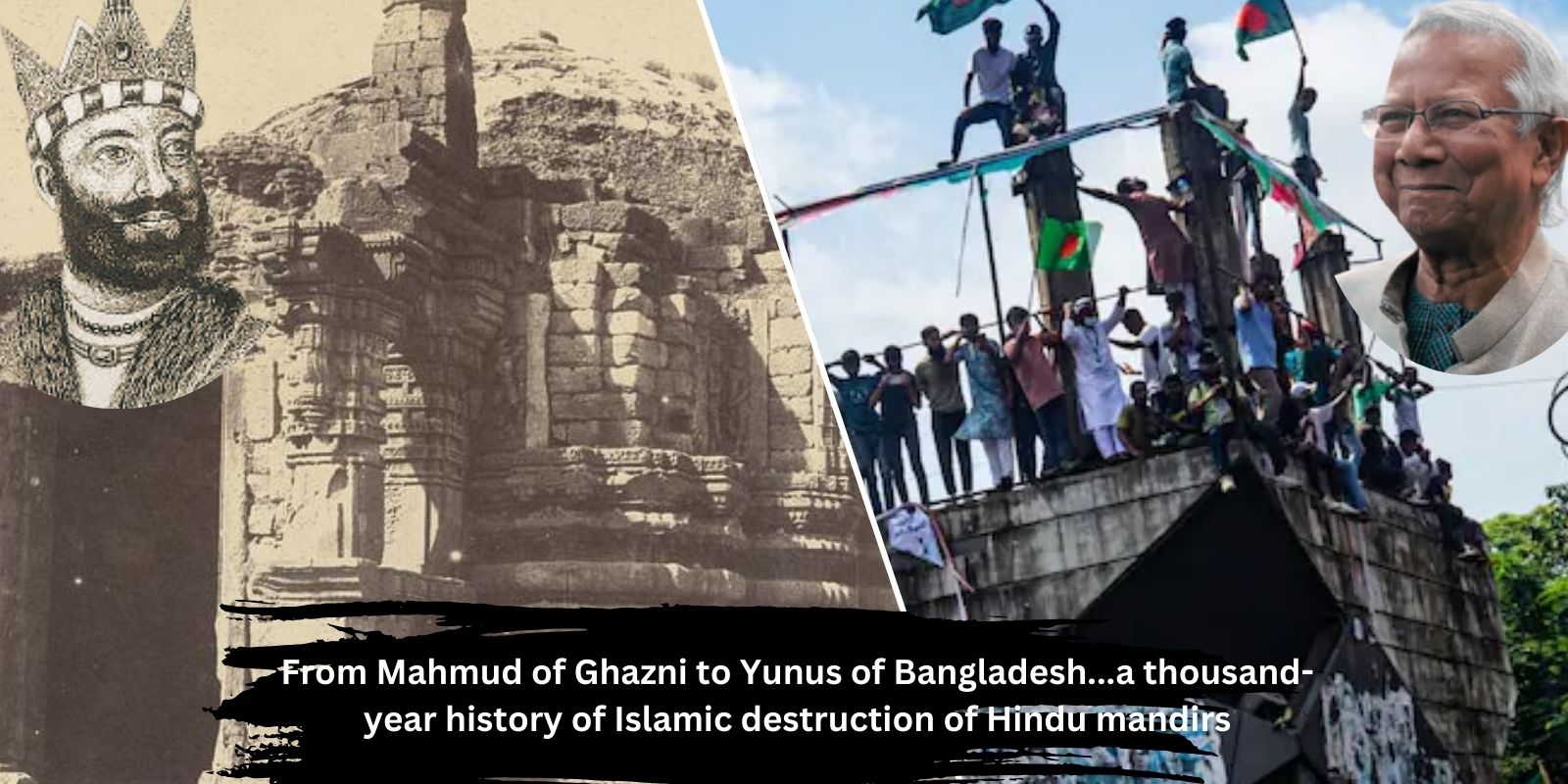
- Mahmud of Ghazni’s 1025 raid on the Somnath Temple marked the beginning of centuries of Islamic invasions characterized by brutal iconoclasm and cultural erosion.
- Over a millennium, Hindu temples were systematically destroyed by Islamic invaders, symbolizing efforts to erase India’s spiritual heritage and assert religious dominance.
- The struggle to restore desecrated temples, such as Somnath and Babri Masjid, reflects a broader effort to reclaim India’s cultural identity and historical justice.
- The legacy of Islamic invasions continues to resonate, shaping contemporary cultural and political discourse around religious identity and historical accountability in India.
When the iconic Laxmi Narayan Temple, also known as Birla Mandir, opened in 1936, it was the first temple to be built in Delhi in several centuries. So many temples had been destroyed by Muslim invaders and rulers that Hindus simply stopped building their places of worship in Delhi. The accumulated fear of a millennium of destruction had prevented Hindus from even thinking of building a temple. In fact, Delhi’s St James Church, the largest Christian church built by the British in India, is 100 years older than Birla Mandir. So when the temple came up, the architects who built it cried with joy, realizing what a historical moment it was for the people of Delhi.[1]
While the first recorded instance of large-scale temple destruction in India happened in 712 CE (with the Arab conquest of Sindh), Islam’s thousand-year iconoclastic fury started with Mahmud’s raid on the celebrated temple of Somnath in 1025 CE, the ruler of Ghazni, a small and dirt-poor kingdom in present-day Afghanistan.
Islamic iconoclasm refers to the destruction of religious icons and monuments, often driven by a desire to assert dominance or religious fervor. The events surrounding the sack of Somnath have echoed through centuries because the attack crossed all limits of barbarism, influencing cultural narratives and political ideologies in both India and the Islamic world. The destruction of Somnath serves as a symbol of Islamic iconoclasm that resonates to this day – a civilizational scar having a lasting impact on contemporary society. It represents not only the violent conflicts between Hindu and Muslim rulers but also the broader phenomenon of Islamic terror that continues unabated. The jihadi tyrants are long gone, but their progeny continue to torment Hindus, disrupting their way of life, attacking their places of worship and festivals, and usurping their properties by waging ‘land jehad’ via the Waqf Act.[2]
Barbarians at the Gate
India, at the beginning of the 11th century, was fragmented and disunited and had fallen from the apex position that it had attained during its Golden Age (200 CE – 550 CE),[3] and still, it was a highly advanced civilization compared with Europe or the Middle East. According to Rizwan Salim: “The followers of Siva and Vishnu on the subcontinent had created for themselves a society more mentally evolved, more joyous and prosperous than what had been attained by the Jews, Christians, and the Muslims. Medieval India, until the Islamic invaders destroyed it, was history’s most richly imaginative culture and one of the five most advanced civilizations of all times.”[4]
The destruction of this rump – and still enviable – civilization is what prompted American historian Will Durant to write: “The Mohammedan conquest of India is probably the bloodiest story in history. It is a discouraging tale, for its evident moral is that civilization is a precarious thing whose delicate complex of order and liberty, culture, and peace may at any time be overthrown by barbarians invading from without or multiplying within. The Hindus had allowed their strength to be wasted in internal division and war; they had adopted religions like Buddhism and Jainism, which unnerved them for the tasks of life; they had failed to organize their forces for the protection of their frontiers and their capitals, their wealth and their freedom, from the hordes of Scythians, Huns, Afghans, and Turks hovering about India’s boundaries and waiting for national weakness to let them in. For four hundred years (600-1000 CE), India invited conquest, and at last it came.”[5]
With the Ghaznavid Empire chipping away at India’s buffer areas in Afghanistan, an attack into the country’s heartland was just a matter of time. Located on the Gujarat coast, the Somnath Temple is described as one of the 12 Jyotirlingas. One of the holiest shrines of Shiva, it held immense spiritual significance and was renowned for its wealth and architectural grandeur. Not surprisingly, the temple attracted the attention of Mahmud, who embarked on his campaign with a well-documented history of raids aimed at plundering wealth and asserting Islamic power. His attack on Somnath was his fifteenth raid into Indian territory.
According to the Arab traveler Alberuni, Mahmud of Ghazni strategically placed agents in the temple, disguising them as holy men, travelers, and traders to gather intelligence. Additionally, the Sultan sent an astrologer to mislead the local Hindu king about the true direction of his attack.[6] Early Muslim visitors and residents in India, including Sufis and dervishes, often served as informants or scouts for Islamic invaders. By employing this approach, Mahmud’s army was able to avoid larger Indian kingdoms, choosing routes of least resistance for both entry and retreat.
Exactly a thousand years ago, in 1025, Mahmud set out with his army towards Somnath. It was a vast Islamic horde of 90,000 men, including 30,000 unpaid volunteers from Central Asia, who joined the invading force in the hope of gaining immense loot and slaves from India.
Upon arrival, Mahmud encountered a fortified structure on a peninsula, surrounded by sea on three sides, with armed defenders visible on its battlements. The Muslim forces initiated a fierce assault that lasted three days, with the battle’s outcome remaining uncertain. Eventually, the attackers broke through the enemy lines and inflicted heavy casualties on the defenders, leaving approximately 50,000 dead in the aftermath.
As Mahmud approached the temple, he beheld a magnificent structure constructed of finely hewn stone. The lofty roof was supported by 56 intricately carved pillars adorned with precious stones. At the center of the hall stood the idol of Somnath, a stone figure measuring five yards in height, two of which were embedded in the ground. The Sultan advanced toward the idol, raised his mace, and struck off its nose. He then commanded that two pieces of the idol be broken off and sent to Ghazni: one to be placed at the threshold of the public mosque and the other at the entrance of his palace. These fragments remain visible in Ghazni to this day. Additionally, two other pieces were dispatched to Mecca and Medina.[7]
The total wealth looted from Somnath amounted to 20 million dinars and was carried away on thousands of camels and oxen. Over a hundred thousand Hindus – men, women, children, and artisans – were captured and sold in the markets of Ghazni. So great was the number of Hindus sold that the price of slaves tumbled in the markets of Central Asia.
Mahmud of Ghazni’s attack on Somnath marked a pivotal moment in the conflict between Hindu and Muslim civilizations. Somnath was more than a religious site; it symbolized Hindu cultural and political strength in the region. Mahmud’s assault aimed not only at plundering riches but also at weakening Hindu kingdoms and advancing Islamic influence in the Indian subcontinent
Legacy of Somnath
The sacking of Somnath marks the beginning of the over thousand-year iconoclastic fury of Muslim invaders. Mahmud’s destruction of the temple opened the floodgates to Islamic depredations in India. The Caliph of Baghdad, who was recognized as both the temporal and spiritual head of all Muslims at the time, bestowed the title of Yamin-ud-Doulah (Right Hand of the Empire) and Amin-ul-Milat (Custodian of Faith) on Mahmud. “Seeing the canonization that success had brought to this magnificent thief, other Moslem rulers profited by his example, though none succeeded in bettering his instruction.” [8] Countless hordes of Turks, Tatars, Uzbeks, and Iranians poured into the country, unleashing an orgy of destruction and loot that has no parallel in world history.
In the two-volume ‘Hindu Temples; What Happened To Them,’ Sita Ram Goel, Arun Shourie, Harsh Narain, Jay Dubashi, and Ram Swarup mention that Mahmud of Ghazni robbed and burnt down 1,000 temples at Mathura, and 10,000 in and around Kanauj. One of his successors, Ibrahim, demolished 1,000 temples each in the Ganga-Yamuna Doab and Malwa. Muhammad Ghori destroyed another 1,000 at Varanasi. Qutb-ud-Din Aibak employed elephants to pull down 1,000 temples in Delhi. Ali Adil Shah of Bijapur destroyed 200 to 300 temples in Karnataka. A Sufi, Qayim Shah, destroyed 12 temples at Tiruchirapalli. Adding up the temples destroyed by just six Muslim rulers gives you the stupendous figure of 15,212. However, such exact or approximate counts are available only in a few cases.[9]
If one begins to calculate the total number of Hindu (plus Jain, Buddhist, and Sikh) temples destroyed by Muslims in India, the final figure would be staggering. It would likely still be a low estimate because not all invaders and rulers systematically recorded every instance of temple destruction.
Goel and his co-writers created what is acknowledged as the most exhaustive work on temple destruction and desecration in India and its near abroad. “Our citations mention 61 kings, 63 military commanders, and 14 sufis who destroyed Hindu temples in 154 localities, big and small, spread from Khurasan in the west to Tripura in the east, and from Transoxiana in the north to Tamil Nadu in the south, over a period of 1,100 years. In most cases, the destruction of temples was followed by the erection of mosques, madrasas, and khanqahs, etc., on the temple sites and, frequently, with temple materials.”
The Unchanging Beast
The destruction of Somnath remains a significant and resonant event in the Indian subcontinent to this day. Many Muslims in India continue to regard figures like Mahmud of Ghazni and the Mughal emperor Aurangzeb, known for their acts of idol-breaking, as heroes and saints. This admiration for historical iconoclasm persists, with some modern Muslims resisting calls to return the sites of demolished temples that were replaced with mosques by medieval Islamic invaders. Additionally, there is growing vocal advocacy among certain groups for integrating India into the Islamic ummah, with aspirations to eliminate idolatry from the country.
The persistence of iconoclasm is a stark reminder to Hindus – who have a notoriously short memory – that the beast that destroyed Somnath is still the same. For a glimpse into what Muslims have planned for India once Islam becomes the country’s majority religion, one only needs to look across the border to Bangladesh, where Islamists are openly razing temples and lynching Hindus. Supported by Islamist leaders and a radicalized army, the campaign against Bangladesh’s defenseless Hindus resembles a turkey shoot.[10]
According to Goel, “In the history of Islam, iconoclasm and razing other people’s temples are not aberrations – stray acts of zealous but misguided rulers – but are central to the faith. They derive their justification and validity from the Quranic Revelation and the Prophet’s Sunna or practice.”
This means that whenever Muslims of the Indian subcontinent have the opportunity and the means, they will unleash a hundred Somnaths in the region.
Temple destruction is not just to please Allah; it has its practical side, too, and comes with earthly rewards for Muslims. “They work to extend the sovereignty of their God and, in the process, their own too. A pious tradition proclaims that the earth belongs to Allah and his Prophet. Therefore, the inescapable conclusion is that the infidels are merely squatters, and they should be dispossessed and the land returned to its rightful owners, the believers.”[11]
Our so-called seculars and liberals miss this aspect of Islam. Perhaps because of their ignorance of the Theology of Islam – rather than their anti-Hindu animus, they assume that Islam comes with the offer of brotherhood and that the marauders who destroyed tens of thousands of temples and killed countless millions of Hindus were motivated by plunder rather than religious fanaticism. By getting blindsided, they are setting themselves – and other Hindus who are gullible enough to be brainwashed by them – up for future pogroms.
Goel explains: “Our Marxist professors and other pandits of secularism are very much mistaken when they discover or invent economic and/or political motives for explaining away the crimes committed by Islam. Either they have remained totally ignorant of what the Theology of Islam prescribes vis-a-vis the unbelievers, their women and children, their properties, their homelands, their religious teachers, and their places of worship; or their deep-seated animus against everything Hindu has pushed them into the camp of those who are out to destroy everything for which this country has been held in high esteem down the ages.”[12]
Closing Remarks
The symbolism of the Somnath Temple’s destruction continues to resonate in India today. One of the most significant manifestations of this legacy is the controversy surrounding the Babri Masjid and its subsequent demolition in 1992. The Babri Masjid, which had been built by the Mughal Emperor Babur on the site of a Hindu temple dedicated to Lord Rama, became a flashpoint for Hindu-Muslim tensions in the late 20th century.
The demolition of the mosque by Hindus, who claimed the site was originally the birthplace of their God, was seen as an act of reclaiming a sacred space that had been usurped by Muslim rulers centuries earlier. This event can be understood as a symbolic reversal of the iconoclasm that had begun with figures like Mahmud of Ghazni, where the removal of Islamic symbols became a means of reasserting Hindu identity and challenging the legacy of Muslim domination.
Plus, the destruction of temples, particularly in regions that have seen significant Islamic rule, is still a contentious issue in the political sphere. The demand for the restoration of temples, the renaming of places that were altered during Islamic rule, and the call for a reevaluation of India’s history from a Hindu perspective are all part of a broader effort to reclaim cultural and religious spaces that have been shaped by centuries of iconoclastic actions.
While the context has evolved, the battle over religious symbols and heritage sites continues. The destruction of Somnath serves as an enduring metaphor for this struggle. It represents not only the physical violence of the past but also the ongoing fight for political power in the Indian subcontinent.
Hindus must never forget that Islam – which means submission – has only a single point agenda in India, and that is to erase all other religions from the map. In this civilizational clash, Muslims only have to win once; Hindus have to win always.
Citations
[1] Rajat Mitra: Did the building of Birla Temple in Delhi end an era of fear for Hindus? https://rajatmitra.co.in/did-the-building-of-birla-temple-in-delhi-end-an-era-of-fear-for-hindus/
[2] 300 acres of farmland in Latur village claimed as Waqf property (Hindustan Times); https://www.hindustantimes.com/cities/mumbai-news/300-acres-of-farmland-in-latur-village-claimed-as-waqf-property-101733773477952.html
[3] Noor Mehta: India’s Golden Age: Gupta Dynasty and the Flourishing Arts (My Lekh); https://www.my-lekh.com/post/india-s-golden-age-gupta-dynasty-and-the-flourishing-arts#google_vignette
[4] Rizwan Salim: What the Islamic Invaders Did to India (Arise Bharat); https://arisebharat.com/2010/12/06/what-the-islamic-invaders-did-to-india/
[5] Will Durant: The Islamic Conquest of India (Center for Indic Studies); https://cisindus.org/indic-varta-internal.php?vartaid=12
[6] When Mahmud Ghaznavi attacked Somnath Temple on this day – Here is what happened (Organiser.org); https://organiser.org/2023/01/08/103793/bharat/when-mahmud-ghaznavi-attacked-somnath-temple-on-this-day-here-is-what-happened/
[7] Sitaram Goel et al: Hindu Temples: What Happened to Them? Volume 1 and 2; https://ia800104.us.archive.org/2/items/HinduTemplesWhatHappendToThemBySitaRamGoel/Hindu-TemplesWhat-Happend-to-Them-by-Sita-Ram-Goel.pdf
[8] Jami‛ al-Tawarikh by Rashid al-Din: Mahmud of Ghazni receiving a richly decorated robe of honour from the caliph al-Qadir in 1000; https://warfare.x10host.com/Persia/14/Jami_al-Tawarikh-Mahmud_of_Ghazni_in_robe_from_the_Caliph-Edinburgh-MsOr20.htm
[9] Sitaram Goel et al: Hindu Temples: What Happened to Them? http://voiceofdharma.org/books/htemples2/ch8.htm
[10] Yunus Is Presiding Over A Bloodbath Against Hindus In Bangladesh. How India Can—And Must—Stop It (Swarajya); https://swarajyamag.com/world/yunus-is-presiding-over-a-bloodbath-against-hindus-in-bangladesh-how-india-canand-muststop-it
[11] Sitaram Goel et al: Hindu Temples: What Happened to Them? Volume 1 and 2; https://ia800104.us.archive.org/2/items/HinduTemplesWhatHappendToThemBySitaRamGoel/Hindu-TemplesWhat-Happend-to-Them-by-Sita-Ram-Goel.pdf
[12] Sitaram Goel et al: Hindu Temples: What Happened to Them? http://voiceofdharma.org/books/htemples2/ch8.htm

Donate to HINDUDVESHA
Our Mission is to explore and expose Hindudvesha through research analysis, education and response.
SUPPORT US