

Murugan Meet 2025: A Civilizational Awakening for a Post-Secular India
 Aditi Joshi · 07/06/2025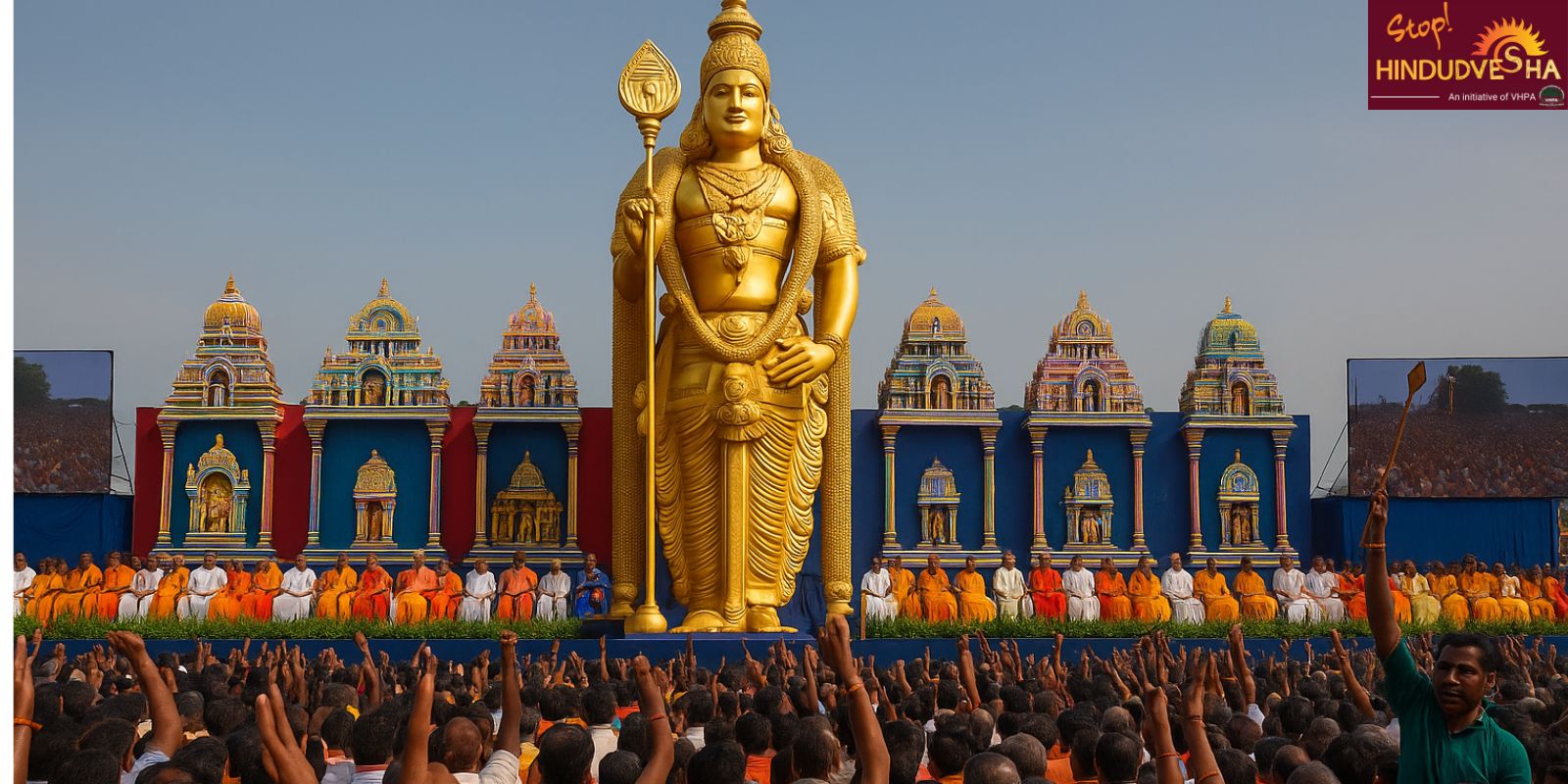
- Though presented as a spiritual event, it emerged as a profound affirmation of Hindu identity, memory, and spiritual sovereignty in a time of ideological erasure.
- The event, organized by acharyas, temple leaders, and cultural seers, avoided political protests or public agitation.
- In a climate where temple lands are contested, sacred spaces renamed, and Hindu autonomy curtailed, the gathering declared that devotion is not passive.
- Rituals were transformed into public acts of remembrance, dignity, and defiance against cultural appropriation.
- The Murugan Meet was not an isolated event. It was part of a growing realization among Hindus that appeasement has failed.
On June 22, 2025, the ancient city of Madurai—long revered as a bastion of Tamil culture and sacred geography—became the setting for a moment that transcended mere ritual. At Amma Thidal, near Vandiyur, more than half a million Hindus gathered for the Murugan Devotees Conference. At first glance, it may have appeared to be a traditional religious gathering. But to those attuned to the deeper pulse of India’s civilizational consciousness, it was evident that this was far more than a devotional assembly. It was a powerful expression of collective memory, identity, and spiritual sovereignty.
Organized through the efforts of Hindu acharyas, temple trustees, cultural activists, and spiritual leaders, the event was not a protest in the conventional sense. It did not rely on placards or polemics. Instead, it unfolded as a Sankalpa—a solemn vow of sacred resistance—rooted in devotion but charged with the unmistakable energy of Shatrubodh: the awakening to ideological, cultural, and institutional threats facing Hindu civilization.
At a time when sacred Hindu spaces are being claimed by missionary interests, when temple lands are being litigated and renamed, and when state control has stripped temples of their autonomy while privileging other religious institutions, this gathering was a declaration. It affirmed that bhakti is not passive, that rituals are not empty gestures, and that devotion can be the highest form of dissent when civilizational continuity is at stake.
The replicas of Murugan’s six abodes, the collective chanting of the Kandha Sasti Kavasam, and the presence of seers guiding the assembly were not just acts of worship. They were acts of remembrance. They were acts of resistance. And they signaled that the Hindu psyche is no longer content with silent endurance. It is beginning to remember, to reassert, and to reclaim.
The Murugan Meet in Madurai was not an isolated occurrence. It was the crystallization of a growing realization among Hindus that the time for appeasement had passed. In its place is rising a movement grounded in clarity, nourished by tradition, and propelled by the recognition that to protect the sacred is not extremism, it is dharma.
Ritual, Replica, and Resistance
At the heart of the gathering stood Murugan, the beloved warrior-deity revered across Tamil Nadu by many names—Kartikeya, Skanda, Subramanya. But to reduce him to a collection of appellations is to miss his true significance. Murugan is not merely a god in the pantheon of Tamil Hinduism; he is a civilizational emblem, a cultural anchor who binds the spiritual to the historical and the Tamil to the timeless. He stands as a radiant embodiment of the unity between Tamil identity and Sanatana Dharma—a unity that has withstood centuries of disruption, distortion, and ideological severance.
The visual centerpiece of the event captured this sacred essence with extraordinary clarity. The organizers unveiled full-scale replicas of the Arupadai Veedu—the six traditional abodes of Murugan revered across Tamil Nadu. These structures, spread across 20,000 square feet, were not erected for spectacle or entertainment. They were acts of sacred restoration, built with painstaking craftsmanship and deep reverence. Each replica stood as a living archive, invoking not only the architectural grandeur of these temples but also their enduring role in shaping the moral and metaphysical imagination of Tamil Hindus for generations.
As devotees streamed in from across the state and beyond, the air began to thrum with the rhythmic cadence of the Kandha Sasti Kavasam, one of the most powerful hymns in the Tamil bhakti tradition. The chanting did not echo in solitude. It rose like a tidal surge, voiced by tens of thousands of men, women, and children—many with tears in their eyes and vel markings on their foreheads. This was not a moment of individual prayer. It was a collective act of spiritual solidarity, a chorus of remembrance and belonging that shook the very ground on which they stood.
In that moment, ritual became resistance[1]. The sacred syllables carried more than devotion. They carried defiance. They carried memory. They carried the ancestral assertion that Murugan’s hills, temples, and shrines are not negotiable zones of appropriation or rebranding. They are sanctified spaces, etched into Tamil soil and soul long before missionary encroachments and modernist erasures attempted to strip them of their Hindu roots.
This act of unified chanting, offered before Murugan’s symbolic abodes, was not a mere recitation. It was a civilizational declaration. It proclaimed that these sacred geographies are not up for debate, and that the cultural memory encoded within them will not be quietly erased. It reminded all present that in the Hindu worldview, the land itself is not neutral terrain—it is an extension of divinity, a repository of dharma, and a battlefield where remembrance becomes a sacred duty.
Through architecture, chanting, and presence, the Murugan Meet revealed that Hindu devotion is not passive nostalgia. It is an act of active reclamation—carried forward by a generation that remembers what was taken and now refuses to forget.
Judicial Struggles and Institutional Pushback
Although the Murugan Devotees Conference was ultimately granted permission by the Madras High Court, the path to approval was marked by a series of legal and bureaucratic hurdles that exposed deeper tensions within India’s so-called secular framework[2]. From the outset, the event was burdened with a maze of restrictions—stringent controls on vehicular access, limitations on drone usage for surveillance and documentation, and caps on the overall size and scale of the gathering. For an assembly that was devotional in nature and deeply rooted in centuries-old cultural tradition, the level of legal scrutiny felt not only disproportionate but also symptomatic of a broader unease with Hindu mobilization in the public sphere.
Despite these constraints, the organizers persisted. They navigated the judicial process with both patience and purpose. After reviewing the facts and representations, the High Court recognized the religious and cultural significance of the gathering. It upheld the constitutional right to peaceful assembly, affirming that Hindus, too, possess the right to congregate in devotion and cultural pride. At the same time, the court issued a word of caution, urging the organizers to maintain communal harmony and ensure that the event remained within the bounds of law and public order.
The matter also reached the Supreme Court, where petitioners sought additional restrictions. However, the apex court chose not to intervene, deferring instead to the judgment and jurisdiction of the High Court. In doing so, the Supreme Court offered a quiet yet firm validation of the event’s legitimacy. This sequence of judicial proceedings serves as a revealing window into the institutional complexities of post-secular India.
In a truly pluralistic society, spiritual gatherings would be celebrated as expressions of cultural vibrancy. But in contemporary India, such events increasingly require judicial validation, bureaucratic negotiation, and constant reassurances that faith will not be mistaken for fanaticism. This legal back-and-forth is not merely about permits and permissions—it reflects the deeper civilizational friction of our time, where Hindu expressions of identity, even when peaceful and devotional, are too often treated with suspicion, as if cultural assertion by the majority is inherently destabilizing.
That the Murugan Meet had to pass through so many institutional filters simply to affirm its existence is a stark reminder of the precarious space Hindu traditions now occupy in the public domain. It also underscores why gatherings of this nature are not just spiritual milestones but acts of civilizational reclamation—asserting not only the right to worship, but also the right to remember, to belong, and to speak without apology.
Civilizational Assertion, Not Political Theatre
As expected, political reactions to the Murugan Devotees Conference revealed more than they concealed. Leaders from the AIADMK, DMK, and MDMK were quick to dismiss the event, branding it a “Sanghi stunt” and an “artificial setup” [3] intended to stoke communal sentiment ahead of the 2026 Tamil Nadu Assembly elections. These accusations, however, did not stem from any substantive critique of the event’s format or content. Rather, they exposed a deeper unease with the rising assertion of Hindu identity in a space that has long been ideologically regulated. [4]
The criticism did not speak to the facts on the ground but rather to the political establishment’s unease with the sight of Hindus organizing outside the framework of apology and deference. In this context, Dravidianist parties’ rejection of the event reflected not a principled stand against politicization but a reaction to the visibility of a cultural force they have long sought to marginalize.
Responding to these claims, Nainar Nagendran, president of the Tamil Nadu BJP, reiterated that the Murugan Meet was not a political rally disguised as a religious event. He emphasized its spiritual and cultural nature, even as the presence of Pawan Kalyan, Deputy Chief Minister of Andhra Pradesh, added a notable public dimension. Kalyan’s participation was significant, not because of his political stature alone, but because of the message he delivered. Standing before thousands of devotees, he denounced the hypocrisy of “fake secularists” and issued a call for Hindu unity, urging communities to move beyond internal divisions and reclaim their civilizational confidence.
This sentiment found formal expression in a resolution passed by the Hindu Munnani during the conference. It emphasized concerns central to the Hindu community in Tamil Nadu, such as temple protection, religious autonomy, and the need for collective coherence in the lead-up to the 2026 elections. Yet the language and atmosphere of the gathering remained anchored in cultural and spiritual values rather than partisan rhetoric.
What resonated from the stage was not the voice of electoral strategy but of a community reclaiming space after a long period of marginalization. The repeated appeals for Hindu unity—voiced by seers and spiritual leaders—were not framed in political terms. They reflected a deeper concern for cultural continuity, spiritual integrity, and a collective memory shaped by reverence and resistance to sustained ideological pressures.
At its core, the Murugan Meet conveyed a message of assertion without hostility, and solidarity without erasure of diversity. The tone was neither combative nor exclusionary. It was the voice of a tradition conscious of what it has lost, and deliberate in how it chooses to recover, not through confrontation, but through clarity, devotion, and quiet determination.
Murugan and the Return of Shatrubodh
The symbolism of Murugan carries layers of meaning that extend far beyond visual devotion. With his spear in hand, eyes radiating clarity, and poised atop a majestic peacock, Murugan is not merely a deity rendered in bronze or stone. He stands as a living emblem of Hindu resilience—a symbol of vigilance, sovereignty, and sacred strength. Every aspect of his form speaks not only to theology but to memory, preparedness, and the enduring struggle between dharma and adharma.
This symbolism becomes especially resonant in a time when appropriation and erasure are often disguised in the language of secular goodwill. A recent instance—where a Velankanni pastor claimed that the sacred Murugan hills belong to Christianity—was not an isolated provocation. It reflected a broader, long-standing effort to reframe Hindu sacred geography within alien narratives. These incursions are often sanitized as acts of inclusion or social uplift. Missionary activities are celebrated as charity, even as temple autonomy is eroded under the banner of state accountability. Meanwhile, churches and mosques remain largely exempt from such scrutiny, protected by both legal frameworks and political convenience.
In this context, the figure of Murugan sends a clear and timely message. It is not a summons to retaliation, but a call to awakened awareness. The era of passive piety is giving way to one of conscious clarity—clarity without rage, conviction without malice, and devotion rooted in understanding.
This is the ground on which Shatrubodh—awareness of civilizational threats—takes root. It does not arise from resentment but from a lucid grasp of the forces that have methodically undermined Hindu agency: ideological conditioning, legal asymmetries, and cultural distortion. Shatrubodh is not a call for dominance; it is a rebalancing—a return to civilizational alignment.
The Murugan Meet did not issue ultimatums, nor did it call for exclusion or supremacy. Its message was quieter, yet far more enduring: remembrance. It reminded Hindus of what is sacred, what is vulnerable, and what must be preserved—not only in temples or scriptures, but in collective consciousness.
It was not a demand for power, but a call for restoration—the restoration of sacred spaces, spiritual dignity, and above all, civilizational self-respect.
Spiritual Assemblies in the Post-Secular Age
India today no longer fits the mold of secularism as understood in the Western world. In truth, it is worth asking whether it ever truly did. The Indian state has, since its inception, walked a precarious line, intervening in Hindu religious institutions, controlling temple administration, and simultaneously granting autonomy and deference to minority religious bodies. This is not secularism as neutrality. It is selective secularism, designed less to separate state from religion and more to curate religious expression along politically expedient lines.
What we are witnessing now is not a collapse of secularism, but its evolution into a new condition, what scholars increasingly identify as post-secular India. In this emerging reality, religion does not retreat into the private sphere. Instead, it reclaims its rightful space in public conversation. This reclamation does not take place through aggression or fundamentalism, but through civilizational clarity. It is a clarity that recognizes religion not merely as belief, but as a vessel of identity, history, and agency.
Seen in this light, events like the Murugan Meet are not outliers—they are harbingers. They represent an emerging template for spiritual citizenship, where devotion is inseparable from dignity, and faith is no longer hesitant to speak in its own voice. The careful reconstruction of the Arupadai Veedu, the thunderous chorus of bhakti chants from thousands of devotees, the navigation of legal hurdles to affirm the right to worship, and the participation of people across regions and languages—all point to a shifting tide. These are not isolated gestures, but signs of a new grammar of Hindu resurgence.
This resurgence is not born of reaction, but of rootedness. It does not seek supremacy, but the restoration of fairness, autonomy, and cultural respect long withheld. It does not demand privilege but asserts the right to live one’s faith with confidence and integrity. Its foundation is not resentment, but remembrance—drawn from sacred memory, ancestral wisdom, and a renewed civic sankalpa: a solemn commitment to protect, preserve, and transmit the legacy of dharma.
The India now coming into view is not rejecting modernity; it is challenging the terms on which modernity was imposed. And it does so not through confrontation or slogans, but through murti, mantra, and memory—the enduring instruments of a civilization that has faced erasure time and again and still finds the strength to sing.
A Veil Raised, A Voice Reclaimed
The Murugan Meet of June 2025 will likely be remembered not merely as a large-scale religious congregation but as a defining civilizational moment. It marked a shift not only in the spiritual atmosphere of Tamil Nadu but in the broader trajectory of Hindu consciousness across India. What unfolded in Madurai was more than an act of devotion—it was an act of remembrance, a reclaiming of cultural memory in a land where memory itself has long been subject to systematic erasure.
This resurgence took place in a region where Dravidianist political theology has, for decades, attempted to sever Tamil identity from its Hindu roots. Through sustained efforts at cultural engineering, linguistic reframing, and ideological control, a narrative was propagated that cast Hinduism as foreign to Tamil soil, even as it flourished for millennia in the region’s temples, scriptures, and festivals. In this context, the Murugan Meet was not just a festival—it was a cultural correction. It confronted false binaries, revived suppressed truths, and reawakened the deep and enduring bond between Tamil culture and Sanatana Dharma.
This gathering was not an expression of extremism; it was a restoration of balance. It marked the return of a spiritual center that had been pushed to the periphery. It served as a reminder that devotion and dignity are not opposites, and that reverence for the sacred can coexist with a resolute defense of the civilizational space it inhabits.
At the heart of this resurgence stood Murugan—the eternal warrior, the slayer of ignorance, the radiant bearer of the vel, and the vigilant guardian of Dharma. To him, millions turned—not only in prayer, but with purpose. His image did not merely adorn the stage; it stirred the soul. It reawakened a memory long buried but never broken, and in doing so, it called people to rise—not in anger, but in awakened clarity.
What began in Madurai does not end there. It is part of a longer journey—a journey toward self-respect without arrogance, cultural fidelity without fear, and a future shaped not by borrowed ideologies but by the wisdom of our own sacred inheritance.
Citations
[1] Murugan Conference In Madurai Was Decidedly Political — But Dravidians Can’t Complain; https://swarajyamag.com/tamil-nadu/murugan-conference-in-madurai-was-decidedly-political-but-dravidians-cant-complain
[2] HC allows Murugan devotees’ conference; https://timesofindia.indiatimes.com/city/madurai/hc-allows-murugan-devotees-conference/articleshow/121836698.cms
[3] Murugan meet an ‘artificial setup’: MDMK; https://timesofindia.indiatimes.com/city/trichy/murugan-meet-an-artificial-setup-mdmk/articleshow/121996175.cms
[4] Murugan Conference Row: AIADMK Condemns Video Criticising Annadurai, Periyar; https://www.deccanherald.com/india/tamil-nadu/cant-accept-criticism-of-annadurai-and-periyar-at-murugan-conference-aiadmk-3600687

Donate to HINDUDVESHA
Our Mission is to explore and expose Hindudvesha through research analysis, education and response.
SUPPORT US