

Lapdog in White Khadi: How the British Created Congress to Serve the Raj
 Aditi Joshi · 09/12/2025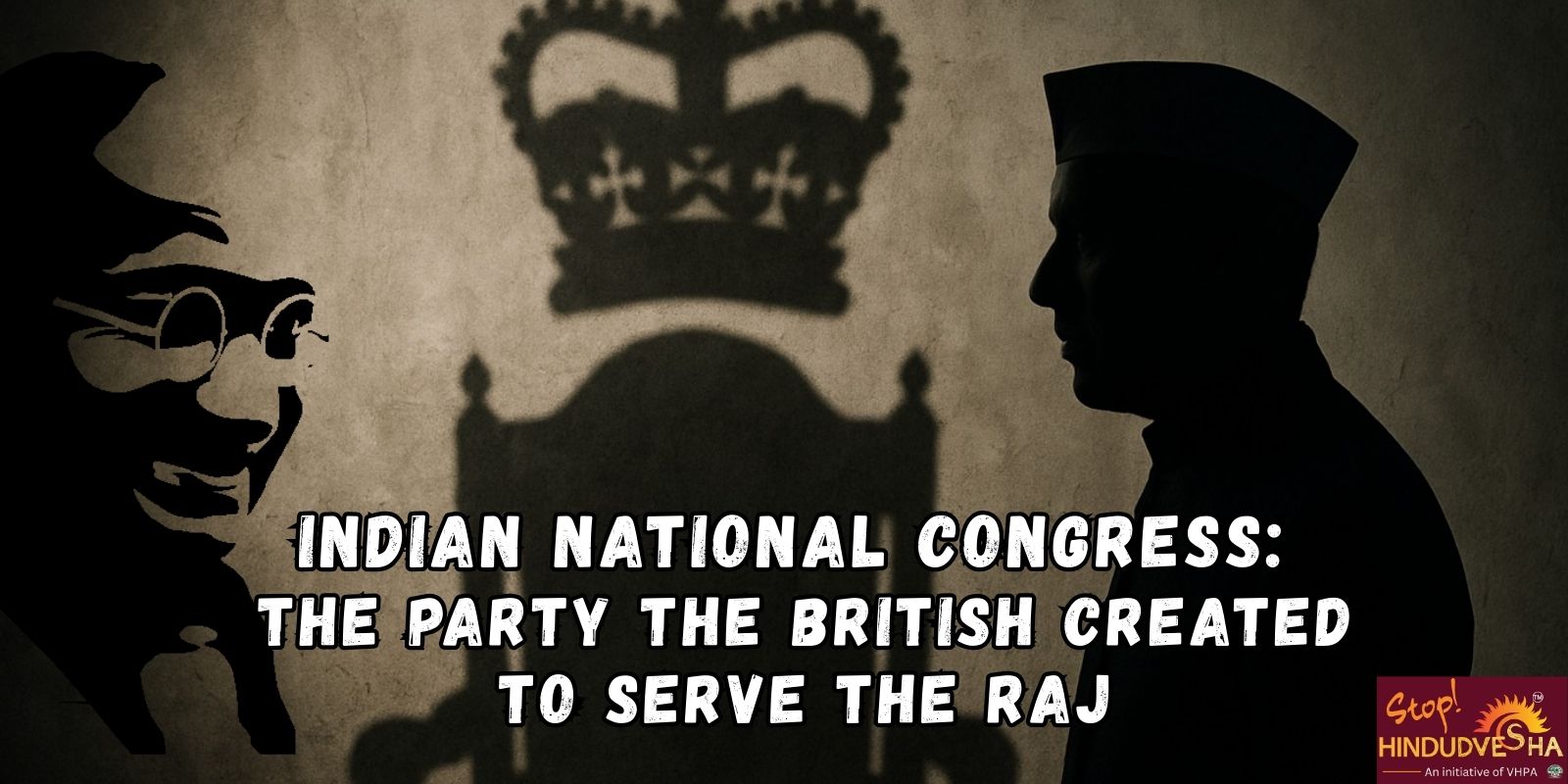
- In the aftermath of the 1857 revolt, the British devised a dual strategy: repression on one side and the creation of institutional “safety valves” on the other to contain nationalist aspirations.
- The formation of the INC in 1885 under A.O. Hume was part of this political design, offering limited avenues for participation while reinforcing the colonial “civilizing mission.”
- Early Congress leaders framed their demands within the boundaries of British approval, focusing on incremental reforms and dominion status rather than independence.
- Although the death of Lala Lajpat Rai in 1928 and subsequent agitations radicalized segments of the nationalist movement, the Congress largely remained tethered to its moderate, constitutionalist roots.
- After 1947, the party assumed power but continued to operate within inherited colonial frameworks, perpetuating centralization, Anglicized political culture, and bureaucratic dominance.
The aftermath of the 1857 revolt, dismissively labeled by the British as the “Sepoy Mutiny,” but more appropriately remembered in Indian historiography as the First War of Independence, marked a watershed in the history of colonial rule in the subcontinent. The scale, intensity, and near-success of the uprising profoundly unsettled the imperial establishment, shaking the very foundations of the East India Company’s authority and exposing the fragility of its political and military apparatus. In its wake, the British Crown assumed direct control over India in 1858, marking the beginning of the Raj period. This transfer of authority was not merely administrative; it was ideological and psychological, signifying the recognition that the governance of India required not only coercive machinery but also mechanisms of consent.
In the post-1857 order, the colonial state recalibrated its strategies of domination. Severe repression was combined with selective accommodation: on the one hand, punitive measures, such as the strengthening of the repressive legal framework and close surveillance of dissent, were employed to prevent recurrence of rebellion; on the other, new political and institutional channels were devised to manage the aspirations of the growing class of educated Indians. The British recognized that this emergent middle class, products of English education and beneficiaries of limited modern employment opportunities, posed both a threat and an opportunity. Left unaddressed, their discontent could ferment into agitation; properly directed, however, it could be harnessed to support the stability of the Raj.
It was within this carefully engineered crucible of suppression and concession that the Indian National Congress (INC) was conceived in 1885. Far from being a spontaneous nationalist movement, its inception reflected the deliberate efforts of imperial administrators such as Allan Octavian Hume, who envisaged the Congress as a “safety valve” for native grievances. By offering a controlled platform where demands could be expressed without destabilizing the empire, the British sought to pacify Indian aspirations while simultaneously legitimizing their self-professed role as “civilizers.” The INC, in its formative years, thus functioned less as an organ of resistance than as a political mechanism shaped by the strategic imperatives of empire.
The Post-1857 Landscape: British Strategy of Control
In the aftermath of the 1857 uprising, the British colonial state pursued a distinctly dual strategy to consolidate its shaken authority. On the one hand, it invested heavily in expanding its repressive apparatus, recognizing that coercion was indispensable for maintaining imperial power.[1] A succession of draconian legislations was enacted to tighten control over public expression and dissent. The Vernacular Press Act of 1878 curtailed indigenous newspapers that had become vehicles of nationalist critique, while sedition provisions under Section 124A of the Indian Penal Code criminalized even verbal or written opposition to colonial rule.[2] Alongside these, an elaborate surveillance machinery was developed, with the colonial police and intelligence agencies tasked with monitoring political associations, tracking nationalist leaders, and preempting mobilization.[3] These measures institutionalized suspicion and sought to deter the re-emergence of large-scale insurrections.[4]
Simultaneously, however, the British were acutely aware that repression alone was insufficient to sustain their legitimacy. The growth of an English-educated Indian middle class, shaped by Macaulay’s educational policies and increasingly conscious of liberal and constitutional ideas circulating in Britain and Europe, demanded a political outlet. Denying such classes a platform risked alienation and unrest; incorporating them within a controlled political framework promised co-optation. Thus emerged the strategy of creating what A.O. Hume himself termed an “escape valve”,[5] an institutional mechanism through which Indian grievances could be aired, petitions submitted, and reforms debated, all within the carefully circumscribed boundaries of imperial tolerance.[6]
This balancing act was not a concession to genuine self-government but rather a calculated illusion of participation. By allowing limited spaces for political expression while retaining decisive control over outcomes, the British were able to diffuse nationalist energies into constitutionalist channels and preserve the impression of benevolent governance. In essence, the colonial state perfected a dialectic of repression and accommodation: it suppressed any movement that threatened imperial dominance, even as it encouraged controlled dialogue to ensure that such dominance remained unchallenged.
The Formation of the Indian National Congress
The establishment of the INC in 1885 must be understood less as the culmination of an indigenous nationalist awakening and more as a carefully managed development within the framework of colonial governance. The Congress, facilitated by Allan Octavian Hume, a retired member of the Indian Civil Service, was conceived with the explicit intent of providing a controlled outlet for the grievances of the English-educated Indian elite. Hume himself is known to have articulated the idea of the Congress as a “safety valve” through which the frustrations of an increasingly vocal class could be channeled into constitutional petitions rather than erupting into revolutionary violence. In this sense, the INC was not born as a challenge to imperial sovereignty but as an instrument designed to preserve it.
The early Congress was not merely tolerated but, in many respects, encouraged and subtly patronized by the colonial administration. Its leaders included prominent figures such as A.O. Hume and Annie Besant, an ardent Theosophist who lent the organization an internationalist veneer, and later Motilal Nehru, who represented the emergent Indian political elite. While these leaders were diverse in their ideological orientations, they operated within the tacit boundaries set by the Raj. The very survival and functioning of the Congress in its formative decades depended upon its avoidance of direct confrontation with colonial authority.[7]
At its inception, therefore, the INC operated less as a nationalist vanguard and more as a political laboratory in which Indians were carefully “trained” in the art of constitutional agitation. The Congress limited its activities to drafting resolutions, sending petitions to the British Parliament, and appealing to the conscience of the imperial government. This exercise in “political apprenticeship” was meant to cultivate moderation, discipline, and loyalty among its members, rather than to foster revolutionary nationalism. In aligning itself with the colonial state’s narrative of a benevolent “civilizing mission,” the early Congress willingly positioned itself as a loyal opposition, seeking incremental reforms rather than the wholesale dismantling of imperial rule.
In effect, the Congress of the late nineteenth century functioned as an auxiliary of the Raj: simultaneously articulating the aspirations of a narrow Indian elite while legitimizing Britain’s claim to be both the arbiter and benefactor of India’s political development.[8]
Controlled Concessions: Rights Without Real Freedom
The concessions extended by the British to Indians in the late nineteenth and early twentieth centuries were never intended as acknowledgments of sovereignty or as steps toward genuine self-government. Rather, they constituted carefully calibrated safety measures, designed to preempt disaffection and contain the growing currents of political consciousness. Limited representation in legislative councils, initiated through the Indian Councils Act of 1861 and modestly expanded in 1892 and 1909, was emblematic of this strategy. While these reforms created the appearance of Indian participation in governance, the councils remained overwhelmingly dominated by British officials, with Indians confined to advisory roles and bereft of real authority.
Similarly, the restricted freedoms accorded to speech and press were hedged by an ever-present apparatus of surveillance and censorship. The British oscillated between tolerating a narrow band of public critique and enforcing laws such as the Vernacular Press Act (1878) and later the Sedition provisions to ensure that dissent never exceeded imperial tolerance. Access to select administrative and bureaucratic positions, under the doctrine of “Indianization,” followed a similar pattern: a small number of Indians, drawn primarily from the English-educated elite, were allowed entry into the colonial bureaucracy, but always in subordinate capacities. This not only placated the aspirations of the emerging middle class but also reinforced the hierarchical nature of colonial governance.
Such calibrated concessions served a dual purpose. Domestically, they functioned as a political safety valve, offering symbolic recognition to Indian elites while ensuring that the broader population remained outside the ambit of political participation. Internationally, they projected Britain as a progressive and liberal ruler, ostensibly committed to the gradual uplift of its colonial subjects. In reality, however, these reforms entrenched the structures of dependency, cultivating a class of intermediaries loyal to the empire while forestalling demands for substantive autonomy.
In this manner, controlled concessions became one of the most effective tools in the British repertoire for maintaining imperial dominance under the guise of reform. Yet, these measures alone could not have functioned so effectively without the willing cooperation of the Indian National Congress in its early decades. The INC, though later celebrated as the spearhead of the nationalist struggle, initially served as the principal conduit through which such concessions were legitimized. By accepting the narrow space allotted to it within the colonial political framework, the Congress not only refrained from challenging the structural foundations of imperial rule but also provided a veneer of representative consent to British policies.
Petitions for increased representation in councils, demands for the Indianization of the bureaucracy, and resolutions advocating dominion status, all articulated within the parameters set by the Raj, illustrate how the Congress internalized the logic of gradualism and moderation. Far from subverting the colonial project, these demands reinforced the British claim that they were benevolent rulers leading India, step by step, toward self-government. In effect, the INC became the institutional partner in the colonial “training ground” of politics, where the educated elite were disciplined into constitutional agitation and discouraged from mobilizing the broader masses.
Thus, while British concessions were designed as instruments of control, it was the Congress’s willingness to operate within their framework that transformed them into an enduring political strategy. In its formative years, the INC functioned less as a challenger to the empire and more as its facilitator, enabling the colonial state to stabilize its rule while presenting itself as responsive to Indian aspirations. The paradox of the Congress, therefore, lies in its dual legacy: it was both the safety valve of the empire and, later, the symbol of national liberation.
The INC in the Early 20th Century: Dominion Status, Not Independence
During the early decades of the twentieth century, the Indian National Congress remained firmly rooted in the tradition of moderate constitutionalism. Its leadership, dominated by figures such as Gopal Krishna Gokhale and other members of the Anglicized intelligentsia, consistently framed their demands within the constitutional and moral frameworks acceptable to the colonial state. The principal objectives articulated in this period included the expansion of legislative councils, greater Indianization of the civil services, and modest administrative reforms. At its most ambitious, the Congress spoke of Dominion Status, a constitutional arrangement modeled on Canada or Australia, wherein India would remain tethered to the British Crown while enjoying limited self-governing privileges. Notably, the idea of Purna Swaraj, complete independence, was absent from the Congress agenda during these years.[9]
Even cataclysmic events such as the Jallianwala Bagh massacre of 1919, in which British troops under General Dyer gunned down hundreds of unarmed civilians, did not immediately alter the INC’s fundamental orientation. While the massacre shocked the conscience of the nation and delegitimized the moral pretensions of the Raj in the eyes of the masses, the Congress’s institutional response remained curiously restrained. Resolutions were passed, condemnations were issued, and the Non-Cooperation Movement was briefly launched under Gandhi’s leadership, but the official demand for complete independence was still withheld.
This hesitation is telling. If there was ever a moment that exposed the brutal reality of imperial rule and demanded a radical break, it was the Jallianwala Bagh massacre. Yet the Congress, tied to its incrementalist, petitionary traditions and beholden to its moderate leadership, continued to skirt around the demand for sovereignty. More than a decade had to elapse before the Congress finally declared Purna Swaraj as its official goal at the Lahore session of 1929. That it took the party over ten years to formally recognize what the people of India had already felt in 1919, that reconciliation with the Raj was impossible, stands as damning evidence of its complicity in sustaining colonial structures.
The Congress’s failure to seize the radical potential of the Jallianwala moment demonstrates how deeply it was enmeshed in the very logic of British rule. By refusing to declare independence as a non-negotiable principle in the immediate aftermath of the massacre, the INC effectively served as a political buffer, preventing widespread outrage from translating into an existential threat to the empire. In this sense, the Congress was less the vanguard of resistance and more the lapdog of the colonial state, ensuring that demands for liberation were deferred, diluted, and domesticated within “safe” constitutional channels.
This adherence to moderation was not merely ideological but also structural. The Congress drew its support largely from the urban, educated, professional middle classes, who often had vested interests in maintaining stability under the colonial framework. Constitutional methods such as petitions, representations, and debates were viewed as respectable and legitimate, while mass agitation and direct confrontation with imperial authority were consciously avoided. The colonial government, in turn, encouraged and rewarded this moderate stance, using it to claim that India was being prepared for self-rule in a gradual and responsible manner.
Yet, parallel to this moderate current, a more assertive strand of nationalism emerged, led by the so-called “Lal-Bal-Pal” trio, Lala Lajpat Rai, Bal Gangadhar Tilak, and Bipin Chandra Pal.[10] These leaders emphasized Swaraj (self-rule) as a fundamental right, rejected the paternalism of the colonial state, and advocated methods of boycott, swadeshi, and passive resistance. Their vision of nationalism was more expansive, drawing upon popular sentiment and cultural pride rather than mere constitutional concessions. However, the radical wing was frequently sidelined within the Congress organization itself. Tilak was imprisoned, Lajpat Rai was exiled for a time, and the movement they represented was fragmented through both internal factionalism and deliberate British suppression.
The colonial authorities skillfully exploited the divisions within the nationalist ranks. By legitimizing and even subtly promoting the moderate leadership, they ensured that the Congress would remain within safe and manageable limits. The result was a paradoxical situation: while the INC claimed to represent the aspirations of the Indian people, it simultaneously functioned as a mechanism to contain and channel those aspirations into forms that did not fundamentally threaten imperial control. In this way, the moderation of the early 1900s Congress provided the British with one of their most effective tools of political management in India.
A Turning Point: Lala Lajpat Rai and Rising Agitations
The brutal assault on Lala Lajpat Rai during the anti–Simon Commission demonstrations in Lahore in October 1928 marked a decisive turning point in the trajectory of the nationalist struggle. The Simon Commission, appointed by the British government to review constitutional progress in India, became a lightning rod of opposition even before it set foot in the country. Its composition, entirely European, with no Indian representation, was perceived as a blatant insult to Indian political aspirations. Nationwide protests erupted under the slogan “Simon Go Back,” symbolizing the deepening disillusionment with the colonial state’s half-hearted and unilateral gestures of reform.
In Lahore, Lala Lajpat Rai, the revered nationalist leader often remembered as the “Punjab Kesari,” led one such protest. The police, under Superintendent James A. Scott, resorted to an indiscriminate lathi charge on the peaceful procession. Rai sustained grievous injuries and, despite medical treatment, succumbed to them in November 1928. His death, widely interpreted as martyrdom, reverberated across the subcontinent. It became emblematic of the violent intransigence of colonial rule and exposed the futility of relying solely on constitutional methods to secure Indian rights.
The impact of this event was profound and immediate. It galvanized a younger generation of revolutionaries who viewed constitutional agitation as inadequate in the face of such repression. Figures like Bhagat Singh, Chandrashekhar Azad, Sukhdev, and Rajguru interpreted Rai’s death as a call to action. The formation of the Hindustan Socialist Republican Association (HSRA) and the subsequent acts of revolutionary violence, including the assassination of J.P. Saunders, mistaken for Scott, in 1928, and the bombing of the Central Legislative Assembly in 1929, were direct responses to this incident. These radical interventions lacked the numerical strength to overthrow British rule, but they ignited the popular imagination, dramatizing the nationalist cause and underscoring the moral bankruptcy of imperial authority.
Yet, the Congress’s response to this surge of revolutionary nationalism once again revealed its ambivalent, almost deferential, relationship with the colonial state. When Bhagat Singh and his comrades were sentenced to death in 1931, appeals for clemency poured in from across India and abroad. The moment offered the Congress an opportunity to align itself with the moral force of youthful sacrifice, to denounce imperial justice, and to claim the mantle of uncompromising resistance. Instead, Gandhi, during the Gandhi–Irwin Pact negotiations, refused to press for the commutation of Bhagat Singh’s sentence. While he offered personal sympathy, he declined to use his political leverage, rationalizing that doing so might derail the fragile compromise with the British.
This refusal was emblematic of the Congress’s larger orientation. At precisely the moment when revolutionary fervor threatened to destabilize colonial authority, the party chose conciliation and compromise. Gandhi’s unwillingness to plead firmly for Bhagat Singh’s life reflected not merely a personal decision but a deeper structural tendency: to privilege negotiated settlement with the Raj over solidarities with those who defied it absolutely. To many contemporaries, and to subsequent critics, this marked yet another instance of the Congress acting as a brake on the nationalist movement rather than as its spearhead.
For the British, the fallout was equally significant. The Simon Commission protests and the militant response to Rai’s death disrupted the illusion that Indian political discourse could be indefinitely contained within constitutional boundaries. The colonial state was forced to reckon with a new dynamic: the rising influence of youth-driven revolutionary movements that operated outside the carefully constructed frameworks of moderation. Yet, while the revolutionaries embodied this uncompromising resistance, the Congress leadership continued to play the role of mediator. Gandhi’s refusal to demand clemency for Bhagat Singh during the Gandhi–Irwin Pact epitomized this contradiction: even as the blood of young martyrs galvanized the masses, the Congress remained cautious, unwilling to jeopardize its negotiating position with the Raj. In this sense, Lala Lajpat Rai’s martyrdom became not only a watershed moment in nationalist politics but also a symbolic rupture, one that exposed the widening gulf between radical nationalism on the streets and the Congress’s posture of controlled dissent, a posture that ultimately reinforced Britain’s ability to manage the pace and direction of India’s freedom struggle.
From “Safety Valve” to “Successor State”
By the time India gained independence in 1947, the Indian National Congress had undergone a remarkable transformation; yet, its origins as a British-approved institution left a lasting and indelible imprint on its character. While the Congress emerged as the recognized vehicle of the freedom movement, the ideological and structural frameworks it had internalized were deeply colonial in nature. The centralized administrative machinery established by the British, premised on a rigid bureaucracy and authoritarian control, was retained almost intact. The Congress leadership, inheriting this apparatus, chose continuity over reform, thereby perpetuating the same modes of governance that had once enabled imperial dominance.[11]
Equally significant was the cultural and political orientation of the Congress elite. Anglicized in their worldview and distanced from the rhythms of the Indian masses, they perpetuated an elitist model of governance that bore a strong resemblance to the colonial order. The rhetoric of democracy coexisted uneasily with practices of centralized control, limited grassroots participation, and the replication of colonial hierarchies. Even in the realm of law, many of the draconian instruments once wielded by the Raj, such as sedition provisions and restrictive press regulations, were retained and redeployed by the independent Indian state against its own dissenters.[12]
Thus, in the years following independence, the Congress functioned less as a revolutionary force that had dismantled the colonial state and more as its successor, carrying forward many of the same institutional legacies under a new tricolor flag. Economic controls, bureaucratic dominance, and an unquestioned belief in centralized planning became hallmarks of postcolonial governance. Even India’s continued membership in the Commonwealth, voluntarily accepting the British monarch as a symbolic head of the association, illustrates the depth of this deference. While framed by Congress leaders as a pragmatic gesture of international diplomacy, it also revealed the psychological residues of colonial subordination: an unwillingness to sever ties fully with the imperial center, even in symbolic terms. The decision suggested that sovereignty was tempered by a lingering need for imperial validation, further underscoring how incomplete the process of decolonization truly was.
The promise of decolonization, understood not merely as political sovereignty but as a deeper transformation of cultural consciousness, civilizational self-confidence, and structural institutions, remained largely unfulfilled.
Fundamental Paradox of INC
The trajectory of the Indian National Congress embodies a fundamental paradox in the history of modern India. Conceived in 1885 as an institutional “safety valve” under British patronage, it was designed to channel nationalist aspirations into constitutionalist frameworks that posed no threat to imperial sovereignty. Over time, the Congress transformed into the primary platform for political mobilization, ultimately steering the country to independence in 1947. Yet, the imprint of its colonial origins remained deeply etched in its structure, ideology, and practice.[13]
This article argues that the Congress’s moderation, its early dependence on British sanction, and its elite composition shaped a political culture that was less revolutionary than reformist. Even as the demand for Purna Swaraj eventually entered its agenda, the methods and institutions through which Congress pursued this goal bore the legacy of colonial frameworks. After 1947, the party inherited not only the centralized bureaucratic machinery of the Raj but also its Anglicized political ethos, continuing to govern through administrative centralization, economic dirigisme, and coercive legal instruments, such as sedition laws. In doing so, it perpetuated many of the structural continuities of empire under the veneer of national sovereignty.
Historiographically, this perspective complicates the triumphalist narrative that often casts the Congress as the sole architect of Indian freedom. While nationalist historiography celebrates its role in unifying disparate constituencies against colonialism, and liberal scholarship underscores its commitment to democratic politics, a more critical reading reveals that the INC also functioned as an inheritor of colonial modernity. Its political culture, far from dismantling the structures of imperial dominance, absorbed and rearticulated them in a postcolonial context.
The implications of this argument extend beyond the realm of political history into the broader discourse of decolonization. If decolonization is understood not merely as the transfer of power but as the dismantling of colonial epistemologies, institutions, and hierarchies, then India’s independence in 1947 represents only a partial rupture. The persistence of colonial laws, bureaucratic practices, and cultural orientations points to the incompleteness of this project. In this sense, the Congress delivered freedom, but not complete decolonization —a distinction that continues to shape India’s political and civilizational landscape.
Ultimately, the story of the Congress invites a larger reflection on the nature of postcolonial statehood. It raises critical questions about the costs of adopting colonial institutions as instruments of governance, the tensions between political sovereignty and civilizational selfhood, and the extent to which a nation can claim to be truly independent when its foundational structures remain indebted to the very power it sought to overthrow. These questions remain central to both the historiography of India’s independence and the ongoing debates on the unfinished task of decolonization.
Citations
[1] Thomas R. Metcalf. The Aftermath of Revolt: India, 1857–1870. Princeton: Princeton University Press, 1964; https://archive.org/details/aftermathofrevol0000metc
[2] S. Natarajan. A History of the Press in India. Bombay: Asia Publishing House, 1962; https://archive.org/details/dli.ernet.148434/page/85/mode/2up
[3] S.R. Mehrotra. The Emergence of the Indian National Congress. Delhi: Vikas Publishing, 1971; The emergence of the Indian National Congress : Mehrotra, S. R., 1931- : Free Download, Borrow, and Streaming : Internet Archive
[4] Rudrangshu Mukherjee. Awadh in Revolt, 1857–1858: A Study of Popular Resistance. Delhi: Oxford University Press, 1984; https://archive.org/details/awadhinrevolt1850000mukh/page/n5/mode/2up
[5] B.D. Mahajan. The Indian National Congress: An Historical Sketch. Agra: Lakshmi Narain Agarwal, 1969; https://archive.org/details/indiannationalco00madrrich
[6] Vinayak Damodar Savarkar. The Indian War of Independence of 1857. Bombay: Veer Savarkar Prakashan, 1909; https://dn790006.ca.archive.org/0/items/indianwarofindep00vina/indianwarofindep00vina.pdf
[7] Bipan Chandra. India’s Struggle for Independence, 1857–1947. Delhi: Penguin, 1989; https://archive.org/details/indias-struggle-for-independence_202106
[8] Anil Seal. The Emergence of Indian Nationalism: Competition and Collaboration in the Later Nineteenth Century. Cambridge: Cambridge University Press, 1968; https://archive.org/details/emergenceofindia0000seal
[9] Stanley Wolpert. Tilak and Gokhale: Revolution and Reform in the Making of Modern India. Berkeley: University of California Press, 1962; https://archive.org/details/tilakgokhalerevo0000wolp/page/n7/mode/2up
[10] Lala Lajpat Rai. Young India: An Interpretation and a History of the Nationalist Movement from Within. New York: Macmillan, 1916; https://archive.org/details/16RaiYoungindia
[11] Partha Chatterjee. Nationalist Thought and the Colonial World: A Derivative Discourse? London: Zed Books, 1986; https://archive.org/details/nationalistthoug0000chat
[12] Bipan Chandra. Indian National Movement: The Long-Term Dynamics. New Delhi: Vikas, 1988; https://annas-archive.org/oclc/925189530
[13] Shashi Tharoor. Inglorious Empire: What the British Did to India. London: Hurst, 2017; https://archive.org/details/inglorious-empire

Donate to HINDUDVESHA
Our Mission is to explore and expose Hindudvesha through research analysis, education and response.
SUPPORT US