

The Left’s Suicide Pact: Deadly Alliances and Fatal Self-Deception
 Som Misha · 06/25/2026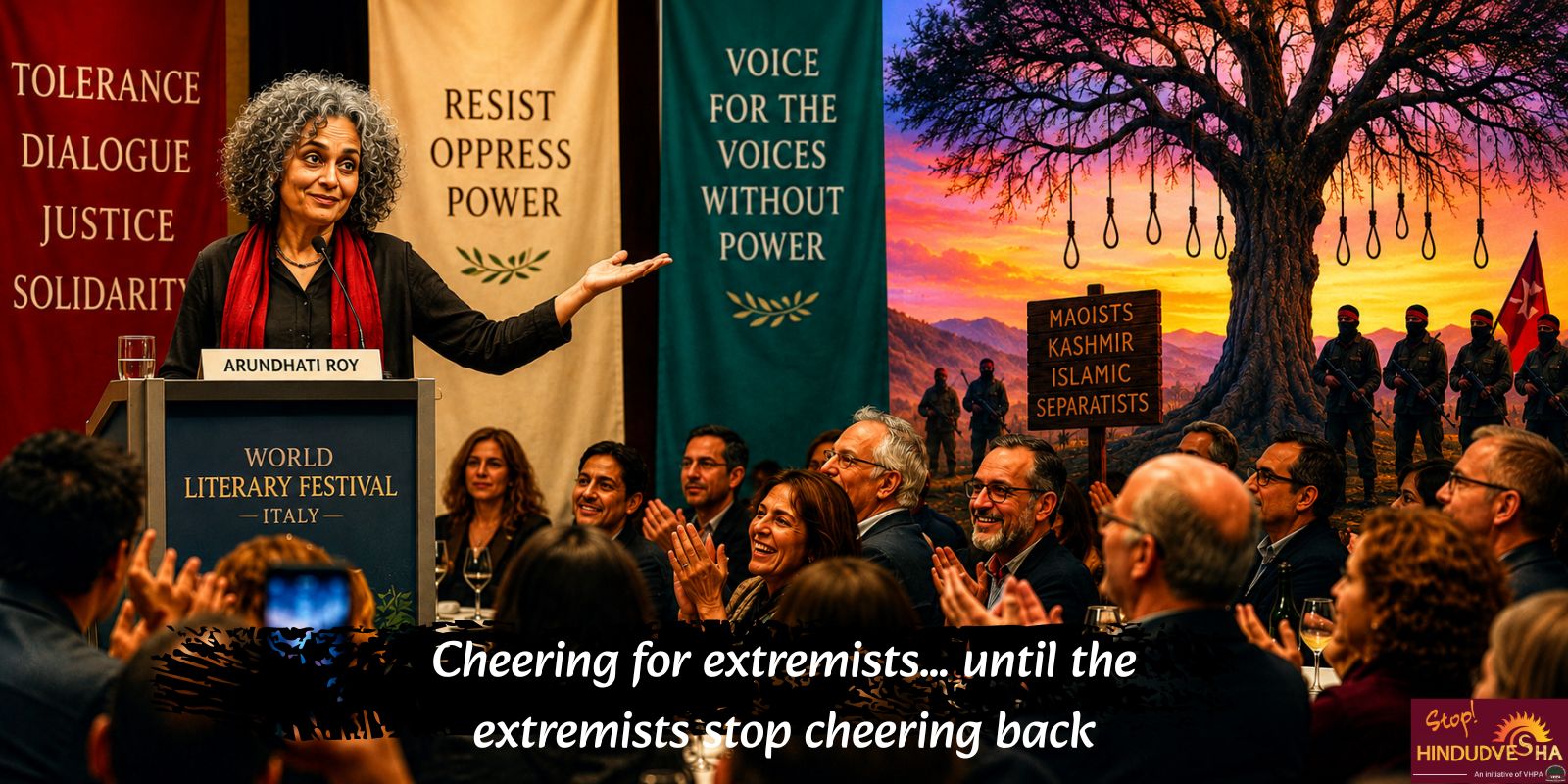
Summary
A movement that once championed tolerance, free speech, and human rights has increasingly embraced censorship, ideological conformity, and dangerous alliances with extremists. The contradictions are stark: left-liberals march for LGBT rights while defending regimes that execute gay people, and romanticize revolutionary movements that would eliminate them first — as Arundhati Roy herself candidly admitted with a laugh.
This self-defeating worldview manifests in intolerance toward dissent, grotesque rhetorical inflation where border control equals fascism, and selective outrage that excuses Islamist excesses while condemning the West. The result is a profound disconnect from ordinary citizens, evident in repeated electoral defeats across India, Britain, Europe, and America. The path back demands intellectual honesty: consistent principles, genuine self-examination, and a willingness to listen to those it claims to represent. Without it, modern left-liberalism risks becoming its own worst enemy.
“At the core of liberalism is the spoiled child — miserable, as all spoiled children are, unsatisfied, demanding, ill-disciplined, despotic and useless. Liberalism is a philosophy of sniveling brats.” — PJ O’Rourke, American author [1]
The setting was Italy. A room full of journalists. Arundhati Roy — an icon of the international left and frequently accused of romanticizing violent movements — had just said something that should have stopped the room cold.
She told the journalists that she and her friends had a running joke. In all the battles they fought, in all the causes they championed, she liked to observe that if the movements they supported ever actually won — the Maoists in the Indian forests, the Islamic separatists in Kashmir — “we will be the first ones to be hanged from the nearest tree. Sometimes you are fighting on the side of people who have no space for you in their imagination. But that’s okay.” She laughed as she said it. The audience, apparently, took it in stride. [2]
Consider the implications carefully. A prominent literary voice of the global progressive movement had just cheerfully acknowledged that the causes she supported would, in the event of their victory, murder her — and had described this prospect, in her own words, as “okay.” Not troubling. Not a reason to reconsider her allegiances.
According to American political writer Bill Weinberg, Roy’s statement amounts to an endorsement of revolutionary suicide — a cheerful admission that the terrorists she roots for would hang liberals such as herself if they ever achieved power.
It is difficult to think of a political statement more perfectly calibrated to expose the contradictions at the heart of contemporary left-liberalism. Here, compressed into a single anecdote, are the core pathologies that have driven millions of voters across the world — from Washington to Tokyo, from working-class England to middle-class India — to conclude that the progressive establishment has lost touch with reality: the reflexive anti-imperialism that has curdled into support for movements whose actual ideology is barbarism; the breezy indifference to consequences; and, above all, the staggering absence of self-examination dressed up as sophistication.
Roy, of course, would never have to live in a Maoist-controlled jungle, or a Kashmir under Sharia. She lives in Delhi, travels to literary festivals, and gives interviews to sympathetic correspondents who throw her softball questions. It is easy to dismiss one’s hypothetical hanging as ‘okay’ when it remains comfortably hypothetical.
The Tolerance Trap
Roy’s Italian performance is an extreme case, but it is not an outlier. It is, rather, the logical endpoint of a series of assumptions that have quietly become orthodoxy within the left-liberal establishment — assumptions about who counts as a legitimate victim, which movements deserve solidarity, and which questions it is permissible to ask.
Left-liberals present themselves as the great defenders of pluralism, free inquiry, and open debate. And yet the political and cultural movement they have built is among the most aggressively intolerant in modern democratic history. The mechanisms are by now well-documented, if seldom admitted. Academics who venture nonconformist views on gender, race, or immigration find their careers subject to organized campaigns of destruction. Journalists who report facts inconvenient to the preferred narrative are publicly shamed into silence or fired. Ordinary citizens — teachers, nurses, civil servants, chefs [3] — have discovered that dissent from progressive orthodoxy can carry professional consequences. American comedian Bill Maher has slammed the Left’s increasing intolerance of free speech: “Comedians are afraid to make jokes in clubs, because somebody will tape it and send it out on Twitter and get the mob after you.” [4]
This is not the behavior of people who believe in the free exchange of ideas. It is instead the behavior of those who believe they already possess the truth and see debate as a threat to it.
The irony is difficult to ignore. The same people who invoke the Frankfurt School [5] — who speak lovingly of “speaking truth to power” [6] — have constructed an elaborate system for ensuring that only certain truths may be spoken, and only certain powers challenged.
The Islamism Problem
Nothing illustrates the depth of the contradictions more clearly than the left-liberal establishment’s increasingly tortured relationship with political Islam.
Left-liberals who would march for LGBT rights on a Friday will spend Saturday defending the political movements of regimes that execute gay men. [7] Those who speak most vehemently about women’s bodily autonomy have been conspicuously quiet — or actively apologetic — about theocratic movements that mandate the veil, prohibit female education, and treat apostasy as a capital offense. The operating theory, insofar as one can discern, seems to be that any movement opposing Western foreign policy or the State of Israel thereby inherits a kind of moral credit that exempts it from the scrutiny applied to everyone else.
Roy is not alone in this. Rather, she is one of the most eloquent and candid representatives of this worldview. She has written, again entirely without embarrassment, that the Iraqi resistance fighting against American occupation is “fighting on the frontlines of the battle against Empire” [8] — neglecting to mention, or apparently to care, that the so-called resistance was at the time systematically assassinating leaders of Iraq’s own secular left: trade unionists, feminists, civil society organizers. The jihadists Roy romanticized as liberators were murdering the very people a genuine progressive might have been expected to mourn.
Similarly, in India, Roy has been a vocal supporter of Kashmiri Muslim terrorists while completely whitewashing their pogroms against the Hindu minority in Kashmir. [9] Again, in a bizarre rant in 2011, she accused India of being a “colonial state waging war against its people.” In the same breath, she claimed Pakistan has never deployed its army against its people. The Baloch Liberation Front issued a statement criticizing her and reminding Roy of the Pakistan Army’s murder of thousands of Balochs and the genocide of 3 million Bengalis in 1971. [10]
Episodes like these lend renewed relevance to Hanlon’s Razor: “Never attribute to malice that which is adequately explained by stupidity.” [11]
The pattern extends beyond individual writers to major institutions. Critics of groups like Human Rights Watch and Amnesty International — including, notably, seculars from within the Muslim and Arab world — have pointed to what they describe as a disproportionate focus on Israeli conduct combined with a marked reluctance to apply equivalent scrutiny to Hamas, Hezbollah, and the Muslim Brotherhood. When institutions that claim to apply universal principles are seen to apply them selectively, they lose the authority that makes universalism valuable in the first place. [12][13]
Dakhane, drawing on decades of lived experience with Islamist movements, puts it with particular clarity: “Their alliance with the far-left is just a way to achieve their goals — and I assure you, their far-left supporters would be their first victims if Islamists were to control the world someday.” This is not a reactionary talking point. It is the observation of a secular Arab liberal who finds himself, with some bewilderment, under more sustained attack from Western leftists than from the Islamists he criticizes. When Dakhane published his own blog, naming and analyzing Islamic extremism, he was viciously attacked — not by Islamists, but by far-leftists in the United States, Europe, and Israel, most of whom did not speak Arabic and had never set foot in the Arab world. [13]
Turkey-based journalist Ali Omar Forozish offers his blunt opinion on the Red-Green alliance: “The Left cares only about the identity of the perpetrator and the identity of the victim. If the perpetrator is a Western ally (Israel), the outrage is infinite. If the perpetrator is an enemy of the West (Iran), the silence is absolute.” [14]
There is a term for the phenomenon in which two groups with entirely incompatible ultimate goals temporarily align against a mutual enemy. It is called a marriage of convenience, and it has never, in the history of revolutionary politics, ended well for the weaker party. Roy herself admitted as much, with that blithe laugh. She simply didn’t seem to think it mattered.
The Hitler Dial
At some point in the last decade — historians will eventually fix the precise date, but it feels like around 2015 — the left-liberal establishment lost its grip on the concept of proportion.
The word “fascist” once meant something specific and terrible. It described regimes that banned opposition parties, imprisoned or killed political rivals, mobilized nationalist mass movements, and built machinery of racial extermination. It described Mussolini. It described Franco. It described, above all, Hitler. The word carried weight because it referred to things that had actually happened: gas chambers, death marches, the industrialization of human suffering.
Today, in the vocabulary of progressive activism, “fascist” describes a politician who proposes stricter border controls. Or a Prime Minister who wants to rebuild Hindu temples shattered by the iconoclastic fury of Muslim invaders and occupiers. “Literally Hitler” describes someone who has won a democratic election by promising lower taxes. A suburban school that puts up a Nativity scene at Christmas is promoting “white supremacy.” A comedian who tells the wrong joke is “doing violence.” The dial has been turned so far past eleven that it has snapped off entirely. [15]
The rhetorical inflation has real consequences. When everything is fascism, nothing is. When every political opponent is Hitler, the word loses its power to identify the genuine article. And when an entire political movement has spent years insisting that democracy is on the verge of collapse — only to watch democracy inconveniently continue — the credibility of that movement suffers in ways that are difficult to repair.
According to Indian journalist Ahmed Shariff, these cries of “fascism” are attention-seeking tactics employed by smooth-talking professional provocateurs. “They know very well the government is not fascist and won’t go to extreme lengths to silence them, so they deliberately provoke people to a point where some lose patience and react angrily, and then BOOM! They run a PR campaign to highlight and exaggerate that one incident and play the victim card to gain public sympathy – ‘Look at all the hate I’m getting!’ Ironically, these same crusaders of free speech will go out of their way to destroy anyone who doesn’t agree with their ideologies. So who really are the fascists here?” [16]
There is something almost poignant about the spectacle of a progressive commentator discovering, after each successive election loss, that the voters who rejected their candidate were not fascists after all — just people who had different priorities, or who had noticed the contradictions and decided they had had enough. The left’s response, too often, is not reflection but escalation: the voters were duped or simply too ignorant to understand their own interests. [17] The possibility that voters may simply have rejected the agenda itself rarely survives serious introspection.
The Closed Room
The modern left-liberal establishment has built extraordinarily effective institutions for producing and distributing its ideas: elite universities, prestigious newspapers, the NGO complex, the entertainment industry, and large swaths of the regulatory state. What it has not built is any serious mechanism for self-correction.
In 1950, American literary critic Lionel Trilling wrote that liberalism’s dominance had made it incurious. The result is a movement that has grown “irritable” — quick to take offense, slow to acknowledge error, and constitutionally incapable of distinguishing between genuine bigotry and honest disagreement. The diagnosis is seventy-six years old and has never been more apt. [18] There’s an excellent term for this quick irritability — recreational outrage. [19]
The Long Retreat from Reality
The electoral results of recent years represent a verdict rendered not by racists and reactionaries — though those exist, as they always have — but by millions of ordinary people who looked at the left-liberal establishment and concluded that it was no longer engaged with their actual lives.
For the first time in five decades, no Indian state will be governed by a left-wing party, following elections in Kerala, a long-time socialist stronghold and home to the world’s first democratically elected communist government. [20]
In the United Kingdom, the “red wall” — a belt of traditionally Labor-voting working-class constituencies — collapsed in the 2019 general election, handing Boris Johnson a landslide victory. The explanation offered by much of the left-liberal commentariat was that the voters had been deceived, or that English nationalism was resurgent, or that the media had been unfair. Less attention was paid to the possibility that decades of metropolitan condescension had finally accumulated past the point of tolerance. [21]
In France, Germany, the Netherlands, Italy, Sweden, and across Central and Eastern Europe, parties that would have been considered fringe twenty years ago are now in government or close to it. In India, the BJP under Narendra Modi has won three successive general elections, largely by positioning itself against what many Indian voters perceive as a left-liberal elite that regards them with undisguised contempt. [22] In the United States, Donald Trump’s return to the presidency in 2024 was greeted with the same stunned incomprehension that had greeted his first victory eight years earlier — as if the electorate’s message had simply not been received, or had been received and dismissed.
What these voters share is not a common ideology. They are not all nationalists, or reactionaries, or dupes of right-wing propaganda. Many of them hold views that are, in conventional terms, quite moderate. What they share is a sense that the left-liberal establishment has stopped listening — that it has retreated into a world of its own making and is increasingly detached from reality.
What Went Wrong
The left has historically been capable of genuine intellectual rigor and moral courage. The labor movements that built the welfare state, the civil rights campaigners who dismantled legal segregation, the feminist pioneers who expanded the scope of democratic participation — these were not people who substituted slogans for argument or condescension for persuasion. They won because they were right, but also because they were honest and because they did the hard work of making their case to people who were not already convinced.
That tradition has not vanished entirely. There are still writers, thinkers, and activists on the left — some of them deeply critical of the establishment’s direction — who practice something recognizable as serious politics. But they are increasingly marginal to a movement that has come to value performance over persuasion, identity over argument, and emotional solidarity over the kind of uncomfortable self-examination that genuine progress requires. [23]
An even more troubling development is that many progressives have adopted an ideology that justifies political violence. A report by the Network Contagion Research Institute says online communities promoting political violence — including support for assassinating public figures such as Donald Trump and Elon Musk — have moved from fringe spaces into mainstream social media discourse. Drawing on national surveys and online activity analysis, the study describes this trend as an emerging “assassination culture.” [24] The report found that 38 percent of respondents (and 55 percent of those left of center) said assassinating Trump could be justified, while 31 percent (and 48 percent of those left of center) said the same about Musk. The study also found that 40 percent viewed destroying a Tesla dealership in protest as at least somewhat acceptable.
Take Cole Tomas Allen, who attempted to assassinate President Donald Trump in the White House. The 31-year-old computer engineer and tutor still lived with his mother and harbored failed dreams of being a professional video game designer. Says Maher: “If you’re doing that much rage-thinking about Trump, you’re not really mad at him. You’re mad at your life. Do you think if he’d ever actually sold a video game and gotten rich, he’d be doing this?” [25]
The writer Liel Leibovitz captures the left’s meltdown with characteristic bleakness: “Liberalism finally got what it had always wanted: a gaggle of detached and uprooted people, alone and scared witless, seeking solace, and suspecting that someone, somewhere is out to get them.” [26] The diagnosis may be harsh, but it is not unfair. Politics built on the management of anxiety — on the constant identification of new threats, new victims, new enemies — is not built for governing. It is built for anarchy.
The Way Back
The path back to credibility for left-liberals — if they are willing to take it — involves listening to people who disagree, including people who come from the communities they claim to represent. It involves applying the same critical standards to movements they are sympathetic to as to movements they oppose. It involves accepting that being wrong is not a moral failing, and that changing one’s mind in response to evidence is a sign of intelligence rather than weakness.
It involves, above all, the recovery of a quality that was once the left’s most valuable possession and has been squandered with extraordinary carelessness: intellectual honesty.
Arundhati Roy is still giving interviews. Much of the progressive establishment still treats such rhetoric as wisdom rather than contradiction. And somewhere, the Maoists and jihadists she champions continue sharpening their knives — for their enemies, and, when the time comes, for their friends.
Citations
[1] PJ O’Rourke, “At the Core of Liberalism Is the Spoiled Child,” Goodreads Quotes, accessed via quote archive, https://www.goodreads.com/quotes/187883-at-the-core-of-liberalism-is-the-spoiled-child
[2] Bill Weinberg, “Arundhati Roy: Please Hang Me,” CounterVortex, https://countervortex.org/blog/arundhati-roy-please-hang-me/
[3] “Celebrity Indian Chef Atul Kochhar Loses Job at JW Marriott Dubai after His Derogatory Tweet on Islam Draws Flak on Twitter,” WION, https://www.wionews.com/india-news/celebrity-indian-chef-atul-kochhar-loses-job-at-jw-marriot-dubai-after-his-derogatory-tweet-on-islam-draws-flak-on-twitter-144152
[4] David Marchese, “Bill Maher Thinks Everyone Else Is Wrong,” New York Times Magazine, September 30, 2019, https://www.nytimes.com/interactive/2019/09/30/magazine/bill-maher-interview.html
[5] James Fieser and Bradley Dowden, “Critical Theory (Frankfurt School),” Internet Encyclopedia of Philosophy, https://iep.utm.edu/critical-theory-frankfurt-school/#H2
[6] “Speak Truth to Power: Human Rights Defenders Who Are Changing Our World,” Robert F. Kennedy Human Rights, https://kennedyhumanrights.org/our-impact/education/educators/speak-truth-to-power-human-rights-defenders-who-are-changing-our-world/
[7] Ali Omar Forozish, “The Great Betrayal: Why the Western Left Ignores Iranian Victims,” Fair Observer, https://www.fairobserver.com/politics/the-great-betrayal-why-the-western-left-ignores-iranian-victims/
[8] Andrew Sullivan, “The War, the Left and Revisionism,” The Atlantic, March 2006, https://www.theatlantic.com/daily-dish/archive/2006/03/the-war-the-left-and-revisionism/235851/
[9] “Kashmir: Hindus Still Waiting for Justice Decades after Exodus,” BBC News, https://www.bbc.com/news/articles/c3ggyz13m2po
[10] “Baloch Liberation Army Chief Slams Arundhati Roy for Praising Pakistani Army, Lists Its Human Rights Violations,” Swarajya, https://swarajyamag.com/insta/baloch-liberation-army-chief-slams-arundhati-roy-for-praising-pakistani-army-lists-its-human-right-violations
[11] Shane Parrish, “Hanlon’s Razor,” Farnam Street, https://fs.blog/mental-model-hanlons-razor/
[12] Eugene Kontorovich, “The Moral Mob and the Human Rights Industrial Complex,” Newsweek, https://www.newsweek.com/the-moral-mob-and-the-human-rights-industrial-complex-opinion-11882578
[13] Omar Dakhane, “The Dangerous Alliance of Faux Liberals and Islamists,” The Jerusalem Post Blogs, http://blogs.jpost.com/content/dangerous-alliance-faux-liberals-and-islamists
[14] Ali Omar Forozish, “The Great Betrayal: Why the Western Left Ignores Iranian Victims,” Fair Observer, https://www.fairobserver.com/politics/the-great-betrayal-why-the-western-left-ignores-iranian-victims/
[15] Vikram Sampath, “In Search of Fascism,” Swarajya, https://swarajyamag.com/books/in-search-of-fascism
[16] “Here Are the 5 Mind-Numbingly Stupid Things That Left-Liberals Say,” OpIndia, March 2019, https://www.opindia.com/2019/03/here-are-the-5-mind-numbingly-stupid-things-that-left-liberals-say/#google_vignette
[17] “As BJP Heads Towards a Historic Win in West Bengal, Liberals Suffer a Massive Meltdown, Ignore 15 Years of Anti-Incumbency and Declare BJP Victory Unfair,” OpIndia, May 2026, https://www.opindia.com/2026/05/as-bjp-heads-towards-a-historic-win-in-west-bengal-liberals-suffer-a-massive-meltdown-ignore-15-years-of-anti-incumbency-and-declare-bjp-victory-unfair/
[18] The Liberal Imagination, The New York Review of Books, https://www.nyrb.com/products/the-liberal-imagination
[19] “Recreational Outrage,” Urban Dictionary, https://www.urbandictionary.com/define.php?term=Recreational+Outrage
[20] “Left May Be Left with No Government after Kerala Elections,” NDTV, https://www.ndtv.com/india-news/kerala-assembly-elections-bengal-elections-kerala-elections-cpm-cpi-pinarayi-vijayan-left-front-communist-parties-left-may-be-left-with-no-government-11445519
[21] Anand Menon, “How the Conservatives Won the Red Wall,” UK in a Changing Europe, https://ukandeu.ac.uk/how-the-conservatives-won-the-red-wall/
[22] Sanjaya Baru, “Why Modi’s Third Victory Is Unique Not Only in India but Also Globally,” NDTV, https://www.ndtv.com/opinion/why-modis-third-victory-is-unique-not-only-in-india-but-also-globally-5847443
[23] Bruce Maxwell and Amélie Charbonneau, “The Problem with Cancel Culture,” Educational Philosophy and Theory (2021), https://www.tandfonline.com/doi/full/10.1080/00131857.2021.2017886
[24] “Assassination Culture Brief,” Network Contagion Research Institute, https://networkcontagion.us/reports/4-7-25-ncri-assassination-culture-brief/
[25] “Bill Maher Condemns Far-Left ‘Assassination Culture’ after String of High-Profile Attacks: ‘You’re Not a Hero,’” New York Post, May 12, 2026, https://nypost.com/2026/05/12/media/bill-maher-condemns-far-left-assassination-culture-after-string-of-high-profile-attacks-youre-not-a-hero/
[26] Liel Leibovitz, “Liberalism Is Stupid,” Tablet Magazine, https://www.tabletmag.com/sections/news/articles/liberalism-stupid-liel-leibovitz

Donate to HINDUDVESHA
Our Mission is to explore and expose Hindudvesha through research analysis, education and response.
SUPPORT US