

Killing Hindi, Severing Dharma: The Silent Sabotage of a Civilization
 K. Sindhu · 08/10/2025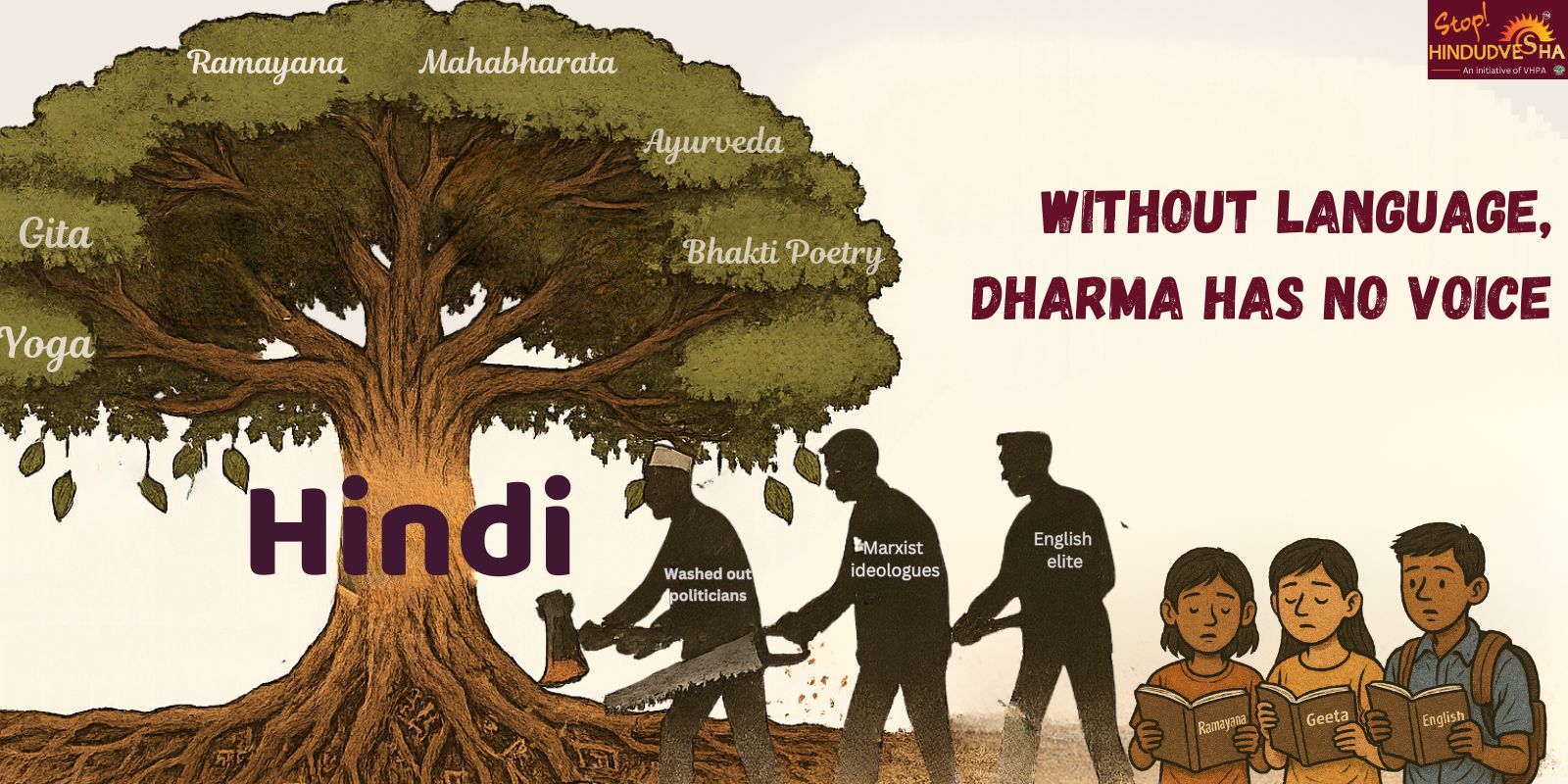
- Recent protests by states like Maharashtra and Tamil Nadu against the Three-Language Formula under the National Education Policy 2020 reflect a recurring trend of politicizing Hindi at the expense of national integration.
- Promoting Hindi is neither anti-secular nor anti-federal; the Constitution safeguards regional languages while encouraging the growth of Hindi as a common linguistic thread for national cohesion.
- Article 351 entrusts the Union—not the states—with the duty to promote Hindi, making state-level resistance constitutionally problematic and disruptive to this national goal.
- Hindi is not just a language—it is a civilizational lifeline, helping to unite Bharat’s diverse regions while enabling a deeper connection with our scriptures, cultural roots, and the living spirit of Hindu Dharma.
Language is not merely a means of communication; it is the carrier of culture, consciousness, and Dharmic continuity—the thread that connects people to their past, their heritage, and their Dharma. In Bharat, where civilization is as much a spiritual expression as a social one, language—especially Hindi and Sanskrit—has long served as a bridge across generations, scriptures, and identities. Yet today, this very bridge is being systematically dismantled in the name of secularism, federalism, or regional autonomy. What is overlooked in this linguistic onslaught is not just a tool of expression, but the living artery of Hindu civilization.
The protest against Hindi is not new, but it has intensified in recent times. Under the three-language formula introduced in the National Education Policy (NEP) 2020, states like Maharashtra, Tamil Nadu, and Karnataka have voiced strong objections, claiming that Hindi is being imposed at the expense of regional languages and state autonomy.[1]
While the roots of this opposition—tied to the Aryan Invasion theory, colonial influence, and politicized linguistic identity—have been discussed in detail elsewhere on this platform [2], this article turns to a different but crucial aspect. It explores how resistance to Hindi undermines Hindu Dharma, severs Indians from their spiritual and cultural roots, and disrupts civilizational continuity. It also examines the Union’s constitutional duty to promote Hindi under Article 351, and the consequences of state-level resistance to this national responsibility.
Article 351: Hindi as a Bridge, Not a Barrier
The Indian Constitution, a beacon of unity in diversity, carefully addresses the nation’s linguistic plurality. Part XVII, covering Articles 343 to 351, outlines the framework for languages. Within this, Article 351 stands out as a special directive duty placed on the Union to promote the growth and development of Hindi, so it may serve as a medium of expression for Bharat’s composite culture.
“It shall be the duty of the Union to promote the spread of the Hindi language, to develop it so that it may serve as a medium of expression for all the elements of the composite culture of India…” – Article 351.
Article 351 envisions a Hindi that expands not by displacing regional languages, but by drawing strength from them, primarily from Sanskrit, and secondarily from the languages listed in the Eighth Schedule. It reflects the constitutional goal of fostering linguistic harmony while advancing a shared medium of communication rooted in Indian tradition.[3] This is not a mere symbolic provision. It is a vision for national unity, recognizing language as a cultural bond in a richly diverse society. Hindi, enriched by Sanskrit and other Indian languages, was meant to be the living, evolving voice of Bharat’s civilizational spirit.
However, this constitutional mandate is increasingly being undermined by political opportunism and narrow linguistic parochialism. The challenges facing Hindi today do not come from foreign forces, but from within. In many parts of Bharat—especially the southern states—Hindi faces neglect, manipulation, and even open hostility. Here, regional identity politics are often used to resist what is, in fact, a Union responsibility, not a state one.[4]
When States Undermine the Centre
Article 351 clearly places the responsibility to promote Hindi on the Union, not the States.[5] It is a central obligation—a directive intended to nurture cultural integration and linguistic unity across Bharat’s diverse landscape. However, in light of recent protests against Hindi, a crucial constitutional question emerges: What are the implications if a State actively hinders or obstructs the Union’s ability to carry out this duty?
This dilemma is not merely theoretical—it is unfolding in real time. Through the three-language formula, the Centre is attempting to fulfill its Article 351 mandate by promoting the use of Hindi in education. However, states like Maharashtra and Tamil Nadu, citing regional identity and linguistic pride, have opposed these efforts. In Maharashtra, political pressure and strong resistance forced the state government to withdraw its decision to make Hindi compulsory from Class 1 to 5 at the primary school level.[6]
This confrontation highlights a significant constitutional deficiency. Nowhere does the Constitution provide a clear remedy or enforcement mechanism if the Union is obstructed in carrying out its special directive. Nor is there any precedent outlining what recourse the Union has when a State actively blocks its constitutionally mandated duty under Article 351.
As a result, the directive risks becoming toothless, reduced to symbolic value rather than a practical enforcement tool. This not only weakens the role of Hindi as a unifying civilizational medium but also erodes the very intent and authority of the Constitution in promoting linguistic integration.[7] Without an effective remedy, the Union’s constitutional obligation remains unfulfilled.
Article 351 and the Missing Right to Enforce
In Jurisprudence, it is often said that every duty comes with a corresponding right[8]. Here, we encounter a constitutional anomaly: the Union is entrusted with a duty under Article 351 to promote Hindi, but who holds the corresponding right to demand its enforcement? Is it the citizens, the linguistic majority, or the cultural inheritors of Dharmic civilization?
This ambiguity has allowed regional politicians, often backed by Anglicized elites, to systematically obstruct efforts to promote Hindi, secure in the knowledge that no clear legal remedy exists against such resistance. The result is a gradual erosion of our civilizational connect.
Unlike justiciable fundamental rights—where citizens possess enforceable claims and the State has a duty to uphold them—Article 351 is a directive. But its neglect carries real, far-reaching consequences: a generation Hindu by birth, yet alien by intellect; a society that reveres the Gita, but cannot read it without Western filters.
English Hegemony and the Elite Disconnect
While some states reject Hindi in the name of regional pride, India’s English-educated elite actively undermines it due to a lingering colonial mindset. Today, English in Bharat is more than just a language—it has become a marker of privilege, power, and social status. Unfortunately, this comes at the cost of civilizational rootedness.
Many argue that English is the language of opportunity and global engagement, and that may be true. But can it also serve as the language of spirituality, of rooted identity, of shared civilizational memory? More critically, can a nation where only 10% of the population is fluent in English truly adopt it as a common medium of communication?[9] The answer is a clear no.
The continued neglect of Hindi has led to a growing number of individuals—particularly among urban Hindus—who neither speak, read, nor understand Hindi, let alone Sanskrit. Worse still, rather than feeling a sense of loss or disconnect, many wear this ignorance as a badge of superiority, taking pride in their command of English while looking down on Hindi with disdain.
This linguistic alienation leads to a deeper cultural and civilizational disconnection. Because of this language gap, many Hindus are unable to read Dharmic texts—whether in their original Sanskrit or in Hindi translations. As a consequence, their understanding of Hindu Dharma is filtered through English translations—many of which are distorted, limited in depth, or framed through Western lenses.
Spiritual Cost of Linguistic Disconnect
For a practicing Hindu, the inability to understand Hindi or Sanskrit is not just a linguistic gap—it is a spiritual disconnection. Vast portions of Hindu literature—the Vedas, Puranas, Upanishads, Bhakti poetry, and saint literature—are primarily available in Sanskrit or Hindi. Without access to these languages, Hindus must rely on English translations, many of which are shaped by Western biases, colonial vocabulary, and civilizational misinterpretations.
Several key concepts lose their original meaning when translated from Sanskrit or Hindi into English:
- Dharma becomes “religion,” stripping it of its richness as cosmic order, social duty, spiritual law, and way of life.
- Sampradaya becomes “denomination,” reducing sacred spiritual lineages to corporate-like labels.
- Moksha becomes “salvation,” turning inner liberation of consciousness into a transactional afterlife reward.
When Hindus engage with such translations without the semantic depth of Hindi or Sanskrit, they begin—often unknowingly—to perceive Hindu Dharma through Abrahamic or Western frameworks. This not only distorts understanding but weakens their connection to tradition, leaving them spiritually estranged from their own heritage.
From Constitutional Duty to Civilizational Necessity
Had Article 351 been implemented in full spirit, a vast section of Bharat’s population would today be fluent in Hindi, with direct access to civilizational literature in its original form or in Sanskrit-rooted translations. The linguistic ecosystem envisioned by the Constitution—a Hindi enriched by Sanskrit and supported by regional languages—would have safeguarded both national unity and regional cultural identities.
Instead, we are witnessing the opposite. Hostility to Hindi has increasingly become a proxy for hostility to Hindu Dharma. Those who oppose Hindi in public education or government often extend their opposition to temple traditions, Sanskrit learning[10], Vedic rituals[11], and Dharmic education. This is not merely a linguistic debate—it is a civilizational assault. We must reject the notion that promoting Hindi is communal or that supporting Sanskrit is regressive. Such narratives stem from deep-rooted self-alienation and post-colonial inferiority. It is time for Hindus—and all Indians—to stop apologizing for their own linguistic and cultural identity.
If Hindus do not understand their own scriptures and continue to depend on distorted translations and colonial frameworks, the civilizational disconnect will only deepen—and may soon become irreversible.
The Myth of Regional Language Erosion
It is crucial to remember that India is not a federation of independent states like the USA. It is a Union of States with a centralizing tendency.[12] Its constitution leans more towards a strong Centre. This structure reflects a deep recognition that Bharat’s unity depends on shared civilizational values, not just political agreements.
Promoting a common language like Hindi is not anti-federal, nor is it an attack on regional languages (Articles 29, 30, 350A, and 350B of the Constitution provide sufficient safeguards to regional and minority languages)[13]. Rather, it is a step towards national integration – an attempt to build linguistic unity throughout India.
If every state overemphasizes its own regional language while sidelining Hindi—meant to serve as a unifying link language—we risk breaking the nation into isolated linguistic silos, promoting fragmentation instead of fostering integration.[14] The promotion of Hindi under Article 351 is not an imposition but a constitutional bridge—a thread that weaves plural identities into a shared civilizational fabric. The Union’s efforts to promote Hindi are not a violation of federalism; they align with the integrative vision of our ancestors and Constitution makers, who saw Hindi as a natural vehicle for expressing Bharat’s civilizational culture.[15]
The NEP 2020 and Renewed Resistance
The National Education Policy, 2020, proposes the Three Language Formula, aiming for every child to learn two Indian languages and one international language, typically English. For most states, this would mean Hindi, a regional language, and English. This formula represents a sincere attempt to strike a balance between regional pride and national unity. Yet, opportunistic political parties misrepresent it, portraying the promotion of Hindi as a saffron imposition in a secular India.[16] This is simply not true. What Article 351 envisions—and what the NEP 2020 seeks to implement—is a harmonious national vision where diversity is respected, but directed toward unity. It does not deny regional languages; it integrates them into a broader cultural framework.
Yet, states like Maharashtra and Tamil Nadu, among others, are refusing to implement this formula when it includes Hindi. Instead, they promote either an English-regional model or, in some cases, rely entirely on English instruction. The consequence is a growing generation of Hindus who know neither Sanskrit nor Hindi, leaving them disconnected from their scriptures, saints, stories, and spiritual heritage.
Teaching in Sanskrit or Hindi is Not Anti-Secular
In the landmark case of Aruna Roy and others v. Union of India[17], the Supreme Court dismissed the argument that teaching Sanskrit in schools violates secularism. Instead, the Court upheld Sanskrit’s cultural and civilizational significance in Bharat, asserting that secularism does not mean alienation from indigenous heritage. It emphasized the role of Sanskrit in preserving India’s culture and values, noting that Sanskrit is the mother of most Indian languages and a language of profound wisdom.
Similarly, in Santosh Kumar and others v. Secretary, Ministry of Human Resource Development, [18] the Apex Court emphasized the role of Sanskrit in preserving and promoting Indian heritage and culture.
If Sanskrit is the root of most Bharatiya languages, then Hindi is its living branch—spoken, understood, and used across the length and breadth of Bharat. If Sanskrit has been judicially recognized for its contribution to national identity and is not seen as communal or in violation of secularism, then how can Hindi—deeply infused with the Sanskritic spirit—be viewed any differently?
Shouldn’t the same constitutional logic apply to Hindi, especially when debating the NEP 2020 or the broader promotion of Hindi? In the Aruna Roy judgment, the Supreme Court clearly stated that secularism does not require detachment from cultural or civilizational roots. Promoting Sanskrit was deemed both constitutional and essential. That same constitutional morality must extend to Hindi.
Both legal precedent and constitutional vision support the view that promoting indigenous languages—especially those that connect people to Dharmic knowledge and civilizational memory—is not a threat to secularism, but a reaffirmation of national identity.
Diversity without Unity: A Civilizational Risk
Currently, we are prioritizing regional languages while neglecting the larger goal of national integration. Article 351 envisions a lingua franca[19] that reflects the spirit of Bharat while honoring its regional diversity. It directs the Union to promote Hindi in a manner that draws from and incorporates regional vocabularies, fostering an organic linguistic unity in diversity. Yet today, we have reversed this vision—celebrating diversity while ignoring unity.
Without Hindi, we risk fragmenting Bharat linguistically—and, over time, even politically. A common language is the spine of national consciousness. It is what emotionally binds diverse regions to a shared identity. Undermining Hindi is like severing that spine.
Even those who identify as secular, atheist, or culturally neutral cannot deny the practical necessity of Hindi. In a nation as vast and diverse as Bharat, inter-state mobility—for employment, healthcare, education, disaster relief, or commerce—demands a common medium of communication. Hindi, spoken or understood to varying degrees across the country, naturally and effectively serves this role.[20]
If not Hindi, then what? English remains elitist and inaccessible to the majority. Regional languages, though rich and powerful, are often mutually unintelligible. Hindi—adaptable, emotionally resonant, and culturally central—is the only practical and inclusive common language.
Even from a non-religious, non-Hindu, purely civic standpoint, rejecting Hindi is both irrational and self-defeating.
Reclaiming Hindi, Reconnecting with Heritage
It is time to reframe the debate. Promoting Hindi is not only a matter of nation-building—it is a matter of dharma-preservation. Without Hindi:
- The Bhagavad Gita is read through the lens of colonial English.
- The Ramayana and Mahabharata are reduced to televised entertainment, not daily spiritual guidance.
- Bhakti saints like Tulsidas, Kabir, Surdas, and Meera become distant figures, not living voices of wisdom.
- Children and youth grow up with foreign moral frameworks, unaware of the profound ethical and spiritual depth of their own tradition.
The Centre must reclaim its constitutional responsibility under Article 351, not as a top-down mandate, but as a bottom-up civilizational imperative. And Hindus must understand: to neglect Hindi is to willingly accept the slow erosion of their Dharma.
The Real Agenda Behind Anti-Hindi Sentiment
The protests against Hindi are not as innocent or organic as they may appear. Increasingly, they are being driven by ideological forces that harbor open contempt for Hindu Dharma and civilizational unity. A growing section of the so-called secular intelligentsia, backed by political interests[21] and ideological activists[22], has weaponized language as a tool to attack Hindu Dharma. They know that Hindi—more than any other modern Indian language—carries the cultural memory and living vocabulary of Hindu Dharma. By opposing Hindi, they aim to sever the umbilical cord that connects young Hindus to their ancestral wisdom, all while masquerading as defenders of linguistic freedom.
The resistance to Hindi is increasingly driven by those with open disdain for Hindu civilization—those who label Sanskrit as “Brahmanical[23],” who mock mantras as superstition, and who brand temples as regressive. They understand that Hindi is a bridge – from Sanskrit to the masses – from the Vedas to the villages. And so, they attack it to undermine the transmission of Dharma itself.
In doing so, they are not only alienating Hindus from their rich heritage but also endangering national cohesion. By opposing Hindi, they are not merely resisting a language—they are severing the arteries of civilizational continuity. Their goal is to uproot Hindus from their literature, bhakti traditions, and sacred texts. This is not just language politics—it is cultural sabotage. Article 351 directs the Union to promote Hindi not out of linguistic chauvinism, but because no nation can endure without a unifying cultural thread.
Final Reflection: The Civilizational Case for Hindi
To reduce Hindi to a mere language dispute is to miss the deeper forces shaping Bharat’s future. This is not a debate of federalism versus centralization, north versus south, or religion versus secularism. It is about whether Bharat can preserve its cultural memory, civilizational identity, and unifying thread.
Hindi, enriched by Sanskrit and supported by regional tongues, is not a threat to diversity—it is what holds that diversity together. Denying it space in education, governance, and public life is not just rejecting a language—it is silencing the most accessible voice of our heritage.
The sidelining of Hindi—often in the name of modernity, secularism, or federalism—is severing the civilizational roots of Hindu society, alienating young Indians from their scriptures and traditions. It also undermines national unity by denying a shared platform for communication, especially among those outside the English-speaking elite.
If Bharat is to grow as a strong, united, and self-aware nation, Hindi must be restored not just as a medium of governance and education but as a cultural lifeline. Without it, we become a house with many rooms but no foundation.
This is not a debate about whether children should learn Hindi, Tamil, or Marathi. It is a struggle for Bharat’s civilizational soul. To kill Hindi is to sever Hindu Dharma from its people. To reject Hindi is to disconnect Bharat from its past and blur its future. Let us not kill Hindi in the name of diversity, nor cut Hindu Dharma in the name of secularism. Let us choose unity, with Hindi as the living thread that binds the soul of Bharat.
Citations
[1]India’s 3-language policy in a tug-of-war: Balancing national unity and state rights; https://timesofindia.indiatimes.com/education/news/indias-3-language-policy-in-a-tug-of-war-balancing-national-unity-and-state-rights/articleshow/122182050.cms
[2] India’s Linguistic Fault Lines: Unpacking South India’s Anti-Hindi Narrative; https://stophindudvesha.org/audio/indias-linguistic-fault-lines-unpacking-south-indias-anti-hindi-narrative/
[3] Language and the Indian Constitution; https://www.defactolaw.in/post/language-and-the-indian-constitution#:~:text=Article%20345%20of%20the%20Indian,official%20purposes%20of%20that%20State
[4]Hindi & Politics Of Regionalism; https://www.thehansindia.com/hans/opinion/news-analysis/hindi-politics-of-regionalism-988905
[5] Article 351 of the Indian Constitution – Significance and Implications; https://www.centurylawfirm.in/blog/legal-section-of-the-day-article-351-of-the-indian-constitution/
[6] Maharashtra withdraws Hindi language orders in schools after backlash, forms review panels; https://timesofindia.indiatimes.com/education/news/maharashtra-withdraws-hindi-language-orders-in-schools-after-backlash-forms-review-panel/articleshow/122154911.cms
[7] Language and the Indian Constitution; https://www.defactolaw.in/post/language-and-the-indian-constitution#:~:text=Article%20345%20of%20the%20Indian,official%20purposes%20of%20that%20State
[8] Correlation between Rights and Duties in Jurisprudence; https://lawbhoomi.com/correlation-between-rights-and-duties-in-jurisprudence/
[9] How Many People in India Speak English? https://www.thehistoryofenglish.com/how-many-people-in-india-speak-english
[10] Saffronisation : Imposition of Hindi and Beyond!; http://www.socialism.in/?p=9433
[11] ibid
[12] The Federal Structure of India: Centralization within a Union Framework; https://lawctopus.com/clatalogue/clat-ug/federalism-in-india-2/
[13] Language and the Indian Constitution; https://www.defactolaw.in/post/language-and-the-indian-constitution#:~:text=Article%20345%20of%20the%20Indian,official%20purposes%20of%20that%20State
[14] India’s Linguistic Secularism – Constitutional Values and Cultural Unity; https://vajiramandravi.com/current-affairs/indias-linguistic-secularism/
[15] Language and the Indian Constitution; https://www.defactolaw.in/post/language-and-the-indian-constitution#:~:text=Article%20345%20of%20the%20Indian,official%20purposes%20of%20that%20State
16] Saffronisation: Imposition of Hindi and Beyond!; http://www.socialism.in/?p=9433
[17] AIR 2002 SUPREME COURT 3176; https://indiankanoon.org/doc/509065/
[18] AIR 1995 SUPREME COURT 293; https://indiankanoon.org/doc/1305668/
[19] Hindi and the Constitution: First among the equals; https://www.barandbench.com/columns/hindi-and-the-constitution-first-among-the-equals
[20] Hindi & Politics of Regionalism; https://www.thehansindia.com/hans/opinion/news-analysis/hindi-politics-of-regionalism-988905
[21] ibid
[22] Saffronisation: Imposition of Hindi and Beyond!; http://www.socialism.in/?p=9433
[23] ibid

Donate to HINDUDVESHA
Our Mission is to explore and expose Hindudvesha through research analysis, education and response.
SUPPORT US