

India’s Caste Census Debate: The Legacy of a British Plot to Undermine Hindus
 Manoj Jwala · 08/05/2025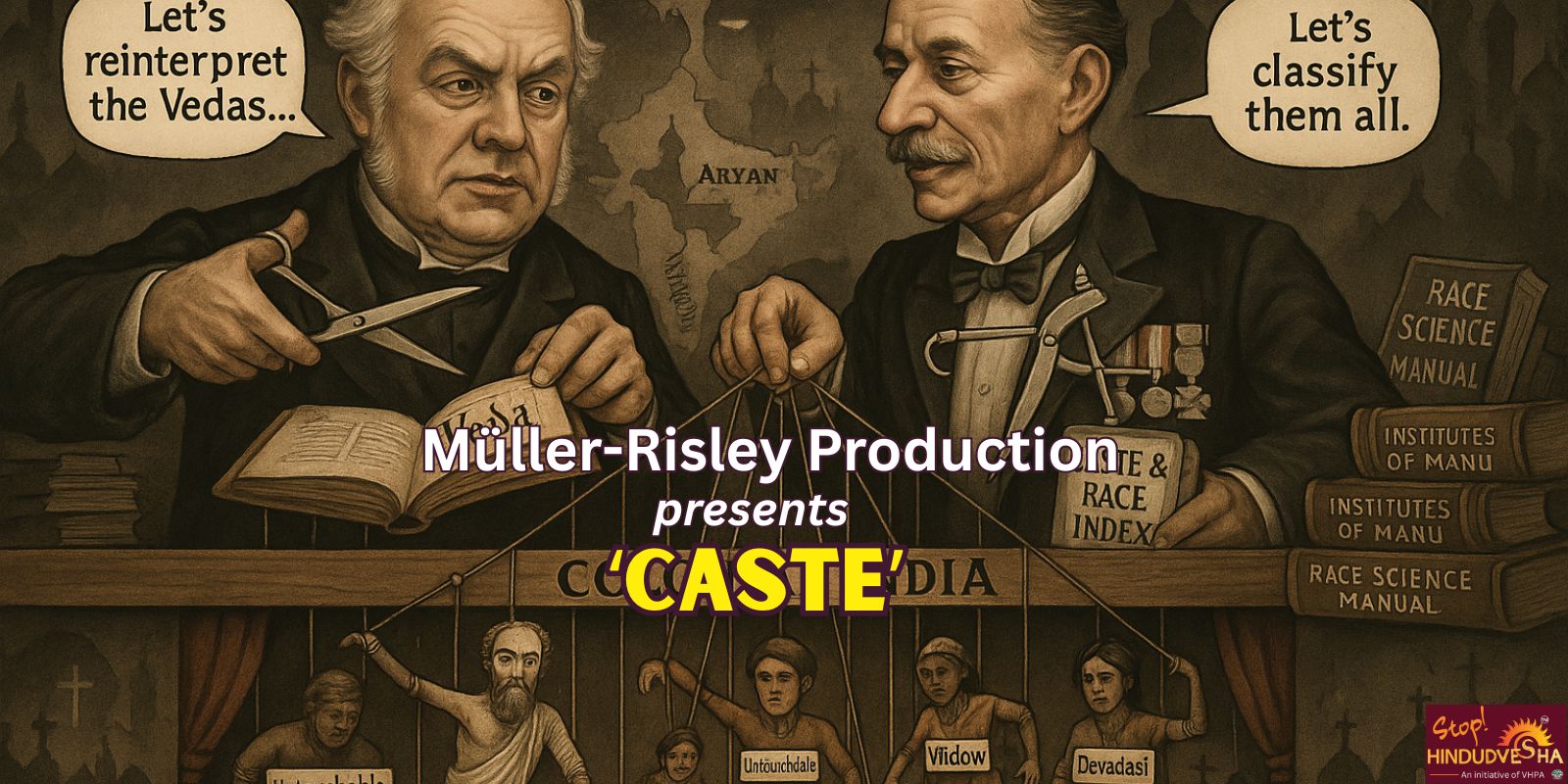
- The modern caste system in India was largely constructed by British colonial rulers to divide Hindu society and aid missionary conversions.
- British census policies, especially those led by Risley, racialized caste using pseudoscience like nose measurements and social taboos.
- Terms like “Dalit,” “untouchable,” and rigid caste identities were artificially created and institutionalized through colonial classification systems.
- Ancient Indian society was based on flexible, profession-linked jaat identities, not birth-based, hierarchical castes as seen today.
- Despite being debunked by scholars and leaders like Dr. Ambedkar, these colonial caste frameworks still influence India’s census, education, and politics.
These days, there is considerable political debate in India about the caste-based census. But behind this lies a deeper intellectual conspiracy connected to ideas of white racial superiority and religious expansionism. This conspiracy began during British colonial rule to justify their control over India. As part of this plan, British officials supported churches and Christian missionaries and aimed to divide and weaken Hindu society.
To do this, they created a census system that broke Hindu society into hundreds of castes and racial groups. This made the Hindu community appear fragmented and weak compared to organized religions like Christianity and Islam. Otherwise, in such a large population, it made no sense to force identities based on caste or race.
In the census forms made by the British, Muslims were simply counted as ‘Muslims.’ But Hindus were divided into many different caste and racial categories. Only those who didn’t fall into any other category were called ‘Hindus.’ In fact, in 1891, the Census Commissioner, E. A. Gait, wrote that after counting Jains, Buddhists, Sikhs, tribals, Muslims, Christians, Parsis, and Jews — whoever was left was labeled as ‘Hindu.’[1]
India’s Social Structure Before Colonial Rule
It’s essential to recognize that the concept of ‘caste’ as a rigid social hierarchy didn’t exist in the Hindu tradition. There is no such structure in Indian scriptures or authentic historical texts. Professor Nicholas Dirks from the University of California also said that caste is not an original part of Indian tradition. He believed that caste, as we know it today, was a modern creation that resulted from the clash between British colonialism and Indian society.[2]
During British rule, people in India identified themselves in many ways — by their temple communities, villages, family lineages, professional groups, or spiritual traditions. European travelers in the 16th–17th centuries barely mentioned ‘caste’ at all. For example, Alexander Dow, a British army officer and translator, translated a Persian book titled “History of Hindostan” in 1768.[3] In that book, the word ‘caste’ appeared only once, which shows it wasn’t an important concept in India at that time. Early European writers didn’t consider caste as something unique to India. Instead, they saw Indian society through the lens of their own ‘caste system’[4] or class divisions, and misunderstood India’s traditional social structure as something similar.
In ancient Indian society, there were groups based on professions, but the kind of caste discrimination that exists today did not. A Greek writer named Megasthenes, who spent a considerable amount of time in India, described in his book Indica that Indian society was divided into seven distinct professional groups. However, his description was more similar to the Roman social system, with which he was familiar, rather than the Indian varna system.[5]
The rigid caste system we see today is actually the result of a planned strategy created by the British. It was designed to support religious expansion and was influenced by colonial-era scholars. From ancient times up to British rule, caste was never a fixed system. People often moved between roles within the four varnas — Brahmin, Kshatriya, Vaishya, and Shudra. For example, Brahmins (traditionally regarded as teachers or priests) sometimes came from what are now referred to as “lower” castes. Saint Ravidas was a leather worker, and Saint Kabir was a weaver.
Anthropologist Susan Bayly also said that there is serious doubt whether caste had any major or harsh influence in Indian society before the British made it a central identity.[6] Scholars like Nicholas Dirks, G.S. Ghurye, Richard Eaton, David Shulman, and Cynthia Talbot found in royal records and travel writings that mentions of caste in pre-British India were rare or nonexistent. Social identities were not fixed; they continually changed. A servant, trader, or farmer could become a king; a soldier could become a farmer. A person’s social identity could change just by moving to a different village. There is also very little historical evidence of widespread caste-based oppression that led to mass conversions to Islam.[7]
Importance of Jaat (not Jaati) in Hindu Scriptures
The four Vedas — Rigveda, Yajurveda, Samaveda, and Atharvaveda — which are the foundation of Sanatan Hindu Dharma, do not mention jaati (caste) as we know it today. However, some texts like the Atharvaveda do mention the word jaat. This refers to jaat-karma, one of the 16 Vedic rituals.[8] In this ritual, the newborn baby’s umbilical cord is cut, the father gives the child a family and lineage identity, and the mother breastfeeds the baby with a gold-infused medicine. The word jaat literally means “one who is born.”
The purpose of jaat-karma was twofold: At the personal level, it connected a newborn to their family, lineage (gotra), and heritage. At the community level, it was society’s responsibility to provide the child with opportunities and training related to the traditional livelihood of their community. In other words, the child would grow up learning the profession common in their community, and society would help guide them in that direction.
In other words, jaat simply meant a group based on profession — for example: Nonia (salt-makers), Telia (oil pressers), Halwai (sweet makers), Lohar (blacksmiths), Charmakar (leather workers), Kumbhar (potters), Dhobi (washermen), Swarna-kar (goldsmiths), etc. In Western terms, these would be referred to as “producer groups” or manufacturing communities. Similarly, some communities were based on language and region, such as Bengali, Punjabi, Maratha, Bihari, etc.
Transformation of Jaat into Caste
However, the meaning of today’s caste (jaati) is completely different from the original concept of jaat in Hindu tradition. Even though the word “jaati” originates from the Sanskrit word “jñāti,” which means “people of the same family or lineage,” its modern usage has diverged significantly from that original concept. Today, jaati in India is used in the sense of “caste”, which comes from the Portuguese word casta, meaning “breed” or “race.” Modern government forms, legal documents, and political discussions in India often use ‘jaati’ in a European, race-based sense, rather than in the traditional, community-oriented way.
Anthropologist Susan Bayly says that before British rule, caste divisions weren’t very rigid in most parts of India, not even in the so-called “Hindu heartland.” The traditional caste system, as people now consider it, began to take shape in the early 18th century.[9]
This leads to an important question: How did flexible and practical ideas like jaat and jñāti from the Vedas turn into the divisive and rigid caste system (caste-jaati) we see today?
To understand this, we must examine how, during colonial times, some Western scholars learned Sanskrit and delved deeply into Hindu philosophy. When they realized the advanced and profound nature of Indian knowledge, it made them feel insecure and envious. They began questioning their own racial superiority, and from that insecurity emerged a wave of intellectual jealousy that redefined jaati in a completely new and harmful way.
From Vedic Aryans to Colonial Race Conspiracies
When European scholars — especially those from England, Germany, and France — came into contact with the ancient Vedic texts of Sanatan Dharma, they noticed the use of the word “Arya” and its association with notions of superiority. This led to a race among them to prove that they themselves were Aryans. Following this idea, in the mid-19th century, a French writer named Joseph Arthur Comte de Gobineau wrote a famous book titled “Essay on the Inequality of Human Races.” In this book, he claimed that the “White Race” was superior to all others, and within that, the Aryans were the highest. His theory gave a strong ideological base to the ideas of racial superiority and colonialism in Europe, which were later used to justify discrimination and oppression in the name of caste, race, and religion around the world.[10]
After this, a full intellectual movement began in the West under the label of “Scientific Racism.” During this period, numerous false narratives about India were propagated. Gobineau’s book became a rich source for these ideas. In it, he cleverly argued that the Aryans — who, according to him, represented the highest capabilities of the white race — had invaded the Indian subcontinent and started mixing with the native people. When they realized that this mixing could harm their racial purity, they supposedly created the varna system as a method of self-protection. In this way, Gobineau presented India’s varna system as a racial segregation strategy, whereas in reality, it was based on a person’s qualities and actions, not on blood or race. This false theory later helped label the Indian caste system as a tool of racial exploitation and gave outsiders a reason to criticize and defame Indian traditions.[11]
The same theory by Gobineau was further developed by the well-known linguist Friedrich Max Müller[12], who worked for the British East India Company. He built upon it to justify and strengthen British colonial rule, as well as to facilitate Christian missionary work. He created a completely fictional and fabricated story. According to him, before the time of Gautama Buddha, all humans lived in the steppes of Asia. Over time, different groups from that society moved in different directions — one group went west and settled in Europe, another went to Iran, and a third moved east into India. When they arrived in India, they are said to have pushed the native people further south.
According to Max Müller, the people who were pushed south became known as Dravidians, and those who settled in their place were called Aryans. This imaginary theory later became the foundation for distorting Indian history. It also created a deep cultural and political divide by portraying the Aryan-Dravidian division as a historical fact.[13] Based on this idea, in 1881, British officials published the first edition of the Imperial Gazetteer of India. In this official document, the three varnas — Brahmins, Kshatriyas, and Vaishyas — were listed as “Aryans,” while the Shudras were labeled as “original inhabitants” or “Dravidians.”
This was the first time the British, after looting India, destroying its traditional industries, and breaking down its social systems, went on to manipulate its population structure. They made a calculated attempt to redefine Indian demographics based on their own ideas.[14]
Max Müller: The Mastermind of the Conspiracy
Max Müller, who was paid four pounds per page by the British government to translate the Rigveda, did not just invent the story of Aryan migration and Aryan-Dravidian racial division. He also attempted to demonstrate racial differences between these groups by deliberately distorting the meanings in his Vedic translations.
He made great efforts to find physical or racial differences between the varnas mentioned in the Vedas. But he failed to find any solid proof because the varna system was never based on physical traits or race. Eventually, in frustration, he picked a word from the Rigveda — “Anas” — which has nothing to do with noses, and interpreted it to mean that the Vedas described the shape of people’s noses.[15]
This intellectual dishonesty by Max Müller became a powerful tool for defining caste and race, and it later shaped a Western distortion where Indian social structure began to be viewed through a racial lens.
From Max Müller’s theory to Risley’s “nose chart”
Max Müller’s misleading theory was quickly adopted by Herbert Hope Risley, a powerful British officer from the Royal Anthropological Institute in London. Risley expanded Müller’s biased Vedic interpretation and created a full-fledged “nasal index chart.”
Risley used this nose chart like a sharp weapon to divide and classify Hindu society into castes. He started determining a person’s race, varna, or caste based on the length, width, and height of their nose.
Before all this, the varna system in India had no connection with race, genetics, or ethnicity. It was based on a person’s traditional livelihood, social role, and cultural heritage. The term jaat, or caste, referred to a local and community-based social structure. It was generally organized horizontally, meaning communities functioned alongside each other, not in a top-down, pyramid-like hierarchy.
This horizontal, profession-based system also offered social protection and stability. It was this very feature that inspired Mahatma Gandhi’s vision of village self-rule (Gram Swaraj). In fact, this flexible caste framework in Hindu society became a major obstacle for foreign religious invaders and missionaries seeking to convert people.
Perhaps this is why Max Müller, the man who helped create the modern race-caste theory, once said: “Caste, which so far has been a barrier to converting Hindus, can in the future become the most powerful engine for conversion — not just of individuals, but of entire classes of Hindu society.”[16]
But those who wanted to expand religion under colonial cover intentionally destroyed this protective structure of Hindu society. In 1901, Herbert Hope Risley was appointed Census Commissioner of India, and later in 1910 he became its President. He used his same old “nose chart” as the basis for the census. In this census, Risley divided Indian society into 2,378 castes and tribes, 43 racial groups, and two main races — Aryan and Dravidian. He even declared that to truly understand an Indian’s identity, “varna, tribe, and race” were the most reliable categories. In doing so, he inserted a completely fictional, race-based framework into official government records and the census system. What was once a system of self-organization became a tool for division and exploitation.[17]
Even before this, Risley had replaced the Indian word varna with the English word caste. He proposed several theories on the origin of the word “caste” and attempted to explain India’s social structure using the Manusmriti. He wrote that there are many theories about the origin of caste, and one of the main references is in Chapter 10 of the Manusmriti, a text that blends religion, law, tradition, and spirituality, which he referred to as the “Institutes of Manu.”
By misrepresenting Indian scriptures like this, Risley tried to impose the European, race-based concept of caste on Indian society. He transformed a flexible, merit-based system into a rigid, birth-based one — in a manner that served the interests of colonial rule and missionary goals.[18]
And how exactly did Risley define and divide these castes and racial groups? Let’s look at a few examples next.
British Policies and Risley’s Bias Gave Birth to Caste Hierarchies
Risley classified Indian society according to the needs of British rule and created an artificial ranking system of higher and lower castes. He identified three main Aryan or upper-caste groups — Brahmins, Kshatriyas, and Vaishyas — and then added three more groups which he called “Castes Allied to Brahmins,” “Castes Allied to Kshatriyas,” and “Castes Allied to Vaishyas.” This created a total of six caste groups.
However, he deliberately omitted the Shudras, who were traditionally considered the fourth pillar of the varna system. To justify this, he used the “Aryan Invasion Theory,” claiming that when Aryans invaded India, they formed relationships with local women, and the children born from these unions were called Shudras. In this way, he labeled Shudras as a “mixed race” of original inhabitants and pushed them into a lower category.
Not only that, he removed the term “Shudra” entirely from the main social list and invented a new fifth group, which he labeled as “Mlechhas” or “Dasyus.” The goal of this entire classification was to divide Hindu society based on race, bloodline, and social rank in such a way that its internal unity would be destroyed, making it easier for colonial powers and missionary forces to dominate.[19] After this, Risley introduced another method. He created a new rule: any community with which Brahmins shared food or social relations should be considered a separate caste group. Based on this, he created six more caste groups. So, in total, twelve caste groups were formed.
Some of these new groups included communities that cooked food for Brahmins, such as Tambolis (betel leaf sellers) and Bhadbhujas (grain roasters), among others. Other groups were ranked based on whether Brahmins were allowed to eat in their homes or not. Using such standards of social contact and food-sharing, Risley made the caste system more rigid, complicated, and fragmented. This caused deep harm to Hindu society’s traditional flexibility and social mobility.[20]
In 1911, Census Commissioner E. A. Gait instructed all census officers that the social rank of every caste should be determined based on how far below the Brahmins they were. In other words, Brahmins were made the reference point for the entire caste hierarchy.
Dalit Identity: A Colonial Construct Against Brahmins
Throughout the caste-classification process, Brahmins were the main target for Risley. According to Christian missionaries, Brahmins were the biggest obstacle to converting Hindus to Christianity.[21] That is why Risley and others wanted to portray Brahmins as enemies of other castes within Hindu society. Based on this view, the categories of untouchables, outcastes, and Dalits were defined using absurd and fabricated logic. For example, communities were labeled as “Dalit” or “untouchable” if they did not accept Brahmin authority, did not take mantras from Brahmins or Hindu gurus, did not accept the Vedas, did not worship major Hindu gods and goddesses, did not employ Brahmins as priests, were not served by “proper” Brahmins, or buried their dead instead of cremating them.[22]
Clearly, such arbitrary and illogical criteria were used to classify many communities as “untouchables,” “outcastes,” or “Dalits.”
Colonial Plot Succeeded: Hinduism diminished, society split
To justify his racial theories, Risley created a rule based on measurements of the nose and skull, which he called the “unfailing law of caste.” According to this, people with thin and long noses (what he called “Aryan noses”) were given higher social rank, while those with wider noses were assigned lower status.
This led to unrest and hostility among various communities. Disputes and even legal cases arose based on such classifications. However, once the British administration officially registered a community under a certain caste, that classification stayed in the records, and many remain unchanged even today. The British were never concerned about whether their caste system was fair or logical. Their main aim was to divide Hindu society from within.
Risley openly stated that through his so-called racial research, he wanted to declare a large section of Hindu society as “non-Aryan” and separate them.[23] In reality, there was no such thing as a non-Aryan in India. Still, British administrators enforced Risley’s racist and conspiratorial recommendations by labeling large parts of the Hindu population as “untouchable,” “outcaste,” “Dalit,” or “indigenous,” and declaring them “non-Aryan Dravidians.”
As a result, even today India continues to witness caste conflicts and social tensions. In the end, this entire colonial religious conspiracy — originally designed to weaken and fragment Hindu society — is still alive in new forms, keeping Hindu society divided into hundreds of castes, weaker from within, and reduced in strength and unity.
Present Situation
India’s current census system is still based on the framework created by Herbert Risley in 1901. At Risley’s request, the British government established a special survey department across India to collect data on castes and races. This department worked directly under him.
It applied the European method of racial classification, based on physical features like the shape of the head and nose, to the Indian population. The goal was to determine how much “Aryan” and how much “non-Aryan” blood existed in each Indian, especially among Hindus. Based on this, an extensive series of volumes was compiled, listing “Castes and Tribes” by region.
Even today, these lists are used as key reference materials in Indian universities for research on caste and society.[24] When this process began, there were about 2,378 listed castes and tribes. However, with every decade of census activity, the number continued to increase, and today it is estimated to have surpassed 5,000.
Meanwhile, many new caste groups have also been created — some of which didn’t even exist before, or were redefined in entirely new ways. The 2021 census, which was delayed due to the COVID-19 pandemic, is now likely to be held in 2027, and it may again be organized along caste-based lines.
The sad part is that these are the very same castes that were labeled and ranked by Risley using arbitrary, artificial, and misleading criteria — and this colonial system is still officially accepted in India today.
Conclusion
The Aryans did not come to India from somewhere else — India itself has always been the homeland of the Aryans. And the so-called Dravidians are not a separate race. This fact has been confirmed by many recent archaeological studies.
Even during British rule, Dr. B. R. Ambedkar strongly opposed Risley’s race theory and exposed it as baseless. He argued that if nose measurements are used to prove racial identity, then Brahmins and so-called “untouchables” belong to the same race. Therefore, if Brahmins are Aryans, then untouchables must be Aryans too.[25] Despite this, even today, many Indian political leaders, policymakers, bureaucrats, as well as students and scholars of history and sociology, still carry deep-rooted colonial biases. They continue to believe that Aryans were foreign invaders, that dark-skinned people are the true natives of India, and that Brahmins divided Hindu society into castes for the sake of exploitation.
In such a situation, the time has come to completely dismantle these false, conspiratorial, and divisive narratives through organized efforts. For this, it is absolutely necessary that the Government of India take concrete legal steps to formally remove all the unscientific and baseless theories introduced by Herbert Hope Risley and Friedrich Max Müller from the nation’s educational institutions, archives, archaeological departments, and the census system.
Only then can India’s historical memory and social structure be truly freed from the distortions of colonial rule.
Citations
[1] Devendra Swarup (Panchjanya); भारतीय राष्ट्रवाद के विरुद्ध ब्रिटिश षडयंत्र; https://panchjanya.com/2006/09/07/196398/archive/rfad9f804/
[2] Nicholas Dirks: Castes of Mind: Colonialism and the Making of Modern India, https://archive.org/details/castesofmindcolo0000dirk
[3] Alexander Dow (Wikipedia); https://en.wikipedia.org/wiki/Alexander_Dow
[4] Wilkerson’s ‘Caste: The Origins of Our Discontents’ (Wikipedia); https://en.wikipedia.org/wiki/Caste:_The_Origins_of_Our_Discontents
[5] Dr. Tribhuvan Singh, शुद्र कौन थे; https://ia904600.us.archive.org/0/items/shudra-kaun-the-awalokan-samiksha-tribhuvan-singh-ocr/Shudra_Kaun_The_Awalokan_Samiksha_TribhuvanSingh_ocr.pdf
[6] BBC: Viewpoint: How the British reshaped India’s caste system; https://www.bbc.com/news/world-asia-india-48619734
[7] ibid
[8] Dr. Savita Gautam (International Journal of Sanskrit Research), वेदों में संस्कारों का महत्व; https://www.anantaajournal.com/archives/2017/vol3issue4/PartE/7-6-53-861.pdf
[9] BBC: Viewpoint: How the British reshaped India’s caste system; https://www.bbc.com/news/world-asia-india-48619734
[10] Alvin K. Benson (EBSCO, 2024), Aryan Race; https://www.ebsco.com/research-starters/ethnic-and-cultural-studies/aryan-race
[11] राजीव मल्होत्रा, ब्रेकिंग इण्डिया (भारत विखण्डन); पृष्ठ-49
[12] Max Müller (Wikipedia); https://en.wikipedia.org/wiki/Max_M%C3%BCller
[13] India Old Days, आर्यों का भारत आगमन; https://www.indiaolddays.com/aaryon-ka-bhaarat-aagaman/
[14] Dr. Tribhuvan Singh, शुद्र कौन थे; https://ia904600.us.archive.org/0/items/shudra-kaun-the-awalokan-samiksha-tribhuvan-singh-ocr/Shudra_Kaun_The_Awalokan_Samiksha_TribhuvanSingh_ocr.pdf
[15] राजीव मल्होत्रा, ब्रेकिंग इण्डिया (भारत विखण्डन); पृष्ठ- 72-73
[16] Ibid, p.72
[17] Ibid, p.76
[18] H.H. Risley, People of India, P.248; https://archive.org/details/cu31924024114773
[19] Dr. Tribhuvan Singh, शुद्र कौन थे; https://ia904600.us.archive.org/0/items/shudra-kaun-the-awalokan-samiksha-tribhuvan-singh-ocr/Shudra_Kaun_The_Awalokan_Samiksha_TribhuvanSingh_ocr.pdf
[20] ibid, p. 217
[21] Center for Indic Research, चर्च-मिशनरियों का ब्राह्मण-विरोध; https://cisindus.org/indic-varta-internal.php?vartaid=540
[22] Sanjiv Khudshah (Forward Press), सबसे पहले ऐसे तैयार हुई अनुसूचित जाति और अनुसूचित जनजाति की सूची; https://www.forwardpress.in/2024/12/news-analysis-story-of-sc-and-st-list/
[23] राजीव मल्होत्रा, ब्रेकिंग इण्डिया (भारत विखण्डन); p.74
[24] Devendra Swarup (Panchjanya), भारतीय राष्ट्रवाद के विरुद्ध ब्रिटिश षडंयत्र; https://panchjanya.com/2006/09/07/196398/archive/rfad9f804/
[25] राजीव मल्होत्रा, ब्रेकिंग इण्डिया (भारत विखण्डन); p.80

Donate to HINDUDVESHA
Our Mission is to explore and expose Hindudvesha through research analysis, education and response.
SUPPORT US