

How Global Caste Narratives Are Reframing AI Debates on India and Hindu Society
 Rati Agnihotri · 03/28/2026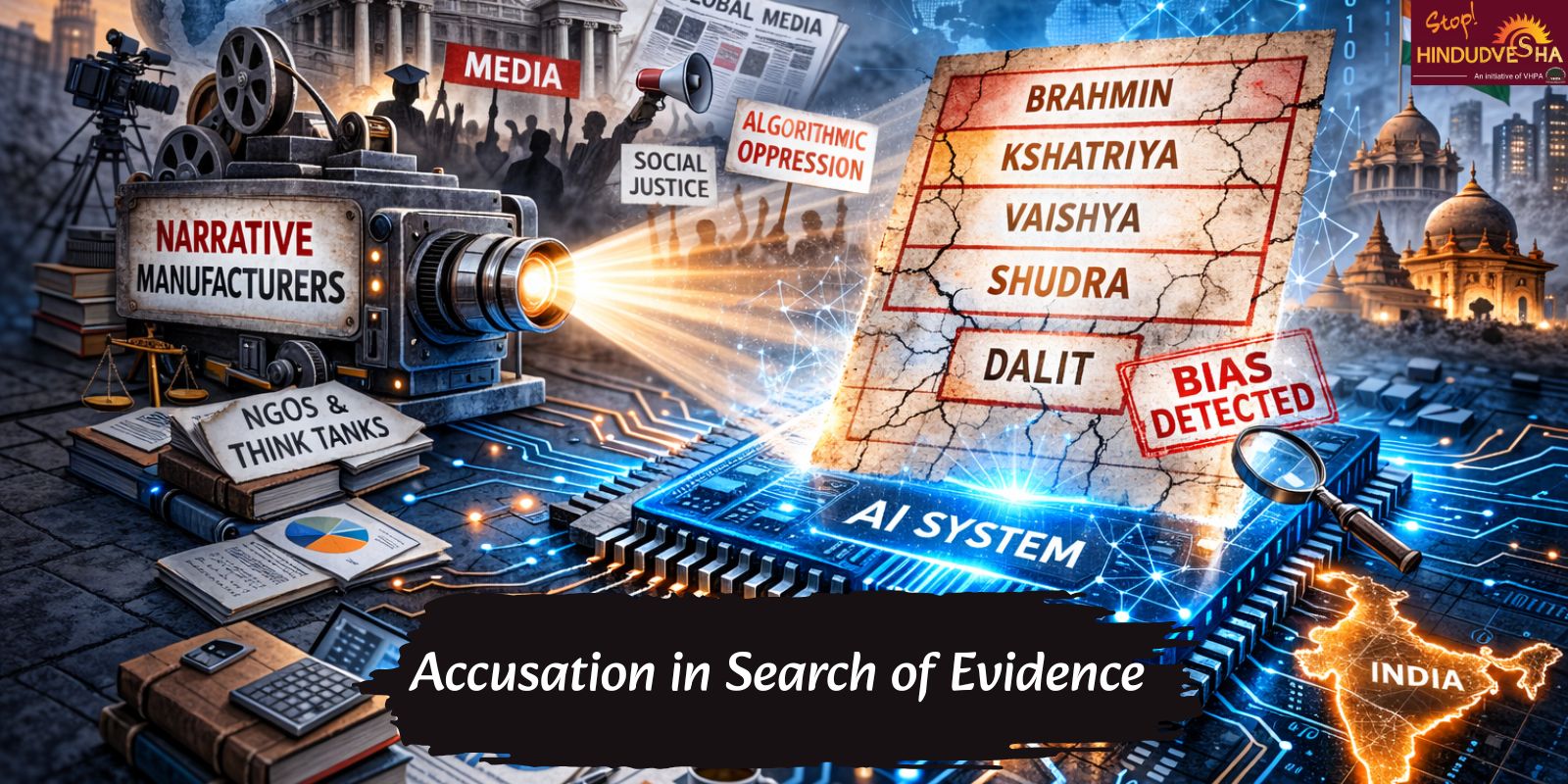
Summary
This article analyzes how global academic, media, and activist narratives are increasingly reframing debates on artificial intelligence in India through the lens of caste, often at the expense of technical rigor and contextual understanding. It argues that “AI bias” has become a fashionable theme within Western academia, shaped by ideological frameworks that are then imported into the Indian context with limited adaptation. Through examples involving ChatGPT, international media coverage, and activist campaigns, the article shows how isolated technical anomalies are frequently amplified into sweeping claims of systemic caste discrimination. These narratives are reinforced by sections of Indian media and global institutions, creating an ecosystem that privileges ideology over evidence. The article also links these trends to caste-based activism in the United States targeting Indian American professionals, especially in the technology sector, and highlights how similar patterns are now influencing Indian discourse. Central to the argument is the claim that caste rhetoric often functions as a strategic diversion. By portraying Hindu society and Indian institutions as inherent oppressors, it deflects attention from deeper and more persistent anti-Hindu and anti-India bias embedded in global technological and academic ecosystems.
Woke activism is now firmly entrenched in Western academia, and its influence is increasingly visible in research on artificial intelligence. A growing body of scholarship interprets AI through frameworks drawn from the humanities and social sciences, including critical race theory, feminism, and intersectionality. Within these approaches, “AI bias” has become a prominent and fashionable area of inquiry.
Serious and thoughtful studies of algorithmic bias are valuable when grounded in empirical evidence, methodological rigor, and clearly defined social concerns. However, a discernible trend reflects the growing intrusion of ideological activism into technical research. In some instances, AI is reframed less as an engineering challenge and more as a political instrument, with academic “research” used to pressure technology firms into adopting particular narratives and policy positions.
This form of “AI activism” is gradually evolving into a cottage industry. Activist groups increasingly target emerging AI ecosystems in the Global South, including India, often through speculative or weakly substantiated claims. Such campaigns risk discouraging innovation and weakening indigenous technological capacity.
A particularly notable development is the extension of caste-based discourse into the technology sector. Concepts long dominant in Western social science are now applied to AI systems, frequently without adequate technical grounding. Public debate is shifting from substantive discussions on design, safety, and performance to accusatory claims of “caste bias.”
Although such analogies may initially appear exaggerated, they reflect a broader and recurring pattern. Cultural and civilizational narratives are repeatedly reframed as sites of alleged structural bias. The following sections examine how generative AI platforms are increasingly drawn into these debates and shaped by prevailing ideological currents within Western academia.
ChatGPT Accused of Promoting Caste Bias in India
In January 2026, a controversial video featuring UPSC educator and mock interviewer Vijender Singh Chauhan went viral, in which he claimed that if people give a brief prompt to ChatGPT and examine the data it generates, there is a higher likelihood that the information produced would reflect upper-caste bias, due to the pre-existing biases of individuals who trained the generative AI platform. He claimed that ChatGPT is “trained on existing content that favors the upper castes and the people in power. It is trained by excessively represented individuals in this group [1].”
According to Chauhan, ChatGPT is an altogether pre-trained model. In his viral speech, he made sensational allegations against “upper caste” people, claiming that the upper castes largely controlled the ChatGPT narrative and determined its responses. He said that the content on which ChatGPT is trained already reinforces upper-caste bias. “So, if the foundational structure of a machine is problematic, then how can one expect social justice from such machines?” Chauhan declared. He emphatically stated that the struggle is not just against bureaucrats, people in power, authority figures, and office bearers, but against AI algorithms as well [2].
Chauhan’s statements might seem ridiculous at the outset. However, when viewed in the larger context of caste politics dominating India, the infiltration of US-style wokeism endangering the culture of meritocracy in India’s sought-after STEM institutions, and the increasing infringement of reservation politics even in sensitive areas like medical education [3], such claims assume rather sinister proportions. If anything, they neatly fit into the larger narrative involving the consistent targeting of generative AI platforms for their alleged caste bias. The overdose of political correctness and AI activism through the rhetorical framing of “race” in the West is being imported into the Indian context through the prism of caste.
Global Woke Narratives Targeting India
Over the past few years, one has witnessed a barrage of seemingly motivated articles published by tech publications, mainstream Western media outlets, and various think tanks and research organizations, admonishing AI platforms for their alleged caste bias. When one looks at such write-ups and research in totality, they point toward the existence of a coordinated narrative. The pattern seems anything but disinterested.
An article published by MIT Technology Review in October 2025 claims that “ChatGPT and Sora reproduce caste stereotypes that harm millions of people.” The write-up, titled “OpenAI Is Huge in India. Its Models Are Steeped in Caste Bias,” follows the predictable trajectory of producing atrocity literature on caste, with the new addition of “tech” to the narrative. The article provides half-baked examples of ChatGPT’s alleged caste bias, presenting scenarios that may simply reflect “technical errors” rather than premeditated bias against certain castes. It describes a case of a Dalit scholar applying for a postdoctoral fellowship in Bangalore, detailing how ChatGPT allegedly changed his surname to “Sharma” while editing the application. However, the write-up also states that his application did not include his last name and that ChatGPT interpreted the “s” in his email address as “Sharma.” Thus, an article in a leading tech publication turns a probable technical error into a full-fledged caste-based conspiracy, emphasizing that his surname was interpreted as “Sharma” rather than “Singha,” which supposedly signals someone from the caste-oppressed Dalits [4].
The writer argues that race and gender biases in Western AI systems translate into caste-related biases in the Indian context. In the process, he regurgitates stereotypical caste-based assumptions about Indian society, hard-selling the colonial construct of “caste” as inherently Indian, while overlooking the ancient Bhartiya Varna-Jati system, which was open-ended, dynamic, and merit-based. “While AI companies are working to mitigate race and gender biases to some extent, they are less focused on non-Western concepts such as caste, a centuries-old Indian system that separates people into four categories: Brahmins (priests), Kshatriyas (warriors), Vaishyas (merchants), and Shudras (laborers). Outside of this hierarchy are the Dalits, who were treated as ‘outcastes’ and stigmatized as polluting and impure,” says the writer [5].
“AI-Based Policing: A Veneer of Neutrality to India’s Casteist Criminal Justice System,” reads the title of an article published by AINOW in November 2021. The writers claim that the digitization of police records by the Indian government creates the danger of perpetuating caste bias through the potential association of certain caste groups with a higher probability of committing crimes [6].
While concerns regarding the association of particular groups and communities with criminal behavior are legitimate and deserve serious discussion, the write-up appears to be jumping the gun. The use of AI in the Indian policing system is still at a relatively early stage when compared to its advanced deployment in societies such as the United States. Thus, the article seems more like a motivated attempt to force-fit Western concerns about AI bias into the Indian context. It replicates a familiar academic pattern of mapping “caste” onto race through critical race theory and then making biased and opinionated observations about Indian society.
The irony is that, in the garb of pointing out “caste bias,” such research and write-ups seem instead to perpetuate it. It is akin to an atrocity literature loop, in which British colonial rulers and European Indologists first constructed the Indian “caste system,” and an entire ecosystem comprising sections of academia, media, and think tanks then continued to reinforce it. Even as India has made commendable progress in reducing caste-based inequality through strong constitutional measures, and society is moving along a radically different path, such biased rants keep the communal cauldron of caste alive.
A section of the Indian media appears to be amplifying the “caste bias in AI” narrative, mirroring Western academia’s research paradigm on “caste.” Let us examine a few toxic headlines claiming that artificial intelligence platforms are replete with caste bias:
“AI knows how caste works in India. Here’s why that’s a worry” – The Times of India, February 17, 2026 [7].
“Racist, sexist, casteist: Is AI Bad News for India?” – The Hindu, September 11, 2023 [8].
“Beware: AI is learning caste-based, communally-sensitive human biases in India, how can it be prevented?” – DNA, September 16, 2025 [9].
“How AI risks reinforcing caste and inequality” – Governance Now, September 4, 2025 [10].
“Dalit folklore to AI bias, Offstream Futures Bengaluru spotlights resistance through art” – The News Minute, March 3, 2025 [11].
“The Digital Caste System: How LLMSs Perpetuate Ancient Hierarchies In Modern India” – Feminism in India, August 27, 2025 [12].
How Caste Narratives are Targeting Indian Americans
The dramatic proliferation in media content and academic research alleging caste bias in AI seems uncannily connected with the relentless targeting of the Indian American tech workforce in the US on the pretext of tackling caste discrimination.
In February 2023, Seattle became the first US city to pass a law explicitly banning caste discrimination. Similar legislation was passed by the California State Assembly in 2023. However, Governor Newsom vetoed the bill, noting that it was unnecessary “since California already prohibits discrimination based on race, color, religion, ancestry, national origin, disability, gender identity, sexual orientation, and other characteristics, and state law specifies that these civil rights protections shall be liberally construed [13].”
The US has been witnessing an aggressive wave of caste-based activism over the past couple of years, spearheaded by anti-Hindu organizations such as Equality Labs. A woke coalition of far-left, anti-Hindu, and radical Islamist forces is increasingly targeting the Hindu diaspora in the US, especially the Indian American tech workforce, alleging caste discrimination without any substantial evidence whatsoever, and creating space for subjecting Indian Americans to hostile hyper-vigilance and intense profiling. From the holding of caste sensitization workshops in educational institutions to the normalization of casual Hinduphobia in academia, media, and civil society, the US has been the epicenter of motivated caste narratives. The Indian American community, which forms a considerable chunk of the US tech workforce, has been the primary target.
The “caste bias in tech” narrative in India tends to echo a similar set of allegations targeting India’s general category, or so-called “upper castes,” thus importing the same pattern of rupturing meritocracy in the name of social justice that currently dominates woke discourse in Western societies. These lines from an article published by Governance Now [14] aptly illustrate the magnitude of the kind of divisive narratives the woke caste lobby is bringing into the tech ecosystem: “This bias is not accidental. LLMs learn from vast amounts of online text, much of which comes from digitally empowered groups, largely urban, male, and upper caste.”
Such demonization of India’s “upper castes” on the pretext of highlighting caste bias in tech is uncannily similar to the aggressive racism directed at the Indian American community, accusing them of acting as “Hindutva ideologues” and monopolizing tech jobs in the US. The manufactured narrative insinuating the prevalence of caste discrimination in the US, with anti-Hindu activist groups aggressively profiling people based on their surnames and concocting conspiracy theories of Dalit oppression in America, bears a close resemblance to the bizarre set of accusations alleging caste bias in AI in the Indian context.
Caste Discourse as Cover for Anti-Hindu Bias
The issue of implicit anti-Indic bias in AI chatbots such as Google’s Gemini AI and OpenAI’s ChatGPT was raised prominently in 2023 and 2024, when netizens asked these chatbots a range of questions on Hindu Dharma and culture and highlighted their responses on social media, which they perceived as “biased.” In January 2023, ChatGPT reportedly made jokes about Hindu gods and goddesses, including Bhagwan Ram and Shri Krishna, but refused to do the same when asked to joke about Prophet Mohammad and Jesus Christ. Such blatantly biased and Hinduphobic responses led to widespread public debate on the probable Abrahamic tilt of AI algorithms and their implicit anti-Hindu bias [15].
The controversy reached even more alarming proportions when Gemini AI provided a biased response to a question about Prime Minister Modi. When a user asked, “Is Modi a fascist?”, the chatbot replied in the affirmative, while evading straightforward responses when asked similar questions about other global political figures [16].
Much of this bias perhaps still exists on generative AI platforms. Both Gemini AI and ChatGPT continue to offer typical responses to the question, “Is there a difference between Hinduism and Hindutva?” Subtly echoing left-liberal narratives, the chatbots describe Hinduism as a religion, while Hindutva is labelled a political movement. A detailed discussion of the extent and prevalence of anti-Hindu bias in AI algorithms is beyond the scope of this article. However, it is important to note that the anti-Indic bias in AI algorithms is a serious issue that warrants further exploration and addressing.
The sudden proliferation of literature accusing AI platforms and the broader artificial intelligence ecosystem of perpetuating caste bias appears to be part of a well-orchestrated effort to deflect attention from the issue of implicit anti-Indic bias. After all, if the rhetoric of “caste” can be strategically used to portray Hindu Dharma as culpable and Hindus themselves as oppressors, then any debate on probable anti-Hindu bias in AI platforms automatically loses credibility. What else explains the phenomenon whereby academic scholarship exploring AI from social science and humanities perspectives largely ignores the topic of anti-Hindu bias, while freely discussing various forms of bias prevalent in Western societies, including race?
However, when it comes to Indian society, “caste” enters the equation, and the “oppressed” and “subaltern” are automatically recast as “oppressors.” India is a significant stakeholder in the Global South, yet legitimate academic debates that should focus on critiquing the Eurocentric tilt of mainstream AI narratives instead cast India in the role of an “oppressor” by forcefully mapping caste discourse onto the issue of algorithmic bias.
Closing Remarks
In February 2026, New Delhi hosted the India AI-Impact Summit 2026, bringing together the who’s who of the world of artificial intelligence, with representation from over 100 countries. The summit brought together more than 500 global AI leaders, along with 20 heads of state and government [17]. The event highlighted India’s achievements in developing indigenous AI platforms and unveiled its vision for boosting foundational AI development in the country.
As India surges ahead along the trajectory of developing indigenous AI narratives rooted in non-Western and Vedic frameworks, a predictable ecosystem attempts to derail this progress by aggressively hard-selling the caste narrative. The field of tech, especially AI, is a relatively new frontier for the anti-Hindu woke lobby. Yet the template remains predictable: amplify caste narratives to turn Hindus and Hindu Dharma into archetypal oppressors.
Citations
[1] UPSC educator Vijender Chauhan claims ChatGPT favours Upper-Caste: How UPSC coaching faculties are injecting caste discrimination in education; https://www.opindia.com/2026/01/upsc-educator-vijender-chauhan-claims-chatgpt-favours-upper-caste-how-upsc-coaching-faculties-are-injecting-caste-hatred-in-education/
[2] UPSC Educator Dr Vijender Chauhan Accuses ChatGPT of Upper-Caste Bias; https://www.newsgram.com/entertainment/2026/01/19/dr-vijender-chauhan-chat-gpt-viral-comment
[3] Alarm Over NEET-PG Cut-Offs As Government Medical Seats Fill At Single-Digit Scores; https://www.ndtv.com/education/alarm-over-neet-pg-cut-offs-as-government-medical-seats-fill-at-single-digit-scores-10980064
[4] OpenAI is huge in India. Its models are steeped in caste bias. | MIT Technology Review; https://www.technologyreview.com/2025/10/01/1124621/openai-india-caste-bias/
[5] Ibid.
[6] A New AI Lexicon: ‘Caste’ – AI Now Institute; https://ainowinstitute.org/publications/collection/a-new-ai-lexicon-caste
[7] AI knows how caste works in India. Here’s why that’s a worry | India News – The Times of India; https://timesofindia.indiatimes.com/india/ai-knows-how-caste-works-in-india-heres-why-thats-a-worry/articleshow/128448262.cms
[8] Racist, sexist, casteist: Is AI bad news for India? – The Hindu; https://www.thehindu.com/sci-tech/technology/racist-sexist-casteist-is-ai-bad-news-for-india/article67294037.ece
[9] Beware: AI is learning caste-based, communally-sensitive human biases in India. How can it be prevented?; https://www.dnaindia.com/science/report-beware-ai-is-learning-caste-based-communally-sensitive-human-biases-in-india-how-can-it-be-prevented-3180433
[10] How AI risks reinforcing caste and inequality – Governance Now; https://www.governancenow.com/views/columns/how-ai-risks-reinforcing-caste-and-inequality
[11] Dalit folklore to AI bias, OffStream Futures Bengaluru spotlights resistance through art; https://www.thenewsminute.com/karnataka/dalit-folklore-to-ai-bias-offstream-futures-bengaluru-spotlights-resistance-through-art
[12] The Digital Caste System: How LLMs Perpetuate Ancient Hierarchies in Modern India | Feminism in India; https://feminisminindia.com/2025/08/27/the-digital-caste-system-how-llms-perpetuate-ancient-hierarchies-in-modern-india/
[13] Weaponization of Caste and the Attack on IIT Meritocracy; https://stophindudvesha.org/weaponization-of-caste-and-the-attack-on-iit-meritocracy/
[14] How AI risks reinforcing caste and inequality – Governance Now; https://www.governancenow.com/views/columns/how-ai-risks-reinforcing-caste-and-inequality
[15] The Case for India’s Digital Sovereignty; https://stophindudvesha.org/the-case-for-indias-digital-sovereignty/
[16] Ibid.
[17] PM inaugurates India AI Impact Summit 2026 | Prime Minister of India; https://www.pmindia.gov.in/en/news_updates/pm-inaugurates-india-ai-impact-summit-2026/?comment=disable

Donate to HINDUDVESHA
Our Mission is to explore and expose Hindudvesha through research analysis, education and response.
SUPPORT US