

Harvard’s Hinduphobia: Why It’s Getting Harder For Hindus To Enter the Ivy League
 Rakesh Krishnan Simha · 10/13/2024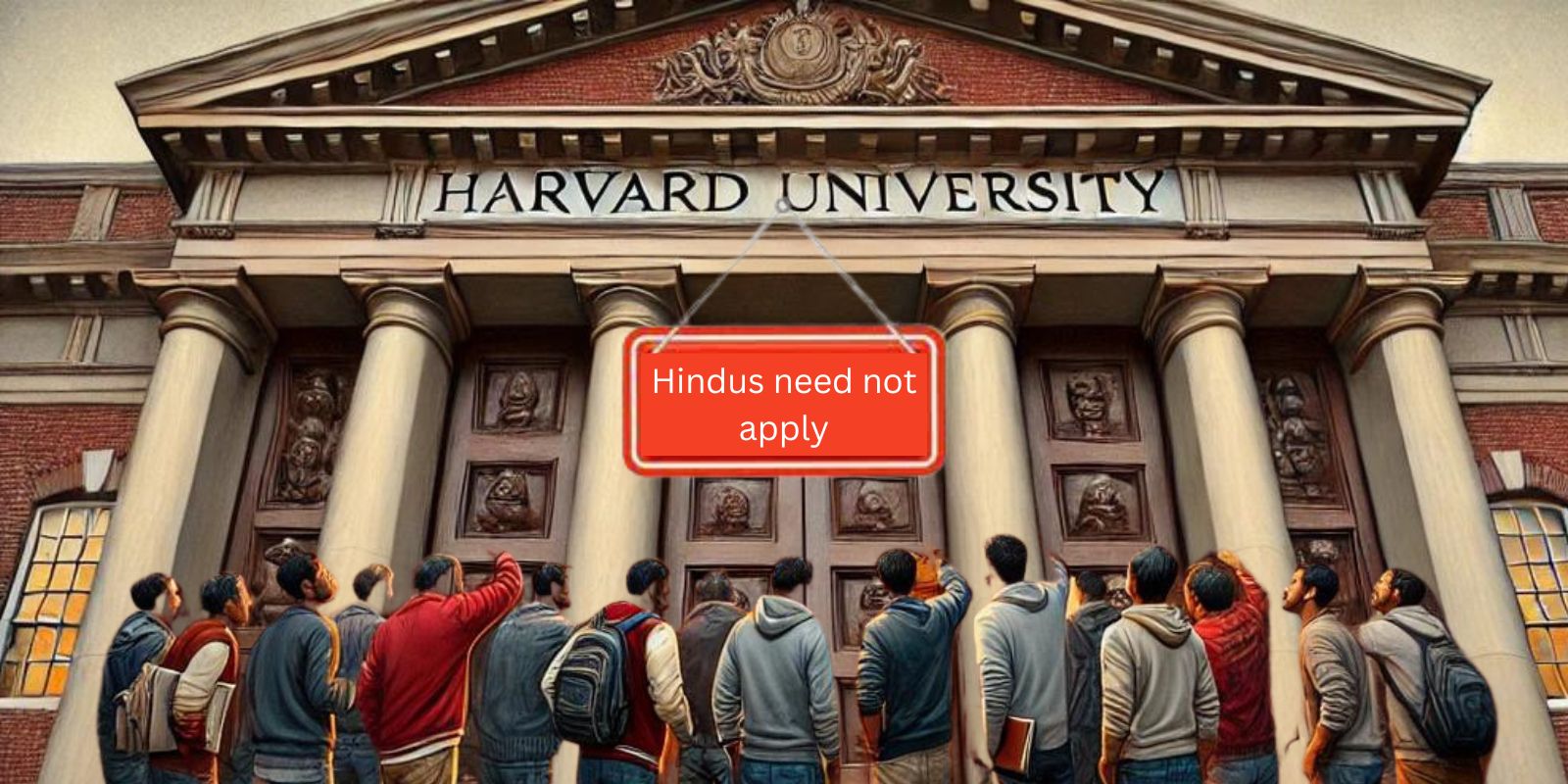
- Harvard University systematically discriminates against Hindu students and promotes anti-India narratives, echoing colonial-era strategies to destabilize Indian society.
- The university favors Indians who criticize India and supports ideologies aimed at breaking India’s cultural unity, effectively shaping a new generation of anti-India voices.
- Wealthy Indian industrialists unknowingly fund these initiatives through their affiliations with Harvard, contrasting with Chinese donors who strategically align funding with national interests.
- Harvard’s biased admissions practices disadvantage high-achieving Indian students.
- The discrimination against Hindus in elite institutions has sparked debates on fairness and bias, calling for reforms in the admissions process and more representation in public discourse.
For decades, Harvard University has been Ground Zero for the plot of anti-India – and in particular anti-Hindu – activists. The Ivy League university has nurtured and trained an assembly line of graduates and academics whose aim is to carry on the work of the erstwhile East India Company – to establish a mentally colonized Indian society that is disconnected from its ancient Hindu ethos so India can never rise again. Harvard’s Hinduphobia is now an open secret, with acclaimed author Malcolm Gladwell pointing out that Indian applicants – overwhelmingly Hindu – are the ones most likely to be excluded from the university’s application process.[1]
While discussing his latest book, ‘Revenge of the Tipping Point,’ Gladwell noted: “My suspicion is that for many people it’s unconscious, but there must be a point at which [Harvard admissions tutors] are confronting the fact that they have gone to extraordinary lengths to make sure that their campus hasn’t become dominated by Asians and Indians.”
The bias is obvious when you see the disparity between Harvard and an institution with a merit-based admissions process like the California Institute of Technology (Caltech). The proportion of Asian-American students at Caltech rose significantly, from 25 percent to 43 percent between 1992 and 2013. Meanwhile, Harvard’s percentage remained between 15 and 20 percent, a disparity attributed to legacy admissions, donor contributions, and athletic scholarships. Indian applicants, Gladwell added, would find it even harder to get into Ivy leagues.
Perhaps you are wondering, isn’t that counter-intuitive? If Harvard’s aim is breaking India by planting its brainwashed graduates in the country, why would it restrict candidates from India? Well, the truth is, the university’s doors are wide open for Indians who speak and write against India. However, if you are an apolitical Indian student who just wants to put their head down and acquire a degree, or God forbid, an Indian who happens to like India, you are not kosher at Harvard.
Vishwaguru of Wokeism
In 2023, a video emerged of an Indian Police Service officer studying at Harvard University explaining how Indians are treated. The video was from the launch of the book ‘Snakes in the Ganga’ by Rajiv Malhotra and Vijaya Viswanathan. The event was organized by the Federation of Indian Associations, Boston.[2]
The officer, Amresh Mishra, from the state of Chhattisgarh, attended a one-year course at Harvard. According to him, “Those who write against India are given priority. Half of the people from the NGO sector who have come to Harvard have written against India in their theses.”
“Anybody who gets a scholarship has to be ‘Anti-Indian.’ Unless you write that you have a wretched life in India, you are not going to get the scholarship.”
“In the classroom, if you speak in favor of India, you are not given that much space. Nobody stops you from speaking in favor of India, but if you speak against India, you get more space, you are applauded. Those who speak in favor of India are not canceled, but they certainly feel out of place in those spaces.”
Amresh explained how the system operates. First, talk about Indian issues such as caste in universities; discuss it with think tanks; take it to the Congress / Senate; and finally, get it accepted at the government level. Then, maybe 20 years from now, the US government will hold the Indian government to account for caste issues just as it does in religious matters. However, he added that this was not the fault of Harvard alone; the Indians who went to study there, including some civil servants, found common cause with the Breaking India voices at Harvard.
Amresh concluded: “My father was proud of me when I got into Harvard. (But) when I came to this book launch, he said, ‘You should cry that you went to the wrong place.’ Such is the reputation of Harvard in India.”
America grooming urban Naxals
Malhotra and Viswanathan have exposed Harvard’s trenchant Hinduphobia by meticulously listing out the university’s machinations in their path-breaking book ‘Snakes in the Ganga: Breaking India 2.0.’[3]
The authors observe that Harvard University has emerged as the leader in a new initiative aimed at recolonizing India, taking over the role previously held by Oxford during the British Raj. Where Oxford once controlled the discourse around India, American institutions, particularly Harvard, are now at the forefront of this effort. The speed and scale of this initiative reflect distinctly American approaches. The book reveals a vast ecosystem and funding network orchestrated by Harvard.
What is strikingly different about the current colonization is that it is being funded by Indians themselves. This is happening via a network of Indian billionaires who are financially supporting this anti-India agenda through their affiliations with Harvard and other Western institutions. The Mahindra Humanities Centre, established by industrialist Anand Mahindra, the South Asia Institute, backed by steel tycoon Laxmi Mittal, and the Public Health Centre, funded by the Piramals are examples of how affluent Indians are unwittingly facilitating the propagation of these narratives.
American concepts such as Critical Race Theory are tweaked as Critical Caste Theory and then funneled into Indian educational institutions via their association with the Ivy League campuses. Ashoka University, the Tata Institute of Social Sciences, and Azim Premji University are among the platforms that propagate ideas and ideologies incubated at Harvard. These institutions serve as conduits for American academic thought, reshaping discourse in India and aligning it with foreign perspectives. Worse, these Breaking India ideas have permeated Indian government agencies and businesses. As a central hub for anti-India narratives, Harvard effectively utilizes India’s scholars, funding, and resources to cultivate a new generation of scholars who are contributing to a significant transformation – or rather degradation – of Indian society.
Malhotra asserts that the attempt to reshape the social structures of another country is an act of arrogance.[4] He highlights two prominent figures within this framework: Ajanta Subramaniam and Suraj Yengde. Subramaniam claims that the Indian Institutes of Technology (IITs) perpetuate “Brahminical” hegemony, asserting that the Dalits face systemic oppression within these institutions. She argues that this perceived Brahmin supremacy is further exacerbated by the international hiring practices of companies that employ IIT graduates. Her assertions, according to Malhotra, receive substantial backing from the Harvard ecosystem, illustrating how these narratives gain traction in influential circles.
Similarly, Yengde, a fellow at the Harvard Kennedy School, promotes the idea that Dalits should align themselves with the African diaspora and identify as black. Malhotra critiques Yengde’s interpretations, claiming they reflect a misunderstanding of Buddhism, Hindu Dharma, and Marxism while also questioning his views on caste and the contentious Aryan invasion theory. This, he argues, contributes to a skewed representation of India’s social complexities.
Rise of Indian applicants
In recent decades, there has been a significant increase in the number of Indian students applying to universities in the United States. Many Indian applicants boast impressive academic records, often excelling in standardized tests and holding numerous accolades. Despite these qualifications, some Indian students and advocates argue that they face unique challenges in the admissions process. The allegations of bias include:
- Stereotyping: Indian applicants are often stereotyped as being academically proficient but lacking in other qualities, such as leadership or uniqueness. This perception may lead admissions officers to undervalue their applications, focusing disproportionately on academic metrics rather than a well-rounded profile.
- Over-representation of certain ethnic groups: Harvard’s admissions policies inadvertently favor certain demographics such as whites, Jews, and blacks, leading to a competitive disadvantage for Indian applicants. This concern is often linked to broader discussions about diversity and representation, where some argue that the emphasis on increasing minority representation can sideline high-achieving students from Indian and Asian backgrounds.
- Holistic review process: While the holistic admissions process aims to evaluate candidates comprehensively, there are claims that subjective elements in the evaluation may result in bias. For example, personal essays and interviews can be highly variable and may favor applicants who can articulate their stories in a way that resonates with admissions officers.
Myth of meritocracy
This brings us to the missing elephant in the room – meritocracy. The harsh fact is that meritocracy is a myth in America. A detailed writeup on higher education in the American Conservative explains that the country’s uniquely complex and subjective system of academic admissions actually arose as a means of “covert ethnic tribal warfare.”[5]
“During the 1920s, the established Northeastern Anglo-Saxon elites who then dominated the Ivy League wished to sharply curtail the rapidly growing numbers of Jewish students, but their initial attempts to impose simple numerical quotas provoked enormous controversy and faculty opposition.
“Therefore, the approach subsequently taken by Harvard President A. Lawrence Lowell and his peers was to transform the admissions process from a simple objective test of academic merit into a complex and holistic consideration of all aspects of each individual applicant; the resulting opacity permitted the admission or rejection of any given applicant, allowing the ethnicity of the student body to be shaped as desired.”
As a result, university leaders were able to genuinely deny the existence of racial or religious quotas while effectively lowering Jewish enrollment and maintaining those reduced levels for decades. For instance, the percentage of Jewish students in Harvard’s incoming class fell from nearly 30 percent in 1925 to 15 percent the following year, remaining relatively stable until World War II. Today, despite these clear historical patterns, Harvard and other Ivy League institutions publicly reject any allegations of racial or ethnic discrimination. They do acknowledge, however, that they provide admissions advantages to underrepresented racial minorities, such as Black and Hispanic applicants.
In the early 1980s, Asian American enrollment at Harvard was approximately 5 percent. However, in the subsequent decade, the rapid growth of America’s Asian middle class resulted in a significant increase in applications and admissions, with Asian students surpassing 10 percent of undergraduates by the late 1980s and exceeding 20 percent by 1993. Yet, from that point onward, the percentage of Asian students began to decline, remaining stagnant or decreasing over the following two decades.
Elite access through cheating
In March 2019, the college admissions landscape was thrown into turmoil by a scandal that revealed the lengths some wealthy parents would go to secure spots for their children at elite universities. Federal prosecutors charged 33 affluent individuals in a complex cheating scheme orchestrated by consultant William Singer.[6]
For years, prestigious universities have faced allegations of bias in their admissions practices. This scandal underscored how financial resources can profoundly affect outcomes, exacerbating social inequalities. While many students strive diligently to achieve their aspirations, others leverage wealth and connections, distorting the competitive landscape.
For example, the chairman of a prominent law firm paid $75,000 for his daughter to take a college entrance exam at a test center overseen by a proctor hired by Singer, ensuring she received the necessary score. Actress Lori Loughlin and her husband, fashion designer Mossimo Giannulli, spent $500,000 to secure admission for their two daughters to the University of Southern California as fake recruits for the crew team. Meanwhile, Felicity Huffman, known for her role in “Desperate Housewives,” managed to arrange for a $15,000 fix for her daughter’s SAT score. Over eight years, Singer amassed $25 million from these schemes.
The shocking revelations raised critical questions about fairness, privilege, and the integrity of the admissions process.
Why Indian Success Remains Unseen
Until the early decades of the 20th century, the Ivy League schools had a quota system for Jewish, which ensured that white students took the lion’s share of the seats. However, these longstanding quotas were dismantled in the decade after World War II after significant media and political pressure.[7]
This pressure was undoubtedly bolstered by substantial Jewish ownership of key media outlets in America, including all three major television networks, eight out of nine leading Hollywood studios, and several prominent newspapers, such as the New York Times and the Washington Post.
Indians may be the wealthiest ethnic group in the United States, with their average household income being $123,700, which is almost twice the US average of $65,316. As many as 79 percent of Indians in the US are college graduates, which is higher than that of the overall American population. However, economic success hasn’t translated into success in other key areas, such as public life, politics, sports, and the media. This makes Indians a largely invisible and politically handicapped group. As a result, it makes it easy for Harvard to discriminate against Hindus and get away with it. No media will cover this blatant bias because the news won’t sell.
India vs. China at Harvard
While Indian billionaires like the Tatas, Mahindras, and Piramals establish chairs at Ivy League schools, which then promote studies aimed at distorting Indian history and breaking India, China strategically engages with Harvard, aligning Chinese billionaires with national interests. Wealthy Chinese individuals and organizations often fund research initiatives that focus on topics relevant to China, such as economic development, technology, and environmental sustainability. In contrast to Indian billionaires who focus on the humanities, the Chinese stay away from it and establish science and technology linkages.
Some Chinese billionaires establish dedicated centers or institutes at Harvard that focus on China studies, business, or international relations. These centers facilitate academic research and promote discussions about China’s role in the world. There is no monkey balancing involved at these centers—the narrative and curriculum are entirely pro-China.
Chinese tycoons also support research that leads to publications and media coverage about China that helps shape narratives in the West. For instance, Harvard’s Fairbank Center for Chinese Studies and the Harvard-Yenching Institute are instrumental in promoting Chinese culture and scholarship. They host numerous events, seminars, and conferences that invite Chinese scholars to share their insights.[8] All this is aimed at counteracting negative perceptions and presenting a more nuanced view of China’s role in the global landscape.
As Malhotra observes: “China-funded Harvard and got them to promote their ideology and point of view. India funded Harvard and let them define the discourse on India – including the ideological basis of Dismantling Global Hindutva.”[9]
Conclusion
Legal challenges have further fueled the conversation around discrimination. In 2020, the US Supreme Court heard cases involving Harvard’s admissions practices, with plaintiffs arguing that the university discriminated against Asian American applicants, including many of Indian descent.[10] The outcomes of these cases could have significant implications for Harvard and the entire landscape of college admissions across the country.
The Indian community and education advocates are divided on this issue. Some argue for the need for systemic changes to ensure fair treatment of all applicants, while others believe that competition is inherent in the admissions process and that all applicants should continue to strive for excellence.
As the conversation evolves, it is crucial for educational institutions to continue examining their practices, ensuring that all students, regardless of background, have the opportunity to present their full potential in the admissions process. Addressing these concerns transparently and thoughtfully will be vital in shaping the future of higher education in the United States.
Citations
[1] Malcolm Gladwell: ‘Indian applicants likely to be excluded from Harvard’s application process’ | World News – Times of India (indiatimes.com); https://timesofindia.indiatimes.com/world/us/indian-harvard-malcolm-gladwell-admission-revenge-of-the-tipping-point/articleshow/113766629.cms
[2] indian applicants + harvard – Search / X; https://twitter.com/search?q=indian%20applicants%20%2B%20harvard&src=typed_query
[3] Harvard is the Vishwa Guru of Wokeism – India Today; https://www.indiatoday.in/impact-feature/story/harvard-is-the-vishwa-guru-of-wokeism-1998279-2022-09-09
[4] Rajiv Malhotra: “New phase of Breaking India funded by Indian billionaires’ backing of Harvard.” (youtube.com); https://www.youtube.com/watch?v=lkD92ct3ILQ
https://www.theamericanconservative.com/the-myth-of-american-meritocracy/
[5] The myth of meritocracy, according to Michael Sandel — Harvard Gazette; https://news.harvard.edu/gazette/story/2021/01/the-myth-of-meritocracy-according-to-michael-sandel/
[6] Ibid
[7] The Myth of American Meritocracy – The American Conservative; https://www.theamericanconservative.com/the-myth-of-american-meritocracy/
[8] History of China at Harvard – Fairbank Center for Chinese Studies; https://fairbank.fas.harvard.edu/about/history-of-china-at-harvard/
[9] Rajiv Malhotra: “Indians funded Harvard which then fuelled Dismantling Global Hindutva.” (youtube.com); https://www.youtube.com/watch?app=desktop&v=LyDjPAKQVkE&pp=ygUII3Nha3RoYW0%3D
[10] Supreme Court Rejects Affirmative Action at Harvard and UNC – The New York Times (nytimes.com); https://www.nytimes.com/2023/06/29/us/politics/supreme-court-admissions-affirmative-action-harvard-unc.html

Donate to HINDUDVESHA
Our Mission is to explore and expose Hindudvesha through research analysis, education and response.
SUPPORT US