

Ganga Under Siege: How the Pollution Debate Distorts Faith, History, and Responsibility
 Aditi Joshi · 05/09/2026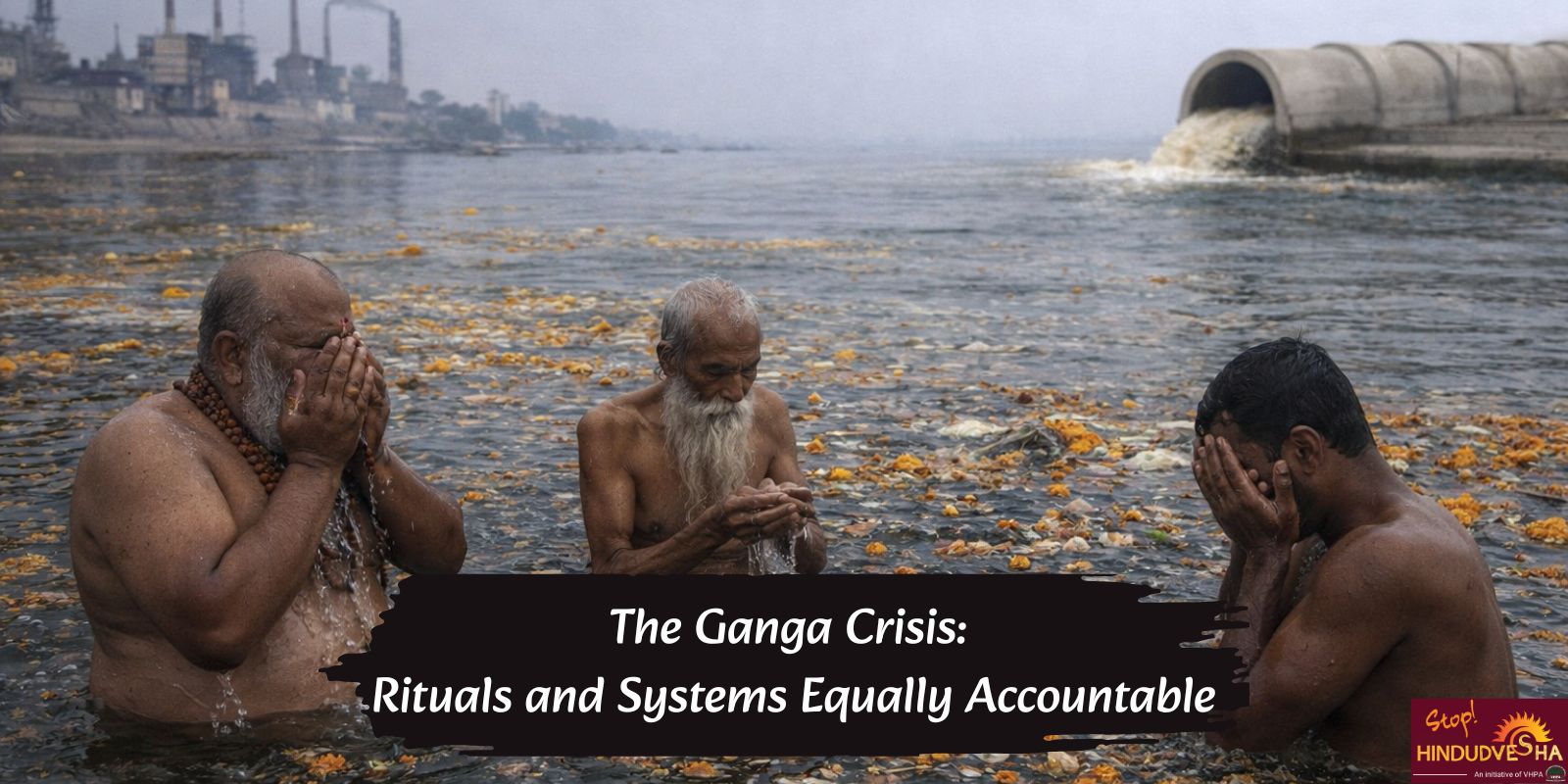
Summary
The pollution of the Ganga is commonly attributed to ritual practices, with Hindu traditions cast as primary drivers of degradation. This account is analytically incomplete. It overlooks deeper structural and historical causes, including colonial disruption of indigenous stewardship, industrial expansion, governance failures, and the erosion of civic discipline. At the same time, a credible analysis cannot ignore everyday irresponsibility in public behavior. The issue is therefore both material and epistemic: not only how the river has been polluted, but how that pollution is understood. A meaningful path to restoration requires moving beyond selective blame toward an integrated approach grounded in dharmic ethics, institutional accountability, historical clarity, and renewed civic responsibility.
The river Ganga occupies a singular place in the civilizational consciousness of India. For millions of Hindus, she is not merely a river in the geographical or hydrological sense, but a sacred presence, Ma Ganga, revered as purifier, sustainer, liberator and witness to the continuity of an ancient civilization. Yet in dominant public discourse, especially in media and policy representations, the Ganga is frequently reduced to a “pollution problem,” an ecological crisis requiring rescue through secular administration, technocratic planning and modern regulation. Within this framing, Hindu ritual practices like bathing, cremation immersions, idol offerings and mass pilgrimage gatherings, are disproportionately emphasized as the visible causes of decline.
Such a framing is analytically shallow and ideologically skewed, isolating ritual practices while ignoring the systemic and historical forces shaping ecological degradation. More importantly, it transforms a complex crisis into a civilizational accusation. The issue, therefore, is not only environmental but epistemic: prevailing discourse on the Ganga sidelines Hindu modes of stewardship while selectively moralizing Hindu devotion. A more rigorous account must examine not only the river’s physical decline but also the conceptual reduction through which a sacred relationship is displaced by technocratic abstraction and civilizational blame.
This article contends that the prevailing narrative of Ganga pollution rests on a distorted frame. It downplays the colonial roots of ecological disruption, minimizes the roles of industrialization and governance failure, and often recasts Hindu religiosity as a source of environmental irresponsibility. At the same time, any serious civilizational defense must acknowledge the erosion of civic ethics among its people. The restoration of the Ganga requires neither self-denial nor sentimental evasion, but an integrated approach grounded in historical clarity, dharmic stewardship, state accountability, and public discipline.
Ganga as Sacred Presence in Hindu Civilization
Any serious account of the Ganga must begin with how she is understood within Hindu civilization. She is not simply “water,” nor a resource to be consumed, extracted, or managed. She is a sacred presence [1]. Her waters are embedded in samskaras, rites of passage, pilgrimage routes, ritual life, death ceremonies, and the sacred geography of the subcontinent. To engage with the Ganga in Hindu thought is to engage with a living current of memory, transcendence, and belonging.
This sacred framing is not symbolic; it structures how the river is related to and cared for. Reverence is not indulgence but an ethical anchor. To call Ganga “Mother” is to place oneself under obligation. The categories through which modern policy often approaches rivers, utility, conservation, resource efficiency, waste control, may describe certain dimensions of ecological administration, but they do not capture the lived reality through which generations of Hindus have understood the Ganga.[2] When the river is reduced to a natural resource, the moral world that once sustained intimate responsibility is simultaneously stripped away.
This matters because how we frame a problem determines how we act on it. If Ganga is viewed only as an environmental object, the proposed solutions will remain bureaucratic and external. If she is recognized as a sacred presence, then restoration becomes not merely a technical exercise but also a cultural and moral obligation. To overlook the sacred here is not objectivity; it is distortion.
How Media Manufactures Civilizational Guilt
Contemporary media frequently links the Hindu faith to scenes of filth, shaping perception through repetition [3]. Images of ritual bathing, floating offerings, cremation sites, or large pilgrimage crowds are circulated as shorthand for ecological irresponsibility. In such portrayals, Hindu devotion is amplified as spectacle, while deeper structural failures are quietly obscured. The symbolic burden of pollution is thus shifted onto ritual life itself.
This framing does more than simplify; it selectively moralizes. Worshippers become culprits, and reverence is recast as hypocrisy. The result is a subtle but powerful form of civilizational gaslighting. Hindus are encouraged to internalize blame for a crisis whose origins lie far beyond the ritual domain. Rather than asking how administrative failure, industrial discharge, collapsing sanitation systems, and long histories of ecological disruption have produced the present condition, the narrative offers a more emotionally satisfying but intellectually weak conclusion: that Hindu culture itself is ecologically deficient.
This is not to claim that ritual practices have no environmental implications. The point is that they are repeatedly made to bear a disproportionate symbolic weight.[4] The crisis is narrated not as a failure of governance or industrial regulation, but as an indictment of a religious civilization. That shift in attribution is politically and culturally consequential. It delegitimizes indigenous categories of stewardship while reinforcing the notion that modern secular authority alone possesses the legitimacy to “save” the river. [5]
Colonial Foundations of Ecological Disaster
Any historically grounded account of the Ganga’s degradation must reckon with colonialism. The roots of the present crisis do not lie solely, or even primarily, in contemporary ritual life. They lie at the heart of the colonial transformation of India’s ecological order. British rule disrupted indigenous systems of water management, weakened community custodianship structures, altered forest-river relationships, and increasingly treated rivers as channels of extraction, transport, revenue, and industrial utility rather than sacred ecosystems embedded within local moral worlds. [6]
This transformation was not merely administrative. It eroded traditional systems of decentralized ecological responsibility as colonial governance centralized authority and subordinated local practices to imperial priorities. Industrial infrastructure—factories and tanneries—expanded along riverbanks with little regard for ecological continuity. Untreated effluents, extractive engineering, and revenue-driven land use set the foundations for long-term degradation. Once rivers were desacralized in policy and reorganized under a utilitarian logic, the conditions for chronic pollution became structurally entrenched.
Yet modern public discourse often erases this genealogy. Pollution appears as a contemporary moral failure rather than the outcome of a deeper historical rupture. By severing the ecological crisis from the colonial dismantling of indigenous stewardship, the narrative absolves imperial modernity and redirects moral scrutiny toward visible religious practice. Such erasure is part of a broader habit of reading Indian realities through frameworks that detach symptoms from their historical causes.
Dharmic Ethics: Purity, Restraint, and Protection
A central weakness in the pollution narrative is its unfounded assumption that Hindu traditions lack concern for cleanliness or environmental discipline. In fact, Hindu thought places substantial emphasis on śauca, purity, cleanliness, and disciplined conduct. Here, purity is not merely ritualistic in the narrow sense; it links internal disposition and external practice. Sacred spaces, rivers, temples, and pilgrimage routes are not morally neutral zones but places requiring restraint, reverence, and care. Polluting them is not an ethically insignificant act; it is a violation of dharma.
The notion that Ganga is sacred or self-purifying has often been caricatured by critics as if theological reverence implies material indifference. This is a profound misreading. Sacred status does not cancel responsibility; it intensifies it. To regard the river as spiritually exalted is not to deny the need for physical protection. On the contrary, dharmic frameworks historically bound reverence and restraint together. The real problem, therefore, is not that Dharma legitimizes pollution, but that contemporary society has often failed to live up to dharmic standards.
This distinction is crucial. If one mistakes lived failure for doctrinal principle, one ends up indicting a civilization for the very ethical decline it once sought to regulate. The challenge is not to replace dharmic vocabulary with technocratic management, but to revive the ethical depth it already contains.
Post-Independence Mis-Governance
If colonialism laid the structural foundations of degradation, post-independence governance failed to reverse them. Independent India inherited a damaged ecological system, but its response was frequently fragmented, bureaucratic and overly technocratic. Large-scale sewage dumping, weak enforcement, municipal negligence, industrial discharge, and the chronic inadequacy of waste treatment systems have continued despite repeated river-cleaning initiatives. Governments have often sermonized about pollution while failing in the most basic responsibilities of sanitation, drainage, regulation, and long-term planning.
The problem is not merely inefficiency; it is rooted in the very framing of the issue. Secular governance has often approached the Ganga as an administrative file rather than a sacred presence rooted in civilizational memory. In doing so, it has tended to sideline or mistrust dharmic frameworks of stewardship rather than draw upon them. The result is a persistent paradox: the state asserts authority over restoration while remaining disconnected from the civilizational grammar through which millions relate to the river.
Technocratic intervention is undoubtedly necessary. Sewage systems must function, industrial regulation must be enforced, and infrastructure must be modernized. But technocracy alone cannot solve a problem whose roots are as much moral and civilizational as they are administrative. Without a framework of shared sacred obligation, state-led programs risk becoming episodic, symbolic, or performative rather than transformative.
Decline of Civic Responsibility
A serious civilizational analysis must also resist one-sided blame. It is not enough to critique media distortions, colonial disruption, or state failure while ignoring the everyday conduct of the people themselves. Public littering, plastic pollution, improper waste disposal, neglect of local cleanliness, and undisciplined pilgrimage practices all contribute directly to the degradation of the river and its banks. To claim reverence for Ma Ganga while treating her waters and surroundings as dumping grounds is to sever devotion from duty.
This point must be stated clearly: the problem is not faith, but the erosion of responsibility.[7] Civic irresponsibility is not a secular category imposed from outside the tradition. If Ganga is Mother, then civic discipline is already contained within that relationship as a sacred and filial obligation. One does not honor the mother through slogans while neglecting her body.
It is therefore necessary to distinguish between the ideals of Dharma and the failures of contemporary society. Hindu civilization need not accept a hostile narrative that treats devotion itself as pollutive. But neither can it evade moral introspection by romanticizing its own intentions. Restoration requires behavioral reform at the level of everyday public life. Cleanliness, restraint, order and local accountability must become part of living dharma rather than outsourced expectations of the state.
Denial of Civilizational Stewardship
Even where people have failed, it remains essential to recognize that Hindu civilization has long possessed its own ethos of guardianship. The dominant discourse often erases this inheritance and presents Hindus only as offenders, not as custodians. Sacred vocabulary is dismissed as backwardness, superstition, or sentimental excess, while the language of managerial intervention is treated as neutral, superior, and rational. This shift is not merely semantic; it relocates moral authority.
When the civilizational community is denied the right to interpret its relation with its own sacred river, a deeper form of dispossession follows. Institutions that neither fully understand nor respect the Ganga’s sacred character begin to define the problem, assign causes, and prescribe solutions. In this process, Hindu memory is sidelined, dharmic ethics are reduced to symbolism, and reverence is accepted only when it fits within secular policy frameworks.
Such a framework is ultimately self-defeating. Sustainable restoration cannot emerge by alienating those most emotionally and culturally bound to the river. A desacralized model of conservation may regulate bodies, but it rarely inspires loyalty, sacrifice, or continuity. Civilizational stewardship must therefore be reclaimed not as nostalgia, but as a serious and necessary source of ecological ethics.
Double Standards in Attribution
A striking feature of the discourse is its selective attribution of causes. In most environmental crises, pollution is attributed primarily to failures of industry, planning, infrastructure, and regulation. Yet in the case of the Ganga, the crisis is often moralized as a failure of Hindu culture.[8]
This creates a double standard in attribution. The community most deeply attached to the river is made to appear uniquely culpable, while systemic causes are diluted, obscured, or depersonalized. The analytical consequence is misdiagnosis; the political consequence is weaponization. A polluted river becomes a pretext for expressing civilizational disdain.[9]
Toward an Integrated Model of Restoration
The way forward lies neither in secular technocracy alone nor in devotional rhetoric divorced from discipline. What is required is an integrated model of restoration in which sacred reverence, civilizational memory, administrative accountability and public responsibility are brought into alignment. The restoration of the Ganga must be ecological, moral, cultural, and institutional at once.
Such a model would involve several interrelated principles. First, Ganga must be recognized not merely as an environmental asset but as a sacred civilizational entity. Second, dharmic ethics of restraint, cleanliness, and guardianship must be revived in the lived public culture. Third, the state must be held to its non-negotiable duties of sewage treatment, waste management, industrial regulation, and infrastructural competence. Fourth, public behavior must change decisively: devotees, pilgrims, residents, and citizens must stop acting as though sacredness automatically compensates for negligence.
To serve Ma Ganga is to protect her in every dimension—physical, ritual, social, and spiritual. In this sense, ecology and Dharma are not in conflict. They appear opposed only when ecological discourse denies the sacred, or when devotion is stripped of discipline. The real task is to bring them back together: devotion and duty must once again be inseparable.
Wrapping Up
The Ganga today suffers from two forms of contamination: physical pollution and ideological distortion. The river has indeed been degraded by sewage, industrial waste, poor planning, and social irresponsibility. Yet the discourse around that degradation is itself distorted—marked by selective blame, historical erasure, and civilizational misframing. Hindu devotion is too often cast as the primary cause, while colonial disruption, industrial modernity, administrative failure, and the erosion of civic discipline remain underexamined.
A truthful account must hold all these dimensions together. It must reject both reflexive defensiveness and civilizational self-reproach. The river is sacred; the people bear responsibility; the state has faltered; history is not incidental. Ganga cannot be restored by desacralizing her, nor by allowing reverence to excuse indiscipline. What is required is not a choice between faith and ecology, but their reunion. To call her Ma is to accept an obligation. The river will not be restored by rhetoric alone. She will be restored when devotion once again takes the form of duty.
Citations
[1] India A Sacred Geography; https://archive.org/stream/indiaasacredgeography/India%20-%20A%20Sacred%20Geography_djvu.txt
[2] Why Is The Ganges River Considered Holy In Hinduism? | Britannica; https://www.britannica.com/question/Why-is-the-Ganges-River-considered-holy-in-Hinduism
[3] Pollution Threat-National Mission for Clean Ganga-INDIA; https://nmcg.nic.in/pollution.aspx
[4] K. Koner, “Reviving traditional water sources for resilient water future”; https://dbndsm.edu.in/Pdf/Publication/Paper/20-21/Kaberi%20Koner%20Reviving_traditional_water_sources_for_resilient_w.pdf
[5] A Holistic Approach for Cleanliness of River Ganga; https://www.nmcg.nic.in/press_pdf/Ganga_rejuvenation_English_Press_Release.pdf
[6] J. Bandyopadhyay, “New Institutional Structure for Water Security in India,” Economic & Political Weekly; https://prod-qt-images.s3.amazonaws.com/indiawaterportal/import/sites/default/files/iwp2/new_institutional_structure_for_water_security_in_india_economic_and_political_weekly_2016.pdf
[7] Resolving The Ganges Pollution Paradox: A Policy‐centric Systematic Review; https://onlinelibrary.wiley.com/doi/10.1002/rvr2.35
[8] Deepsikha Dasgupta, “Faith and filth: Waste, water and rituals on the banks of India’s Ganga,” The Sociological Review Magazine; https://thesociologicalreview.org/magazine/august-2022/water/faith-and-filth/
[9] Ganga and Gandagi: Interpretations of Pollution and Waste in Benaras; https://www.researchgate.net/publication/237802487_Ganga_and_Gandagi_Interpretations_of_Pollution_and_Waste_in_Benaras

Donate to HINDUDVESHA
Our Mission is to explore and expose Hindudvesha through research analysis, education and response.
SUPPORT US