

Closing the Gap: How Indian American Giving Has Caught Up, and What Comes Next
 Dr. Jai G. Bansal · 03/23/2026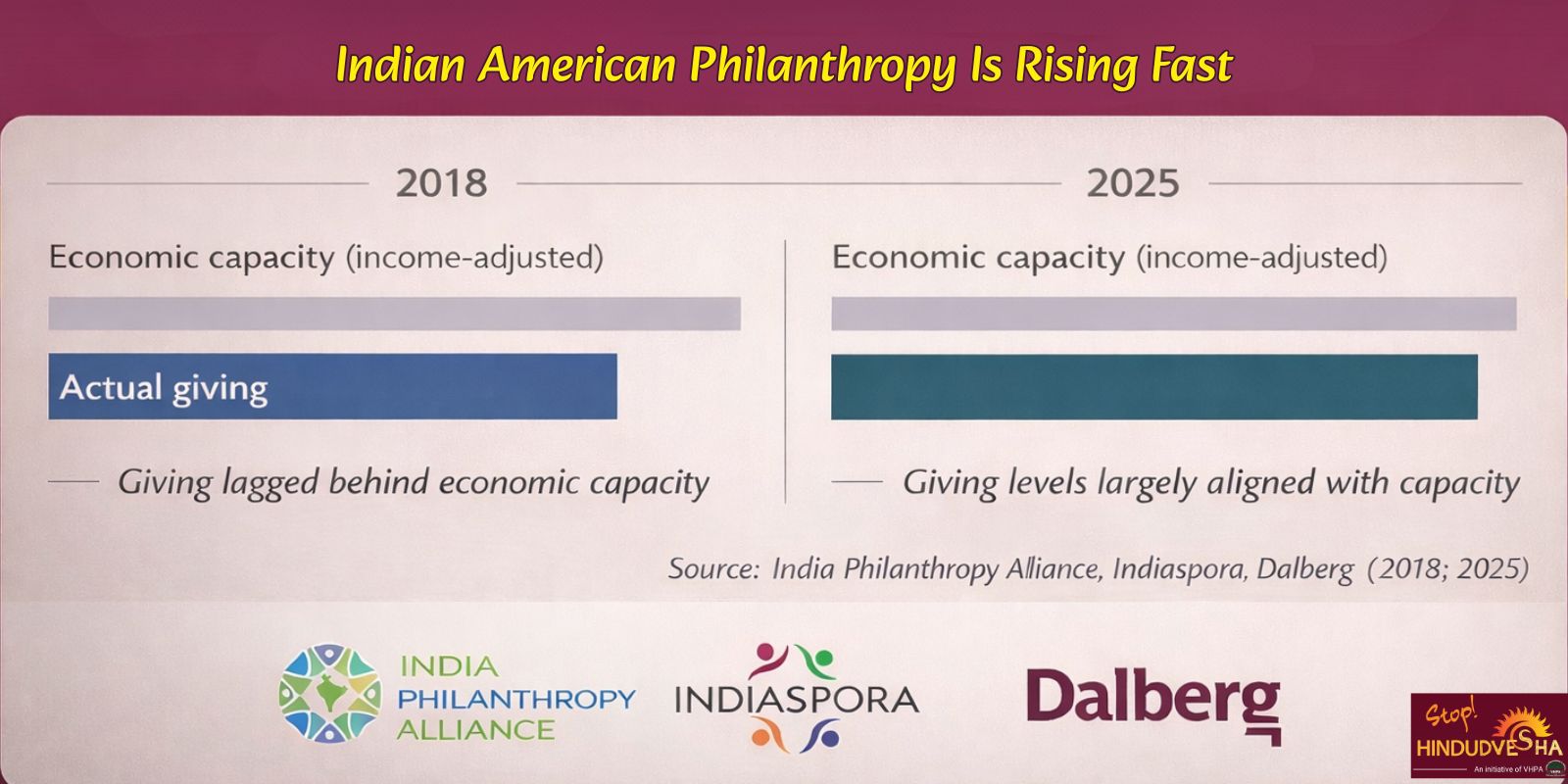
- Indian American philanthropic giving has moved significantly closer to income-adjusted capacity since 2018, narrowing a gap that once defined the community’s giving profile.
- The convergence reflects not only higher donation levels but also more consistent participation across donor segments.
- While giving lagged well behind economic capacity in 2018, by 2025 it is largely aligned, marking a clear shift in baseline performance.
- The remaining gap is concentrated among lower- and middle-income households rather than high-capacity donors.
- The data reframes the conversation from whether Indian Americans give enough to how recent gains can be sustained and institutionalized.
A new report on Indian American philanthropic giving[1] offers the most comprehensive update in seven years on how the community gives, where gaps remain, and how patterns have changed since the first major study in 2018. Published by the India Philanthropy Alliance in collaboration with Indiaspora and Dalberg, the report revisits a central question in diaspora philanthropy: has Indian American giving kept pace with the community’s growing economic strength?
When the 2018 study was released, it drew attention for identifying a significant gap between Indian American giving levels and those of the broader U.S. population, even after adjusting for income. Despite high rates of volunteering and civic participation, Indian Americans were donating well below their economic capacity. That finding prompted reflection and a deliberate effort by donors and community organizations to rethink philanthropic engagement.
Since then, the landscape has shifted. The Indian American population has grown larger and more affluent, with rising median incomes and an expanding cohort of high-net-worth individuals. The community now plays a more visible role across the professional, economic, and civic life of the United States, while philanthropic institutions serving the diaspora have become more established. At the same time, a generational transition is underway, with U.S.-born Indian Americans beginning to influence priorities and modes of giving.
Against this backdrop, the report examines whether philanthropic behavior has evolved alongside these changes. Based on a nationwide survey of more than 400 donors, it analyzes giving patterns, motivations, and persistent barriers, paying close attention to differences across income levels, generations, and familiarity with philanthropy.
Rather than treating Indian American donors as a single group, the report approaches philanthropy as a system shaped by trust, access to information, social norms, and life stage. Its findings raise timely questions about how giving habits are formed and sustained as the community enters a period of unprecedented wealth creation and transfer.
This summary distills the report’s central insights, focusing not only on how much Indian Americans give, but on how philanthropic capacity is built and expressed.
From More Giving to Better Giving
The progress described in the 2025 report extends beyond an increase in total donations. It also reflects a shift in how Indian American philanthropy is practiced. Compared with 2018, donors today appear more deliberate in their choices, more attentive to aligning giving with values, and more engaged in forms of contribution that extend beyond financial support alone. These patterns suggest a philanthropic culture shaped increasingly by intention rather than habit.
One of the clearest indicators of this shift is the continued strength of volunteering within the Indian American Diaspora. Survey respondents reported an average of roughly 200 volunteer hours per year, nearly three times the national average. While this represents a modest decline since 2018, it closely mirrors broader post-pandemic trends and should not be read as a weakening of civic commitment.
The nature of this engagement is particularly significant. Indian American donors are heavily involved in skills-based and leadership-oriented service. Many participate in direct activities such as community cleanups or food distribution, while others serve on nonprofit boards, lead fundraising efforts, mentor students, or provide pro bono professional expertise in fields such as law, medicine, technology, and finance. These contributions often strengthen organizational capacity and governance, delivering impact that extends well beyond their monetary value.
Alongside volunteering, alignment between donor priorities and actual giving has improved. The report tracks this through the “passion-donation gap,” defined as the difference between the share of respondents who identify an issue as a top concern and the share who donate to it. In 2018, this gap averaged eight percentage points. By 2024, it had narrowed to four, indicating greater success in translating concern into action.
Education remains the most widely cited area of passion, followed by healthcare, climate change, the arts and culture, and access to technology. These fields benefit from established philanthropic ecosystems, which likely contribute to stronger alignment. At the same time, issues that previously played a smaller role—such as gender equality, human rights, racial justice, and immigration—now feature more prominently, particularly among younger donors and women. Gender equality stands out as the most cited issue among women respondents.
These shifts point to a gradual move away from default or legacy giving patterns toward more considered choices shaped by values and experience. The report also notes that even basic strategic practices, such as setting a giving budget or identifying priorities, are associated with stronger alignment between donor interests and actual giving.
Where the System Still Fall Short
The gains described in earlier sections are substantial, but they coexist with structural weaknesses that continue to limit the reach and durability of Indian American philanthropy. The 2025 report is explicit on this point: progress has not eliminated friction in the giving system. Instead, it has clarified where existing approaches fall short. The remaining gaps stem less from donor indifference than from misaligned infrastructure, uneven access to knowledge, and engagement models that do not reflect donors’ realities.
The clearest sign of this breakdown is the persistence of an estimated $1 billion annual giving gap. Unlike in 2018, this shortfall is no longer driven by high-capacity donors. It is concentrated among lower- and middle-income households, particularly those earning under $200,000. For these donors, giving as a share of income has stagnated or declined, reflecting broader national trends among everyday donors facing rising living costs, student debt, and career uncertainty. In this environment, philanthropy is often constrained by immediate financial pressures.
[Note: The report does not directly analyze the effects of U.S. tax policy on giving behavior. However, broader national research suggests that changes introduced by the 2017 Tax Cuts and Jobs Act, including the higher standard deduction and reduced itemization, may have weakened tax-based incentives for charitable giving among middle-income households. These effects may form part of the wider context in which giving among under-$200,000 households has declined, alongside rising cost-of-living pressures.]
This concentration carries longer-term consequences. Many of these donors are earlier in their careers and are likely to experience significant income growth or inherit wealth in the future. Failure to engage them now risks creating a participation gap that persists even as financial capacity increases. The challenge, therefore, is not only financial but developmental.
Systemic limits are also evident in persistent mismatches between donor priorities and actual giving. While overall alignment has improved, large gaps remain in areas such as gender equality and climate change. Both attract strong stated interest but receive disproportionately low levels of funding. Climate-focused donors frequently report difficulty identifying credible organizations, while the gap for gender equality has widened since 2018, particularly among women donors.
These mismatches reflect uneven philanthropic ecosystems across issue areas. Education and healthcare benefit from established institutions, familiar pathways, and clearer measures of impact. By contrast, climate action, gender equity, and certain human rights efforts are often perceived as complex or difficult to evaluate, leaving donors uncertain about where to engage. In the absence of trusted intermediaries, interest does not reliably translate into support.
Gender disparities further expose structural weaknesses. Indian American women volunteer at higher rates than men but donate less as a share of income. The report attributes this gap not to lower motivation, but to time constraints, competing responsibilities, and limited solicitation. Many women report dissatisfaction with their current giving levels, pointing to unrealized potential rather than disengagement.
Finally, gaps in basic philanthropic knowledge and inconsistent engagement—particularly among younger and NextGen donors—compound these challenges. Many report limited guidance and few direct invitations to give. The diagnosis is consistent: generosity exists, but the systems needed to convert it into sustained, strategic giving remain incomplete. The next section examines how these challenges vary across donor segments, and why uniform solutions are unlikely to succeed.
Donor Segments That Matter Most
The structural weaknesses identified in the report do not affect all donors equally. One of its most important contributions is identifying two variables that explain much of the variation in Indian American giving behavior: generation and philanthropic knowledge. These factors intersect with income and life stage, shaping distinct motivations and barriers. Understanding these differences is essential not to categorize donors, but to design systems that reflect how people actually give.
Knowledge Level
Self-assessed knowledge of philanthropy is a strong predictor of giving. Novice donors contribute less than one-tenth of the Indian American average, while expert donors give more than twice as much, even after accounting for income. This gap reflects differences in confidence and access rather than differences in generosity.
Novice donors often want to give more but lack clarity on which nonprofits to trust, how to structure giving, or how to assess impact. Few have budgets or strategies, leading to sporadic and reactive donations. Notably, many novices already have significant financial capacity, suggesting that the absence of early guidance suppresses giving even among the wealthy.
By contrast, knowledgeable and expert donors typically have defined priorities, budgets, and strategies. They are more likely to engage in peer learning, board service, and long-term planning. For them, the challenge is not whether to give, but how to give more effectively and in alignment with family values.
Generational Differences
Generational differences introduce a second axis of variation. First-generation donors give slightly above the community average and account for much of the growth in recent years. Most support causes in India, reflecting strong transnational ties. Their primary constraint is trust. Many struggle to evaluate organizational effectiveness, particularly for India-based nonprofits, and are hesitant to increase giving without credible verification and impact data.
NextGen donors, while central to the future of Indian American philanthropy, currently give less than half the community average. Their interests often center on U.S.-based issues such as gender equality, climate change, and racial justice, alongside an interest in India. Their barriers are less about trust and more about knowledge and engagement. Many report limited guidance and few direct invitations to give, resulting in under-participation.
Women Donors
Women donors volunteer at higher rates than men but give a smaller share of their income, despite strong interest and dissatisfaction with current giving levels. Time constraints, competing responsibilities, and limited solicitation remain key barriers.
These patterns underscore a central conclusion: no single strategy will address the remaining gaps. Philanthropic systems must evolve to reflect differences in knowledge, generation, and experience. The next section examines the infrastructure and engagement models required to convert latent generosity into sustained, strategic giving.
What Needs to Happen Next
If the remaining gaps in Indian American philanthropy are structural rather than motivational, then the response must also be structural. The 2025 report is explicit that good intentions alone will not drive the next phase of impact. What is required is sustained investment in donor-facing infrastructure that reduces friction, builds trust, and supports donors across income levels, generations, and stages of experience. These interventions are most effective when treated as an integrated system rather than as isolated initiatives.
Strengthen Information Infrastructure
Across all donor segments, the most frequently cited unmet need is access to reliable information about credible nonprofits. Donors often struggle to identify organizations they trust, particularly in complex issue areas and when giving to India. This uncertainty suppresses giving not because of indifference, but because confidence is lacking.
The report calls for shared, year-round information platforms that go beyond episodic vetting. Curated and regularly updated lists of credible organizations, organized by issue area and geography, would address a common barrier faced by novice, NextGen, and FirstGen donors alike. Emphasis on transparency, operational effectiveness, and clear impact indicators would make giving more accessible and repeatable.
Early Donor Education
A second priority is normalizing philanthropic education, particularly for newer donors. Even simple practices such as setting a giving budget or identifying priorities are linked to higher and more aligned giving, yet many donors lack exposure to these tools. Foundational guidance on evaluating nonprofits, understanding tax considerations, and structuring recurrent giving can significantly increase donor confidence. These resources should be positioned as part of financial adulthood rather than as specialized expertise reserved for the wealthy.
Expand Peer-Based Giving Communities
For many donors, particularly NextGen donors and women, access to information alone does not translate into sustained participation. The report identifies a strong interest in social models of giving that combine shared learning with coordinated action. These include structured giving circles and donor networks in which participants pool resources, discuss priorities, and make collective funding decisions.
Such models lower entry barriers by normalizing participation, reduce uncertainty through peer validation, and support accountability through ongoing engagement. While widely used in other philanthropic communities, peer-based giving structures remain limited within the Indian American context despite clear demand. Their underdevelopment represents a missed opportunity to engage donors who seek connection, guidance, and continuity rather than one-time transactions.
Engage NextGen and Families Early
Many NextGen donors want to give but lack guidance, opportunities, and direct outreach. Addressing this requires intentional investment in NextGen leadership pathways, low-friction giving opportunities, and early engagement that shapes long-term habits. Family philanthropy offers a complementary lever, helping align values across generations and transmit giving norms as wealth transfers accelerate.
These measures do not seek to change donor intent. They focus on removing barriers that prevent generosity from becoming consistent and sustained. The next section considers what success could look like if this infrastructure is built, and why the coming decade represents a decisive opportunity for Indian American philanthropy.
Conclusion: Why This Decade Is Decisive
The 2025 report marks an inflection point in the evolution of Indian American philanthropy. Over the past seven years, the community has moved from a period defined by underperformance relative to economic capacity to one characterized by measurable growth, greater intentionality, and expanding engagement. The question that animated the 2018 study—whether Indian Americans give enough—has been substantially reframed. The more pressing issue now is whether recent gains can be consolidated and sustained as the donor base grows more diverse and generational change accelerates.
The stakes are heightened by the scale of the forthcoming change. The Indian American community is entering a period of unprecedented wealth accumulation and transfer, with significant implications for philanthropic capacity. How donors engage during this transition will shape not only aggregate giving levels, but also the durability of institutions, norms, and relationships that support long-term impact. Absent deliberate system-building, there is a risk that philanthropic participation will remain uneven, even as financial capacity expands.
What distinguishes the present moment is that the constraints facing Indian American philanthropy are increasingly practical rather than motivational. The report makes clear that generosity and interest are widely distributed. The challenge lies in translating that intent into consistent, strategic action across income levels, generations, and life stages. Doing so requires infrastructure that supports donors over time, rather than episodic responses to specific campaigns or crises.
The past decade demonstrates that collective effort can change behavior. The next decade will test whether those changes can be embedded institutionally. If the community succeeds in strengthening the systems that support informed, sustained giving, it will not only preserve recent progress but also shape a philanthropic model capable of enduring across generations.
Citation
[1] Daleburg: From Closing the Gap to Setting the Standard: The State of Philanthropic Giving in the Indian American Diaspora. https://dalberg.com/our-ideas/from-closing-the-gap-to-setting-the-standard-the-state-of-philanthropic-giving-in-the-indian-american-diaspora/

Donate to HINDUDVESHA
Our Mission is to explore and expose Hindudvesha through research analysis, education and response.
SUPPORT US